
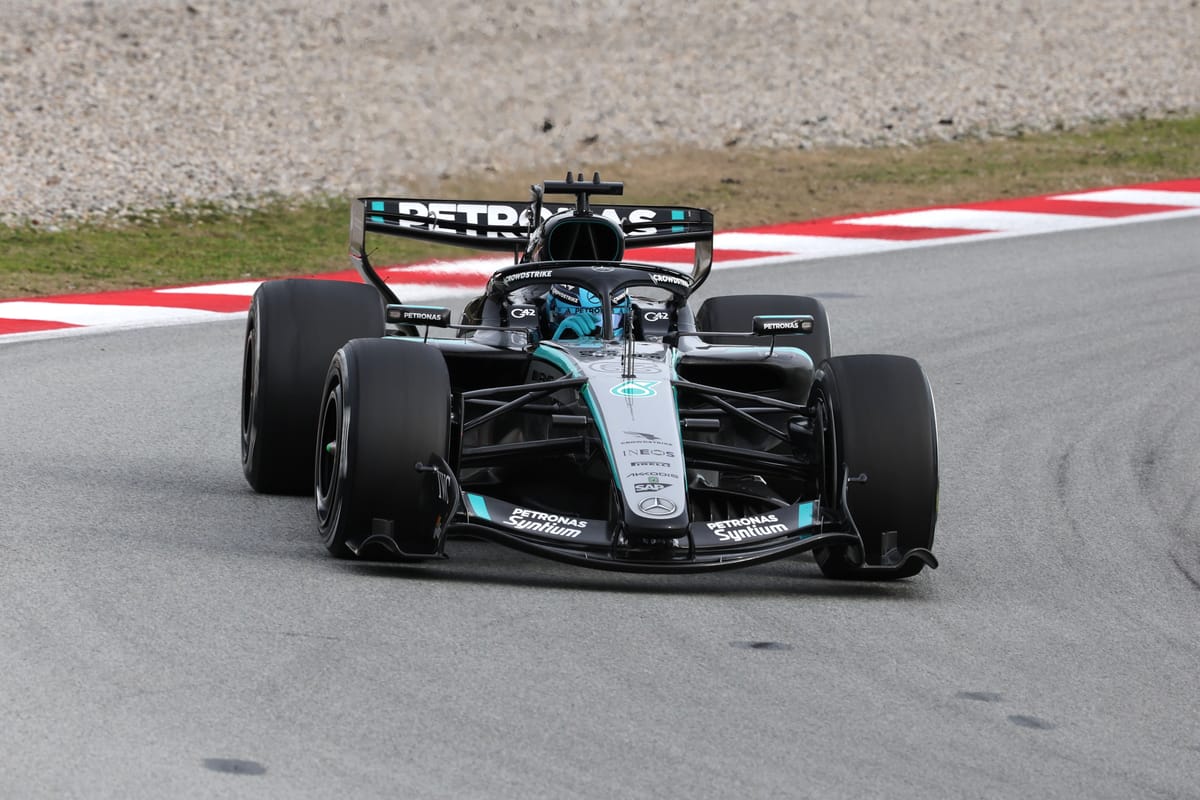
The initial evidence and impressions of Formula 1’s blurry emerging 2026 picture point to Mercedes making an ominous start that includes avoiding a problem that plagued it during the ground-effect era.
As Mercedes kept being talked up as the early favourite last year, long before cars ever hit the track, the reality was nobody knew for sure. It was simply the general consensus that Mercedes appeared to be in the best place in terms of its engine development in particular.
Now the W17 and Mercedes’ engine have been running on track, and the team’s feedback on how last week’s Barcelona test went has been established, that sentiment has only been strengthened.
The initial remarks are encouraging on both car and engine, the most amusing being George Russell, claiming to be quoting team boss Toto Wolff, saying the new car is “not a turd”, then Wolff confirming that interpretation.
Though this was unusually jovial there was actually a serious underlying point. As Russell pointed out that even this early on, you know when you’ve got problems. The negatives are highlighted early in testing and Mercedes seems quite confident that has been avoided.
And it is not the reliability or the early pace of the car when it was on-track that has left Mercedes most encouraged. The laptimes are inevitably a red herring at this stage and good mileage only counts for so much.
But how the car feels and what the data is telling them versus expectations is the most reliable information Mercedes has to work with.
This is where things sound better than they ever did in the preceding ground-effect era.
Countless times across 2022 to 2025, Mercedes personnel would end up mentioning variants of ‘the car has this much theoretical potential, but on track it’s doing something else’. After getting caught out at the start of 2022, Russell admitted Mercedes wanted to reel in expectations this year.
Russell said Mercedes was confident there wouldn’t be any “crazy unknowns or unforeseen things” – like the porpoising phenomenon that caused Mercedes nightmares when the ground-effect era began – but the thing about unforeseen problems is you don’t anticipate them in advance.
That’s why Mercedes left Barcelona with such a positive feeling. The car reacted as it expected, the aerodynamic performance being measured on the car tallies with what is being seen in simulations, how the car handles on track is broadly the same as in the virtual world – Kimi Antonelli said it was actually “quite a bit better” than on the simulator.
And Russell said this correlation overall is better than anything Mercedes has had since its last title-winning season in 2021.
“The car reacted as we anticipated,” he said. “The numbers we’re seeing from the aero on the car match what we see back on the simulator. How the car is handling is matching how it feels on the simulator.
“This is something we’ve not really experienced since 2021 as a team. We’re sort of ticking the boxes of everything that we want to tick.”
Something that helps make this a little more meaningful is that Russell claims he was “pushing the limits” of the car immediately. So Mercedes will be optimistic that all the positive early reads aren’t just because the car’s being run too conservatively and all the problems will be unearthed once it all gets turned up to 11.
That obviously doesn’t mean the Barcelona version of the W17 was its final form and when everything is balanced on more of a razor blade in terms of set-up optimisation and engine power, there’s bound to be stuff the drivers don’t like or that the team needs to improve.
But Russell’s implication from saying he was “pushing the boundaries of the car” from the very start is that he was doing enough early on to clock any initial vices and most importantly any big discrepancies with all of Mercedes’ preparations back at base.
And that’s not happened yet, which may be enough to be confident that the particular difficulties of that phase are behind the team and it is now going to get the benefit of all of the work and the digging into the tools to actually make them better.
“That’s what I think,” said Wolff. “The pre-investment in tools and in simulations and doing the correlation work will be beneficial.
“But in the same way, the learning curve will be steep. Once we see what the others do, we will better understand. It’s quite interesting to see on the Ferrari and on the Red Bull, the way they were managing energy in Barcelona was different to us. It wasn’t worse. It wasn’t better, but it was just different.
“Learning from seeing the others, learning from the more mileage that we will be doing, the challenges in the races where we realise, ‘hold a minute, on Sunday, we haven’t mapped it in the way you win races’. Maybe we have mapped it for a quick lap and then suddenly you fall back.
“The most clever guys in the car and on the engineering side are gonna win.”
‘Wary and sceptical’
Mercedes’ confidence or optimism does not extend much further, though, for fear of being misled by its own expectations.
Wolff was willing to at least hint how happy Mercedes is when he said they are enthusiastic about the new rules and “you wake up with a more of a smile if your car is quick” and “generally we are happy people”.
But he was also keen to stress that there is no clear performance picture “contrary to what many people think”, as well as reminding us that he’s a “glass-half-empty person” and is “wary and sceptical” Mercedes has a title-challenging package.
And on whether it’s a car that can win the world championship, Russell inevitably said it’s still “way too early” to tell: “We’ve had a very reliable test. But we’ll have to wait and see if the car lives up to the expectation.”
Still, there’s been no attempt from Mercedes to hide its satisfaction with how its first week of testing had gone. There are no prizes for finishing its three days early but it did mean two things: one, the car ran so well Mercedes had no downtime in between days of running where it needed more time to prepare; and two, it gave itself an extra 24 hours to start crunching all the data accumulated.
Russell said the test “exceeded our expectations” in terms of reliability and how smoothly it went. Engine validation was the primary objective for all the manufacturers last week and Hywel Thomas, who runs the Mercedes engine programme, suggested there is still plenty more to come as “we weren’t running, but we managed to walk” in the test.
That in itself is quite foreboding given the impression Mercedes made on almost everybody, although it mainly means the faster-paced stuff will come at the next two tests in Bahrain, making sure everything is “nailed on and perfect” for the start of the season proper.
Engine edge
Reliability was really impressive among most teams and manufacturers at Barcelona so it’s certainly not as simple as ‘Mercedes was the only team that could get its engine to work, therefore it’s streets ahead’.
This was certainly no repeat of the disastrous start most had with the brand new hybrid engines back in 2014 when hardly anyone could string laps together at the first test. Mercedes technical director James Allison alluded to this when he said it was surprising just how well everybody seemed to run in Spain after expecting a “symphony of red flags and smoking vehicles”.
But it means teams will be hoping to go into the season focused on performance rather than “trying to keep everything held together with baling wire and tape”, as Allison puts it, which places an even bigger emphasis on getting the most out of the new engines early.
There are early suggestions that works teams have an inherent advantage at this stage of 2026 as their understanding of how to best run the engines is the most advanced.
With significantly more electric power to play with and batteries that need to work extremely hard to recharge to maximise what can be deployed, the new 2026 formula is expected to produce much bigger demands on how the drivers and teams manage the engines strategically.
This favours teams like Mercedes at the moment as they’ve had the most information at the earliest opportunities, and designed their cars around maximising it. It’s considered no coincidence that the best prepared teams last week seemed to be Mercedes, Ferrari and Red Bull.
Russell admits there are things that still need to become second nature for drivers as right now all the techniques to maximise recharging the battery are “a bit of a surprise”, so he reckons the ones who put the most work in today will come off best.
In that sense Mercedes racking up so many more laps than most has to be considered a potential advantage. Nothing is guaranteed, though, as all at Mercedes are quick to stress – and inevitably still more to come from this package.
“There’s definitely still room to improve and I think as with any new generation or new car you bring to the table, everything’s not going to be perfect on day one,” said Russell.
“Now, the test exceeded our expectations in terms of reliability and how smoothly everything went, but it isn’t to say that everything was perfect.
“We’re still pushing really hard to improve on the limitations I had, understanding this new engine, as that was the first time we drove that on the track, and there’s definitely room to improve that.
“It’s so challenging to say and in a competitive season, you’re looking at one or two tenths splits the top couple of teams.
“After these days of testing it’s impossible to know who is on the right side of that tenth or not.”