
Things I’ve noticed since the Wimbledon final.
YouTuber Ashley Neaves of The Tennis Mentor sat down for an interview with Andy Murray recently, which I thought was interesting given the technical/tactical dichotomy that seemed to be present in how Murray and Djokovic viewed the game. Some excerpts:
Neaves: Obviously you’ve got a very analytical brain yourself. Where did that start?
Murray: When it comes to tennis, my mum was always encouraging learning to play the game and finding different ways to win points and using different skills, she wasn’t so much focused on technique, which, you know all coaches are a bit different, but she was always encouraging us to play the game and learn how to find ways to win. Then I went to Spain when I was 15. Because I was quite good as a junior I ended up training with a lot of the senior professional players, and at that stage, physically, I wasn’t able to keep up with them, so again, I had to find different ways of winning which wasn’t based on power and strength, and that was where I think I took that (being analytical) to the next level.
Murray is describing what is called a ‘game-based approach’ to coaching, which stands in contrast to the more traditional technique-first, or ideal form approach that has spawned many YouTube channels that highlight and teach technique through a video. From acecoach.com:
“Tennis is a game, and people need to learn not only how to stroke, but how to play as well. Playing requires not only physical motor skills but cognitive skills like problem-solving and decision-making. This means the tactical development of a player is every bit as important as their technical development. The Game-based approach maintains the fun of playing by either scaling the game down for success (for starter players), or placing players into commonly encountered tennis situations. Either way, players learn as they play. Tactics and techniques all weave together. The Game-based approach teaches players in harmony with the true nature of tennis. That tennis is an ‘open skill’ which balances both the motor and cognitive aspects of a player.”
The game-based approach is invaluable to a coach when it comes to applying constraints, using tactical stories to train situations (rather than isolated strokes), and placing players within challenging situations in order to bring out desired techniques and tactics intuitively. In coaching science this is known as an ‘ecological dynamics approach’:
“An ecological dynamics approach views movement as emerging from a self-organizing relationship formed between an individual, the task being performed, and the environment (including the opponent) in which it occurs, creating a movement system. Skills applied effectively in the game are understood as dynamic functional movement solutions that emerge as the player continuously interacts with an array of constraints related to the task and the environment.”
— Hopper, T., & Rhoades, J. (2023). Biomechanical insights on Tennis Canada’s skill fundamental phases: Ecological dynamics, force generation and reading gameplay. ITF Coaching & Sport Science Review, 31(91), 18-25.
While this newsletter is technical in nature when it comes to the pro game, my philosophy is that 99% of us “chuckers”, to use a Roddick term, benefit hugely when they focus on ball control for a desired tactic (e.g., hit low and deep) rather than some idealised form of an isolated shot. If players struggle to achieve a certain ball control, then a coach can guide a player using the Path – Angle – Speed (P.A.S.) principle of shot projection to help create an intuitive swing for club players, without ever mentioning wrists, arms, etc., too much. It’s impossible to do that through video. A player needs to go out and hit a lot of balls with an intent, a measure, and an idea on how to improve upon it (ideally in the form of a coach with a good understanding of P.A.S.).
“The trap is that every error is technical. The physics of the shot were incorrect. However, an ineffective response by the coach is to falsely think every solution is technical.”
It’s similar to Tiger Woods’ advice:
I think Nicholas Massu used a constraints approach (in this example, constraining time) to help Thiem shorten his swings in 2019 by rushing him on dead balls. Of course, I’m sure it was spoken about as a goal, but when it comes to the drilling, instead of making things explicit, verbal, left-brained, you try and make it implicit, visual/metaphorical, right brained:
More surprising in the interview was the type of information Djokovic was wanting from Murray:
Neaves: What did you learn about yourself when you were coaching Novak?
Murray: Well I think first of all you learn a lot about your weaknesses. I think a lot of ex-players, it’s very different being a player versus a coach…Obviously when you’re working with someone at that level, it probably shows up your strengths, but also your weaknesses as well. And I’d say that most ex-players are sort of weak at the technical side of the game, and at times Novak was looking for quite a lot of technical feedback, which was something I wasn’t comfortable with. One, in terms of how to teach somebody technique, I think that coaches that work with younger players and are used to doing that are stronger than a lot of coaches on tour, because once a player is sort of 20, 22 years old, you’re not trying to overhaul their game or technique, it’s more little changes here and there.
It’s interesting that Djokovic — a paragon of technical proficiency — was still wanting a lot of technical feedback after 30 years of honing his craft. Much of the discourse on coaching pros is that “their strokes a set, it’s all mental and physical at this point”, and there’s certainly some truth in that, but I’ve always felt that the best seem to continually be willing to tinker in any of the four domains — technical, tactical, mental, and physical — if it means there’s a chance of patching a weakness or bolstering a strength. In fact, I think the better players are the ones who perhaps can play with some thought of their swing in mind to an extent if said thought is helpful to making them swing better.
I like to listen to quite a few tennis podcasts — Gill Gross, Served with Andy Roddick, The Changeover guys, the Mini-Break, etc. Some excerpts from recent episodes I found interesting.
Tallon Griekspoor was brutally honest on the tactic of playing Zverev:
“It’s pretty clear when you play against Zverev what the tactic should be. I’ve said it a couple of times, open and wide, and people were shocked, but I think there’s only one tactic against Zverev, and that is: every ball to the forehand.”
— The Changeover Podcast
Sam Querrey on mentality:
Gross: There are a lot of players who will come out with quotes that are something along the lines of “It’s all mental. The difference between the top-5 and top-50 is mental”….You’ve played everybody. When you were playing Rafa, you weren’t beating him because of your backhand and movement, right. It wasn’t your head, it was those things, right?
Querrey: Correct. Like, mental is a little part of it…I’ll give them credit, some part of it is mental. But when you watch Alcaraz move around the court… no one moves like him, no one has the power he has. He’s just a better athlete, a better tennis player, he has a better forehand. There are some parts of it that are mental, yes, but generally speaking, the best players are just better. They’re stronger, they’re more flexible, they have better timing, more natural talent. All the things that check out. That drives me nuts too, “oh they’re just mentally better”. No they’re not — they probably are that too, they probably are mentally better as well! — but most of it is natural talent, strength, speed, timing. That is what’s better, that is what makes them the best player.
— Monday Match Analysis
Eubanks and Roddick on Tennis in 2025:
Roddick: Are you as shocked by what you’re seeing by power, speed, movement out of the corners, every fucking guy sliding on grass? Is this something that you think has happened, or gone crazy in the last five years? Because I’m watching it and it’s like I’m watching aliens.
Eubanks: …From 2017 til now — roughly eight years — we’ve seen a lot of tennis and a lot of changes in tennis, and when I talk to a lot of players who also went through this same timing, they’re all like, “the game shifted massively in the last two to three years.” Like, something happened. And I know a lot of players have spoken about the balls post-Covid, but think something has happened on the tennis side… the Carlos’, the Sinners, Cobolli, who obviously had a great run and plays similar: ripping on both wings, sliding on both legs. The days are gone where you have a safe place to go on the court now.
Roddick: When it becomes like a mono-surface, and you’re not dealing with playing on a lightning surface and then going to the slowest surface you’re ever seen, where everything is kind of like, slow-adjacent, is this the first generation that’s grown up on that where you have to take full cuts because you’re on slower surfaces? And then we get to Wimbledon and Grigor starts slicing, and peoples heads explode.
Eubanks: …Zverev has talked about it a lot. It’s not tennis anymore, and I’m paraphrasing, but everyone is just ripping off both wings. The skill aspect of playing a short slice, a deep slice, playing high and heavy and catching the next one on the rise as a redirect, using the variation that we see Carlos do so well, that’s kind of gone out the window, because if you play a slice on a slow court and the ball checks up a little bit, guys will take full cuts on it. But that’s why we saw Grigor having a lot of success with guys this year at Wimbledon, because the grass keeps the ball a bit lower, but I guarantee you if Grigor tries that same slice in, say Acapulco, where it’s heavy, slow, guys will be running around ripping balls.
The slice discourse is interesting, because I think there is still plenty of room to employ it in 2025 with so many flat backhands, especially in quicker conditions, and youngsters coming through are still developing flat, punchy backhands that a low slice can expose. A recent example…
Evans got the better of rising youngster Alex Michelsen in Washington this week, before succumbing to tricky-lefty Corentin Moutet in the next round. I’ve always been bullish on Evans when the opponent’s Ad-side game is very flat; bonus bullish if the run-around forehand isn’t particularly strong/heavy.
Many seem to think the backhand slice is a “weak” shot in the modern game, and in certain instances it is, but in this niche setup (flat-ad siders) it’s a subtle weapon of sorts if you have expert control of it, even if the opponent’s backhand is very good (as Michelsen’s is; it’s his best shot, but it is somewhat neutered when forced into low contact points).
Here’s a collection of the Brit’s scalps against career top-10 players with decent H2H counts at ATP level. Keep in mind Evans is 5’9’’ with a career-high of 21:
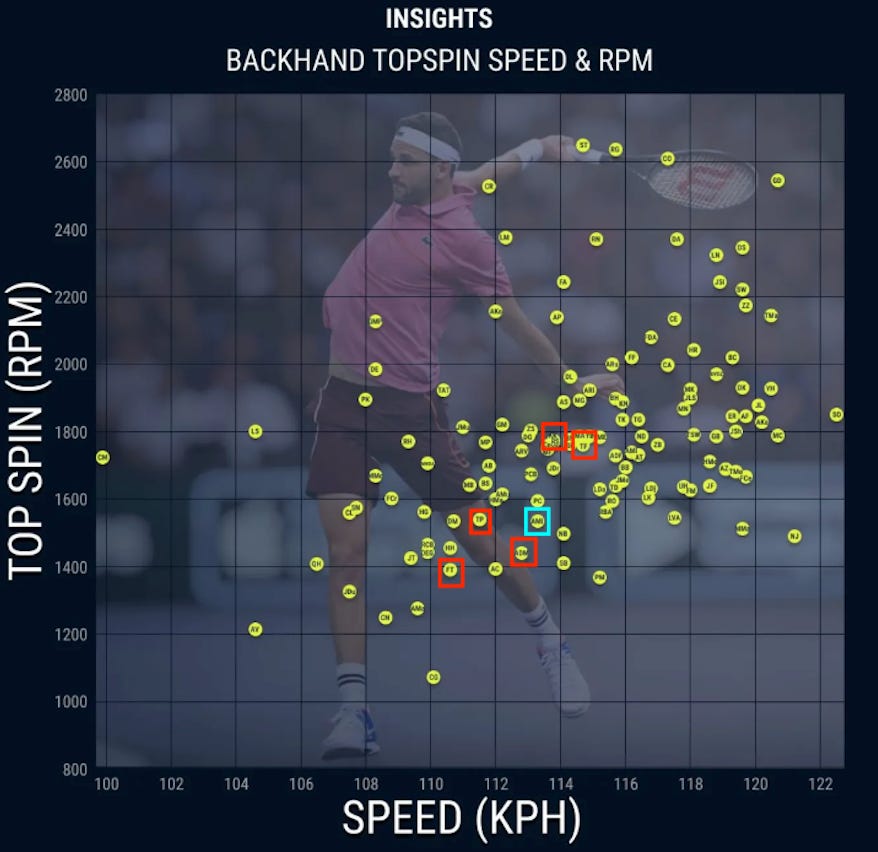
All of these players have better resumes than Evans, but the common weak point in their game that Evans exposes is their considerably flat and compact backhands. Good pace absorbers, weak racquet head speed/spin generators. As the poster boy of this elite group with the worst results against Evans, look how far Khachanov chokes up on his backhand grip, making it an excellent absorber of hip-height pace, but a weak generator of pace or spin; there’s very little racquet head speed. He excels against low and flat and hard balls — the trend of today’s game — but struggles against kick serves up high, or the Evans slice down low:
A visual of each player’s 2024 average backhand topspin and speed, with a graph from Tennis Insights.
Then there’s his inverse performance against a lower-ranked cohort of lefties, especially if they are of a counterpunching mentality.
The outlier?
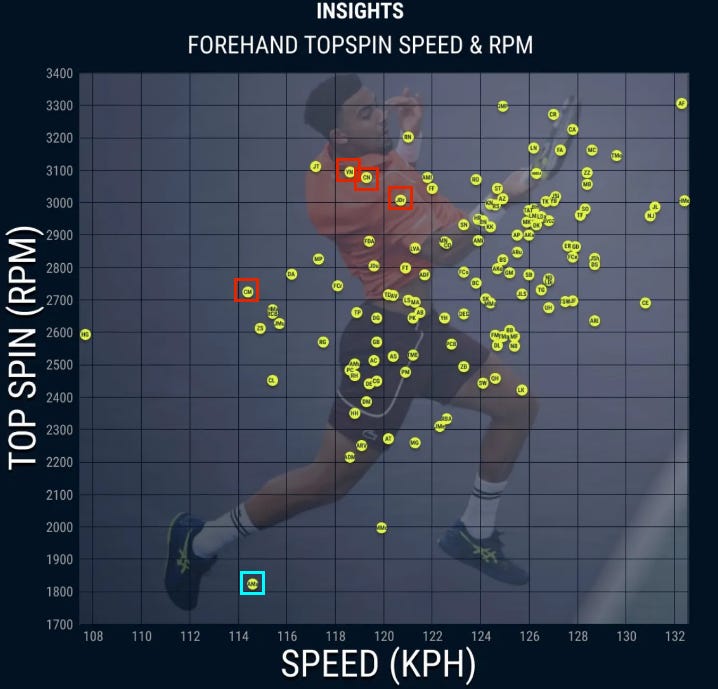
4-1 against Mannarino, who’s forehand is off-the-charts for flatness and speed, basically occupying an identical speed and spin section to that of the Khachanov backhand:
On the topic of backhands, encouraging signs for one-handed aficionados.
I like to keep an eye on youngsters who are pushing into the top 500 and get an early peek at how their game is technically. Of the 18-and-under crowd who I’m bullish on are Joao Fonseca, Federico Cina, Henry Bernet, and Justin Engel, but keep a tab on the name of #560 Pierluigi Basile.
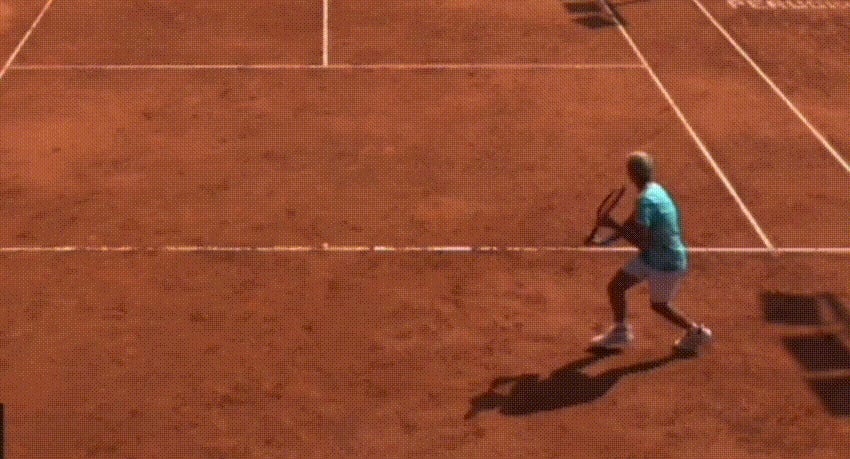
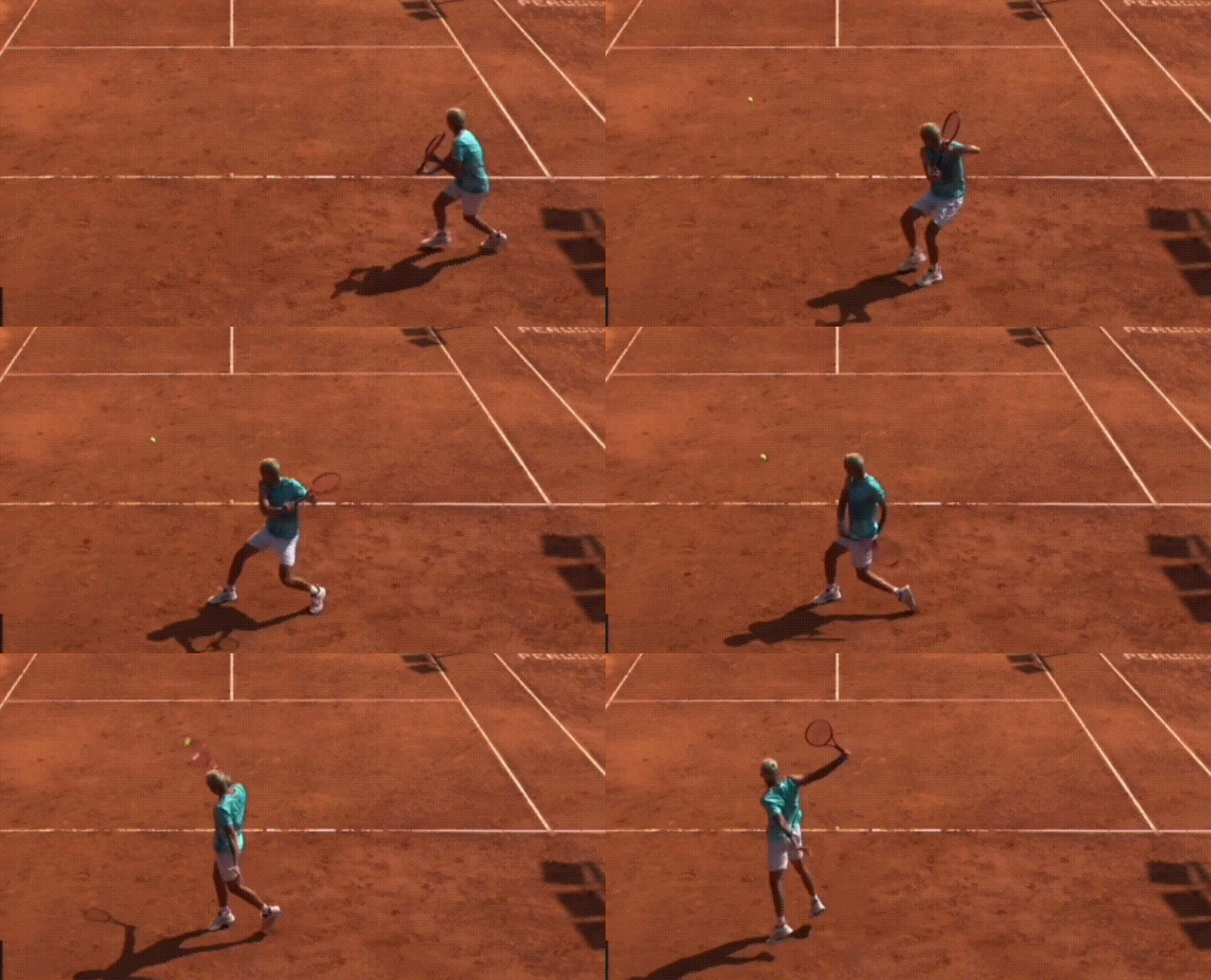
The Italian 18-year-old has a monster of a topspin one-handed backhand.
Unsurprisingly, it has similarities with the great modern one handers that we discussed in the Tsitsipas backhand piece, most importantly, a very deep slot position, creating a large internal rotation of the shoulder and a long in-to-out horizontal runway from which to accelerate from.
Unlike Bernet, who seems quite good on the slice backhand, Basile’s is very underdeveloped from what I can see, and it will be interesting to track his progress off clay as he rises through the ranks of the men’s tour.
Alex de Minaur is the 2025 Washington Champion after overcoming a 2-5 third set score and saving three match points at 4-5 when serving to stay in the match. I didn’t have time to watch the match unfortunately, but I did catch a replay from 3-5 in the third and there were certainly some mental demon’s in Fokina’s head when serving for it.
It’s a cruel finish to a great week for Fokina, who also blew match points in the Delray Beach final earlier this year against Miomir Kecmanovic, especially so given the Spaniard is still chasing his first tour-level title. But as de Minaur said in his post-match speech, Fokina is way too good not to nab a title soon enough.
The Aussie brings good form to Toronto, where he reached the final here back in 2023, losing to Sinner. These Sunday starts…
If time permits I’ll get a draw preview out tonight, but the draw looks pretty open for a lot of seeds given the absence of Sinner, Alcaraz, Draper, Djokovic, etc.
That’s all I’ve got. Hope this was interesting in some way for you guys. I’ll see you in the comments. HC