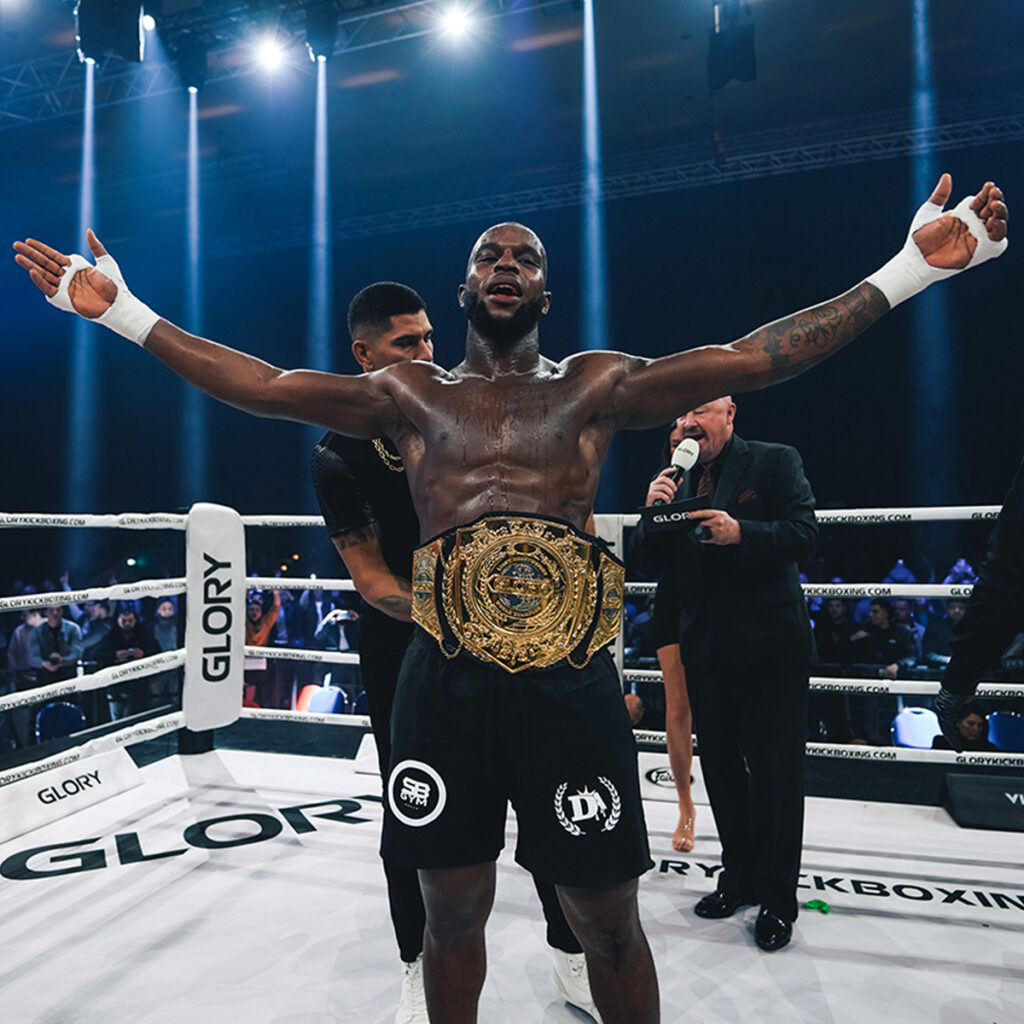
Donegi Abena’s rose from a troubled childhood in the Netherlands to becoming a world champion in one of combat sports’ most prestigious organizations. Now, at 27 years old, the Surinamese-Dutch fighter has taken his final step away from kickboxing’s elite, signing with the PFL to pursue gold in MMA.
The Early Struggles of Donegi Abena
Abena’s childhood unfolded within the Dutch foster care system, a period that shaped his understanding of hardship. The experiences of growing up without a stable family environment taught him early lessons about survival. In reflecting on those formative years, Abena has been candid about the behavioral struggles that defined his adolescence. He explained:
“Yes, I was a little badass, and very aggressive. That’s how I was built,” He elaborated further on the underlying causes of his aggression, noting that emotional expression proved difficult during those years. “Because when you are younger, you’re not good with talking, you’re not good in expressing yourself. That’s where I remember the science, you know: men are designed to fight. If you go to the Stone Ages, they were designed to fight, and maybe it was the same for me; I was ready for them, ready to fight people.”
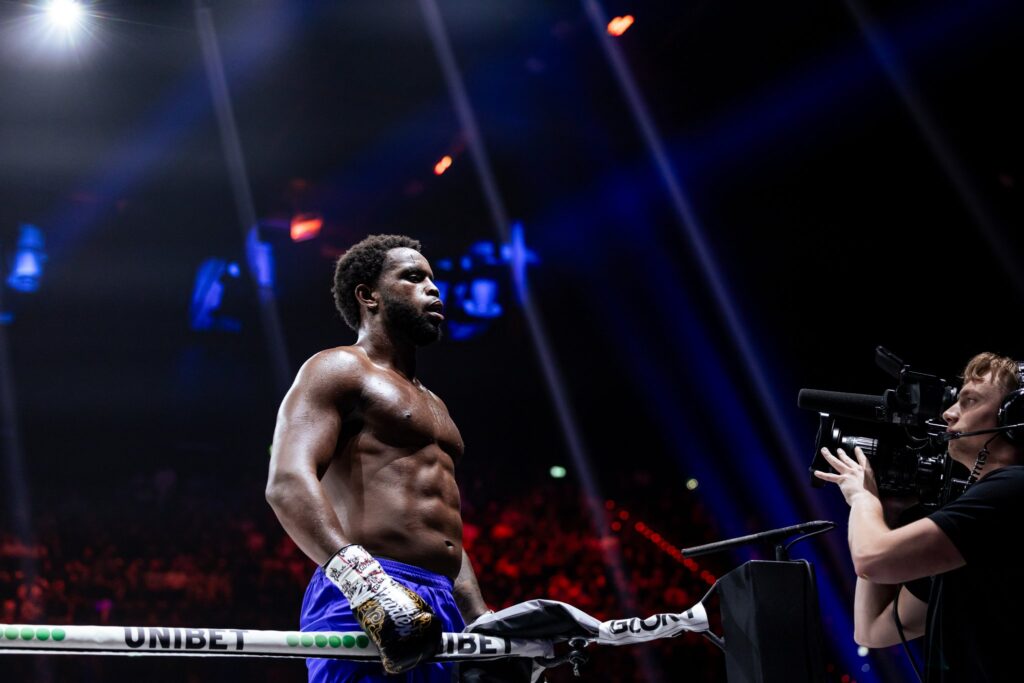
The trajectory of his adolescence was headed toward one of several possible negative outcomes. Street fighting had become a regular occurrence, a way for him to channel the aggression and frustration that came from his circumstances. However, at age 15, a conversation with a friend would alter that trajectory entirely. One of his childhood companions had a brother who trained in kickboxing. The suggestion was simple but transformative.
“And when I was like 15, 16, one of my homeboy’s brothers, he was doing kickboxing, and he said to me like, ‘Hey yo, you’re fighting a lot, you got too much energy, too much aggression, you know, come with me to the kickboxing gym and let’s see.’ So I went with him to the gym, and look where we are right now, you know. Within four years I fought for the GLORY world title. I lost, but I did something with my youth, with my life. I started from the bottom, from being an aggressive young child going for street fights, this and that, to GLORY.”
The Rise Through Professional Ranks
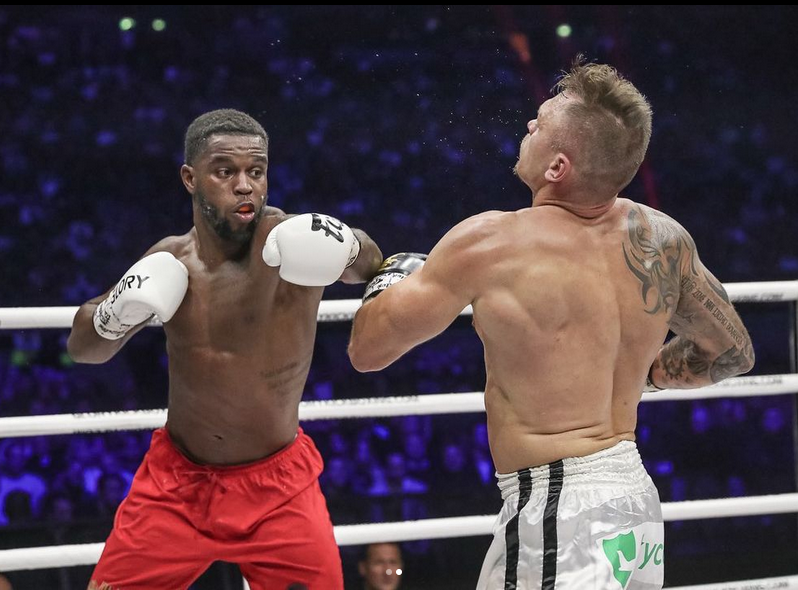
Abena’s early professional record demonstrated steady, consistent progress. He competed across various European promotions, gradually building his credentials. By 2018, at age 20, he signed with GLORY Kickboxing, the world’s premier kickboxing organization.
Within his first year, Abena was already challenging for major honors. His record accumulated victories through 2019 and into 2021, though early bids for championship gold resulted in defeats. At Glory 66 in Paris on June 22, 2019, he faced then-champion Artem Vakhitov in a bout where he had an opportunity to become GLORY’s youngest champion at that time. Despite a competitive fight, Vakhitov prevailed by split decision. That loss, while significant, did not derail his progression. It pushed him harder.
The years that followed included a significant layoff and continued development. By late 2022, Abena had positioned himself as the legitimate number one contender in the light heavyweight division. After defeating Felipe Micheletti by unanimous decision at Glory Collision 4 on October 8, 2022, he earned his championship opportunity. This was the comeback.
Championship Achievement
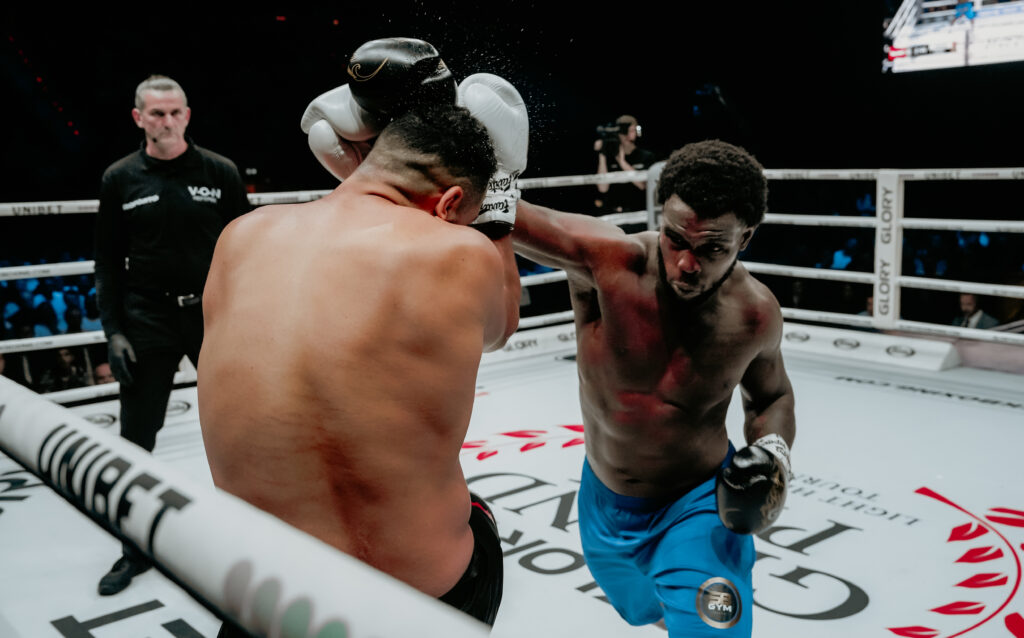
On February 11, 2023, at Glory 83 in Essen, Germany, Abena faced defending light heavyweight champion Sergej Maslobojev. The fight marked a rematch of their previous encounter, which Maslobojev had won by split decision at Glory Collision 3 in October 2021.
This time, the outcome differed significantly. Abena imposed his will throughout the fight, controlling the action with his striking combinations and pressure. The ringside physician halted the bout in the fourth round due to a cut on Maslobojev’s shin, awarding Abena the GLORY Light Heavyweight Championship by technical knockout.
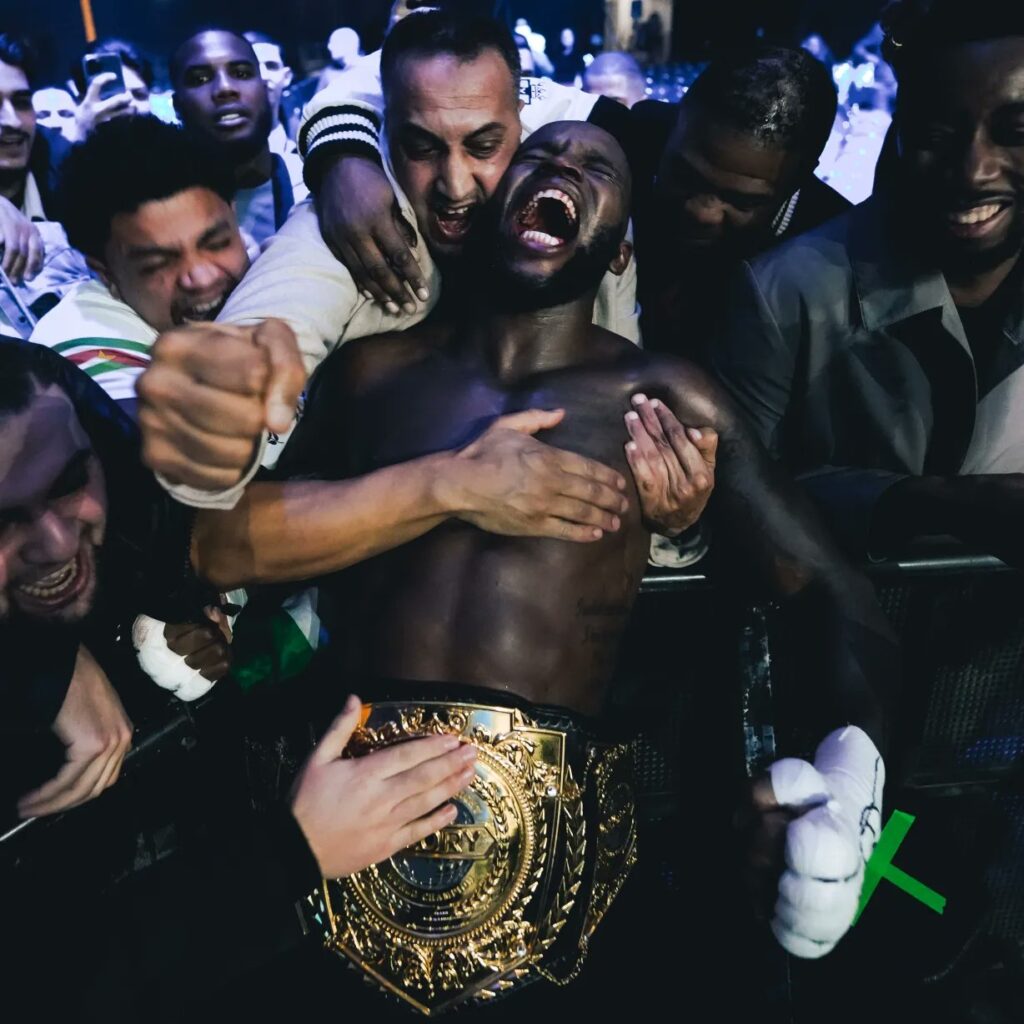
At 24 years old, Abena became one of the youngest champions in GLORY history, cementing a remarkable ascent from foster care to world championship status in the sport’s most competitive organization. The achievement carried particular weight given the obstacles he had overcome to reach that point.
Title Defense and Grand Prix Success
After defending his crown, he faced the Moroccan tornado Tarik Khbabez on March 9, 2024, in Arnhem. Khbabez defeated Abena by split decision, costing him his championship belt in an upset result. Rather than spiral from that loss, Abena channelled his disappointment into the light heavyweight division’s grand prix tournament, held on June 8, 2024, in Rotterdam.
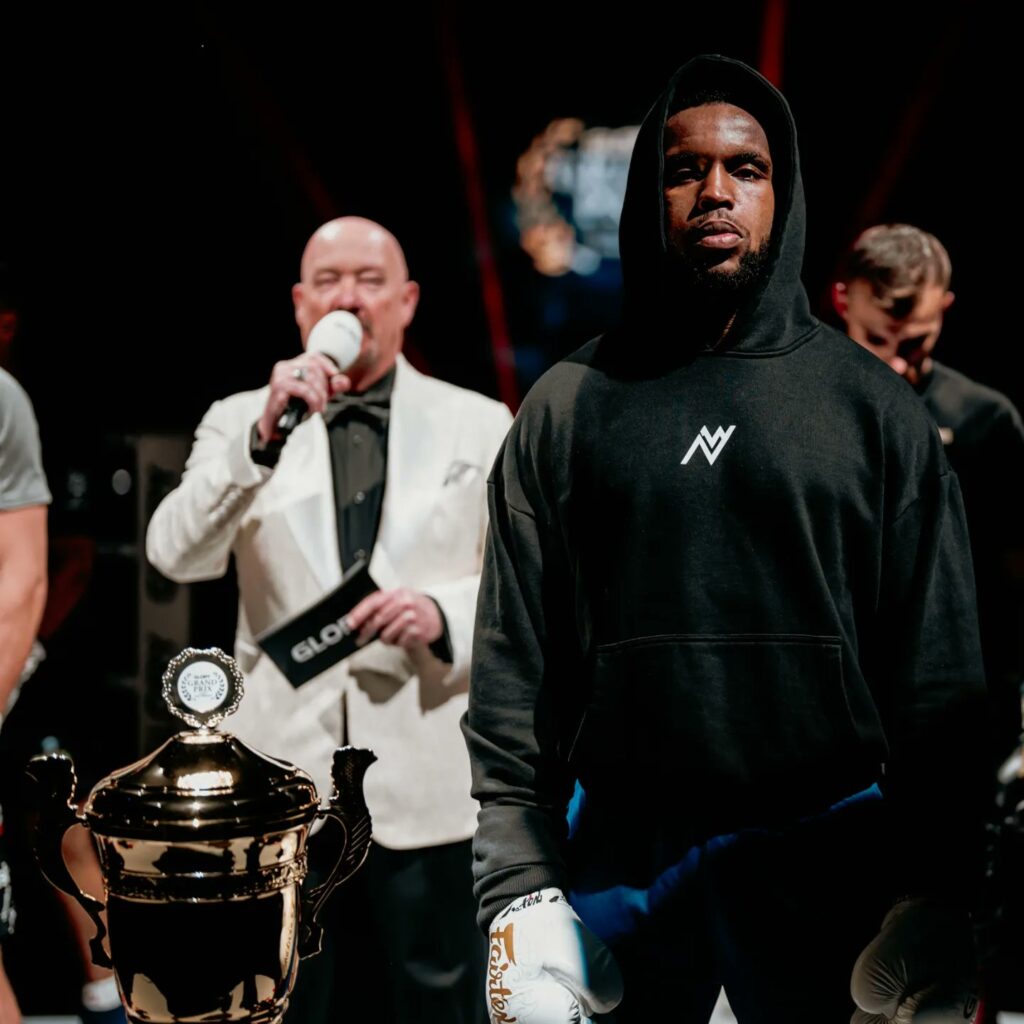
The eight-man, single-night tournament offered significant stakes: a trophy and a $100,000 prize to the winner. Abena entered the tournament with something to prove following his championship loss.
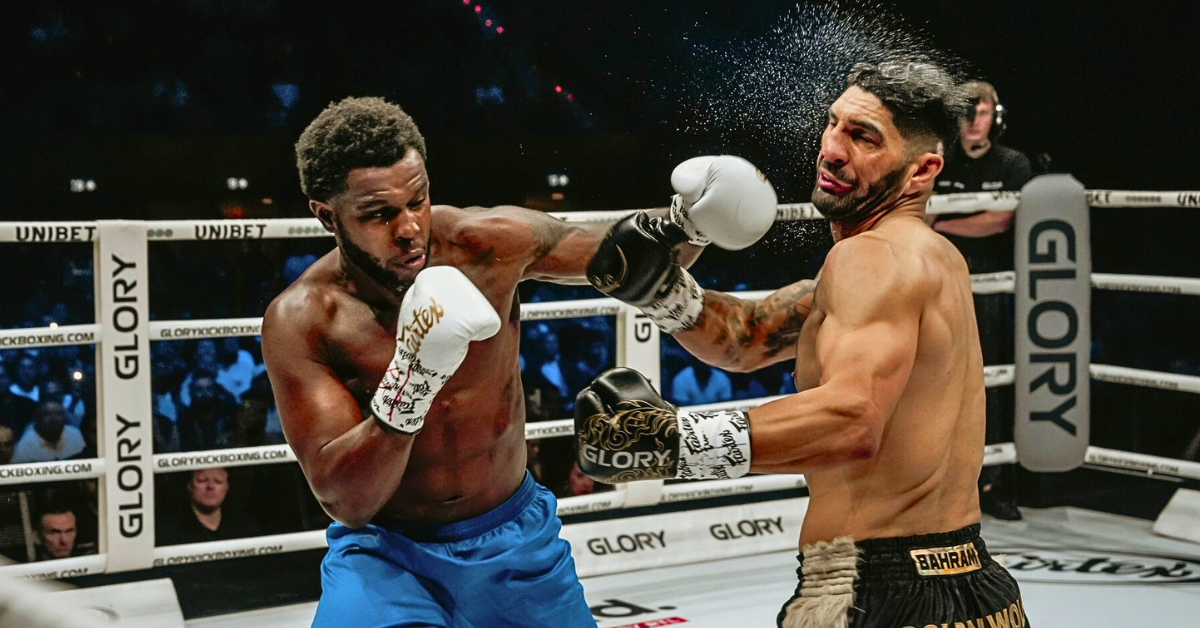
He dispatched Stefan Lătescu in the quarterfinals by third-round technical knockout, stopping his opponent with low kicks 59 seconds into the third round. In the semifinals, he again used low kicks to stop Tarik Khbabez, earning a place in the finals against the incredibly dangerous Bahram Rajabzadeh. In the championship bout, Abena delivered a dominant performance, securing a first-round stoppage that earned him the tournament title and the $100,000 prize purse.
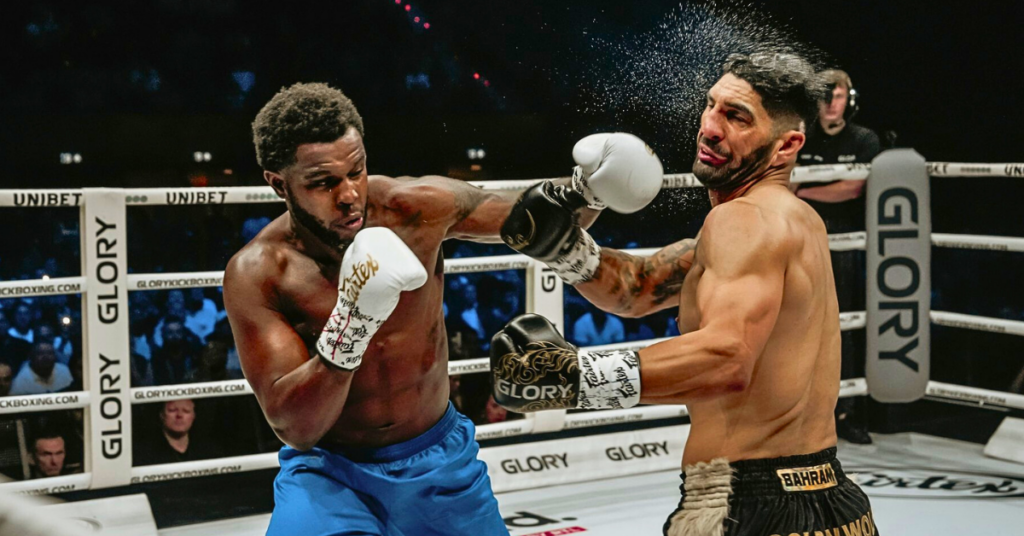
That victory cemented his status as one of the division’s elite competitors. As of June 2024, he was ranked the number one light-heavyweight in the world by GLORY, a position earned through his championship run and grand prix victory.
Bringing the Championship Home and Charity Work
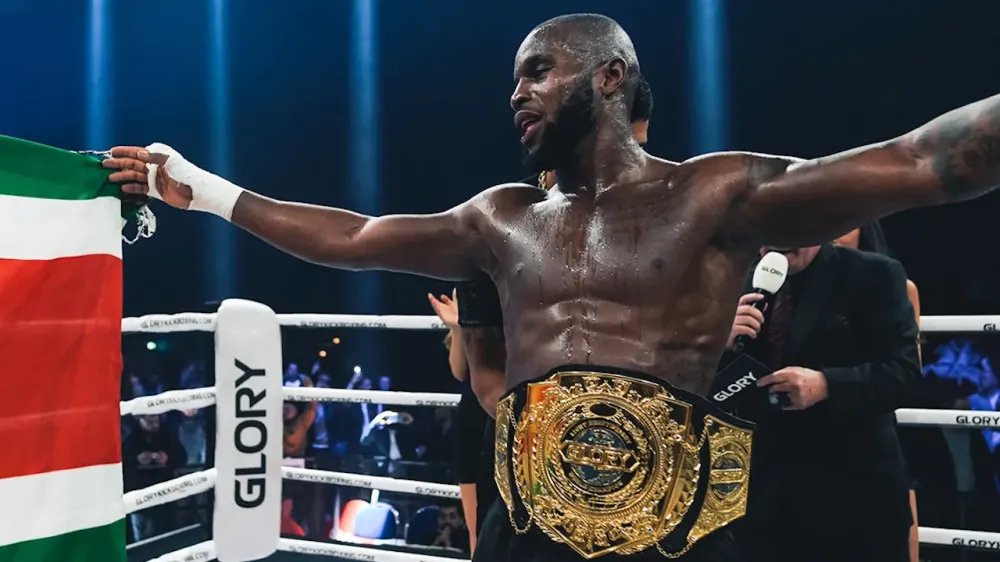
Part of Abena’s rise to prominence included a commitment to his heritage and the community he came from. Following his championship victory, he brought the GLORY belt to Suriname, participating in foundation work and community events designed to inspire youth in his homeland.
“Oh, it felt very good. And the children, they really liked it, they enjoyed it, just seeing a champion there. And I hope that I’ve given them something for the future to look to. Like, ‘Oh, he became world champion, maybe I can become world champion.’ You have to give something to the youth to look up to. And I hope so, I hope that I can find the next world champions too,” Abena said when reflecting on bringing the title to Suriname.

His community involvement extended to formal charitable partnerships. Abena worked with the Ilonka Elmont Foundation, a nonprofit organization founded by legendary Muay Thai fighter and seven-time world champion Ilonka Elmont. The foundation focuses on supporting underprivileged children, particularly those with special needs and disabilities.
Elmont described the foundation’s approach and Abena’s role:
“Everything the foundation does is working with underprivileged children in South America and the Caribbean. And then we divide them into underprivileged children with a socially, economically backward background, and children with disabilities, special needs.
“And what we do, we do about four sports days, score safe for these children. And every sports day we have a well-known artist, and we have a professional athlete joining to participate. And what we do is try to bring the dream closer to these kids. Like, they see those fighters on TV and they never dreamed about it that they would be playing tug-of-war with them. And now they have it. Or they see singing a song on TV, and now they are able to sing with the musicians. So these are the things what we do.”
Abena’s involvement with the foundation provided him the opportunity to give back directly. “Yes. The foundation is making sure that children with a mental disability can work out, because in Suriname there’s not much for people with disabilities. So she’s doing, every two or three months, she’s doing a sports day, let’s say it like that, for children with a disability to train. And every time when she has a day for the children, she brings a famous person with her to work out with the children. And this time I was the lucky one.”
The Transition to a New Level of Celebrity
Success at the world championship level transformed Abena’s public status and the responsibilities that accompanied it. The transition from relatively unknown fighter to world champion required an adjustment regarding how he conducted himself in public and what behavior befitted his new position.
“I’m coming from the type of thing that nobody looked at you. Nobody’s looking at you, nobody’s caring about you, so you can do whatever you want. But all of a sudden you become a world champion and all the eyes are on you. So you have to behave more professionally, you have to carry yourself way different than before, because these days, through social media and things, people like to judge everybody without knowing them,” Abena reflected on the shift.
Training with the Fury Camp and Boxing Development
While his kickboxing had reached the elite level, the fluidity and subtlety of professional boxing offered skills that could complement and enhance his overall fighting arsenal. He began training in London for boxing fundamentals approximately eighteen months before his discussions about joining GLORY camps.
“Yes, I’ve been training in London for boxing for like one and a half years now, and I’ve been going back and forth, back and forth, just to pick up the boxing fundamentals: the movement, the way of punching, and the calmness. Because with kickboxing everything is tight and aggression, while boxing is way more fluid and relaxed: open your eyes, look there, you go, point. So I started doing that,” Abena explained, detailing the intentional shift in approach between the two disciplines.
His boxing coach maintained connections with the Fury family’s training camp in England. Approximately two months before his Glory Collision 6 title defense against Mohamed Touchassie, that connection bore fruit.
“And my boxing coach is apparently good friends with the Fury’s, and he said to me like two months ago, ‘We can go to Camp Fury because Tommy had to fight, yeah, we can go to Camp Fury and join them in camp for some sparring.’ And we went there and we just started working together, we just started working,” Abena recalled.
Mental Approach and Confidence
Throughout his career and particularly as his profile grew, Abena developed a philosophical approach to fighting that emphasized calm and confidence rooted in ability. His early experiences with adversity had instilled a fatalism about dealing with difficult circumstances that extended into his professional fighting mindset.
When discussing his approach to challenges and high-pressure situations, Abena conveyed a remarkable steadiness. “I feel the same as the last time, just relaxed, relaxed. Because if you know that you know the game, you get calm. If you don’t know the game, you’re not confident in your abilities, you’re going to scream and make noise to cover your insecurities. But we know that we know the game, so we are very calm,” he stated.
He expanded on this perspective when discussing the adversity he faced in his career and personal life. “Yes, I know. We went through trials and tribulations. We come from far, we had to dig deep, and we keep digging deep. And for me it’s nothing new, so it doesn’t really hurt me because I’m used to it, you know. I’m used to being the odds not in my favor. I’m used to it, so this is nothing new for me, you know. Just another day at the office, just another day at the office,” Abena said.
That perspective is a recognition that the obstacles he faced in professional sport paled in comparison to the systemic challenges he had overcome to reach that point. Setbacks became manageable when contextualized against a childhood in foster care and the journey to world championship status.
Advice for Others Facing Similar Struggles
Abena’s platform and journey gave him credibility when offering guidance to others facing similar difficulties. Having navigated the transition from troubled youth to professional success, he provided practical advice rooted in his own experience.
“Just go to the gym and get all your anger out. Because with an angry mind you can’t see clear. So first get the anger out, then you will see clear, and then you need to make the right choices. And it’s difficult to make the right choices, so you need to get the right people around you. And for me, still to this day, I make and I made the wrong decisions and sometimes not having the right people around me. But time will tell and time will learn you who’s good for you and who’s not good for you. And the people, even though you love them to death, get rid of them,” he advised.
The persistence of this lesson in his own life was notable. “Yeah, that’s very important. And even if you love people, get rid of them if they are not making you be a better person or better fighter or whatever. If they’re holding you back, you have to get rid of them,” he reiterated.
The Transition to MMA and the PFL
In December 2025, Abena announced his signing with the Professional Fighters League, marking a transition from elite kickboxing competition to mixed martial arts. The move represented a significant career change for a fighter who had dedicated decades to developing expertise in a single discipline. At 27 years old and with extensive professional experience at the highest levels of kickboxing, Abena chose to begin the challenging process of learning MMA.
The PFL at light heavyweight represents an elite organization with world-class athletes. Abena’s record as a professional kickboxer stands at 30 wins with 10 knockouts, and multiple world titles, making him a dangerous prospect.
The path from troubled youth to celebrated athlete remained unconventional, and the final chapter was being written. Abena’s entry into mixed martial arts represents the pursuit of new challenges. His track record suggested that underestimating his ability to overcome obstacles would be a mistake. The young man who had fought on streets and in foster care homes had graduated to fighting on the world’s largest combat sports stages. Whatever comes next, he approaches it with the same determination that has forced him to overcome setbacks and capture world titles.