
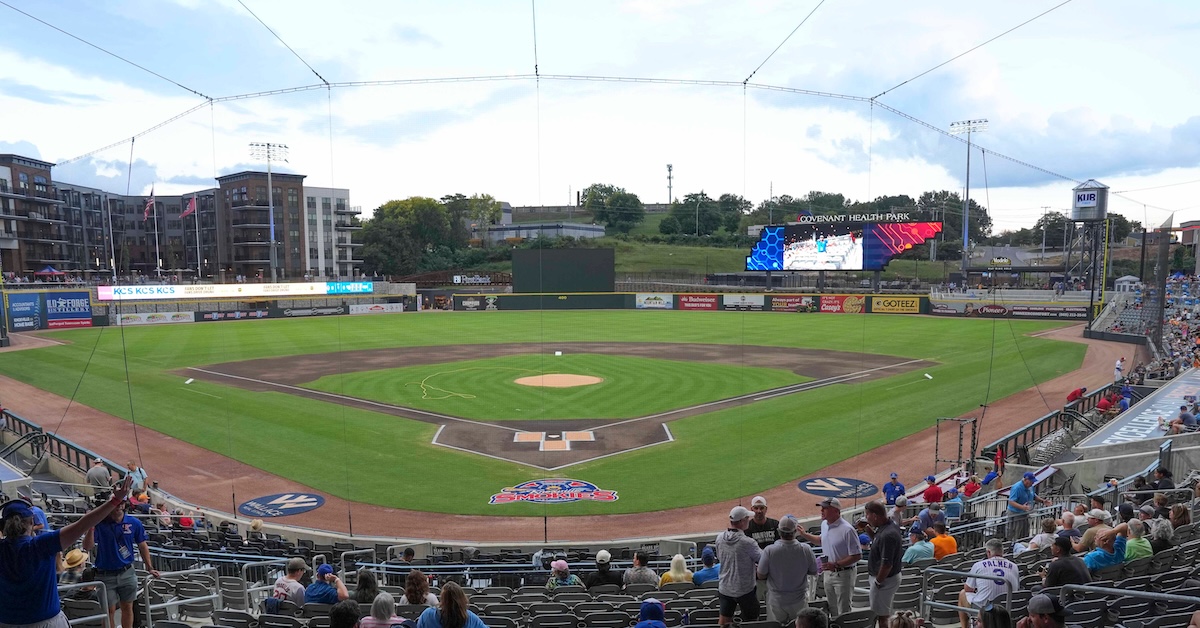
Several times during the last half decade, Major League Baseball has piloted rule changes in the minor leagues, some that have already been implemented at the highest level and others that remain purely experimental. Over the weekend, I learned about a league memo circulating among baseball operations departments regarding various experimental rule changes that will be tested during the upcoming minor league season; I then acquired the document from a club source.
This memo, which has not been previously reported, was sent to general managers, assistant general managers, farm directors, and player development personnel with the request that it be relayed to managers and coaches throughout the organization. I have excerpts from the memo below, as well as some thoughts spawned by its contents. Some of the rule changes being piloted in 2026 are aimed at augmenting the game’s aesthetic, others at further increasing the pace of play. Some of them seem like they’re for player development purposes only and not likely to be a future big league feature.
1. Starting Pitcher Reentry. In Arizona Complex League, Florida Complex League, and Dominican Summer League games, the starting pitcher will be permitted to re-enter a game after being removed, subject to the following restrictions:
- Only the starting pitcher may reenter the game after being removed.
- The removed starting pitcher may only reenter the game at the beginning of the inning following removal and may only reenter the game once.
- To be eligible for re-entry, the starting pitcher must throw at least 25 pitches in the inning during which he is removed.
This is the first rule change listed in the memo, but it’s also the only one that seems like it’s being implemented solely with player health and development in mind and isn’t being piloted for eventual big league use. Rookie ball youngsters can struggle to throw strikes, which frequently has a knock-on effect on the rest of the pitching staff, and those impacts tend to snowball. It’s increasingly common for Complex-level games to get out of hand and force position players to work an inning or two, and those innings turn into unwatchable pseudo-baseball with very little developmental value. If one inning gets away from the starter in a Rookie ball game, managers are faced with pushing the envelope on his single-inning pitch count or wearing out their bullpen. Choose the former and increase injury risk to a young pitcher; choose the latter and not only are you possibly shifting that risk to your relievers, but the starter who needs reps in order to learn how to pitch isn’t getting them because he’s being removed early in games.
A potential pitfall of this rule is that it widens the gap between the difficulty of Rookie ball and Class-A ball, a leap that players have already been struggling with since the elimination of advanced short-season leagues and affiliates. Those short-season leagues, like the Pioneer and Appalachian Leagues, once offered a useful difficulty level in between Rookie and full-season ball. Now, many players show up to Low-A unprepared, enough that it has impacted the overall quality of play there. Though I think this rule change will mostly be positive, putting these kind of bumpers up on Rookie ball makes it even less a simulacrum of full-season ball than it is already. Also, how is the box score going to look?
2. Automated Ball-Strike System (“ABS”) & Check-Swing Adjudication
- Pacific Coast League. Games played in the Pacific Coast League will use the ABS Challenge system and follow the same rules that have been adopted at the Major League level for the 2026 season (i.e., each team will start the game with two challenges, successful challenges will be retained, teams will receive an extra challenge if they have no challenges remaining in extra innings, etc.). Consistent with past seasons, MLB will monitor gameplay to determine if there is a desire to test changes at a later point in the season. Beginning on May 5, 2026, the batter, pitcher, or catcher may also appeal the umpire’s decision regarding whether the batter swung at a pitch (“Check-Swing Challenge”). A swing will be considered to have occurred if the maximum angle between the bat head and the bat handle exceeds 45 degrees. This rule was tested in the Florida State League and Arizona Fall League in 2025. In the FSL, the strikeout rate was over 3% lower when Check-Swing Challenge was used, having a positive impact on balls in play and encouraging more extensive testing at higher levels. Under this format, each team will continue to start the game with 2 challenges. Challenges may be used on either ball/strike calls or swing/no-swing calls, but not both on the same pitch.
- International League. All games played in the International League will use the ABS Challenge system and follow the same rules that have been adopted at the Major League level for the 2026 season (i.e., each team will start the game with two challenges, successful challenges will be retained, teams will receive an extra challenge if they have no challenges remaining in extra innings, etc.). As noted in the section above, MLB will monitor gameplay and decide if changes to the ABS Challenge system will be tested later in the season. Players in the International League will not be permitted to challenge check-swings, but, beginning with the series that starts on May 5, 2026, umpires will be instructed to call swings/no-swings based on the 45-degree threshold described above. Prior to May 5th, umpires will call check-swings as they have in recent seasons.
- Florida State League. Combined ABS and Check-Swing Challenge will be used in the FSL under the same format as the PCL (i.e., teams have 2 challenges that may be used for ball/strike calls or swing/no-swing calls).
- Clubs are encouraged to submit height measurements for positions players who were not measured by one of the MLB-led teams during 2025 or 2026 Spring Training. This will allow the players to use a strike zone that will closely replicate the one that will be used if the player is called up to the Major League team. Height measurement protocols and guidance will be distributed by MLB prior to the start of the season.
The 45-degree mark requires that hitters swing well beyond what we currently associate with a strike call on a check-swing appeal to one of the base umpires. When we’re watching a check swing from the dugout angle, perpendicular to the belt line of the hitter, most of us would say that if the barrel passes the knob of the bat at all, it constitutes a swing. Pretend you’re the third base umpire on this check swing. Does he go?
You can see the home plate umpire in the video appeal to the third base umpire, who say Braden Montgomery swung. That was also my conclusion in real time, and I’m betting it was yours, too. But this is what the 45-degree line looks like:
This is a pretty jarring difference compared to what I assume most of you consider the line, and it’s going to be interesting to see whether/how long it takes both umpires and hitters to adjust to this new boundary. The fact that it runs parallel to the baseline gives umpires a handy visual aid for comparing the bat angle from their vantage point. Hitters in last year’s Fall League started challenging every one of their check swings when they realized where the line was. Very few check swings traverse that great a distance; hitters tend to be pretty good about keeping it close to 0 degrees. How far does the bat need to go for us to conclude that the hitter was successfully tricked by the pitcher? For me, the burden of proof shouldn’t be quite this severe.
3. Pitch Clock Changes. When the Pitch Clock Regulations were implemented, a number of accommodations were included to help players and staff adjust to the new Regulations. These accommodations have been effective – a Pitch Clock violation occurred just once every 5.2 games at the Major League level in 2025 – but they have also been utilized more frequently over time, diminishing the intended benefits of the Pitch Clock in terms of both game time and action. For example, the average duration of a 9-inning game increased from 2 hours and 36 minutes in 2024 to 2hours and 38 minutes in 2025. In addition, the success rate on stolen base attempts has declined from 80.2% in 2023 to 77.8% in 2025. In an effort to address these trends, the following changes to the Minor League Pace of Game Procedures will be tested during the 2026 season, with the goal of determining which changes, if any, are appropriate for the Major League level in the future.
- PitchCom Safe Harbor. In Triple-A, teams will be assessed a mound visit if play is stopped for the purpose of addressing an issue with PitchCom (at which point the team will have the opportunity to address the issue while the Pitch Clock is turned off). If the team does not have a mound visit remaining, a Pitch Clock Violation will be assessed (i.e., automatic ball), at which point the team will have an opportunity to address the issue while the Pitch Clock is turned off.
- Defensive Signals. At all levels, the clock will no longer stop and reset when the catcher leaves his position to give defensive signals. If the catcher is unable to return to the catcher’s box with at least 9 seconds remaining on the clock, a Pitch Clock Violation will be assessed (i.e., automatic ball).
- Mound Visits. At all levels, mound conferences must end and all coaches and players, other than the pitcher, must be off the dirt of the mound and moving toward their positions or the dugout before the mound visit clock reaches zero. Failure to comply with these requirements will result in a Pitch Clock Violation (i.e., automatic ball).
- Batter Timeouts.
i. Double-A & Triple-A. When a batter requests time, the home plate umpire will grant time, point at the batter, then immediately reset the Pitch Clock. Batters must return to the batter’s box and become alert to the pitcher before the clock reaches 8 seconds remaining.
ii. High-A. Batters will only be permitted to request time with runners on base (i.e., batters will not be permitted to request time with the bases empty). Umpires may continue to grant time if a special circumstance applies (e.g., hitter is brushed back, there is bona fide equipment issue, or injury concern).
iii. Single-A. Batters will not be permitted to request time. As in High-A, umpires may continue to grant time if a special circumstance applies (e.g., hitter is brushed back, there is a bona fide equipment issue, or injury concern).
- Disengagement Limit. In Double-A, the Disengagement Limit will be reduced from 2 to 1. When there are runners on base, pitchers may pickoff or step off once during a plate appearance without penalty. If they disengage a second time and all runners return safely, time will be called and all runners will be advanced one base. Consistent with the Disengagement Limit used at other levels of play, if a runner advances a base during a plate appearance (e.g., stolen base), the Disengagement Limit will reset.
Now that we’ve had things like PitchCom, the pitch clock, and rules limiting disengagements for a bit, teams and players have found the loopholes and grey areas. MLB has noticed these circumventions, as well as other areas where tremble fat exists during the flow of a game, and these experimental rules seemingly seek to address them. (The possible implementation of batter timeout limitations was first reported by The Athletic in December.) Isolating little rule changes, level-by-level, allows MLB to assess each tweak’s impact on its own. Halving the number of disengagements at Double-A is the most substantial of these potential changes because it impacts both pace of play, as well as the game’s aesthetic by encouraging stolen base attempts.
4. Positioning of Second Base. To encourage more action on the bases, in the International League second base will be placed entirely within the perimeter of the infield diamond during the second half. This change will decrease the distance between first base and second base, and the distance between second base and third base, by approximately 9”, i.e., double the change achieved by increasing the size of the bases from 15” inches to 18.” MLB will work with the groundskeepers in the International League to move second base prior to the start of the second half of the 2026 season.
There’s a difference between “encouraging more action on the bases” and “implementing rules that highlight speed.” I’m not sure which one people actually want, but I worry this hypothetical rule change might borrow from one to serve the other. The difference between fast and slow players (in any sport) is magnified over greater distances. To score from first on a double requires breathtaking speed. Reduce the distance between bases and that becomes less true. If we continue contracting the distance between bases, eventually we’d get to a point where speed becomes moot.
You Aren’t a FanGraphs Member
It looks like you aren’t yet a FanGraphs Member (or aren’t logged in). We aren’t mad, just disappointed.
We get it. You want to read this article. But before we let you get back to it, we’d like to point out a few of the good reasons why you should become a Member.
1. Ad Free viewing! We won’t bug you with this ad, or any other.
2. Unlimited articles! Non-Members only get to read 10 free articles a month. Members never get cut off.
3. Dark mode and Classic mode!
4. Custom player page dashboards! Choose the player cards you want, in the order you want them.
5. One-click data exports! Export our projections and leaderboards for your personal projects.
6. Remove the photos on the home page! (Honestly, this doesn’t sound so great to us, but some people wanted it, and we like to give our Members what they want.)
7. Even more Steamer projections! We have handedness, percentile, and context neutral projections available for Members only.
8. Get FanGraphs Walk-Off, a customized year end review! Find out exactly how you used FanGraphs this year, and how that compares to other Members. Don’t be a victim of FOMO.
9. A weekly mailbag column, exclusively for Members.
10. Help support FanGraphs and our entire staff! Our Members provide us with critical resources to improve the site and deliver new features!
We hope you’ll consider a Membership today, for yourself or as a gift! And we realize this has been an awfully long sales pitch, so we’ve also removed all the other ads in this article. We didn’t want to overdo it.
Or am I thinking about this wrong and the opposite is true? Is it possible that, by inching the bases closer together, some very fast players would essentially become uncatchable, that they’d be able to skip from base to base so easily that we’d see fewer throws and 50/50 tag plays on the bases because catchers would have no chance to nab guys who run really well? This is the experimental rule change I am least confident in assessing, not just its impact on baserunning, but also its impact on the middle infield defenders and where they’d need to be positioned in order to operate around a shallower second base in a timely manner.
5. Other Changes. Consistent with rules changes made in the Major Leagues, Minor League umpires at all levels will proactively monitor base coach positioning (i.e., not just in response to complaints from the opposing manager) and may call interference on a runner who initiates contact with a fielder with the intent of “drawing” an obstruction call.
This is a large list of trial rule changes, but many of them (basically everything in section 3) are pretty benign things that most of us would probably come up with if we sat at the bar spitballing ways to polish up MLB’s Pace of Play initiatives from the last few years. The Check-Swing Challenge (regardless of the angle, but especially the 45-degree version) and the Positioning of Second Base are more substantial potential alterations. I think it’s fair to say MLB has done a pretty good job of assessing potential changes in these minor league laboratories, and that the ones it has decided to implement at the big league level have generally been well-received. (I believe the same will also be true for the ABS challenge system, perhaps most of all.) My personal feelings and hypotheses aside, the impact of all of these changes should be studied before conclusions about how to proceed are made.