
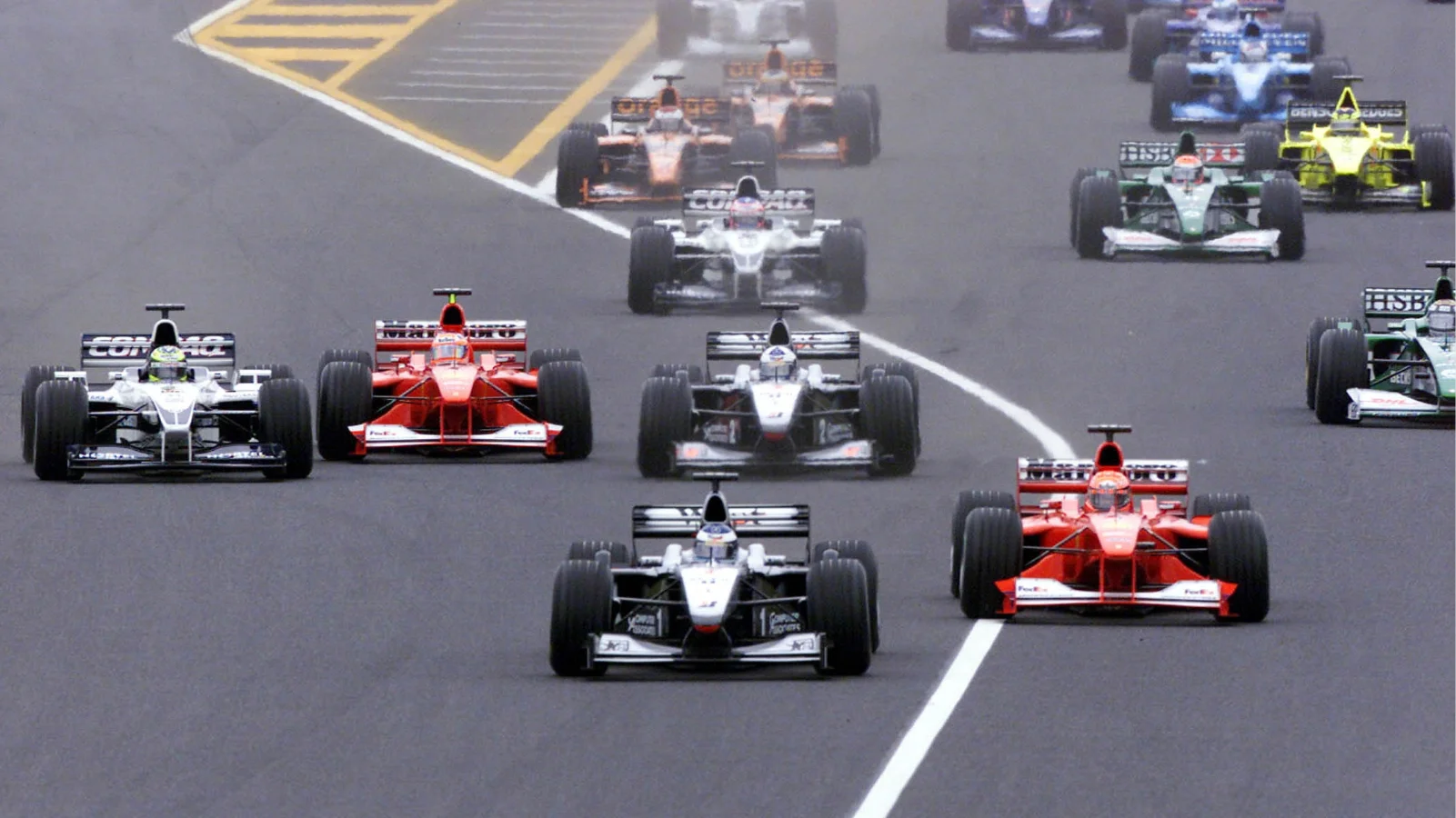
Since its debut in 1976, the Japanese Grand Prix has been held dear in the hearts of hardcore Formula 1 fans, and has thrown up its fair share of drama along the way.
In recent years, the country has switched to an earlier date in the calendar, but traditionally, the race has been one of the last, if not the last, race on the schedule.
And by default, the Japanese Grand Prix has therefore been a race that has been an almost-traditional World Championship decider.
Motorsport Week takes a look back at 13 times the event has hosted a title-decider, with the additional occasion the country – under a different event – also did.
Did you know that the #F1 title was decided 14 times in Japan?
Full article available on our website.#JapaneseGP #Formula1 pic.twitter.com/0ZVjAJsIBg
— Motorsport Week (@MotorsportWeek) March 27, 2026
1976 – The ‘Rush’ rivalry reaches its crescendo
1976 will go down as one of the most dramatic seasons in F1 history, regardless of the additional Hollywood sprinkles it got from the film Rush.
Niki Lauda was leading the standings ahead of James Hunt when the Austrian was severely burned in an infamous crash at the Nurburgring.
Suffering from severe smoke inhalation to boot, Lauda received the last rites, as his condition worsened.
But after miraculously pulling one foot out of the grave, Lauda returned just six weeks later, taking points at the Italian Grand Prix, with Hunt having used his absence to claw back the deficit in the title race.
Therefore, it all came down to a final-race showdown at Fuji.
Lauda, incredulous that the race was green-lit to go ahead despite heavy rain, retired out of principle early on. Hunt, despite suffering a puncture, fought through the field to take third place, enough to see him secure the championship by one point.
1987 – Piquet takes quietest title win after Mansell agony
Fuji held one more race a year after Hunt’s triumph, before the event went into hiatus.
10 years later, it returned, this time at Suzuka, and Britain still had not seen another champion of its own since Hunt.
Nigel Mansell was in contention to break that streak, having narrowly lost out in Adelaide a year before.
On that occasion, his Williams teammate Nelson Piquet also lost out, but this time, the Brazilian would take glory, albeit under agonising circumstances for Mansell.
In qualifying, Mansell, in an attempt to better his time, lost control of his car on the exit of Turn 6, and swept across the track into the opposite tyre wall.
The car was kicked up into the air and landed on its wheels, but the ferocity of the landing caused a spinal concussion to Mansell, ruling him out of the race, and handing Piquet the championship.
1988 – Senna’s glorious fightback
A year later, Williams was out of contention, having lost its Honda engines, who chose to power Lotus and McLaren instead, and for the latter team, it helped spark one of the most dominant seasons of all-time.
The team won all but one of the 16 rounds, with Alain Prost, firmly established in the team, now teamed up with Ayrton Senna, who joined from Lotus.
Their infamous rivalry was more cordial in its debut year, and in Suzuka, Senna held the upper hand going into the race, but an appalling start saw him drop down the order, leaving Prost with the advantage.
Senna, using all his Honda turbo engine’s extra grunt – and a fair chunk of his enormous talent – he clawed his way through the field and made up every place, before overtaking Prost to win the race, and take his first World Championship.
1989 – ‘This is fantastic! They meet! This is what we were fearing might happen’
A year later, and the Prost/Senna rivalry was now at boiling point, and the feelings between the two was needle to the very extreme.
The roles were reversed this time, as, like Senna in ’88, Prost could wrap up the title with a race to spare with victory, and things were going to plan.
But with Senna bearing down on him, the Brazilian made a bold move at the final chicane, and the two infamously collided. Senna had made the move from some distance back, but replays would show that Prost turned in early. But in either case, both were out.
Or so it seemed. Senna gesticulated to the marshals to bump start him, which they duly did. With the McLaren finding power on the incline down towards the start-finish straight, Senna navigated the escape road and got going.
Needing to change his front wing, Senna lost the lead to Alessandro Nannini’s Benetton, but with just a couple of laps to go, Senna repeated the same manoeuvre, managing it successfully, and going on to win the race.
But the drama did not end, as Senna was disqualified for cutting the chicane, handing the victory to Nannini and the title to Prost.
— Motorsport Week (@MotorsportWeek) March 27, 2026
1990 – ‘And it’s happened immediately!’ Prost and Senna Round 2
Once again, with two races to go, the title was between the old adversaries. This time, with Prost now at Ferrari, having escaped McLaren, feeling they were favouring Senna.
Senna took pole position, but raged that the pole position slot was on the opposite side of the grid, therefore placing him at a disadvantage as he was off the racing line, and therefore on the dirty side of the track.
Despite protesting, Senna did not get his own way, and at lights out, Prost used the extra grip to take the lead immediately.
But Senna tucked in behind, and lunged up the inside. In a cloud of gravel trap dust, it transpired the two touched, and both men were out. Senna was World Champion.
Senna later admitted to committing the collision on purpose, and proved to be a serious blot on his copybook.
1991 – Senna withholds Mansell battle to take title number three
1991 began with Senna running away with the title, as Mansell – now back at Williams – struggled with the reliability of his car, the first Williams to have the then-new semi-automatic gearbox system.
But the Englishman mounted a mid-season fightback, and kept his name in the title conversation with superb wins at Silverstone, Monza and Spain, where the two enjoyed a famous wheel-to-wheel battle on the pit straight.
With Mansell suffering a wheel detachment in Portugal, Senna retained the advantage, and Mansell needed to finish ahead of him in Japan to keep his title challenge up.
But early on in the race, when chasing Senna, Mansell tried too hard and went wide on the exit of Turn 1, spinning off into the gravel trap, handing Senna the win.
After a year of dutiful number two performances for McLaren, Senna, who was about to win the race, slowed on the approach to the line to hand the win to teammate Gerhard Berger, who took victory.
1995 – Schumacher takes a second title at rescheduled Pacific round
In 1994, Japan held two Grands Prix, the first in the Spring of that year, at the new Aida circuit, known as the Pacific Grand Prix.
Schumacher won that, and after an earthquake in the country, the 1995 race was rescheduled to the round before Suzuka.
After psychologically getting the better of Damon Hill across the year, Schumacher won in dominant fashion at Aida to take his second World Championship.
At Suzuka, Schumacher won again to secure a first-ever Constructors’ Championship victory for the Enstone-based squad.
1996 – ‘And I’ve got to stop, because I’ve got a lump in my throat’
1996 would prove to be Hill’s best chance of securing his maiden title. With Schumacher moving to Ferrari, Williams looked unassailable, and Hill led the title across the entirety of the year, but was mathematically not secure when arriving at Suzuka for the final race.
With rookie teammate Jacques Villeneuve hot on his heels, Hill was nine points ahead and favourite, and cemented that by jumping Villeneuve at the start.
Out in front, Villeneuve was forced to mount a comeback, which was halted when his right-rear tyre vacated his Williams, and sending him out of the race. Hill did not need to finish, the title now confirmed to be in his grasp.
In an emotional moment, legendary commentator Murray Walker announced Hill’s approach to the chequered flag, and when crossing the line, uttered the immortal words: “And I’ve got to stop, because I’ve got a lump in my throat.”
Hill, in winning the championship, became the first son of a World Champion to become champion too, mirroring his father Graham, who win in 1962 and 1968.
— Motorsport Week (@MotorsportWeek) March 27, 2026
1998 – Hakkinen takes his moment in the sun
At Adelaide in 1995, Mika Hakkinen suffered a horrifying accident which left him in the clutches of his maker.
Miraculously, the ‘Flying Finn’ recovered quickly enough to pick up where he left off in 1996, and finally claimed a long-overdue maiden Grand Prix victory at Jerez the following year.
1998 presented Hakkinen with his best chance of glory, with the McLaren MP4/13 being its best car in years.
Despite the car advantage, Schumacher once again used all his genius to hang in there all season and take the title to a showdown in Suzuka.
Hakkinen was given an early Christmas present with the Ferrari stalling on the formation lap, sending Schumacher to the back.
Schumacher needed to win to take the title, so his chances were now almost impossible, but miraculously made it through the field to make a game of it.
But a puncture saw him retire, handing Hakkinen the title, and perhaps making him one of the most popular champions in F1 history.
1999 – Mika makes it two in a row
Hakkinen had a glorious opportunity to retain his title when Schumacher broke his leg in a crash at the British Grand Prix.
But bad luck and schoolboy errors saw Hakkinen fail to seize the advantage, and found a new challenger in the form of Schumacher’s teammate, Eddie Irvine.
The Ulsterman was made de facto number one and wins in Austria and Germany saw him build a championship challenge.
In Malaysia, Schumacher returned, but was forced to play the dutiful number two to Irvine, who led a Ferrari 1-2. Hakkinen was briefly handed the title after both red cars were disqualified for a technical infringement. But Ferrari’s appeal was successful, and Suzuka held another decider.
With Ferrari forced to use a different floor [which was partly the cause of the initial disqualification], Hakkinen was able to take the title with comfort, as Schumacher and Irvine finished a distant second and third respectively.
2000 – ‘We did it! We did it!’ – Schumi’s red dawn
2000 appeared to be Schumacher’s biggest chance yet of taking his third title and his first for Ferrari. The project was now in its fifth year, and the partnership had yet to yield any success.
With the Ferrari firmly a match for the McLaren car that year, Schumacher opened up a title lead but Hakkinen kept himself in touch, and coming into the penultimate round at Suzuka, Schumacher could sew-up the title with a victory.
Despite Hakkinen getting the jump on him at the start, a superbly executed Ferrari strategy saw him take victory and the championship, dethroning Hakkinen.
2003 – Schumacher becomes the greatest of all-time despite calamitous race
2003 saw Schumacher’s dominance threatened by a host of suitors, chiefly his brother Ralf and his Williams teammate Juan Pablo Montoya, as well as Kimi Raikkonen, only in his third season of F1 and his second with McLaren.
Despite holding a chunky points advantage, Schumacher was only 14th on the grid, due to changing weather conditions that plagued the session in which drivers could only set one flying lap only, as per that year’s new rules.
With Ferrari teammate Rubens Barrichello in the lead – creating a buffer between Raikkonen and the title – Schumacher began to carve his way through the field, but his progress – and its front wing – was cut off in its prime when trying to divebomb the BAR of Takuma Sato.
Quickly changing it, Schumacher was swiftly sent back on his way and began to redo the work he had already done. But hearts were in mouths when he found himself in an on-track battle with Ralf, who nearly took him out when spinning a few laps later.
Barrichello took victory, and Schumacher finished eighth to secure one point to help him take the title, breaking the-then record of five World Championships.
2011 – Two in a row for Seb
Sebastian Vettel broke new ground in 2010 by becoming the youngest World Champion ever, a record that still stands, with a thrilling final race showdown in Abu Dhabi.
A year later, the German carried his momentum through another superb Red Bull car, and at Suzuka, a third-place finish was enough to see him secure title number two.
— Motorsport Week (@MotorsportWeek) March 27, 2026
2022 – Super Max doubles his money
After a contentious 2021 title victory in Abu Dhabi, Max Verstappen suffered a tough start to 2022, but quickly regained the momentum and opened up a sizeable points lead over teammate Sergio Perez and Charles Leclerc of Ferrari.
A chance of capturing his second crown in Suzuka was possible, and a dominant win saw Verstappen missing out on the points tally to secure it. But a post-race five-second penalty for Leclerc saw Verstappen emerge up onto the podium as the champion.
READ MORE – George Russell and Oscar Piastri top free practice for F1 Japanese GP