
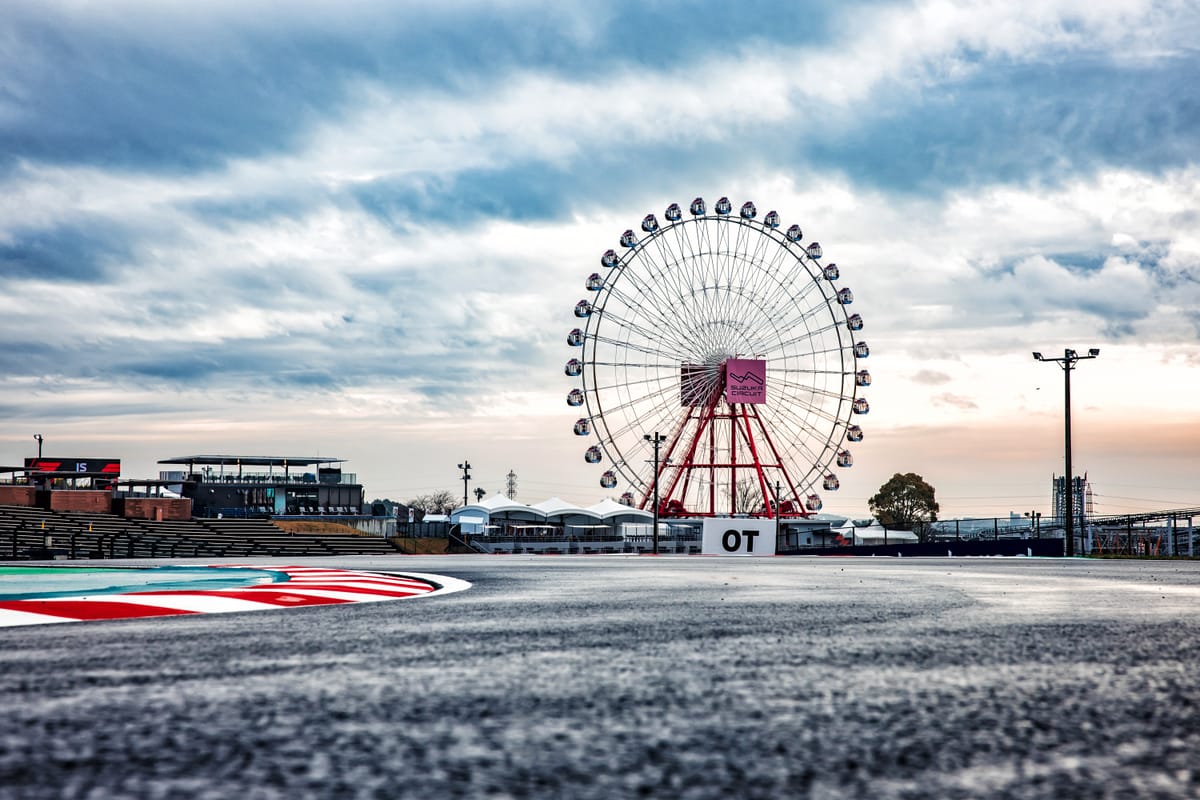
The FIA’s decision to drop the harvesting level per lap from nine to eight megajoules in qualifying for this weekend’s Japanese Grand Prix is a step in the right direction, but more could have been done to ensure qualifying is the spectacle and driving challenge it should be.
Pre-2026, the laptime I used for these Suzuka calculations was 1m27.3s and the braking time 10.03 seconds, with 62% of the lap on full throttle (defined as the driver requesting full torque). That means 54.12 seconds of full torque request.
Add on 5% for these lower grip cars and we get a laptime of 1m31.5s, braking of 10.5s, which means 56.83s full torque request. That means that 24.3s seconds of the lap was part throttle when full torque is not requested. During this period, you don’t need all 350KW, so some energy can be saved, but probably not too much harvested.
If we take it that 4MJ can give you 350kw for a maximum of 11.5 seconds, it means that to achieve that driver requested full torque requirement of 56.83 seconds, you need a total of 19.8MJ for a lap.
So, with the late changes reducing the harvesting to 8MJ maximum per lap around Suzuka and the braking time of 10.5 seconds per lap, you can only harvest 3.65MJ under braking. This gives you a total of 7.65MJ for the lap.
If you arrive at the start finish line with a full battery pack to start the qualifying lap, this will then give you a total of 11.65MJ for it. Therefore, during the lap, you need to either find 8.15MJ from that part-throttle period, clipping, or accept you will deploy less.
For reference of torque output versus time for a battery storage capacity of 4MJ gives you.
350kW for roughly 11.5seconds.
300kW for roughly 13.3 seconds.
250kW for roughly 16.0 seconds.
200kW for roughly 20.0 seconds.
In my opinion, the only way to achieve this is lots of lift and coast, through Turn 1 into Turn 2 is an ideal candidate. Also, through the esses just to control the speed and also Degner 1. It will be sad to see, but I’m sure we will also see plenty of it through 130R as well. Once, it was a demanding flat-out corner, but I suppose those days are long gone, however with nothing much to gain on the way to the chicane, it’s an ideal place to maximise harvesting for the short run to the finish line.
Basically, the driver has to dictate whether he wants the car to go slower or faster. He has two pedals to achieve that, and I believe his demands should be what the system reacts to and provides.
All this ‘hidden’ circuit mapping that Charles Leclerc was commenting on, confusing the system doesn’t need to be there; give the driver back control.
After all, that’s what the steering wheel does – the driver tells the car to turn left or right. Can you imagine the chaos if that system was allowed to be fly-by-wire? It wouldn’t take long for a driver to lose confidence after a couple of programming errors, and basically it’s now the same with the torque delivery.