
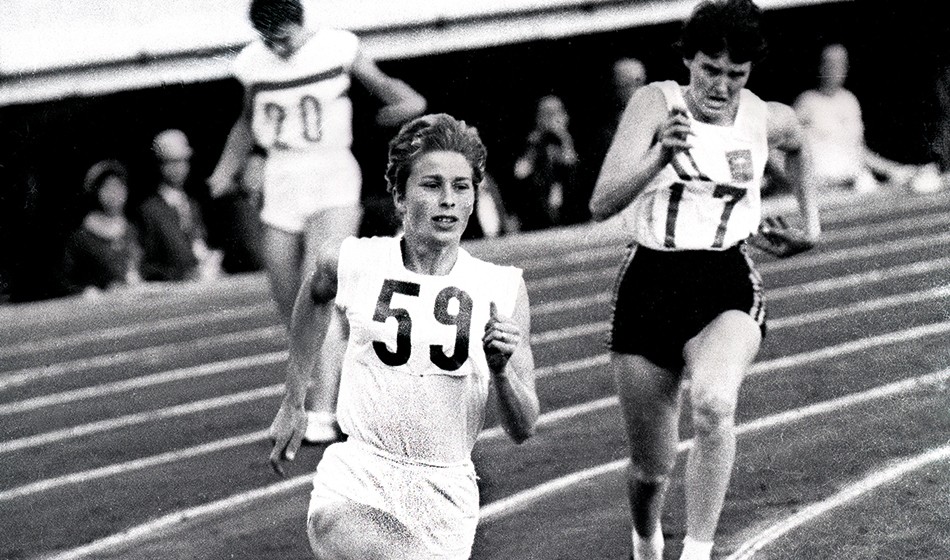
The first ever female British Olympic gold medallist in athletics, who created history at the Tokyo Games of 1964, passes away at the age of 86.
While others had come close, Mary Rand was the first.
Great Britain’s original “golden girl”, who has passed away at the age 86, became her nation’s first female Olympic athletics champion, at the Tokyo Games of 1964. She did so in some style, breaking the long jump world record in the process before going on to take a silver medal in the pentathlon and bronze as a member of the British 4x100m team at those same Games.
She was the trailblazer that showed the way for so many – from the likes of fellow Tokyo gold medallist Ann Packer to Mary Peters, Sally Gunnell, Denise Lewis, Kelly Holmes, Christine Ohuruogu, Jess Ennis-Hill and Keely Hodgkinson to follow.
Rand arrived in Tokyo off the back of a disappointing Games in 1960 but she was one of the brightest stars in the Japanese capital. Speaking to AW in 2022 and recalling that Olympic long jump final, in which she secured gold with a leap of 6.76m that would stand as the world record for four years, she said: “The 800m was going on. I remember vividly having to wait until the runners went past because there was so much noise in the stadium. I would just wait so I didn’t have that disruption and then I took my jumps.
“I didn’t know until many years afterwards that I was jumping against the wind – and that five of my jumps beat the Olympic record. Irena Kirszenstein – who went on to win seven Olympic medals and was a phenomenal athlete – was right behind me jumping and I had to wait for her and a couple of the Germans in the last round.
“At that point, I didn’t even know I’d got the world record. I didn’t know whether or not I was able to hold on to it because the others were really great athletes. They could have pulled one out of the bag, really. So I was on tenterhooks for a while. I couldn’t believe it when I found out that I’d won.
“I was so thrilled for my parents, too, because four years before that they had sat and done an interview and they were all thinking I was going to win in Rome. Of course, everything went wrong and so four years later my dad was still alive and he got to see me win a gold medal. It was like the icing on the cake. I never thought I’d end up with a set of medals – gold, silver and bronze in Tokyo.”

Upon the occasion of her 80th birthday, former AW editor Mel Watman wrote an in-depth feature about Rand’s career. An abridged version is below:
Born in Wells, Somerset, on February 10, 1940, Mary Bignal, as she was then, first attracted attention while a sports scholarship pupil at Millfield School.
Many successes followed, including British records and a Commonwealth long jump medal, and by the time of the 1960 Olympics she was being talked of as a possible long jump gold medallist. In Rome she led the qualifiers with a UK record 6.33m, only to wind up ninth in the final later that day with 6.01m. The gold medal went at 6.37m, the silver at 6.27m. The problem was that Rand fouled her first two jumps.
Her confidence shattered, she measured out her run-up anew but it was of little avail and she failed to qualify for another three jumps.
In 1962, only four months after the birth of her first daughter Alison, Rand made a remarkable comeback to earn the bronze medal in the European long jump championship. She enjoyed a glorious season in 1963, which included a world record (alongside Madeleine Weston, Daphne Arden and Dorothy Hyman) of 45.2 for the 4x110y relay, a 6.44m long jump (the official world record by then was 6.53m by Tatyana Shchelkanova of the USSR), a British 80m hurdles record of 10.8 and further UK records in the pentathlon of 4712 and 4726.
Her annus mirabilis, however, was 1964. She hardly put a foot wrong all summer, which began with a 4847 score in the Somerset pentathlon championship back at Millfield School. The downhill track and other irregularities ruled it out as a UK record but it was a great morale booster. In June she claimed back the record she had lost to Mary Peters three weeks earlier by scoring 4815, while in July she not only won the WAAA long jump with UK record leaps of 6.53m and 6.58m but also tied the European 100y record of 10.6. She was in fantastic form for her final pre-Olympic appearance, in Portsmouth.
Admittedly, the following wind was way over the limit at 4.0m/sec but she had some six inches (16cm) to spare on the board as she matched Shchelkanova’s world record of 6.70m.
After leading the qualifiers with an Olympic record of 6.52m, Rand opened with a UK record of 6.59m, consolidated with leaps of 6.56m and 6.57m, improved to 6.63m and then, in the fifth round, produced that extraordinary jump of 6.76m.
As her coach John Le Masurier was to write: “Technically it was superb – a fast approach, with the body becoming vertical as she crouched into a powerful take-off. A perfect hitchkick with the feet stretched forward together for landing and just sufficient forward speed remaining to allow her to stand up in the sand.”
It was a performance ahead of its time, for there was a headwind of 1.6m and the clay runway was rain-soaked. Off a synthetic surface and with that amount of wind in her favour it’s possible she would have jumped very close to seven metres – the sort of distance that would not be attained for another dozen years.
In the pentathlon, which started two days later, Rand again competed brilliantly to become only the second woman ever to exceed 5000 points. She totalled 5035 (10.9 hurdles, 11.05m shot, 1.72m high jump, 6.55m long jump, 24.2 200m) and finished ahead of Irina Press in three of the five events.
However, she lost so many points to Press in the shot – no fewer than 384 – that the muscular Soviet athlete ran out the winner 211 points clear with a record-breaking score of 5246.
Rand’s film star looks and sunny personality combined with her Olympic triumph made her truly the “golden girl” of British athletics. She was voted BBC sports personality of the year for 1964 and was awarded the MBE.
Her imposing list of personal bests included 10.6 100y, 11.7 100m, 23.99 and 23.69w 200m, 56.5 440y, 10.8 80m hurdles, 13.4 & 13.3w 100m hurdles, 1.72m high jump, 6.76mm long jump, 12.25 shot, 5035 pentathlon. She was also credited with a pioneering 12.22m triple jump in 1959 (“I don’t know why it isn’t a proper event for women,” she remarked in 1964) and even competed in a mile walk race.
Ann Packer (Brightwell), who won her 800m gold medal in Tokyo a few days after Rand, summed up what many believe. “Mary was the most gifted athlete I ever saw. She was as good as athletes get.”
Achievements:
1966: British Empire and Commonwealth Games long jump gold
1964: Olympics long jump gold, pentathlon silver; 4x100m bronze
1962: European Championships long jump bronze; 4x100m bronze
1958: British Empire and Commonwealth Games long jump silver
Mary Rand relives her finest moment