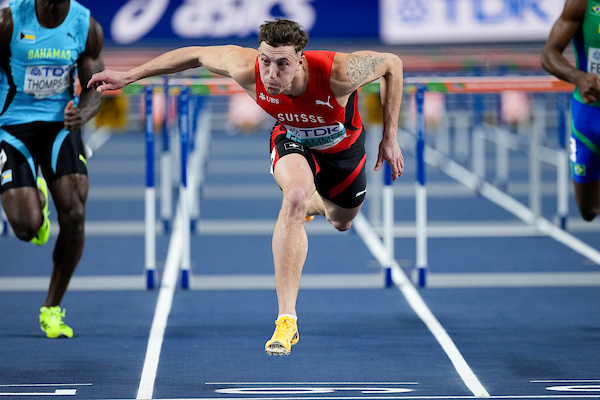
Five Big Moments from Day 2 at the World Indoors Championships in Poland
Day 1 gave the championships its spark. The men’s 60m had already turned the Kujawsko-Pomorska Arena into a full-on theatre production, with Jordan Anthony’s 6.41 world lead and the knife-edge battle behind him making it feel as though Poland had opened this meet with a sprint final and a street fight at the same time.
Day 2 did not try to copy that energy. It found a different rhythm and a deeper one. The session opened with Belgium winning the first mixed 4x400m relay ever held at these championships in 3:15.60, a world-indoor-best mark that gave the day a sense of movement right away, as if the meet had shifted from a flash knockout to a title fight where every round was going to matter. That was the mood for the rest of the evening in Toruń. There was speed, there was history, and there was the kind of composure that wins medals when legs get heavy and noise gets loud.
What stood out most from Day 2 was not simply that stars won, but how they won. Some raced with patience, some with authority, some with timing so exact it felt like counting coins in an unstable currency market. Here are some of the top stories from Day 2 of the World Indoors.
1. Josh Kerr reminded everyone that indoor racing is a craft, not just a test of fitness
Josh Kerr’s 3000m victory felt like a lesson in control. Cole Hocker had already beaten him earlier this season at Millrose, and the event itself had enough firepower to become messy in a hurry, yet Kerr never ran like a man chasing revenge too early. He sat in the race, watched the pieces move, and trusted that the right moment would arrive. When it did, he took the front on the final lap and held on to win in 7:35.56, with Hocker charging late for silver in 7:35.70 and Yann Schrub taking bronze in 7:35.71. World Athletics called it the second-fastest men’s 3000m ever run at the World Indoors, and that part matters because it shows this was not only tactical. It was sharp, fast, and championship-hard at the same time.
Kerr’s win also carried a little edge. The race had been billed as one of the night’s headline clashes, and it delivered without becoming chaotic. Hocker’s final push was brilliant, and Schrub’s bronze, just one hundredth behind Hocker, gave the finish even more weight. Still, Kerr looked like the man who understood the room best. Indoors, rewards that skill. Space is tighter, decisions come quicker, and the race can disappear if you panic for two seconds. Kerr did none of that.
2. Simon Ehammer turned the heptathlon into a masterclass and then into history
The performance of the day may have belonged to Simon Ehammer. His 6,670 points broke Ashton Eaton’s long-standing world record of 6,645, and he did it with a series that never really lost momentum. Ehammer opened with a personal best of 6.69 in the 60m, built through the field events, then closed the deal on the second day with a world heptathlon best of 7.52 in the 60m hurdles before finishing off the job in the 1000m.
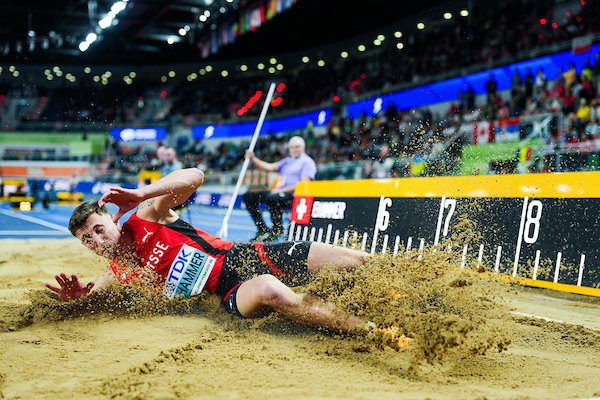
What made it impressive was how complete it felt, as it was a full set of serious performances. In multi-events, athletes often spend the second day trying to protect what they built on the first. Ehammer did the opposite, pressing on. That takes confidence, but it also takes clarity. His competition looked like someone writing in permanent ink while everyone else was still sketching in pencil.
3. Mondo Duplantis made history feel routine again
There is something almost unfair about the way Armand Duplantis competes now. The bar moved to 6.25m, the meet needed a statement, and he provided one with the ease of a man reaching for a coat on a hook. The clearance gave him a championship record and a fourth straight World Indoor title, while Emmanouil Karalis took silver at 6.05m and Kurtis Marschall bronze at 6.00m.
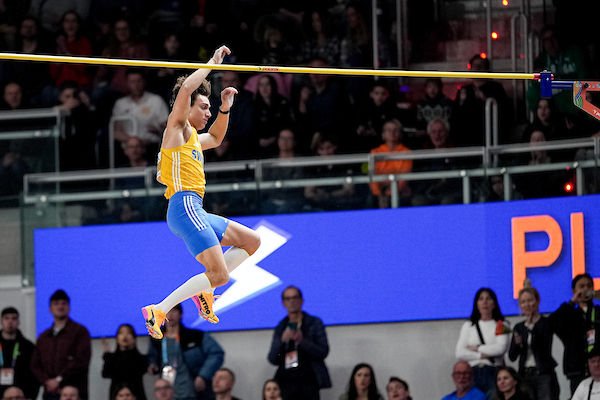
That winning streak helps explain the feeling around him. Duplantis no longer shows up as part of the field, but more like the standard the field is measured against. Last week, he had already raised his own world record to 6.31m in Uppsala, so Saturday’s championship record was not even his absolute ceiling. That is what makes his dominance so striking as he’s basically is controlling the meets.
4. Zaynab Dosso owned the women’s 60m from the semis to the final
Zaynab Dosso’s title was built on repetition, and that was the beauty of it. She ran 7.00 in the semifinals, then came back and ran 7.00 again in the final, which is the sort of doubling that tells you an athlete was not borrowing one perfect race. She was the best woman in the event all evening. Behind her, Jacious Sears and Julien Alfred both ran 7.03, with Sears taking silver by three thousandths. Alfred, the defending champion, was beaten in a women’s 60m for the first time since her NCAA days in 2022.
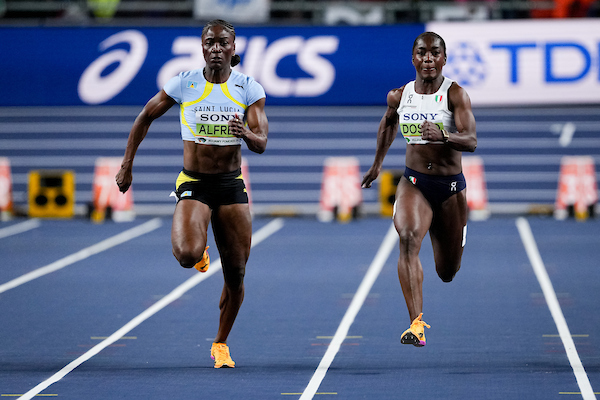
The final itself was rich with storylines. Dosso won her first world indoor title, Sears announced herself with authority on a global stage, and Alfred still ran well enough that the margin tells you how hard it was to beat her. But Dosso deserves the center of the frame. She did not steal this title. She took it cleanly, twice, with the same exact number glowing on the clock.
5. Jakub Szymański gave the home crowd the night it wanted
Every major championship needs one home-soil moment that lifts the building a little higher, and Jakub Szymański delivered that in the men’s 60m hurdles. He won in 7.40, ahead of Spain’s Enrique Llopis in 7.42 and Trey Cunningham in 7.43. What made the result even more compelling was that Cunningham had blasted 7.35 in the semifinals to move to No. 5 on the all-time list, so the final was not set up as a coronation for the Pole. It became one anyway because Szymański handled the moment better than anyone else when the medals were actually on the line.
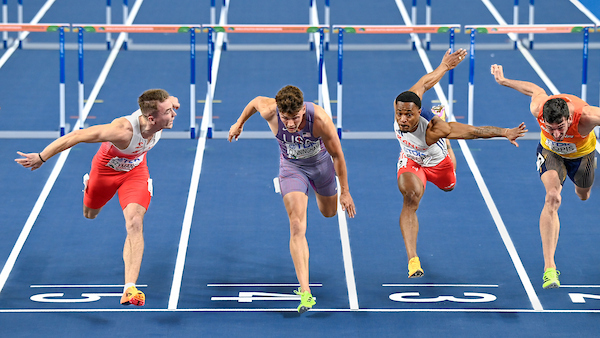
Jakub SZYMAŃSKI, 60 Metres Hurdles Men, POL
Trey CUNNINGHAM, 60 Metres Hurdles Men, USA
Wilhem BELOCIAN, 60 Metres Hurdles Men, FRA
Enrique LLOPIS, 60 Metres Hurdles Men, ESP, photo by World Athletics
That is often how championship hurdling works. The fastest time before the final gets the attention. The cleanest run in the final gets the gold. Szymański gave Poland a victory that felt personal to the arena, and those are the wins people carry out of the building.