
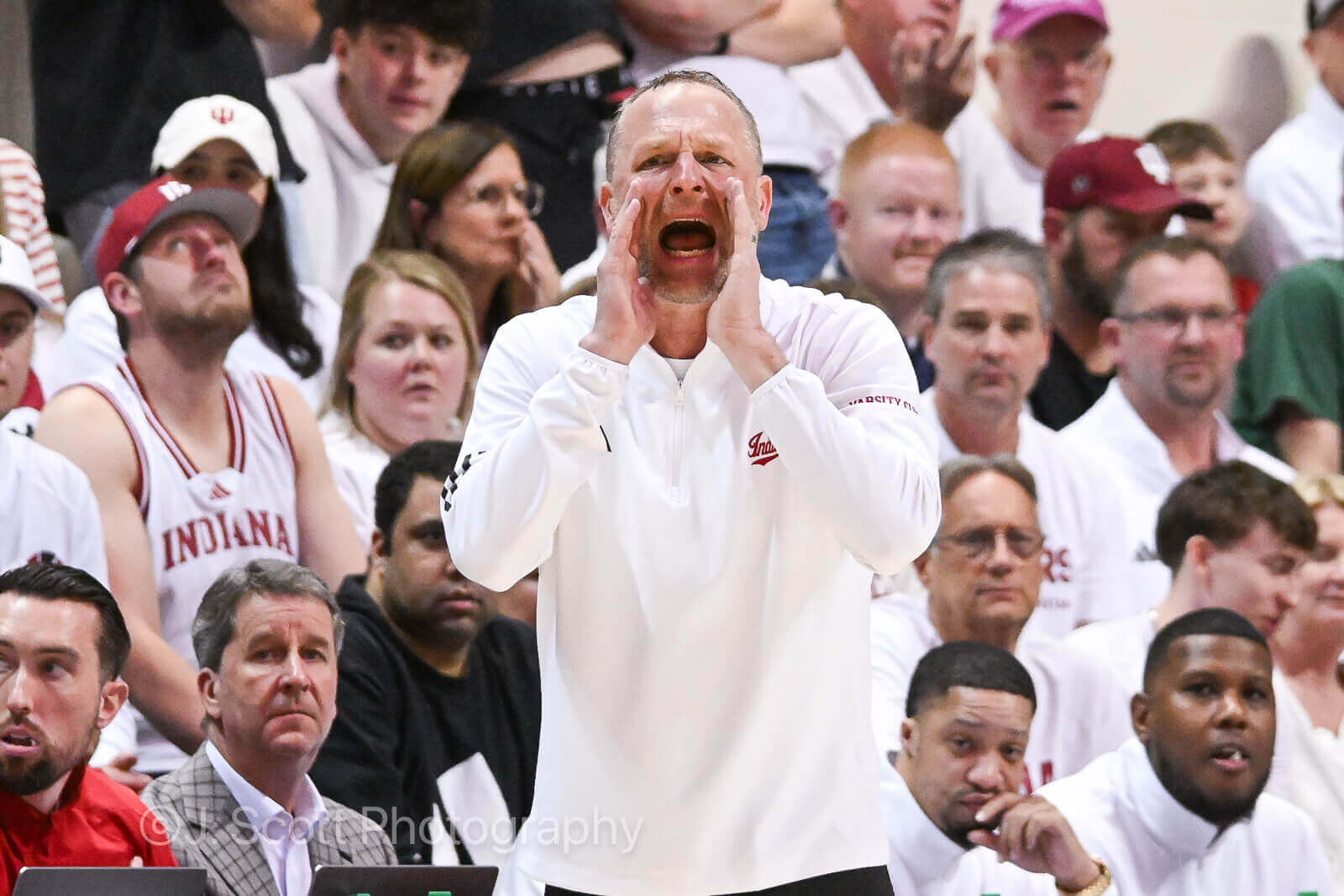
IU basketball dropped its fourth-straight game, falling 77-64 to Michigan State on Sunday at Simon Skjodt Assembly Hall.
Here are five takeaways from the loss to the Spartans:
Another poor defensive effort
With the Big Ten schedule now 90 percent complete, the evidence is concrete: Indiana can’t stop the league’s best teams.
The Hoosiers now have the Big Ten’s fourth-worst defense after allowing 1.281 points per possession in Sunday’s loss to Michigan State.
Only Rutgers, Maryland and Penn State are allowing more points per possession in Big Ten play than Indiana.
The Hoosiers don’t force turnovers, struggle to keep opponents off the offensive glass and can’t defend without fouling.
The defense on Sunday was so poor, particularly in ball-screen situations, that Darian DeVries went to a zone at times as the Spartans continued to exploit mismatches off switches.
Michigan State, not known for its perimeter shooting, rattled in 12 of its 24 3-point attempts for 50 percent.
When the final horn sounded, Indiana had trailed the entire game and the points per possession it allowed ranked as its third-worst defensive performance of the season.
Indiana fails to capitalize on Michigan State’s late-game scoring drought
Jeremy Fears made a 3-pointer with 7:05 to play to give Michigan State a 72-60 lead.
The Spartans didn’t score another point until Fears made a jumpshot with 1:25 left, marking a scoring drought of exactly five minutes and 40 seconds.
It was a perfect opportunity to crawl back into the game, one that the program desperately needed with its NCAA tournament chances hanging by a thread.
But rather than seizing the opportunity, Indiana used the prolonged Michigan State drought to score a total of four points and cut a 12-point deficit to eight.
After the Fears bucket with 1:25 left, Indiana didn’t score again. In fact, Indiana scored a total of nine points over the game’s final 10:58.
It was the latest example of the Hoosiers’ failed late-game execution offensively, who scored 12 points over the final 10:04 against Northwestern in their previous loss.
Second-chance points fuel Michigan State’s second half offense
For a half, Indiana managed to neutralize Michigan State’s offensive rebounding.
In the opening 20 minutes, the Spartans had just one offensive rebound on 10 missed shots and didn’t score a second-chance point.
The second half, however, was a different story.
Michigan State grabbed nine offensive rebounds and scored 12 second-chance points.
Over its last four games, Indiana has been outscored 54-14 in second-chance points.
“I thought our first shot defense was really good in the second half,” Darian DeVries said postgame. “Then they got nine offensive rebounds in the second half, which were just killers for us because we had opportunities there.”
No bench points, as two players scored 49 of IU’s 64 points
Indiana’s reliance on Lamar Wilkerson for offense continues to put immense pressure on the senior guard to single-handedly carry the team.
Wilkerson had help on Sunday in the form of Tucker DeVries, who had 20 points. It was the first game with 20 or more points for DeVries since the Rutgers game on January 23.
But outside of Wilkerson, who had 29, and DeVries, the rest of the roster scored 15 points.
Sam Alexis, the most consistent option in the frontcourt, had eight points in 31 minutes. Nick Dorn was again nearly invisible with four points in 28 minutes. And Conor Enright had three points in 27 minutes on 1-for-7 shooting. Enright has scored six points total over the last four games.
The IU bench logged 34 minutes and went scoreless.
Michigan State’s bench, by comparison, went for 22 points, including 18 from sophomore Kur Teng, who shot 6-for-8 on 3s.
Reed Bailey continues to struggle in the IU front court
Davidson transfer Reed Bailey, one of IU’s highest-priced acquisitions in the transfer portal last spring, continues to provide very little for the Hoosiers.
Bailey followed up last week’s one-point, one-rebound performance against Northwestern in 14 minutes with no points and no rebounds in eight minutes on Sunday.
The 6-foot-10 forward’s only counting stats in Sunday’s game were a turnover, a block, a steal and three fouls.
When a player who was expected to be a key cog in your rotation continues to produce this little, it’s a clear issue and a missed evaluation by the coaching staff.
Maybe Bailey is miscast in his role or maybe he’s not up to the task of competing against the physicality in a rugged Big Ten. But his lack of production, along with the rest of the bench, has put all the onus for production on just a few players. That’s not a sustainable model for consistently winning games, particularly against quality teams.
See More: Five Takeaways, Michigan State Spartans