

GG beat MI by 11 runs, marking GG’s first ever win over MI (!). Season-long trends decided this one; GG’s great batting & MI’s poor powerplays, with one caveat – a lazy shot by NSB meant Harmanpreet didn’t have a reliable partner to chase down GG’s modest 167-run total.
But, what happened beyond the headlines?
-
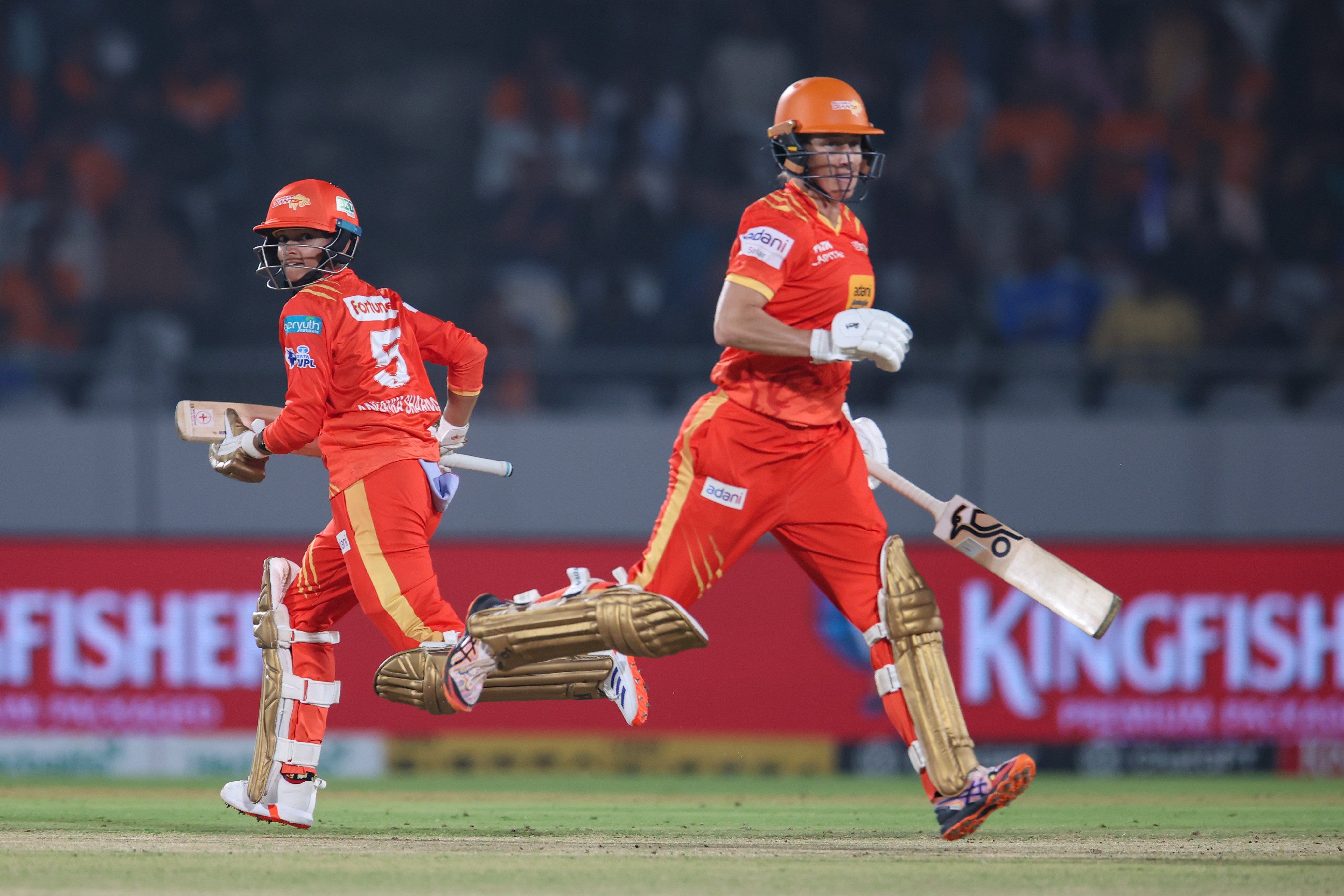
🏃♀️ The 6 vital runs GG picked up during their powerplay overs…
-
📉 …the 17 vital runs that MI gave away during GG’s death overs…
-
🏏 …and MI’s terrible PP overs that left them far behind the required run rate.
If you’re reading this online, remember: you can get it via WhatsApp or direct to your email👇!
✍️ Written by Raunak Thakur, who runs Dead Pitch’s Society. Follow him on X.
“We are going to have a bat tonight,” Ashleigh Gardner said at the toss. “We’ve always set a really good marker early on in our innings.”
It sounds simple, but it’s a radical decision. For 40 WPL games in a row before tonight, the team who won the toss has chosen to bowl first. But, to Gardner’s credit, she realised that GG’s team has found success in the counterfactual – all five of their wins this season have come when batting first.
This advantage has been built by exploiting the strengths and weaknesses of the drastically different pitches at both the DY Patil in the first leg of the season, and their home base of Vadodara in the ongoing second leg. The former was a flatter pitch designed to produce big scores, while the latter’s black soil has been trickier for batters to navigate – especially in the first innings powerplay overs.
At the DY Patil, the average first innings powerplay score across all teams was 50.1 runs. Across three powerplay innings batting first, GG topped that number by scoring 198 runs and averaging 66 per game. The method was explicit. Trust the bounce, take on length, go aerial early. Those innings contained nine 6s and twenty-two 4s. In all, 71.7% of GG’s runs came via boundaries.
In comparison, the league wide boundary percentage at the DY Patil stood at 79.1% – combined, the five teams scored 551 including eighty 4s and fourteen 6s. Unsurprisingly, this difference is a consequence of GG’s decision to actively run as often and as quickly as possible.
Non-boundary strike rate (NBSR) is a big fancy name for a simple metric; if you take away all the boundary balls, how quickly does a team score its runs? During the first leg of the WPL, all five teams averaged an NBSR of 48.7. In other words, they ran nearly 1 run every 2 balls. That’s not a bad return when you’re also scoring a boundary every 4.2 balls.
Then again, GG scored a boundary every 3.84 balls and had an NBSR of 72.7. One tactic fed into the other; the quick singles forced field placement changes that GG’s experienced opening duo of Beth Mooney & Sophie Devine could exploit for easy boundaries. It also worked in reverse; the constant boundary hitting caused teams to focus on stemming the bleeding, leaving them unprepared to collapse on GG’s quick running.
At Vadodara, these numbers are much lower due to the trickier, bowler-friendly surface that swung the ball, gripped the ball, and provided uneven bounce. The average score across all five teams dropped to 42.5 runs per first innings powerplay (a number that MI’s poor powerplay batting were still 10 away from tonight).
Across the league, only two 6s have been hit in 8 first innings powerplays, and, unsurprisingly, the league-wide NBSR rises to 55.7. Teams are forced to pivot toward a run-heavy strategy to keep the scoreboard ticking (an idea that MI ignored today).
For many sides, that shift coincides with stagnation in boundary hitting. Not for GG.
Batting first at Vadodara, GG have scored 153 runs across 3 first innings powerplays, averaging 51 runs in the phase. They’ve hit no 6s, but have put away twenty-four 4s – that’s more than they scored in 3 first innings powerplays at the DY Patil. Additionally, their dot ball percentage has stayed stagnant across both venues – 36.1%, and their NBSR has only marginally dipped to 67.9 – well clear of the league average.
The pitch conditions changed, and so GG changed with it. Most impressively, these dual strategies have been implemented even when Devine or Mooney fall early.
In the reverse fixture against MI, the Kiwi captain fell in the third over, and Kanika Ahuja walked out with GG at 22-1. The all-rounder traded off singles when she could, and targetted weak balls when possible to end the phase on 22 (9). Similarly, tonight, when Mooney fell early, Anushka Sharma came out and followed the plan. Take the singles that you can, and hit the weaker balls – largely off MI rookie Vaishnavi Sharma – when they are presented to you.
In all, GG took 6 quick singles in the powerplay tonight – runs created via conscious decisions to nudge and move before the fielding team even realises they’ve got a potential run out on their hands. In a game that came down to Harmanpreet Kaur’s ability to score last-over boundaries, those extra runs were invaluable.
Data from ESPNcricinfo & Cricmetric.
If you’re reading this online, remember: you can get it via WhatsApp or direct to your email👇!
✍️ Written by Tarun Pratap, who runs The Rank Turner. Follow him on X.

Ashleigh Gardner was always going to try.
GG reached the end of the 15th over at a relatively modest 106-3, but the GG skipper was sitting pretty on 18 (17). This season, once she crosses her 20th ball, Gardner’s strike rate jumps from a good 127.43 to a ridiculous 172.41. MI’s delay in responding to Gardner’s predictable onslaught in the 16th and 17th overs cost them valuable runs – and might cost them a place in the eliminator.
Hayley Matthews was charged with the 16th over – Gardner has a strike rate of 210 against the West Indian across all T20s in the last 2 years. Matthews’ first ball was over pitched outside off, and duly dispatched over Gardner’s favoured deep midwicket boundary for 6.
To get the ball closer to Gardner’s body, the off-spinner went around the wicket. The idea was to restrict the Aussie batter’s arm movement, but it just played to her strengths as she was easily able to penetrate that long on to mid wicket region by moving around the crease. The last 5 balls were dispatched for 13 easy runs.
MI then turned to Shabnim Ismail, their premier bowler…in the first 10 overs of a game. Ismail’s 4-year WPL numbers tell a clear story by phase. Between overs 1–6, she goes at 6.44 RPO with a dot-ball percentage of 62%; between 7–11, she is even tighter at 4.68 RPO. She’s elite against top order batters.
But at death, the drop-off is sharp. In overs 17–20 across WPL seasons, Ismail has gone at an economy of 10.84, with a dot-ball percentage of just 40.4%. MI are aware of this disparity in performance; before tonight, Ismail had bowled just one death over all season, conceding 11 runs. When she did appear here, Gardner and Georgia Wareham pounced. The 17th over went for 17 runs, and GG were suddenly sitting pretty at 142/3 with three overs to go. 180 seemed probable, and 200 didn’t seem impossible.
Only then did MI turn to Amelia Kerr, and predictably, she made a difference. This season, across overs 16–20, all the other MI bowlers combined have gone at 11.78 RPO and taken just 7 wickets. Kerr alone has 6 wickets, and concedes just 9 RPO. Zoom out further, and her death-overs dominance sharpens: across all WPL seasons in overs 17–20, Kerr has bowled 22.4 overs and taken 19 wickets, all at an economy of 8.6.
Kerr used Gardner’s strength to deceive her. As a leg-spinner, she drifts the ball in before taking it away. The inward drift towards leg side lured Gardner, who saw it as a hitting option over midwicket. She followed the drift of the ball and ran down the wicket, staying leg side of the ball, to hit it on the leg side, but the ball turned away after pitching, beating the bat, leaving her stranded to be stumped.
Only 4 runs conceded alongside the wicket of the most dangerous batter, and Kerr had structurally altered the GG innings. The perfect example of her effectiveness beyond her over could be seen in how Matthews’ final over – MI’s 20th – went without Gardner and her aggression on the pitch.
Matthews followed the same plan as that of the 16th over; bowl round the wicket, into the batter’s body, and give them no room. The off-spinner had conceded 13.5 RPO in her first two overs; she conceded just 7 in MI’s last over. Without Gardner, none of GG’s other batters could target the legside boundary as effectively.
While Gardner’s explosion came a couple of deliveries early today – on her 18th ball rather than her 20th – MI’s decision to bowl Ismail before Kerr can’t be described as anything other than reckless. MI have the best death overs bowler in the history of the WPL, and they didn’t use her against GG’s best batter until it was too late. It may have cost them a chance to defend their title.
Data from ESPNcricinfo & Cricmetric.
If you’re reading this online, remember: you can get it via WhatsApp or direct to your email👇!
✍️ Written by Neha Shetty & Tarutr Malhotra.

MI have found themselves at the bottom of the powerplay batting charts, scoring 280 runs in 8 matches at a strike rate of 97.22 – that’s the slowest number amongst all five WPL teams this year.
Unsurprisingly, the opening slot has been a revolving door, with five different batters given the responsibility of salvaging the first six overs at various points. S Sajana and Hayley Matthews won the race to be the fastest snail, having opened MI’s last four innings together.
MI’s thinking seems to be straightforward; Matthews has opened all four seasons, while Sajana has shown immense promise lower down the order. Across her WPL career, Sajana has a boundary percentage of 75.36% and a strike rate of 164.29 in the death overs. However, outside those five overs, her numbers tank. She has scored just 121 runs off 104 balls in 13 innings, striking at 116.3 and scoring roughly one boundary every 6 balls.
That pattern is reflected in Sajana’s numbers this year. As an opener, she has 52 runs off 47 balls at a strike rate of 110.6. She hasn’t made it out of the powerplay in four attempts. Comparatively, in her minimal time down the order, she has struck at 164.29.
The contrast is obvious: when Sajana bats late, her strike rate jumps and her boundary frequency almost doubles. Against a spread field and under-pressure bowlers who are prone to miss their lengths, the 31-year old’s cross-batted power game carries far less risk. Pushing her up the order doesn’t unlock untapped value so much as it wastes one of MI’s best phase-specific weapons in a misguided attempt to kickstart their faltering powerplay batting.
There is also an innings construction and tempo cost attached to sticking with Sajana. When the 31-year old tries to manufacture shots early, she is effectively betting on boundary errors rather than strike rotation to kickstart MI’s game.
Sajana’s dot-ball percentage in the powerplay, at around 38%, is not unusually high. The issue lies in how she reacts to those dots. Rather than relying on strike rotation, Sajana goes for boundaries early – she has a boundary percentage of 73.68% this year – thereby stalling MI’s powerplay tempo.
Today’s scorecard reflects that pattern; 22 of Sajana’s 26 runs came from 5 boundaries, while her other 20 balls faced garnered just 4 runs. Worse still, Sajana faced 25 powerplay balls – 69% of the phase’s deliveries – and stalled MI’s chase. They started the innings needing 8.4 RPO. After what should’ve been their most lucrative phase, they were left needing 9.57 RPO – a number they’ve only managed twice in the last 14 overs this season.
In MI’s third game of the season – the reverse fixture against GG on the much higher scoring DY Patil pitch – they had to chase down 192 runs. Their top 3 scored 75 (50) on the day – compared to tonight’s 34 (39) – and it still took a 11+ RPO miracle from Harmanpreet Kaur (71 off 43) to win the game.
In MI’s second game of the season versus DC – again, at the DY Patil – they scored 152 runs in the last 14 overs courtesy two brilliant performances from Harmanpreet Kaur (74 off 42) & Nat-Sciver Brunt (70 off 46).
It’s not a coincidence that these are two of MI’s three victories this season (the third featured an even more improbable innings – NSB’s maiden WPL century v RCB). Without a combination of NSB and Kaur propping up their innings, MI collapse. There’s a reason the two middle order stars have scored 48% of the team’s runs this season – they keep having to rescue the innings after MI’s powerplay collapses.
After the English captain got out to a surprisingly poor shot in the 7th over tonight, the writing was on the wall. Even another Herculean effort from Kaur tonight was not enough. The MI skipper put together 39 off 17 in the death overs, while her partners only scored 7 (7) while losing 3 wickets. Ironically, Kaur probably could’ve used a batter like Sajana at the death as MI fell short by just 11 runs.
Data from ESPN Cricinfo, Cricbuzz, Cricmetric & Cricsheet.
If you’re reading this online, remember: you can get it via WhatsApp or direct to your email👇!