
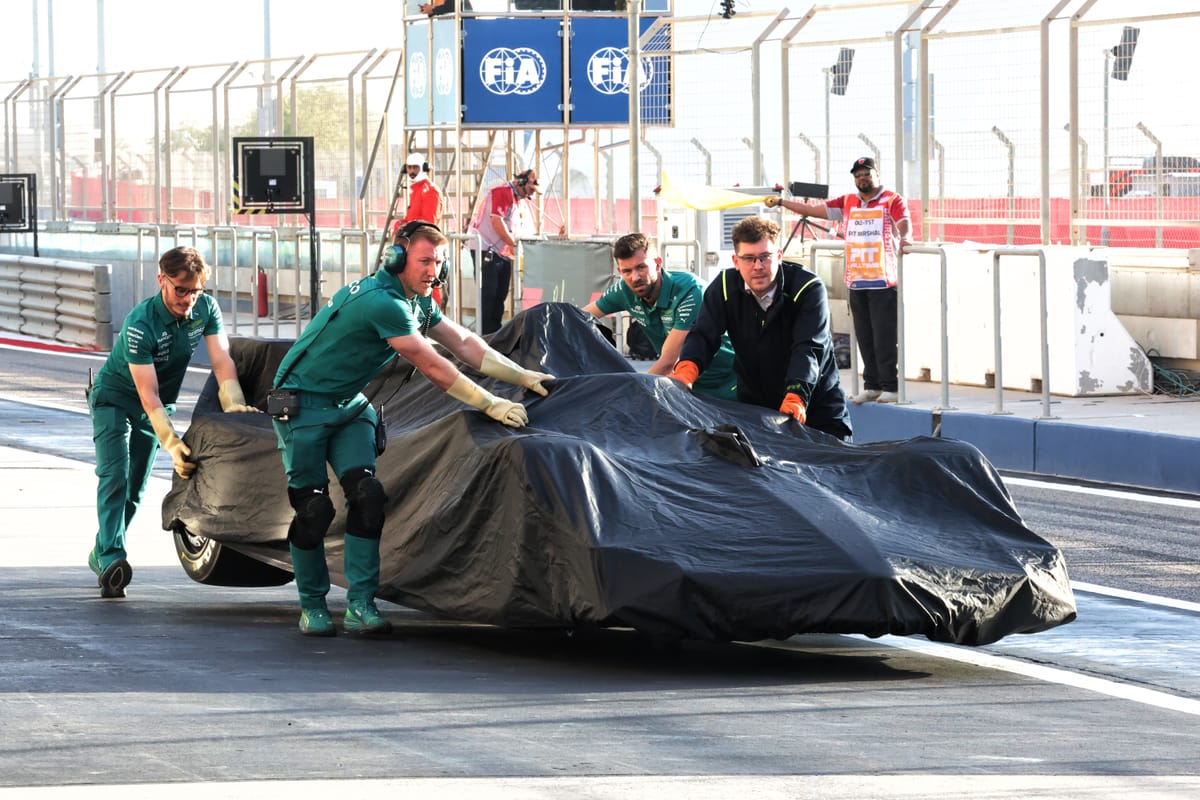
During my days as Jordan Formula 1 team technical director, I worked with Honda. Following pre-season testing for 2026 showed that the years may have rolled on, but the problems remain more or less the same. That means I have sympathy for the situation Aston Martin finds itself in.
In my final Jordan days in 1998, a commercial decision was made to change from a very good Peugeot engine to a not-so-good Honda one. That has another parallel with today given that was a year of dramatic regulation changes with narrow-track cars and grooved tyres, so not so different to what Aston Martin is dealing with.
Although there are other problems, the primary trouble appears to be the Honda side. And without wanting to pass the buck onto anyone else, a look back at my experience in 1998 has plenty of similarities.
Our 1997 car was pretty good, and but for a few small mistakes by both team and drivers we really should have won Jordan’s first grand prix. That didn’t happen, but we had a good handle on what made a car built to those regulations tick. But the changes in 1998 changed that.
Relive the whole 1997 F1 season – including Jordan’s heroics and near-misses – in an exclusive Bring Back V10s bonus series in The Race Members’ Club. Get a seven-day free trial here
At that time in our existence, any form of simulation was basic to say the least as we were largely limited to using an Excel spreadsheet. We focused on building a car that was better in all areas we researched than the ‘97 car, so stiffer, lighter, lower centre of gravity, higher downforce levels and more efficient. We succeeded in most, but not all, of those areas but were pretty happy with where we ended up.
I also spent a lot of time building up a new relationship with Honda. The engine was built by Honda in Sakura, but christened a Mugen-Honda as Mugen was going to represent Honda at the circuit. As a consequence of this relationship, we had to switch from our well understood Jordan-Penske dampers to Showa. I’m not going to spend a lot of time comparing these two companies, and I’m not saying there was anything wrong in that department, but it meant building up a whole new relationship after seven years with Jordan-Penske units.
As for the engine, we never got a power curve from Honda with numbers on it. Everything came with a percentage of maximum power versus revs, so that made it very difficult to really know where we were. For our limited simulation capabilities, everything was a guess.
When we went testing for the first time, we had both chassis and engine problems, which I suppose was to be expected. The chassis problems we could tackle with our own developments, but even with those it took time to realise where we went wrong.
For me, it took until after Monaco, the fifth race of the season, for it to click. Up until then, Ralf Schumacher could be quick, but his team-mate Damon Hill just didn’t like the feel of the car and, more importantly, its characteristics confused him.
As for the engine, it was a different story. I would describe the Honda approach as sort of hands-off: it was responsible for the design and build and it worked, job done.
However, that was one of the problems, because the engine was designed and built by Honda and run by Mugen-Honda. As is the way with Japanese business culture, neither company could actually confront the other about the performance. It was OK when it came to mechanical problems as you had hard facts, but general parameters like fuel consumption, which was about 5% higher than Peugeot, and actual performance were out of bounds for discussion.
The main feedback from Honda about the lack of performance was that the Jordan’s airbox was too small. It wanted something about twice the size. We always based a lot of our aerodynamic research time into managing the airflow spillage from the airbox when the engine couldn’t use any more airflow and when the driver would shut the throttle. The last thing you needed was the rear wing downforce to suffer in either of those circumstances.
After I realised that Honda wasn’t talking about the performance problems, I felt I had to use my famous diplomatic training skills to highlight the situation. So after the season started I did four one-day trips to Sakura to meet with the design team and a Mugen-Honda representative.
The first three were a failure as I just couldn’t get the message across. However, after round four at Imola I felt we had enough actual data for one last trip. That was the one circuit which had reasonably consistent acceleration off chicanes and this allowed us to compare that data to the previous season. If the mid-corner speed was the same and the throttle application was the same, then if the power output was the same in my opinion the acceleration off the corner should be the same.
So off I went to Sakura with my backpack over my shoulder full of data and we sat in an office for most of the rest of the day discussing the lack of acceleration compared to the previous year and how I felt that we had probably 50bhp less than the Peugeot unit from the previous year, which had roughly 745hp. They didn’t accept this and that’s when my diplomatic training kicked in, I started to get a bit angry and bang the desk (lightly) and with that a young engineer jumped up and left. I thought I had upset him.
Happily, he came back about 10 minutes later with a sheet of paper, he hit his calculator for a few seconds and then declared, ‘we have a problem’. His numbers showed Honda had just under 700bhp. From there on in, the tone of the meeting changed dramatically.
I was on my way home first thing the next day, but they asked me to stay for an extra day. When I got into the office the next morning, they had a development plan laid out on a wall board with dates when they could achieve each one of them. Together, we shuffled them around a bit as it would require us also making some new parts like exhaust systems etc, because part of that development plan was also to change the engine’s firing order.
As a quick note, the reason for the firing order change was related to the extra fuel usage, so I was very happy that they had also taken note of my fuel usage comparison data. In those days, the engines had injectors that sat above the top of the trumpets to give the atomised fuel and air time to mix before being pulled into the cylinder. The problem was that with them sitting above the trumpets, if a cylinder near to another cylinder was on the induction stroke it would scavenge fuel from its neighbour.
To cut a long story short, and understanding that everything takes time, Honda supplied a different engine specification to us for the British Grand Prix, which was round nine of 16 that July. It didn’t recover all of that missing 50bhp, but was probably a good half of it. That, combined with the changes we had made to the car, was enough for Jordan to turn the corner and score its first point of the season at Silverstone.
Unfortunately, it was too late for me. I made up my mind to leave after Monaco in May when the rest of the management didn’t back me up when I was a) trying to get Honda to react to the situation, and b) trying to recognise the car problems that required fixing. For me there was no point blindly trying to develop your way out of problems, to fix it the first thing was to understand it.
For Aston Martin, the problems are not dissimilar. The car on the circuit doesn’t look great, the drivers on the radio and behind the scenes are obviously complaining about everything, but mainly highlighting the driving and handling problems.
Until you have a really bad day like Aston Martin had at the end of testing when running was limited to a few out and in laps, Honda would have thought improvement was potentially just around the corner. You could probably say the same about the problems it had with McLaren, particularly in 2015 and 2017.
Once Honda reacts, there will be no power unit manufacturer better or faster at taking the required steps. It just needs that kick up the ass to get it going. And I think everyone at Sakura just had that.