
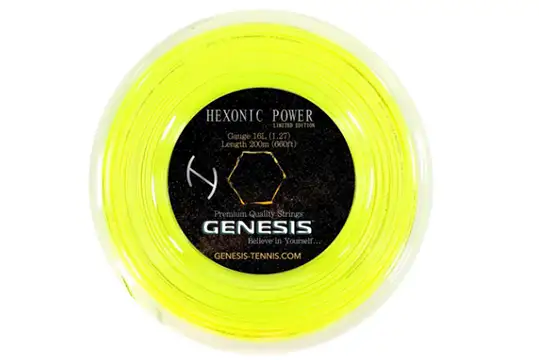
I tested Genesis Hexonic 2.0 (1.28mm) in my Blade V9 98, a frame that already leans into control, feel, and connected response. That made it a perfect platform to see what this thicker 1.28 gauge version actually brings to the table.
From the first rally, Hexonic 2.0 felt purposeful. This isn’t a flashy, elastic poly trying to give you free depth. It’s a structured, spin-oriented control string that rewards clean swings and consistent acceleration. In the Blade V9, it felt stable, disciplined, and built for repeatable ball striking.
And in 1.28mm? It immediately felt like a serious option for players who chew through thinner polys too quickly.
Tech & specs
- Profile: Shaped (6-sided)
- Gauge: 1.27mm / 17
- Material: Co-polyester
- Available Colors: Yellow/Black
Playtest Impressions
First Feel
In the Blade V9, Hexonic 2.0 felt firm but not harsh. The 1.28 gauge gives it a slightly denser, more stable sensation at impact. You don’t get that hollow or springy feel some thinner shaped polys can have.
The launch angle sat in a controlled medium window. Not low and dead. Not high and loopy. It encouraged confident swings without feeling unpredictable.
Forehands
On heavier forehands, the six-sided profile engaged nicely. You can feel the string grip the ball and release it cleanly. Spin was strong but controlled, it didn’t feel erratic or “over-snappy.” The Blade’s already connected response paired well with Hexonic’s structured feedback.
When I flattened out drives, depth stayed predictable. This is not a trampoline string. You generate the pace. The string simply keeps the trajectory honest.
Backhands
One-handed backhands felt solid. The thicker 1.28 gauge gave added stability through contact, especially on flatter drives. When rolling crosscourt, spin felt reliable and repeatable rather than extreme.
There was a reassuring sense of “I know where this ball is going”, which is exactly what you want in match play.
Serves
On serve, Hexonic 2.0 rewarded commitment. First serves didn’t explode like ALU Power, but they felt controlled and stable. Kick serves had good bite without launching too high. Slice serves stayed sharp and predictable.
The thicker gauge gave extra confidence on bigger swings, it never felt like the stringbed was overreacting.
Tension & Durability
This is where Hexonic 2.0 really stands out. In 1.28mm, it’s a very solid option for serial string breakers. If you’re the type who snaps 1.20 or 1.23 shaped polys regularly, this thicker version makes a lot of sense. The edges hold up well, and the string maintains structure across multiple sessions.
Tension holding felt strong. It softened gradually rather than collapsing. Even after several hours, the launch didn’t suddenly spike or become erratic.
Pros & Cons
Pros
- Strong, disciplined spin from the hexagonal profile
- Excellent control and predictable depth
- Added stability from 1.28mm gauge
- Good tension maintenance
- Great option for serial string breakers
Cons
- Limited free power
- Not ultra-plush, still a performance poly
- Spin is strong but maybe just short of elite
- Big hitters wanting explosive pop may prefer something livelier
Who this suits
Best For:
- Control-oriented baseliners
- Players who swing fast and want trajectory discipline
- Blade, Speed, or similar control-frame users
- Serial string breakers who need added durability
- Players who value stability over flash
Not For:
- Players chasing free depth
- Those wanting maximum comfort
- High-arc topspin players who prefer livelier launch
- Players who love ultra-crisp, explosive feel
Comparable strings
In my Blade V9 setup, Hexonic 2.0 compares to:
- Solinco Hyper-G (1.25) – Hyper-G feels livelier and higher launching; Hexonic is more controlled and slightly firmer in 1.28.
- Head Lynx Tour – Similar spin focus; Hexonic feels slightly denser and more durable.
- Luxilon 4G – 4G is firmer and more linear; Hexonic offers more spin engagement.
- Tecnifibre Black Code – Black Code grips more aggressively; Hexonic feels more stable and less elastic.
Final verdict
In the Blade V9 98, Genesis Hexonic 2.0 (1.28mm) delivered disciplined spin, stable depth, and excellent durability. It’s not built for fireworks or free pace. It’s built for reliability. If you’re a heavy hitter who regularly breaks thinner strings and wants a shaped poly that holds up without losing control, this gauge makes a lot of sense. It’s stable, consistent, and built to last, and for a lot of competitive players, that’s exactly what matters.