

With the Good Night Campout wrapped and a new year underway, we’re thrilled to share that hundreds joined our sixth year-end overnighter. To reflect on these good times, three of our editors and five friends put together recaps of their rides. Find standout photos and mini-stories from Mexico, New Mexico, Canada, Poland, New Zealand, and beyond here…
Launched in 2020 to spark a sense of connection at the end of an especially disconnected year, the Good Night campout has become an annual tradition that coaxes riders outdoors during the busy season leading up to the end of the year in December. Once again, images and clips rolled in from across the globe via the #GoodNight2025Campout hashtag on Instagram and comments on the site, and a few of us managed our own quick escapes, too. As a bonus, we assembled six prizes from Rene Herse, Rogue Panda, and Tumbleweed. We’re currently sifting through submissions and will randomly select winners in the next week. In the meantime, dive into the stories and photos from Good Night 2025 from friends and editors below.
Logan Watts
Oaxaca, Mexico
It took a minute to sink in after looking it up, but, wow, this was my fourth Good Night Campout in a row in Oaxaca and my fifth in Mexico. Time flies. Maybe it was a subconscious decision to take a different, rather unconventional approach this year. Instead of bikepacking locally at a festive, meandering pace in the valley—as we’ve done since 2022—we opted for a more challenging ride high in the Sierra Norte, a trip that would require over 3,000 meters of elevation gain and let us tackle some tough singletrack along the way.


That said, it was technically only more challenging for two of us. Cass and I would winch up into the mountains, while our compadres cruised to the forested rendezvous point in a van. Fortunately for us, that meant they were bringing a menagerie of wonderful snacks and all our camping gear. While purists might grimace, there was a reason for this format. Our ride to the prearranged campsite would net about 2,000 meters of climbing. Going without bikepacking gear would let us reach camp before dark without being completely shelled. Then we could bag a couple of singletrack loops in the Ixtepeji network before making camp—bagging loamy singletrack trails on my first Good Night Campout without bikepacking bags!
We left the hustle and bustle of Oaxaca de Juárez around 9 a.m. and climbed to the top of the almost traffic-free Libramento, an old byway connecting Etla with the city. It’s now all but abandoned, which provides an accessible greenway for city-dwelling runners and cyclists to use for morning or afternoon exercise. That climb alone gained about 300 meters. Then, getting to La Mesita made for another 300… and the climb hadn’t even started.

La Mesita is the most popular and accessible gateway to the Sierra Norte from the Etla Valley. As outlined in our Hebras de Ixtepeji route, folks riding up in this direction can camp at La Mesita Ecoturismo San Pablo Etla. It’s a lovely spot overlooking the valley with water, power outlets, a compost toilet, and an outdoor art and butterfly sanctuary, and it sets you up well to reach Ixtepeji without the grueling push we did. We paid the requisite 60 pesos to access the area and chatted with Leonardo, who manages the gate, before topping off our bottles and starting the big climb.
Several hours later—after some 7,000 feet (2,130 meters) of climbing—we rolled into our campsite. Virginia, Emma, Adam, and Larita, his ridiculously cute chihuahua, were waiting. We took Adam on one more bonus loop to check out a new trail recently built by the community in Ixtepeji. Adam managed to roll most of it aboard his rigid 1990s-era Norco Sasquatch 26er, despite a couple of steep sections with tire-grabby chunk! That evening, we all went about the usual campsite activities, though our meals were slightly different from typical ultralight bikepacking fare. Virginia and I made a very hearty gnocchi with mushrooms, calabacita, and an avocado-Parmesan cream sauce.

The next morning was the highlight of the trip. We woke well before dawn and made the roughly 200-meter ascent to the mirador for a proper sunrise coffee outside. All four and a half of us crammed into the top floor of the wooden fire-tower lookout and made our respective morning ritual liquid variations: me with an AeroPress, Cass and Emma with cowboy coffee, and Adam with a pour-over using his self-roasted local Oaxaca beans. After lingering over coffee, good conversation, and the warming sun, Adam, Cass, and I rolled out for another loop in the Ixtepeji network. We opted for the Carbonera trail, one of our favorites. It’s a spiraling descent with a couple of steep drops and a double switchback through a grove of giant agave. From there, we climbed back up the dirt-road escalator to the junction and took a trail called El Santo to the campsite.
Once we cleaned up after an extra-long breakfast, we packed up and started act three of our ride, a stout traverse toward our “long trail” of choice. I hadn’t heard the term long trail until visiting Oaxaca; here, it refers to singletrack descents that start high in the Sierra Norte and drop precipitously into the valley. Most are quite harrowing, with steep, rutted, challenging sections that shed some 1,500 meters of elevation in just a few kilometers. We opted for a hike-a-bike to the tippy-top of the escarpment due north of the city, then pointed our tires down a steep new trail and onward to an older classic called Donaji—also known as Prohibito since it was off-limits for several years. Donaji is no joke, but it’s undoubtedly one of the best, with several sections that demand commitment and grit.


We picked our way down through vertically shifting eco-zones, from orchid-dappled cloud forest to the hot, thorny valley. The trail finally spit back onto the Libramiento via a steep gravel section. With sore legs, beaten arms, and rumbling bellies, we said goodbye at the bottom and peeled off. I freewheeled toward the city’s afternoon bustle while Cass traversed back to his place in the hills. It wasn’t the easiest Good Night Campout, or the purest, but it was exactly what I needed: big climbs, a descent that was on the edge of my comfort zone, and coffee with friends above the clouds. I suppose rituals only matter if they evolve. This one felt less about baggage and more about two things that I hope to embrace more of in 2026: big efforts and good company.
Miles Arbour
British Columbia, Canada
Getting out for a campout in the Pacific Northwest this time of year requires a lot of motivation. I’m usually okay with a bit of type two fun, but when temperatures are hovering around freezing and rain is the forecast, the last thing I want to do is go bikepacking. Right up until the night before, Emily was still trying to find ways to get out of our Good Night 2025 campout, and Skyler admitted he was ready to bail if Emily did. There’s a bit of pressure to make it happen as an editor of the website, but thankfully, we never regret it.


This year, we returned to the Malaspina Peninsula at the tip of the Sunshine Coast for an ultra-short sub-24-hour campout. We lucked out with dry and relatively mild winter conditions, so we hauled in some firewood to ensure we had something warm to look forward to. Our massive 11-kilometer loop brought us toward Sarah Point at the north end of the Sunshine Coast Trail, then looped around toward Okeover Arm and the Bliss Portage Hut.
It was fitting to end a busy year with such a relaxed overnighter. The ride to camp took only a few hours with almost as much break time as riding time, following narrow gravel spurs and the occasional punchy climb. We gazed up at massive old-growth Douglas firs as a weightless fog weaved its way through their branches. Most of the Sunshine Coast has been devastated by logging—seemingly no slope too steep or tree too remote—so it’s refreshing to see some massive trees still standing.


Our group had little desire to hang around in the morning, so after packing up our gear and making a quick tea, we rode the last few kilometers to complete our loop. We beelined it to Nancy’s Bakery in Lund for cinnamon buns and more warm drinks before returning home to rest before New Year’s Eve. I loved that I wasn’t exhausted from our campout, which served as a necessary reminder that bikepacking doesn’t always need to be hard. I hope that’s one thing everyone can let go of for 2026.


Jeff Kerkove
New Mexico, USA
Two and a half desert-dream days circling the north loop of the Monumental Loop near Las Cruces felt like stepping straight into a warm postcard that refused to fade. This Christmas, Bex Howard and I happily traded Colorado’s currently cold, snowless mountains for New Mexico sunshine, and the desert welcomed us like it had been expecting company. Daytime temps hovered in the upper 70s, bronzing skin and spirits alike, while nights stayed so comfortable the stars seemed to lean in, curious and unblinking. Coyotes stitched their songs across the darkness, distant and steady, like guardians clocking the night shift in the Chihuahuan Desert.


The riding itself felt endless and timeless in the best way. The trail rolled and wandered through wide-open horizons, quiet arroyos, and segments of silence so complete you could hear your own thoughts stretch out and relax. The miles slipped by without urgency, each turn offering another subtle shift in color, texture, and light. It was the kind of terrain that invites you to look up, breathe deeper, and remember why wandering under your own power feels like such a gift.


Refuel stops became moments of pure joy. B&E Burritos in Hatch delivered essential, legendary happiness wrapped in checkered paper, the sort of calories you’re convinced were engineered specifically for long days outside. Every bite felt earned and perfect, a small celebration in the middle of dusty miles and sun-warmed afternoons.
Evenings slowed time to a gentle crawl. Cards spread across the camp pad, Jack Daniel’s spiked hot chocolate steaming in the cool desert air, and sunsets that painted everything in molten gold before quietly slipping away. The Good Night 2025 Campout absolutely delivered! Sun-warmed days, star-bright nights, tired legs, full hearts, and happy souls. It was a good kind of tired, the kind you carry home with you into the new year, measured not in minutes or miles alone, but in smiles that linger long after the desert dust settles.
Wojtek Waloch
Zielona Gora, Poland @coffeeteatrip
The Good Night campout is easily one of my favorite cycling events. It’s a perfect excuse to get out and ride at a time of year when conditions are usually anything but inviting. Going into Good Night 2025, the forecast looked promising: a light frost and a thin white blanket of snow. But on the day of departure, an unexpected thaw hit around noon. The snow vanished, and everything turned wet. By evening, right around start time, the frost returned, transforming every road into a skating rink.


Those conditions were enough to scare off my riding companions, so I set out alone to close out the year. About a third of the way in, after a series of crashes and constantly picking the bike up off the ground, I seriously started questioning the whole idea. The thought of turning back crossed my mind, but it didn’t stay for long.
When I finally reached the spot, I was in for a real surprise. In what had always been a fairly wild place, one of my favorite locations for quick overnighters, a proper roofed shelter had appeared. Solid, spacious, with a table and benches inside. I settled in quickly, hung my hammock, took a short walk around the area, admired the star-filled sky, had dinner, and went to sleep listening to the wind moving through the trees.


Morning arrived with the orange glow of sunrise. I put water on for coffee and a simple breakfast, then stepped out to watch the day come alive. The sunshine was deceptive, though the temperature felt nothing like the comfort of my sleeping bag with two underquilts clipped beneath the hammock.


Coffee and food helped me warm up, then it was time to pack up and point the bike toward home. A truly successful way to wrap up a year of overnighters. All the best for the year ahead. See you somewhere out on the trail!
Nic Morales
Orlando, Florida
With a freak snowstorm in early November and a few weeks of harsh, damp cold following suit, I quickly made arrangements to spend the turn of the year in my hometown of Orlando, Florida. Convinced it would be the perfect getaway from the relatively harsh North Carolina winters I’m still acclimating to, I figured nothing could beat a few weeks in the Sunshine State. Despite some well-missed familiar faces, comfort foods, and seeing my family, the trip down to Florida wasn’t the winter escape I’d expected. Well over a million people have moved to central Florida since I started bikepacking in 2019. With little in the way of non-car-based infrastructure, the experience of returning to where I’d grown up was characterized by a sea of brake lights, a cacophony of car horns, and very little of the landscapes that had allowed me to fall in love with it by bicycle.


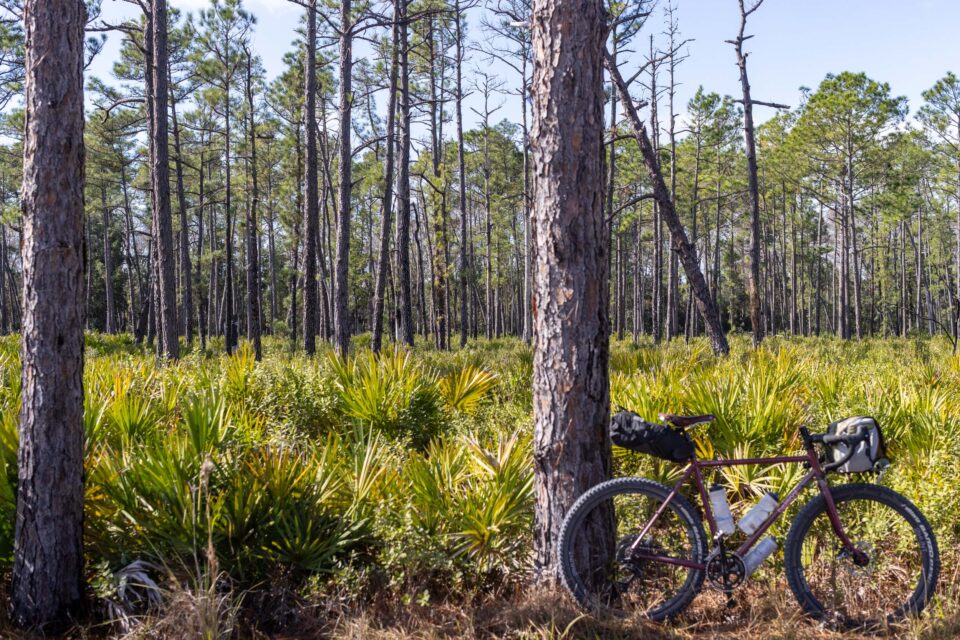
Nevertheless, I got out for an overnighter in one of the few remaining preserves still within biking distance of metro Orlando. Seminole State Forest is one of the first places I ever bikepacked and one I still hold dear. It sits just north of the city and serves as a gateway to the wildlife corridor following the St. Johns River. Most of what you ride to get there is “junk mileage” on bike paths through suburban development, but I always felt it allowed for a nice transition from what I was trying to get away from. When the white sand road starts, you’re no longer in the Florida of today; you’re in the “real” Florida. It’s an escape I once cherished, mainly because real estate developers and Buc-ees hadn’t found it yet.


However, the encroachment of ready-made neighborhoods is no longer theoretical. Houses line its boundaries, and a new highway exit is slated to bisect the land between the forest and the northern Wekiwa region. Still, an evening beneath towering split oaks after darting through a classically Floridian pine scrub reminded me of the perspective I clung to when I still called this place home. Living in western North Carolina means world-class riding is just out my door. It’s a reality that is still new to me, but also something I’ve started to grow accustomed to.
Living in Florida requires an appreciation of the scraps. The tiny strips of green that reveal the original beauty of a paradise now lost. Seminole State, for however unassuming it may appear to me now, still embodies the value its inhabitants believe needs development to realize. I don’t know how often I’ll return to Florida in the future. The bait-and-switch of discovering its beauty for myself only to have it taken away just a few years later is difficult to parse. But one last night in what remains feels like the bookend on the mindset that allowed me to appreciate so much about this place. Savor the small things. Sometimes, it’s all we have.
Ann Driggers
Colorado, USA @anndriggers
I headed out to say goodnight to 2025 with a small, solo yet intentional adventure: a wee overnighter, riding a few miles along a snowy but plowed road into the forest with my hot tent and no agenda beyond riding until the noise fell away, finding a quiet spot in the trees, and settling in for the night. Once camp was set, I lit the wood stove, made hot chocolate, opened a book, and let the cold stay outside where it belonged. The bike leaned nearby, dusted with frost, while I cozied up inside, listening to my favorite soundtrack: the crackle of the fire and the sizzle of melting snow in the pan on the stove.


Being a night-sky photography geek, the night delivered more than I hoped for. Under a clear sky and a bright waxing gibbous moon, the forest was luminous. Moon-cast shadows slid across the snow while stars wheeled slowly overhead. As I lingered outside with my camera, star-gazing and soaking in the stillness, a fiery green meteor suddenly cut across the sky—brief, brilliant, and then gone. My personal year-end fireworks display!


Despite the freezing temperatures, I was comfortable in my hot tent, sleeping well and waking only a couple of times to stoke the fire. In the morning, the final day of the year, I awoke to a sky turning pink and blue, frost crystallized on my camera lens but not on me. After packing up slowly, I rode out of camp, grateful for the final miles of the year on my bike, a warm shelter, and one last night under the stars to say goodnight to 2025.
Clotaire Mandel
Patagonia @lepedalistan
I’ve been hanging around Bariloche for a while, waiting for my new passport, then waiting for the wind to die down a bit, and finally waiting for Christmas. Time flew by, and the passport still hasn’t arrived. But I just couldn’t wait any longer in a busy, crowded city. So, I took the train with friends, headed south after Christmas toward El Bolson.


After spending months in the dry altiplano and the desertic stretch of the Ruta 40 in Argentina, I was eager to see some trees. Something as simple as lush trees and birds singing. Some rivers and lakes. You only realise what you truly need once it’s gone. And as much as I can love the desert, I needed some green and blue.
Sick of sleeping in hostels, we really wanted to sleep outside. We couldn’t camp inside the national park outside of Bariloche, so we pushed the pedals to cross it and camp somewhere beyond. And we finally saw the only house in the park. As soon as we crossed the gate, José waved at us and invited us inside. He cleaned a little corner and lit a fire for us to cook. We pitched under a barn, out of the wind, and fell asleep quickly, rocked by the little stream nearby.


He invited us inside in the morning, boiled up some water, and showed us his little wooden house. We couldn’t understand everything he said because of his Patagonian Spanish, but it didn’t matter. We were afraid of bothering him the day before, but we stayed longer than expected in the morning as we felt very welcome, with a few words exchanged. We said bye, thanked him, and rolled down the hill.
Hana Black
New Zealand @beinghana
For us antipodeans, the Goodnight 2025 Campout takes place during the summer solstice. Having returned from an eight-week bikepacking trip in Morocco less than a week earlier, we decided to stay local for Christmas, creating a perfect opportunity to tick off a few more “No Exit” roads, as part of a personal project to ride every public road on Banks Peninsula.


Banks Peninsula is the conspicuously circular appendage jutting off the east coast of the South Island of New Zealand. This unique landform was created by volcanic activity, leaving two large calderas long since inundated to form the peninsula’s major harbours.
The topography is carved by numerous valleys and ridges, which fall steeply to a rugged coastline indented with deep coves. It was one of the first places settled in New Zealand, with most of the original forest cleared for building ships and houses, and the bare land converted to pasture. The upside is a network of rural roads connecting the remote farmsteads and stations, many of them gravel.


We’ve lived in Lyttelton Harbour for 20 years and have done many rides in what is essentially our backyard. Just a couple of years ago, I realised I was bored of riding the same loops, and started investigating the numerous “No Exit” roads I’d always avoided. Most of these drop from around 600 to 700 metres to near sea-level or climb up from the coast to finish unceremoniously at a farm gate, with the occasional sign offering access to the sea. Your only option is to turn around for the gruelling climb back up or, if you’ve already done the hard work, blast back down. Since then, all my rides on Banks Peninsula have been aimed at discovering what lies at the end of each of these roads and filling them in on a map.
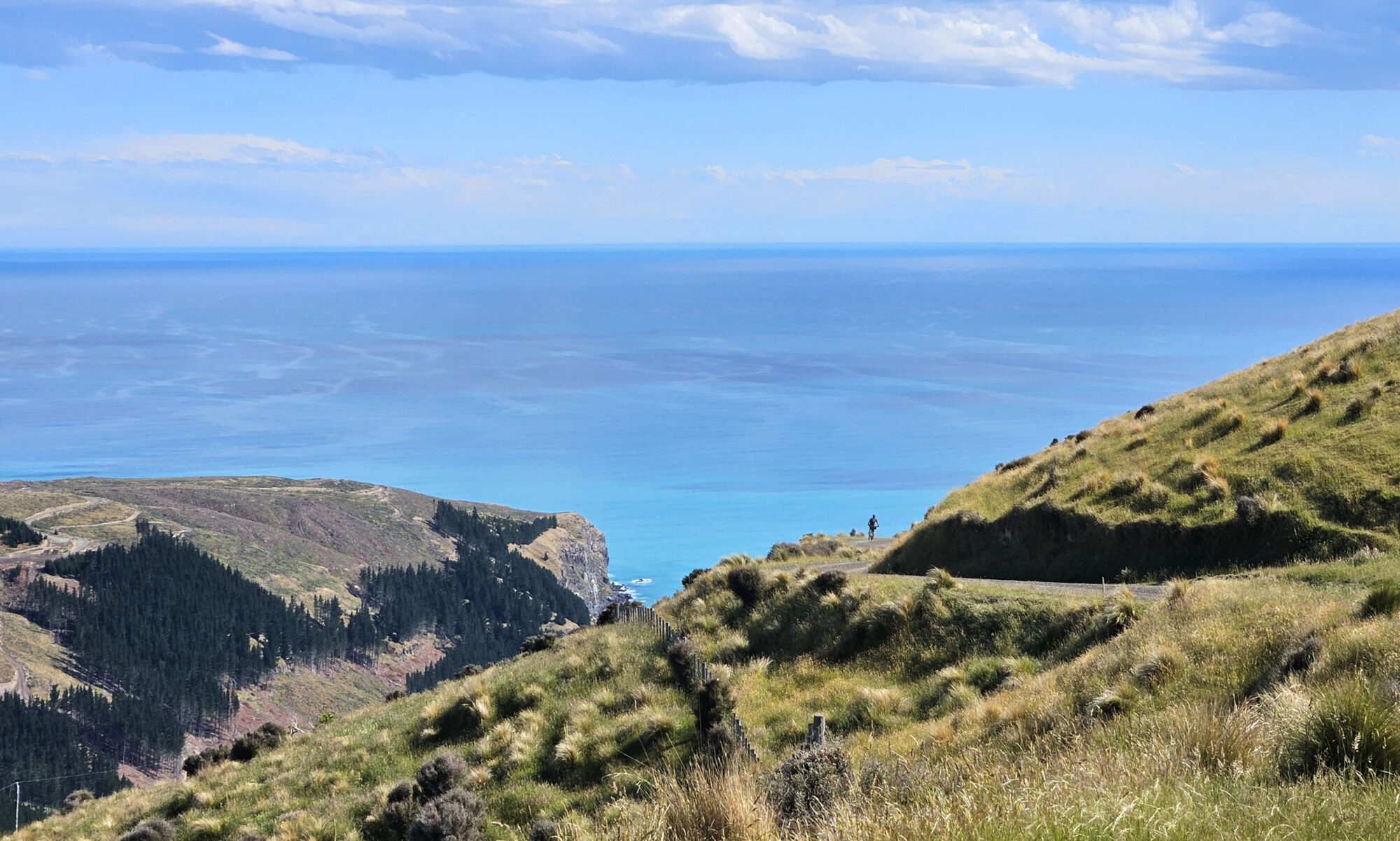
On Christmas Eve, we set off for Bossu Road after lunch, which traverses the southernmost part of the peninsula. With grades often hitting 20 percent, the first cluster of roads around Devils Gap netted us 1,774 metres of climbing in just 48 kilometres before we called it a day to rest our aching legs. Tucking into the tussock in our bivvy bags, with bowls of instant noodles, tofu, and edamame washed down with ginger beer, we enjoyed the spectacular light show as the sun slowly melted into the Pacific Ocean. A perfectly timed early-morning pee woke me right as the sun magically appeared again, its golden glow highlighting the aptly named Lands End, the day’s objective. Christmas morning was spent rolling down four sinuous ridges with expansive views, all of them ending sooner than expected at a locked gate and a private property sign—no gifts for us at the end of the world except the hard grind back up.
Thanks to everyone who took part in this year’s event! Stay tuned for more roundups and coverage of the Good Night 2025 Campout over the next week…
Further Reading
Make sure to dig into these related articles for more info…
Please keep the conversation civil, constructive, and inclusive, or your comment will be removed.