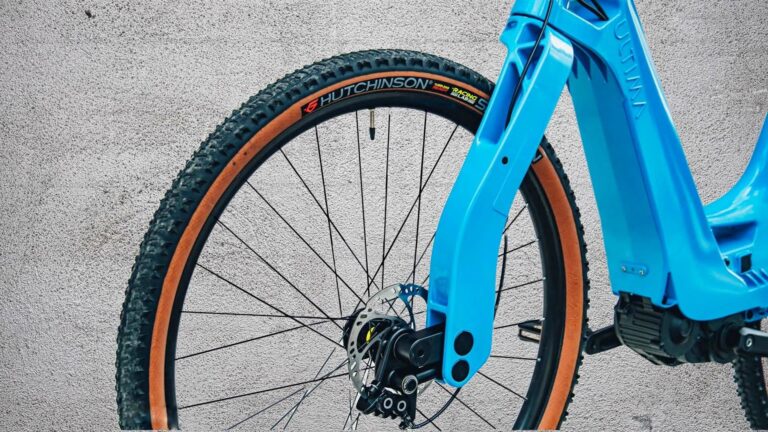
What real benefits does a wider tyre provide for gravel bike comfort? How much difference does dropping your tyre pressure make for comfort? And is it worth fitting a suspension fork to smooth out rough roads?
ESMTB set out to answer these questions by measuring vibrations at the handlebars to determine which tyre and pressure combinations offer the most comfort, both with and without a suspension fork.
The results are surprising in some ways, and expected in others.
Let’s take a closer look.
Gravel Comfort Over Big Hits & High-Speed Chatter
Before diving into the details, it’s important to note that ESMTB is primarily measuring how a gravel bike handles large impacts, rather than the smaller, high-frequency vibrations typical of most gravel roads. Basically, the focus is on acceleration peaks rather than average surface vibrations.
If most of your gravel rides are on less bumpy terrain, our CYCLINGABOUT Comfort Lab tests (which measure average acceleration) offer insights more relevant to those conditions.
You can view all of our vibration tests HERE.
Test Setup

To evaluate the effect of suspension forks, tyre width, and tyre pressure on gravel bike comfort, ESMTB used two identical Canyon Grail bikes. One was equipped with a rigid carbon fork, while the other featured a DT Swiss F 132 ONE suspension fork offering 40mm of travel.
ESMTB tested two different front tyres at two pressures – 21.8 psi (1.5 bar) and 29 psi (2.0 bar):
- 45 mm Width – Maxxis Reaver on a Zipp 303 XPLR rim (actual tyre width 48.1 mm)
- 50 mm Width – Maxxis Rambler on a Zipp 303 XPLR rim (actual tyre width 52.7 mm)
In total, 24 test runs were completed on the same section of rough gravel road. The course featured a slight downhill gradient of approximately 5%, a rough surface, and a small rut near the end, which was representative of the harsher types of terrain encountered on a gravel route.
For consistency, a fixed riding line was marked and used for every pass. Each run began at the same entry speed, with the rider coasting (no pedalling) and maintaining a consistent body position throughout the test section.

Handlebar acceleration was measured using a BYB Telemetry system, which recorded maximum acceleration in g-force via an inertial measurement unit (IMU). Higher g-force values indicate larger impact peaks transmitted to the handlebars, and therefore less comfort. In simple terms, the greater the g-force, the stronger the impact felt through the rider’s hands.
All testing was conducted with a 69 kg rider to ensure consistent loading across runs.
Please note: I’ve omitted some data from the ESMTB test. In particular, the 2.1″ tyre test was excluded because it was mounted on a significantly narrower rim (24 mm rather than 32 mm), which likely influenced the results. ESMTB also tested these gravel tyres at 14.5 psi and 7.2 psi. Tyre pressure calculators suggest these values are unrealistically low for typical riding conditions, so I’ve excluded the data from this analysis.
Vibration Test Results
Rigid vs Suspension Fork
| Tyre Width & Pressure | Maximum Handlebar G-Force With A Rigid Fork | Maximum Handlebar G-Force With A Suspension Fork | Max G-Force Reduction With Suspension |
|---|---|---|---|
| 45mm @ 29 psi | 16.2 | 9.9 | 39% Lower |
| 45mm @ 21.8 psi | 15.6 | 7.5 | 52% Lower |
| 50mm @ 29 psi | 15.9 | 7.9 | 51% Lower |
| 50mm @ 21.8 psi | 15.3 | 6.1 | 60% Lower |
As expected, the test results showed that fitting a suspension fork instead of a rigid fork reduced the maximum handlebar g-force across every tyre width and pressure tested.
The largest reduction was approximately 60%, recorded when using a suspension fork with 50mm tyres at 21.8 psi. The data clearly demonstrates that a 40mm-travel suspension fork significantly increases comfort over big hits on a gravel bike.
In practical terms, this means a gravel bike equipped with suspension allows you to run higher tyre pressures without sacrificing comfort, improving rolling efficiency on smoother surfaces.
Rigid Fork vs Tyre Pressure
| Tyre Width & Pressure | Maximum Handlebar G-Force With A Rigid Fork | Max G-Force Reduction For Each Tyre Width |
|---|---|---|
| 45mm @ 29 psi | 16.2 | Baseline |
| 45mm @ 21.8 psi | 15.6 | 3.7% Reduction |
| 50mm @ 29 psi | 15.9 | Baseline |
| 50mm @ 21.8 psi | 15.3 | 3.8% Reduction |
Looking specifically at the rigid bike data, lowering tyre pressure reduced the maximum handlebar g-force by roughly 4%, depending on the setup. That’s certainly enough to be noticeable over rough terrain.
That said, the reduction is smaller than many riders might expect. One likely explanation is that gravel tyres provide limited damping; they behave largely as uncontrolled air springs. While they can reduce overall vibration amplitude, they don’t effectively damp sharp impact peaks, so the highest g-force spikes still transmit through to the handlebars.
If you take one thing from these results, it should be this: there’s little benefit in switching from 45mm to 50mm tyres if you plan to run the same pressure. The reduction in g-force at the handlebars was not even 2% when comparing the 45 and 50mm tyres at the same pressure. The comfort advantage of a wider tyre only materialises when you take advantage of its greater air volume by lowering the pressure accordingly.
Suspension Fork vs Tyre Pressure
| Tyre Width & Pressure | Maximum Handlebar G-Force With A Suspension Fork | Max G-Force Reduction For Each Tyre Width |
|---|---|---|
| 45mm @ 29 psi | 9.9 | Baseline |
| 45mm @ 21.8 psi | 7.5 | 24.2% Reduction |
| 50mm @ 29 psi | 7.9 | Baseline |
| 50mm @ 21.8 psi | 6.1 | 22.8% Reduction |
The most surprising findings came from the gravel bike fitted with the suspension fork. In this setup, changes in tyre pressure produced much larger reductions in maximum g-force than we saw on the rigid bike.
One possible explanation is that the tyre and suspension fork are now working in combination to smooth out impact peaks. Rather than the tyre acting alone as an air spring, it becomes part of a two-stage system. Together, they appear to reduce peak accelerations much more effectively.
Running the ideal tyre pressure for your body weight, riding style and the terrain, will maximise your comfort over big hits. But it’s actually even more pronounced on a gravel bike with suspension!
The Effect of Tyre Width
| Tyre Width | Maximum Handlebar G-Force With A Rigid Fork | Max G-Force Reduction | Maximum Handlebar G-Force With A Suspension Fork | Max G-Force Reduction |
|---|---|---|---|---|
| 45mm @ 21.8 psi | 15.6 | Baseline | 7.5 | Baseline |
| 50mm @ 21.8 psi | 15.3 | 1.9% Reduction | 6.1 | 18.7% Reduction |
When looking at the effect of tyre width at the same pressure, there was little difference between 45 mm and 50 mm tyres on the rigid gravel bike, with only a 1.9% reduction in maximum g-force.
However, the same comparison on the bike fitted with a suspension fork produced a much larger change. Moving from 45 mm to 50 mm tyres reduced maximum g-force by 18.7%. Again, this suggests the wider tyre is able to work alongside the suspension fork to damp bigger hits.
Summary

The data shows that a suspension fork, even with just 40 mm of travel, is the most effective way to reduce impact peaks. At typical gravel tyre widths, it can cut maximum g-force vibrations by around 40 to 60%, which is a far greater effect than lowering tyre pressure or increasing tyre width alone.
On a rigid bike, lowering tyre pressure can help narrow this gap slightly, but the effect is relatively small, reducing vibrations by about 4%. When lower tyre pressures are combined with a suspension fork, however, the two appear to work together as a two-stage system. In this setup, dropping pressure from 29 psi to 22 psi (2.0 to 1.5 bar) reduced maximum g-force by roughly 23 to 24%.
Tyre width can also reduce vibrations, but the results suggest a suspension fork is needed to fully realise the benefit. Increasing tyre width from 45 mm to 50 mm reduced maximum g-force by around 19% on the bike with a suspension fork, compared with only about 2% on the rigid bike.