
It isn’t often that a new tiremaker comes into our space as a viable competitor, especially one that moves straight to the front of the field. For 2025, Vitour was that company, and its Tempesta P1 was that product: pointy-end grip, long-term consistency, category-leading durability and a wide range of motorsports-friendly sizes.
Enter the Vitour Tempesta Enzo V-01R
The Enzo was Vitour’s original attempt at building a competitive Super 200, but it fell just short of the day’s category benchmarks, like the Bridgestone Potenza RE-71R and BFGoodrich g-Force Rival.
To make matters worse, the Yokohama Advan A052 arrived on the scene shortly thereafter, pushing the bar even higher. Vitour went back to the drawing board, eventually creating the P1.
Meanwhile, the Enzo found a home in drifting, with several compounds supplied around the world. In that venue, durability, consistency and price are valued as much as ultimate grip–same as today’s North American endurance road racing scene.
But which compound would be best for the U.S. market? This past spring, we were asked to help answer that question and can now release those results publicly.
Photograph courtesy Vitour
As a testing benchmark, we chose the Continental ExtremeContact Force, the spec tire for the World Racing League. It’s also one of the strongest entries on ChampCar’s 2026 “white list” of allowed tires. (Read more here.) We’ve tested the ExtremeContact Force a number of times, so we have comparative data to effectively rank its performance against the full landscape of 200tw offerings.
Two versions of the Enzo were supplied: one in the V01R compound and the other in V02R. The former was ultimately selected for U.S. production, so we’ll focus on that here.
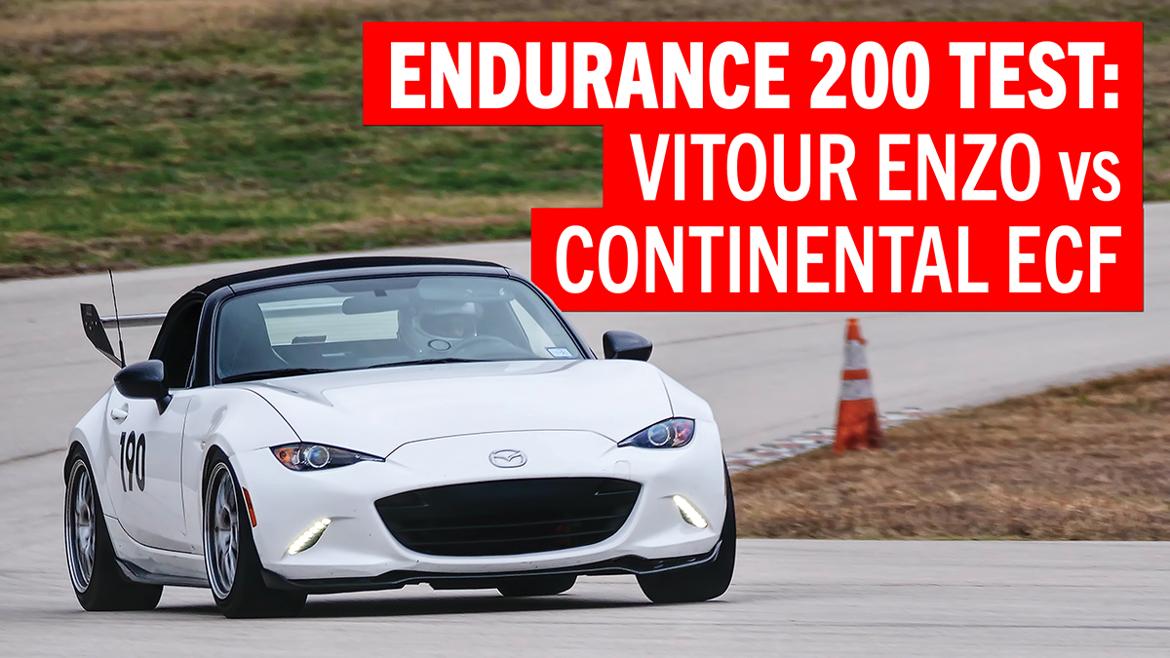
Once again, we tapped our Triple Threat ND Miata as test mule. We now have thousands of laps behind its wheel at our home track, Harris Hill Raceway. The car’s setup has been tweaked to be both quick and consistent around that somewhat bumpy circuit. Tire size was 245/40R17 mounted on 17×9-inch wheels.
Each set of tires was heat-cycled with a 45-minute highway drive, six laps of gradually increasing pace laps and another 45-minute highway drive, then removed and cooled for at least 24 hours. Notes were taken regarding the highway ride quality and street driving dynamics.
Test day weather was perfect. Cloudy skies and 67° to 77° ambients kept track temps super consistent over the course of the morning.
One 20-minute warmup session was driven on scrubs, both for practice and to clean up the track from overnight dust and dirt accumulation. When times stabilized at the known best pace for those tires, track evolution was complete and testing began.
Continental ExtremeContact Force
- $273 each (from Tire Rack)
- Fast lap: 1:26.4
- Average of laps 3-6: 1:26.7
On the road: The Continental ExtremeContact Force exhibited a linear and direct response to steering inputs to deliver an athletic handling characteristic. It was harsh over road irregularities and noisy on anything other than smooth pavement.
On the track: When pushed to the limit, the Continental ExtremeContact Force was highly responsive, easily driving down to an apex. Audible feedback announced impending slip. Breakaway was a bit edgy but recovery was easy.
Full grip was not available until after a hard out lap and partial push lap. At that point, the performance was quite consistent for the duration of the session.
Vitour Tempesta Enzo V-01R
- $218.00 each (direct from Vitour)
- Fast lap: 1:25.7
- Average of laps 3-6: 1:26.8
On the road: The new Vitour Enzo V01-R was quiet with no appreciable drone. Ride comfort was quite smooth for a UHP tire, with road irregularities absorbed quite well.
Steering response was average for this category, with a largely progressive feel. Small inputs generated small reactions for a calm driving experience on the highway, but larger inputs elicited sportier handling on twisty roads. On-center feeling was moderate.
On the track: The V-01R came alive on track, turning more the harder it was pushed. It was eager to dive to apexes and deliver the grip to stay on line. Very little warmup was needed on the out lap for full pace, and the tire heat-soaked a bit after one and a half hard push laps. Pace was consistent thereafter.
Continental ExtremeContact Force (retest)
- Fast lap: 1:26.1
- Average of laps 3-6: 1:26.3
To bracket the test and check for any potential track evolution or driver improvements, we ran the Continental ExtremeContact Force again at the end. It was consistently one- to two-tenths quicker than in the first session, which data analysis showed to be due to slightly improved grip in the Turn 3-2 complex. Since the tire had residual heat from running earlier, it also did not need as much warmup this time.

Conclusions
Testing shows that the Vitour Tempesta Enzo V-01R is superior to the Continental ExtremeContact Force in single-lap pace, but it falls off to a consistent deficit of at least a half second compared to the Continental.
At full tread, the Enzo V-01R exhibited pace-versus-heat traits typical of many in the Extreme Performance Summer category of tires: a couple of quick laps, then a drop-off of a full second for the remainder of the session.
The Continental ExtremeContact Force, by contrast, remains extremely consistent across long sessions. It has no initial flyer laps, instead settling right into a very specific pace range. This is ideal for endurance racing, its intended design purpose.