
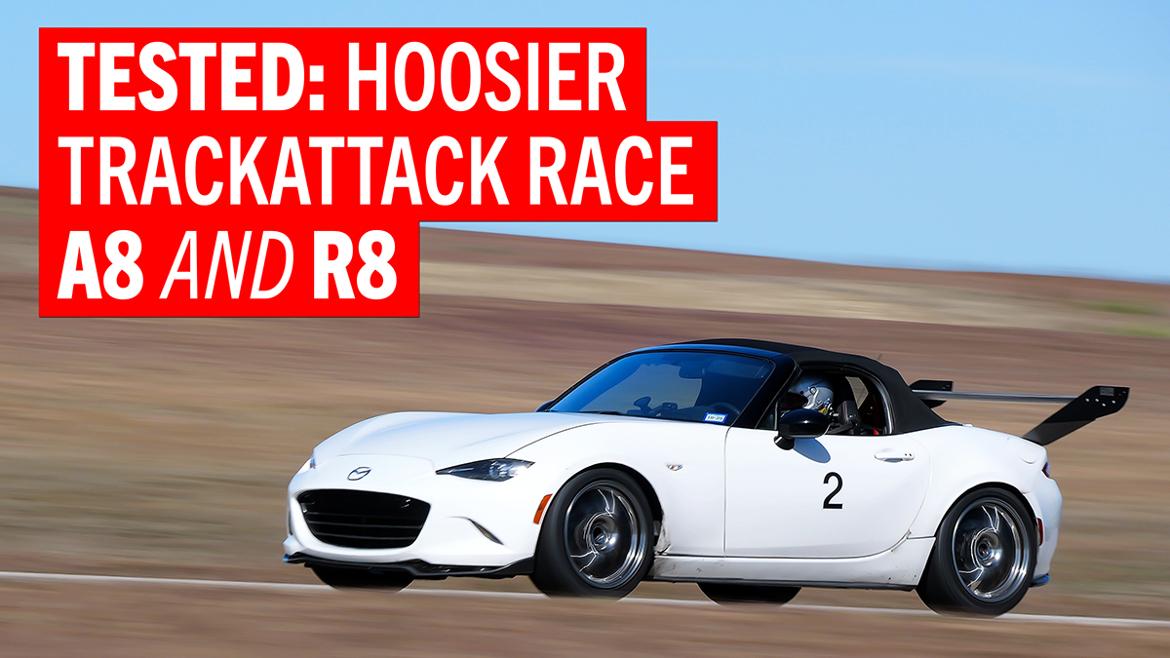
If you’ve spent any significant time in motorsports in North America, you know Hoosier Racing Tire. And while the majority of the company’s business revolves around circle track racing, it has been a force in amateur road racing and autocross for decades.
Up until last year’s launch of the TrackAttack Pro–a streetable 200tw track day tire–its primary applicable products have …
Hoosier TrackAttack Pro
Photograph courtesy Tire Rack.
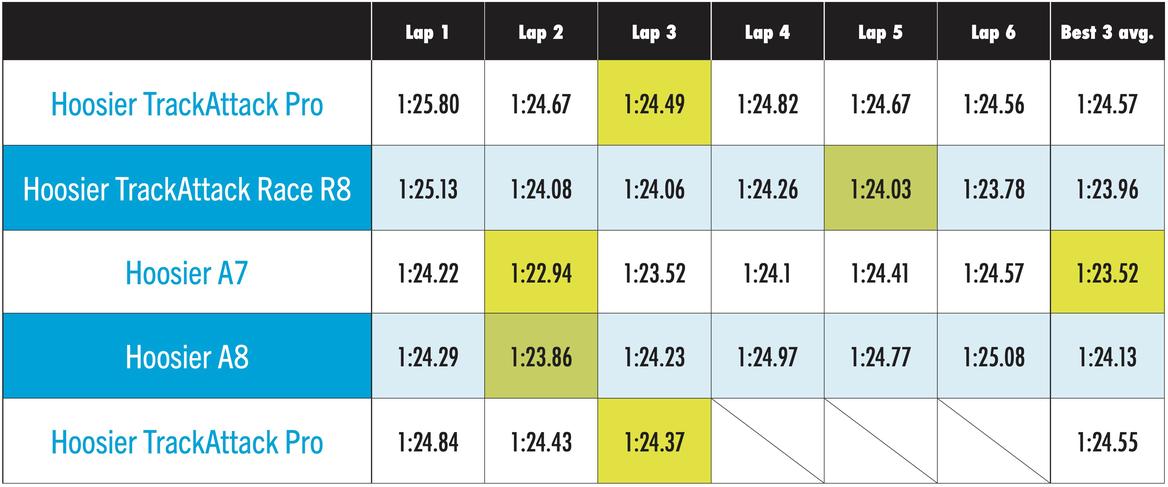
For a bracket tire to verify consistency of the conditions and driver, we wanted something a little closer to R-comp performance, so we started with a set of Hoosier TrackAttack Pros–veterans of a previous test.
Based on experience, we gave them an aggressive out lap to quicken compound activation, but the tire still took until the middle of the first timed lap to come in fully. After that it was extremely consistent, with us connecting the dots the best on lap 3. Later data analysis would show about two-tenths left on the table for the perfect lap.
Hoosier TrackAttack Race R8
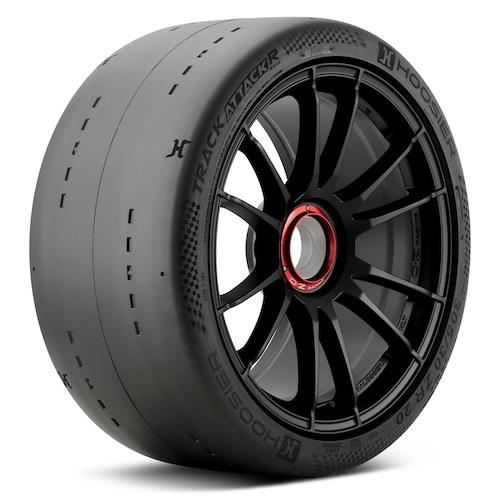
Photograph courtesy Tire Rack.
Next up was the first of our new tires, the R8. Again we used a hard out lap to bring in the tire quickly, and again it took until midway through the first timed lap for full grip to develop. After that, the tire was amazingly consistent–not just in capability but in the ease of extracting the pace. While only six laps are shown here, we did a total of eight laps to see if the tire would ever fall off. It didn’t. Bravo, Hoosier.
Hoosier A7
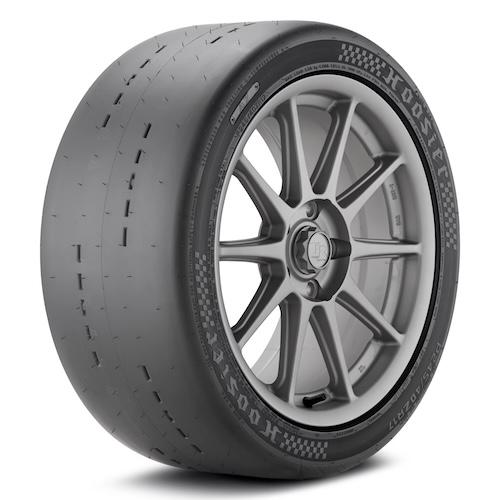
Photograph courtesy Tire Rack.
Moving to the A7 to get a direct A/B comparison with its successor, we knew what to expect. We’ve driven this tire off and on for most of its lifetime, though not so much on this car. We opted to do a medium out lap to avoid early heat soak, but we were balked by traffic and got very little heat into the tire before the timer began.
Midway through the lap, grip came in like a light switch. Boom. Hero mode engaged. Suddenly the car was unstoppable, and for lap 2 we turned our quickest lap ever in this car at this track.
The fun continued until midway through lap 3, but then heat soak began to set in. Pace fell off a bit with each subsequent lap. Had we nailed our prep lap, we’d have had two flyers available. Data shows we pushed a couple of braking points a little further on that third pass, so we left one- to two-tenths on the table.
Hoosier TrackAttack Race A8
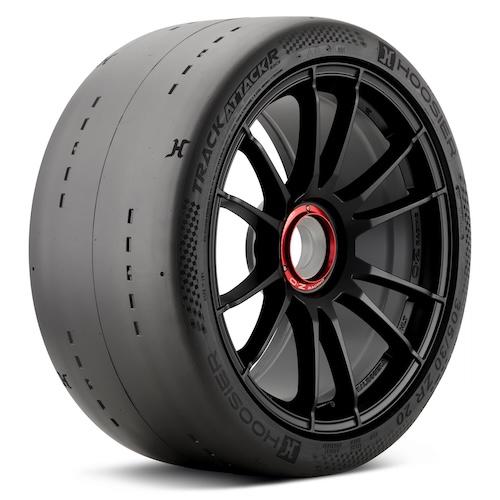
Photograph courtesy Tire Rack.
Still giddy from the A7 experience, we anxiously bolted on the A8 tires. We put in a medium-effort out lap, but it was clear that full grip was not yet available as we crossed the start line into Turn 1’s 100 mph, wide-open-throttle approach. Grip finally got there midway through the lap, but the transition was more subtle than the A7’s flick of a switch.
If you’ve looked ahead at the lap time charts, you know what came next: disappointment. The A8 was no faster than the R8 on a flyer and followed the same temperature profile as the A7. It had about two laps’ worth of full grip before falling off, and that timing gave us just a single flyer opportunity since we didn’t nail the prep lap.
From feel, the A8 just didn’t seem to have the same mid-corner grip as the A7. Looking at data backs this up. Further, high-energy, combined-loading events suffered, so the corners of the friction circle could not be fully exploited. This hurt corner-exit power-up, magnifying the time delta down each subsequent straight.
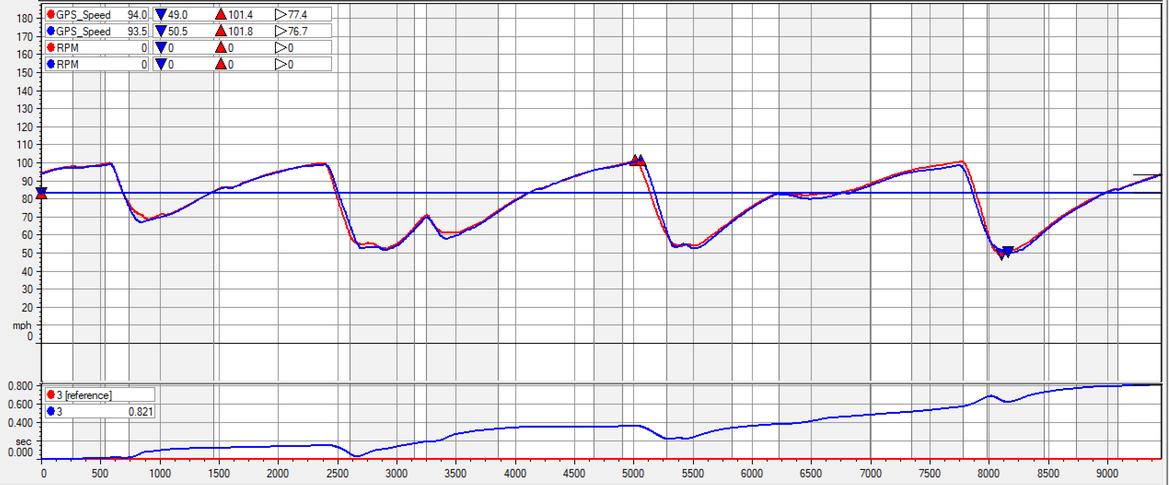
Note how the Hoosier A7 (red trace) has better grip in the center of the turn and then rolls power better coming off. This gains time all the way down each straight over the A8 (blue).
Hoosier TrackAttack Pro (retest)
By now, we were perplexed and worried that track evolution had crept into our data integrity. So we bolted on our bracket tires for a retest and perfectly duplicated our first session’s early laps. With some residual core temp in the tires, full grip was already there for lap 1 after an aggressive out lap.
Why only three laps? The car broke. Specifically, we cracked a front hub: heard a noise mid-corner, then felt vibration only on turns in one direction, and the brake pedal got longer due to pad knock-back. These were familiar symptoms that we’d recently experienced on the other side, so we immediately pitted to avoid catastrophic failure at speed.
We usually time these hubs out once a year and were overdue to do so, but we’d been waiting on the imminent release of a stronger aftermarket solution. Instead, The Universe smote us for our lack of proper maintenance. We carry a spare, but we’d already nailed the bracket validating the test data, so there was no need for a clumsy onsite repair.
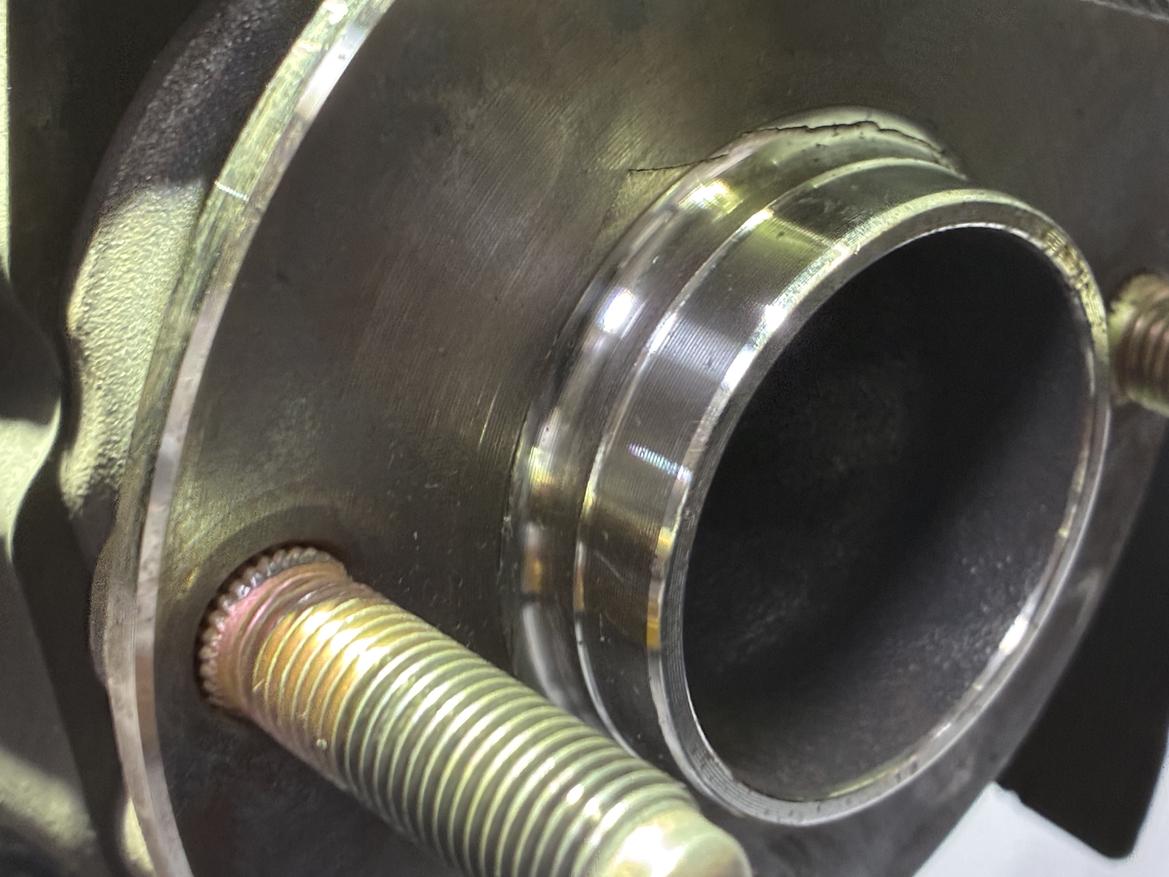
Photograph by Andy Hollis
While we were happy with the quality of our overall data, the A8 session was a bit of a letdown, for sure. It just didn’t perform for us as expected. Discussions with engineers at Hoosier offered little insight other than to give it another go on another day. So we did.
Let’s try this again.
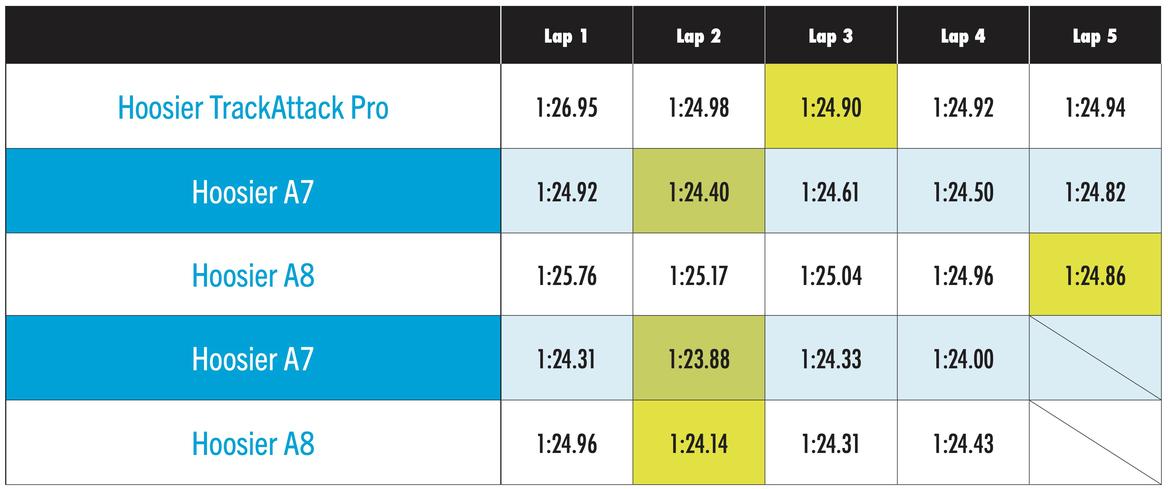
After a massive ice storm blanketed the area for several days, mild, 70° afternoon temps returned a week later. We’d have to run the track in the opposite direction, so lap times wouldn’t be directly comparable. Plus, the precipitation had left the track quite green. Evolution would be a factor for this round, so we opted to focus entirely on back-to-back runs of the A7 and A8.
Once again, we began with two sessions on the Vitour P1 to scout out the grip and clean up our line. Quick time was 1:25.7, a far cry from the 1:24s we’d run the previous week. Next, we bolted on the TrackAttack Pros to get closer to our R-comp grip levels. As consistent as ever, we strung together a series of 1:24.9s once the grip came in fully on lap 2.
At this point, the track surface was still cool to the touch. Overnight subfreezing temps and a cloudy morning had slowed the warming effects of the now-full sun. That heat sink effect kept both the A7 and A8 in their sweet spot for more laps during the first back-to-back session. And while the gap between them narrowed, the new tire still failed to beat the old.
By now, traffic started to increase as others came out to enjoy the balmy conditions. In addition to laying down more rubber, we had to wait longer for session gaps to get unimpeded lapping. This also gave the sun more time to work its magic on the surface temps.
All of this showed up in the second back-to-back comparison with times looking more like the previous week’s. Each tire produced a flyer plus a bevy of quick laps. Again, we narrowed the new-versus-old gap through more familiarity with the warmup characteristics of the A8. Its progressive switch-on would shift the balance to oversteer during early laps as the rear tires received less energy, becoming more neutral later.
Why? Because most of the braking energy is coming from the front, so despite the Miata’s neutral handling, the front tires do more work in a lap. A more powerful vehicle would likely do the opposite, cooking the rear tires as excess power is applied on corner exits.
Final Thoughts
Hoosier’s new TrackAttack Race R8 is an absolute home run: super easy to drive, amazingly consistent and quick. It’s the perfect choice for front-running road racers and track day folks who just want to drive flat out every session. All that remains to be seen are longer-term effects of heat cycles and durability, but we’re given assurances that both are improved from the R7.
The A8 is likely going to take some setup work for many competitors to maximize its potential. One of Hoosier’s goals with the tire was to be able to complete full sprint races for more cars in more conditions. To achieve this, some of the A7’s temperature-related peakiness of grip has been smoothed over