
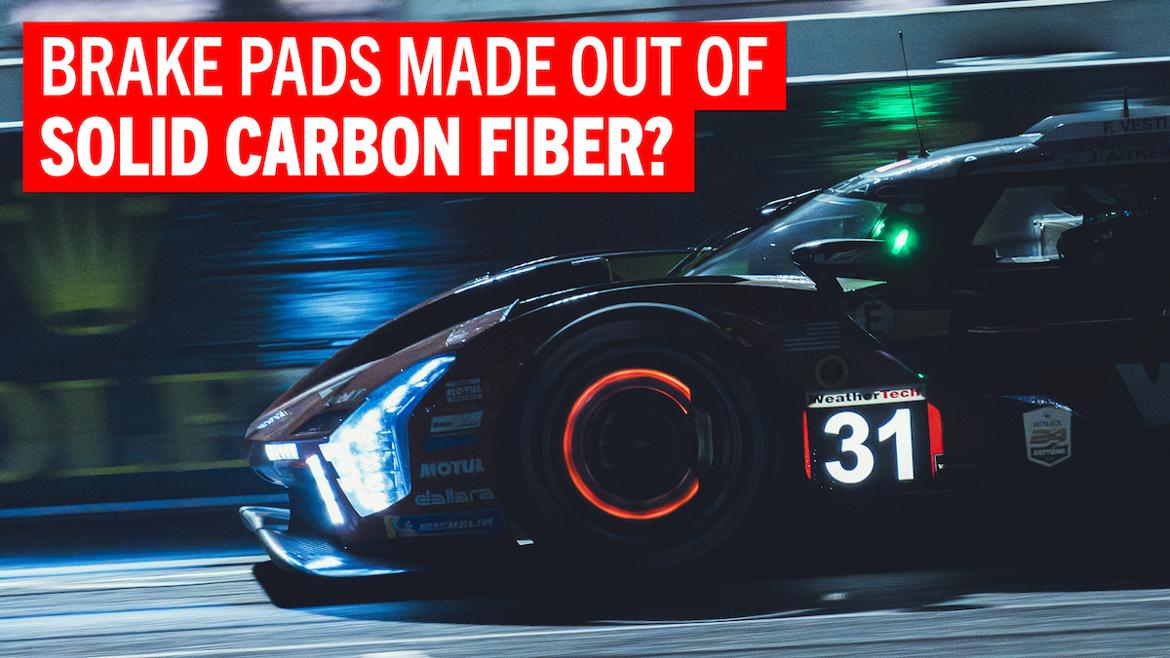
“It sounds cliché, but motorsports is the ultimate proving ground.” That’s Brembo’s Motorsport Division manager Glenn Messina during a recent chat we had with some of the Brembo crew.
And while that statement may be couched in a bit of marketing flair, we were a little unprepared for some of the specifics we learned about Brembo’s capabilities on IMSA’s fastest cars. TL;DR: IMSA GTP brake technology is very close to Formula 1 brake technology. Blame–or thank–STEM.
Following the conversation was difficult, though–not because of the subject but because I was busy fiddling with a Brembo GTP-spec caliper and brake pad that they left sitting on the table during our chat. Both pieces were impossibly light and impossibly rugged looking, but the pads in particular were hard to put down because simply handling them sent my brain into weird gymnastic trying to reconcile what I was looking at versus what I was feeling.
GTP brake pads are machined from solid blocks of carbon fiber–no backing plates included or needed–and are about 28 mm thick and 150 mm wide. They’re beefy and solid feeling but weigh impossibly little. A similarly sized piece of ham would weight twice as much as these pads, which probably clock in at the single digits of ounces.
But don’t let their lack of mass fool you. These pads, which are paired with carbon rotors, are doing some serious work, turning the kinetic energy of 200 mph race cars into heat during a 24-hour race where drivers will stomp the brake pedal in anger close to 4000 times.
Glenn Messina, Brembo Motorsport Division manager, shows us a carbon fiber brake pad employed by IMSA GTP racers. Photograph by J.G. Pasterjak.
How much heat? Glad you asked. During the hottest portions of the race, when ambient temps at Daytona, for example, can exceed 80° Fahrenheit, track temps can be 40% higher than that. And if the green flag has been out for a while, peak temps at the pad/rotor interface can exceed 1500°. That’s hot enough to melt aluminum or magnesium, well past the point at which zinc melts, and woe be to you if you left any strontium nearby, because it’s likely history, bucko.
Yet these carbon pads are so thermally efficient that far less than half that heat conducts through them to reach the caliper surface.
Your natural follow-up question–and ours: “Well, just how many sets of these wonder pads are GTP teams replacing during the Rolex 24?”
Surely a material of such low mass, dealing with such high levels of friction-based heat, must be constantly sacrificing itself in service of energy transfer.
Yeah, no.
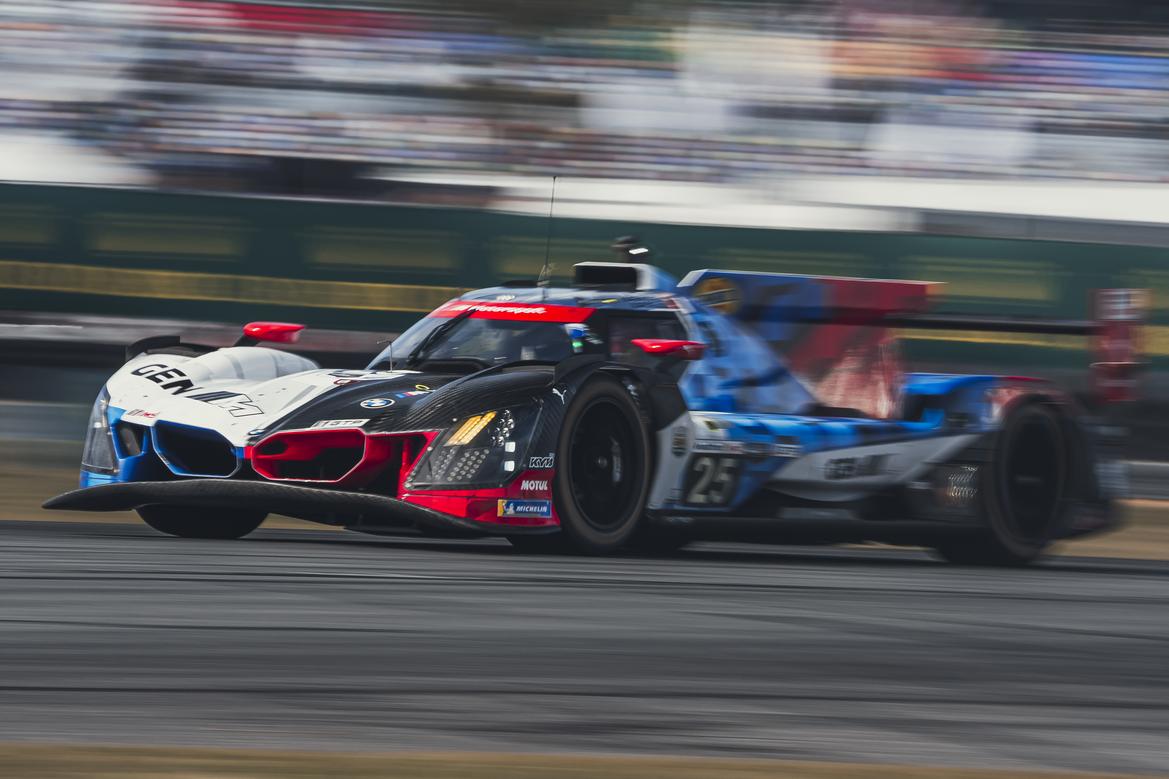
“A GTP team [at Daytona] in a carbon/carbon application, over 24 hours, we’ll say they might use 50% of the pad,” Messina tells us. Which is kind of insane given the amount of time these bits spend arresting a 2300-pound race car from 180+ mph.
Now, GTP cars do harvest some of that kinetic energy directly back into the hybrid system, but those pads, rotors and calipers are still doing most of that work, and for them to barely be losing half of their mass is astounding.
“Usually, if GTP teams change pads, it will be because of a feel or pedal travel issue related to wear and pad thickness, not because the pads are in danger of wearing out or losing effectiveness,” Messina clarifies.
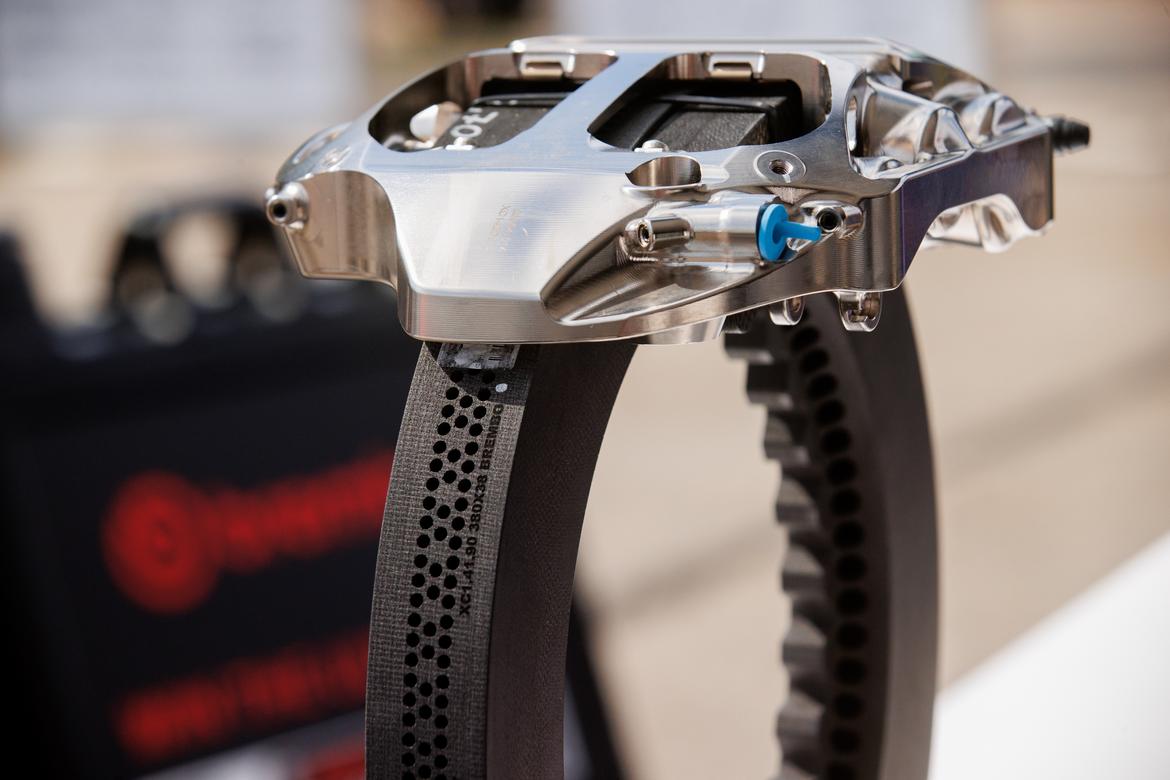
IMSA GTP cars pair carbon rotors with those carbon pads. Sorry, but this setup likely won’t fit your Miata.
Teams on the IMSA GT side, which use more conventional materials in the brake systems, see a bit more wear over 24 hours, but Brembo-equipped GT teams still usually complete a 24-hour race at Daytona on two sets of pads. These services will usually be completed by swapping out the caliper, rotor and pads as an assembly, a job that takes under a minute for a good crew. That’s thanks to the use of dry-break connections and radial-mount calipers, which pop off with just a couple bolts.
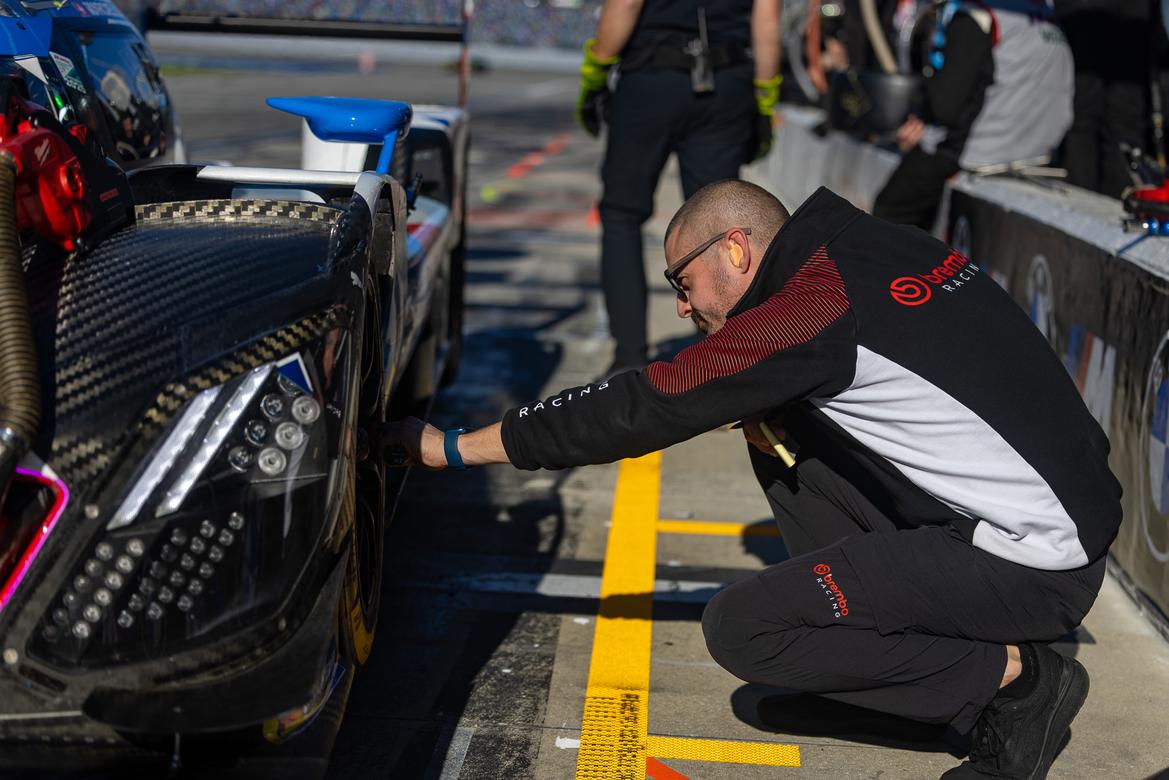
Even though Brembo techs don’t have to cart around a ton of GTP replacement pads, they’re still in the pits monitoring their customers’ cars.
“Motorsport just exposes us to a lot of different technical challenges in a compressed time frame and a compressed demand framework,” Messina says. “It’s not something you could realistically duplicate in-house when it comes to development. The demands in motorsport are constantly being pushed by the teams and the sanctioning bodies, and we get to be reactive to that environment. There’s so many variables that are just well beyond your control, from conditions to driver styles and skill levels, that it just delivers us a huge benefit from motorsport that we could never duplicate any other way.”
Comments

I’ll never be able to look at a GTP car the same way again…

Someone somewhere is ready to slap a LIFETIME sticker on those pads.
In reply to Stueck0514 :
If a set can last 24 hours straight, it does make me wonder how long they’d last on a daily-driven street car. 
(I know, different mission, different car, but just imagine if most people on the road never had to change their brake pads.)

In reply to Colin Wood :
You almost get that with EV’s, but they would still need serviced every so often to keep everything lubed up and moving.
In reply to Aaron_King :
I usually have a bad time when I lube my brake pads.

So, something similar to a Space Shuttle heat shield tile?

JG Pasterjak
Tech Editor & Production Manager
4/8/26 11:32 a.m.
VolvoHeretic said:
So, something similar to a Space Shuttle heat sheild tile?
Yeah that was the first thing that came to mind when we were chatting. Those pads are just so counterintuitive in so many ways. Like, you pick them up and they’re almost impossibly light, so you can definitely see how they’re excellent insulators, but then your brain can’t reconcile how they can produce and withstand the kind of friction they must need to generate to make enough heat to slow those cars down. It’s really impressive stuff.

I sat next to JG during the roundtable. Yes, the pads were light. And, yes, they were rather distracting.

Colin Wood said:
If a set can last 24 hours straight, it does make me wonder how long they’d last on a daily-driven street car.
Probably about 2 blocks before the car accidentally runs a red light because it won’t stop without heat in the brakes and gets totaled by a beer truck going the other way.

j_tso
SuperDork
4/8/26 2:00 p.m.
Brembo-equipped GT teams still usually complete a 24-hour race at Daytona on two sets of pads. These services will usually be completed by swapping out the caliper, rotor and pads as an assembly, a job that takes under a minute for a good crew. That’s thanks to the use of dry-break connections and radial-mount calipers, which pop off with just a couple bolts.
This is the stuff I want!
Displaying 1-10 of 10 commentsView all comments on the GRM forums
You’ll need to log in to post.