
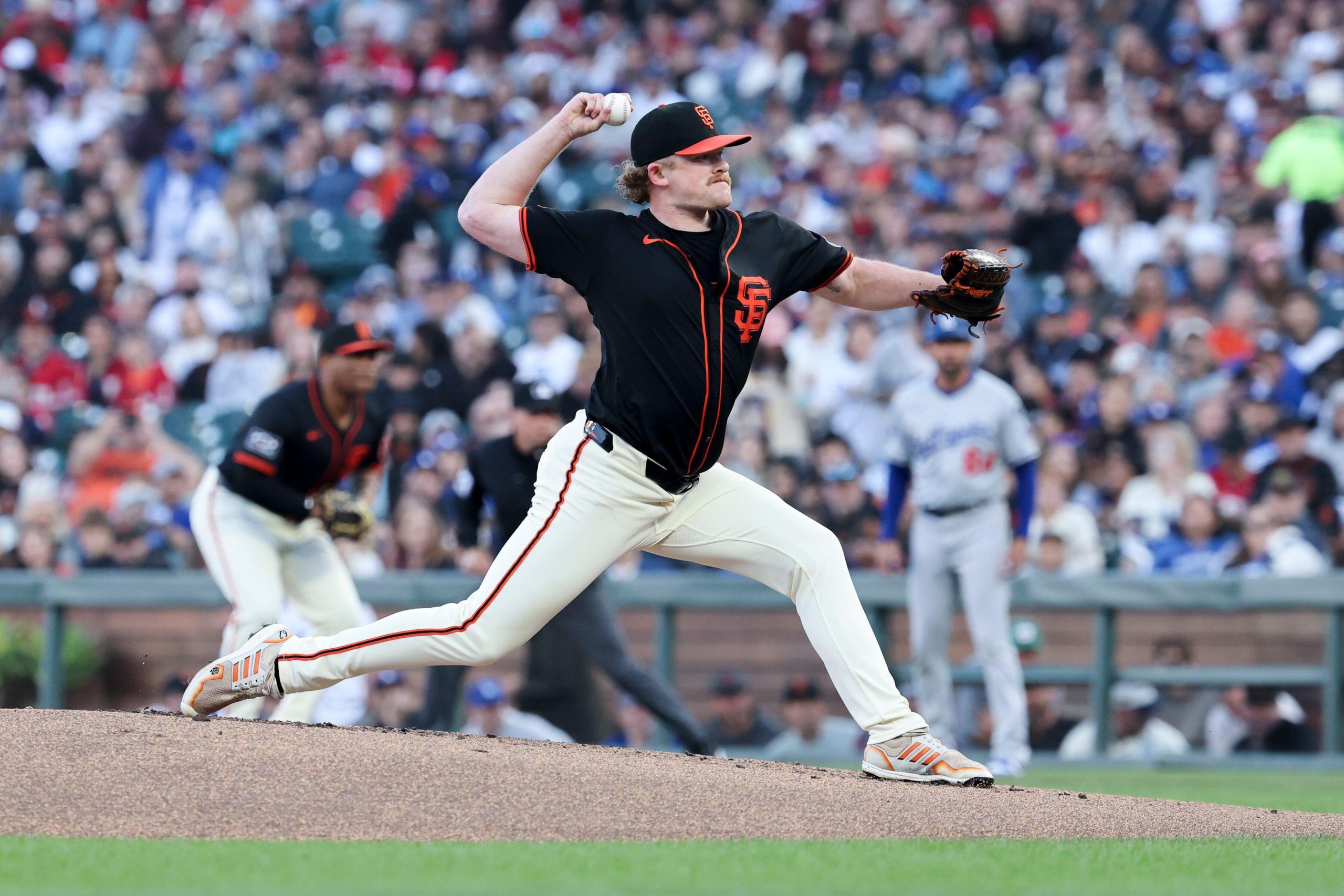
But he had voids in his pitch plot.
Hitters could eliminate worrying about north and south and more neutral pitch types and location.
What did he do?
He expanded his pitch menu to make the calculus more difficult, forcing hitters to defend a greater array of potential options and locations. And he did it not by adding designer breaking balls but rather with fastballs.
He added a cutter in 2024 and increased its usage in 2025. Once a four-seam dominant pitcher, it was an offering he had largelyy shelved since his reinvention as a two-seam artist. Yet, in 2025 he threw at his four-seamer at the most frequent rate since 2021 (7.8% rate). After sprinkling in a new cutter in 2024, he also ramped that up to a career-best rate in 2025 (2.6% to 7.9%).
While his raw stuff declined, his overall results improved.
Among qualified pitchers, Webb enjoyed the second greatest decline in out-of-zone contact in the majors in 2025 (-10.8%), one of only two pitchers to enjoy double-digit declines with Cristopher Sanchez being the other. He also enjoyed the ninth greatest decline with zone contact (-1.4%).
Over 207 innings in 2025, a large single-season sample in the modern era, Webb proved there is tremendous benefit – at least for some arms – in expanding an arsenal even when it reduces the overall Stuff+ grade of an arsenal.
“It is almost like trying to get a hitter off your scent,” Driveline’s Arizona pitching coordinator Dylan Gargas said.
Michael Wacha is another veteran pitcher who added a new fastball to become a three-fastball arm like Webb.
Wacha began his career with a four-seam and changeup combination, an unusual pairing for a successful right-handed starter. But those offerings were so good for the first full four seasons of his career the unusual mix didn’t matter.
“I’m a pronator so I’ve always had trouble spinning the ball,” Wacha told me in September.
While Wacha always possessed a cutter he mixed in sparingly, he needed other offerings to better combat his reverse platoon splits as his career began to sputter in 2018-21.
In 2022 with Boston, he began throwing a two-seamer at a double-digit rate which he’s continued since. And when joining the Royals as a free agent in 2024, he also added a slider.
Even though these added offerings don’t grade as plus offerings, even though he’s a natural pronator, these different looks have allowed him to level his platoon splits. His best two seasons by fWAR have come in the last two years. Wacha said it was modern pitch design that helped him add those pitches and dip into the pro-supinator bucket of offerings.
“That’s where I use the tech,” Wacha said. “’Are my fingers getting to the front of the ball?’ It could have helped out earlier but I’ve tried to take advantage of it now.”
While Wacha and Webb have other pitches, too, they are two pitchers who have evolved to throw three fastballs.
They are not alone.
Consider that in 2015 there were 263 MLB starting pitchers that threw at least 10 innings. Within that group, 52 threw three fastballs at a rate or 5% of more
This past season in 2025 there were 253 starting pitchers who tossed at least 10 innings, and of that sample 92 threw at least three fastballs at a rate of 5% or greater.
“You hear about guys getting bucketed with the pronation, and supination biases, I think they’ve often been convinced that they can only do one or the other,” Gargas said. “So, there’s been a shift there, a belief, just the knowledge being able to throw multiple (fastballs).”
More pitchers are throwing more fastballs and getting away from the idea they can only reside in the two- or four-seam bucket.
Whether you are a natural pronator or supinator, there is evidence that not all fastball shapes have to grade as plus pitches to be effective in raising the performance of an overall arsenal.
This made me curious.
How many pitchers should be adding pitches? It’s an especially relevant question in this age of pitch design – when technological advancements and an avalanche of data have never made it easier to add a new pitch.
While we can isolate and evaluate an individual pitch relative to a league average, it’s more difficult to evaluate how expanding an arsenal influences overall performance.
I asked Driveline’s Jack Lambert to bucket MLB starting pitchers (minimum 100 innings) by one-, two-, and three-fastball arsenals to see what we could glean from a macro-level regarding the benefits of throwing more – or fewer – fastballs.
What we found was interesting.
Pitchers who threw three fastballs had the lowest walk rates among all groups.