
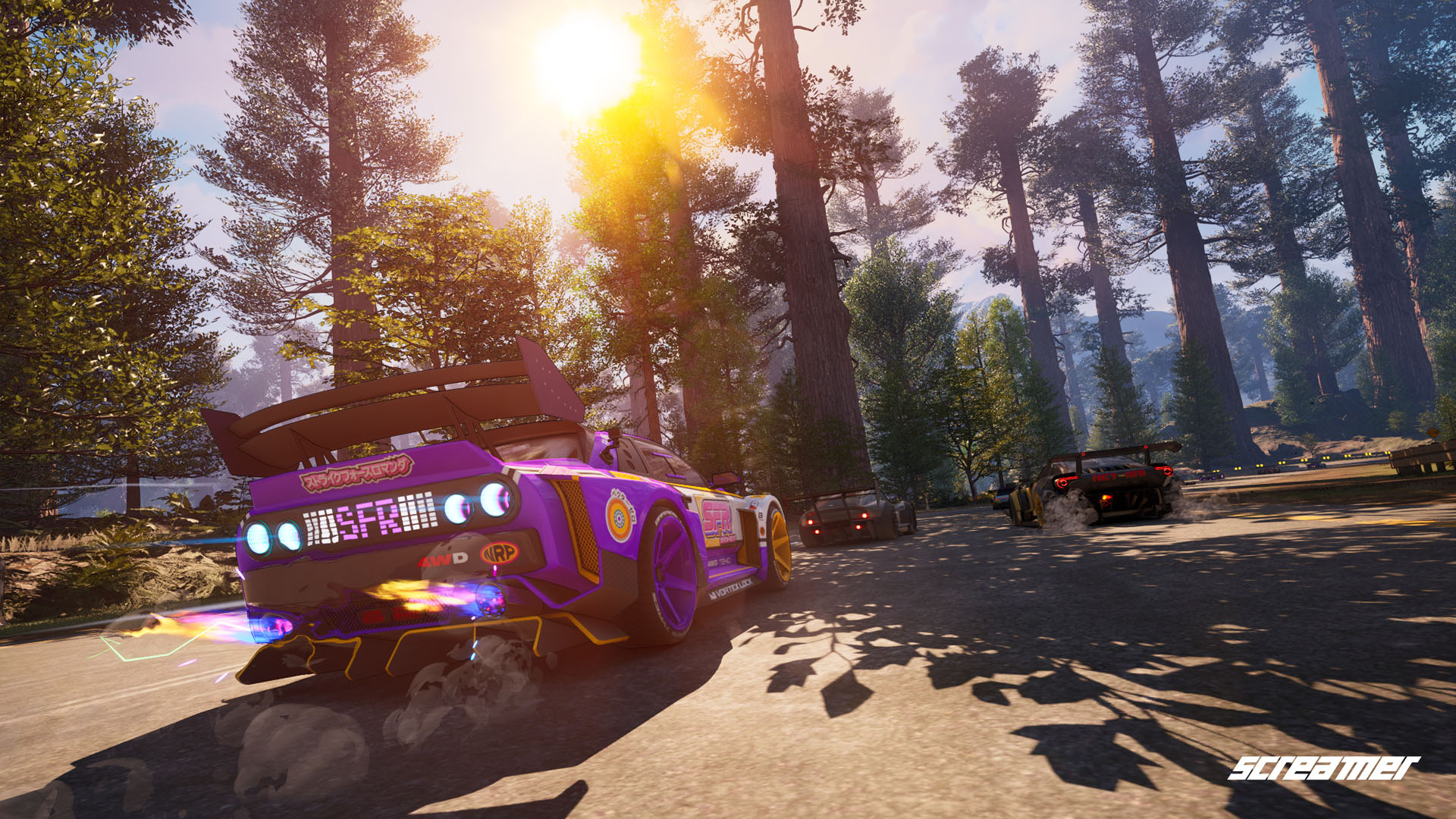
The golden age of arcade racers feels like a distant memory. Back in the 1990s, titles like Ridge Racer and Daytona USA dominated the landscape, but the rise of sim racing has relegated pure, track-focused arcade racers to the indie scene. Milestone aims to change that with the release of Screamer.
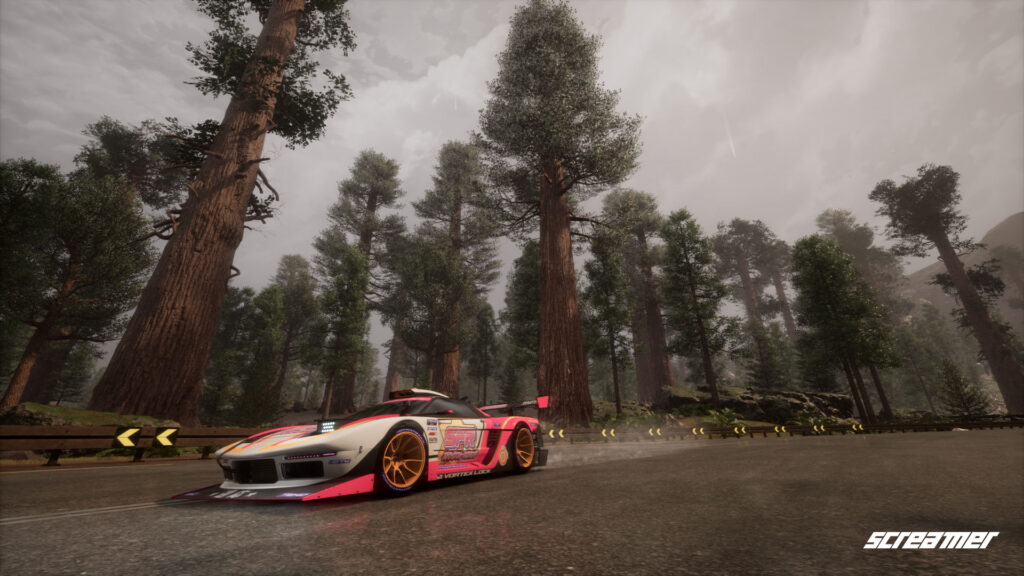
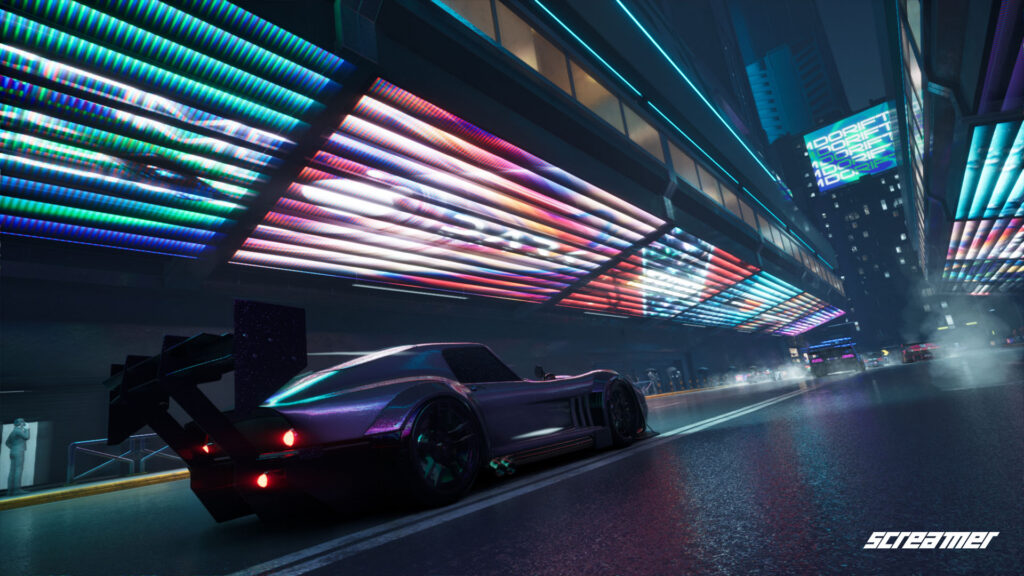
A reimagining of the original 1990s PC arcade series, it offers a fresh take on arcade racing, with an anime aesthetic, a narrative-focused campaign and fighting-game-style combat mechanics.
“What if instead of remastering the game [Screamer], we try to reimagine it?” said Game Director Federico Cardini at Gamescom last year. “What if we push the boundaries of what an arcade racer can be?”
Development for the ambitious arcade racer started three years ago, but the Italian developer has wanted to reboot the series for much longer. “It’s something we’ve been toying with for a long time,” Creative Director Michele Caletti told Traxion. “We needed the right idea, the right team and the right moment.”
Milestone feels that moment is now. While there’s a high demand for arcade racers to return, few developers and publishers are willing to risk greenlighting them after the commercial failures of games like Split/Second, Blur and Onrush.
“We noticed there was a decline in high-profile arcade racers and an increase of ‘simcades’ that inevitably all look the same. [Modern] arcade racers have tended to refrain from innovation,” said Caletti.
“This is something that grew on us. If we have an idea, there’s a good chance it will be noticed strongly.”
Although Screamer is billed as a “complete reboot” for the series, it retains the original game’s spirit in key areas.
“Screamer was very impressive visually: you saw just one screen, and you knew what it was,” reflected Caletti. “It was simple at the core, but something you had to master. It had an incredible sense of speed, energy and dynamics. We wanted to achieve the same [with the reboot].”
Long-time fans will spot references to the original in the reboot. “The Green Reaper team’s cars are direct references to the names of the original cars in Screamer,” revealed Cardini.
“While we have taken a freer approach to the rest of the game with the anime inspiration, [the original] Screamer was the backbone.
“As racing game fans, we wanted innovation in the arcade scene. We are following Screamer’s footsteps of being a misfit in the racing game space.”
“If you start from the usual tropes of racing games, you can only go so far”
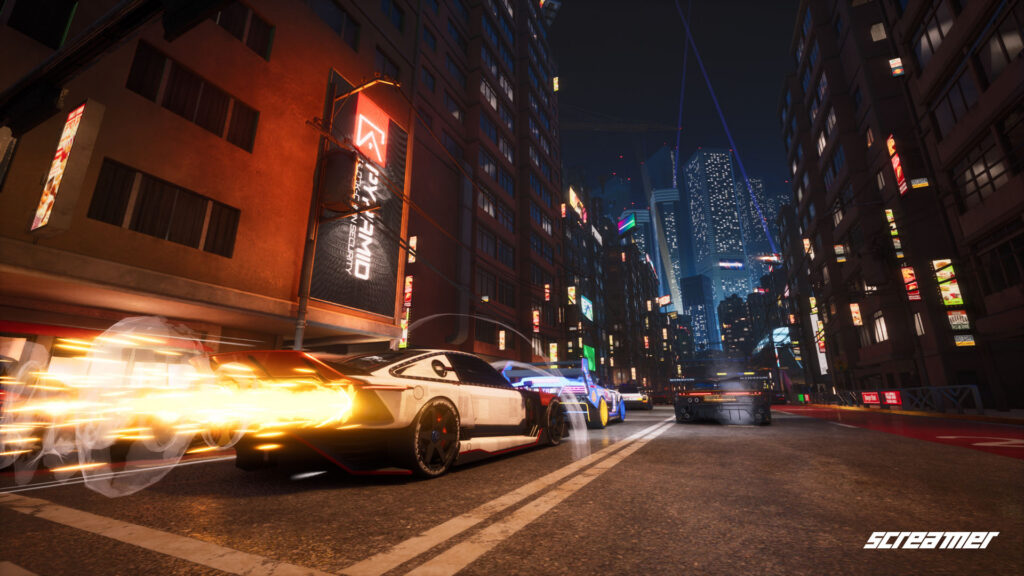
Milestone makes no secret of the team’s love of anime such as Akira, Ghost in the Shell and Bubblegum Crisis. This influenced Screamer’s central story, where a diverse cast of drivers enter an illegal street racing tournament hosted by the mysterious Mr. A.
The story is told through dialogue and animated cutscenes produced by Japanese animation studio Polygon Pictures, with an art style designed to “strike a difficult balance between fantasy and realism.”
Avoiding rookie driver tropes, the ensemble cast’s backgrounds range from army veterans to scientists and pop stars.
“They join for a variety of reasons,” explained Cardini. “Some because of revenge, others because of money, or they have something to prove to their family. It’s not like the usual racing structure.
“If you start from the usual tropes of racing games, you can only go so far. They always end up with the same themes and narrative tensions that are already well explored in movies and games.”
Story modes aren’t new in racing games, but they rarely feel integral to the gameplay. In Screamer, every car is fitted with a high-tech device known as the Echo, which forms the basis of Screamer’s unique combat mechanics.
“There are many considerations not usually present in a racing game”
Inspired by the resource management in classic fighting games like Tekken, Street Fighter and King of Fighters, players fill energy bars with resources known as Sync and Entropy to activate speed boosts, perform Strike or Overdrive attacks, or defend with shields.
This focus on tactical gameplay creates a steeper learning curve than most modern arcade racers. However, Milestone considers this one of the game’s strengths, as it rewards skill and mastery of the mechanics.
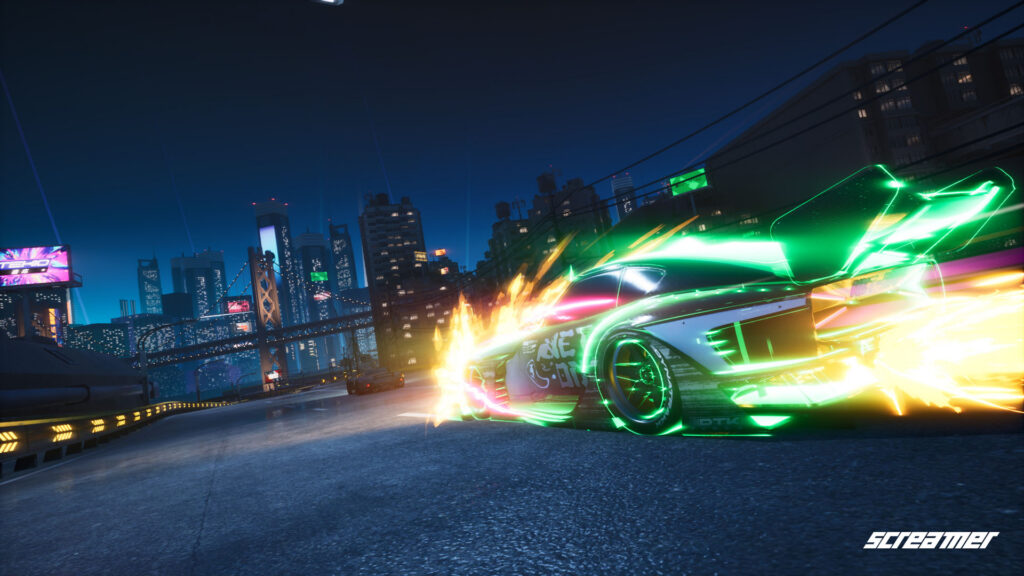
“Knowing when to boost is not as obvious as having a Mushroom in Mario Kart,” said Cardini. “If you boost at the wrong time, you crash into the wall. That’s by design.
“If you make an offensive action and miss the opponent, you might have taken a big hit on your chances of winning because you haven’t used your resources properly. There are many considerations not usually present in a racing game.”
Caletti adds that the “point is staying in the groove” when utilising the Echo.
“If you’re understanding the timing, you feel like you’re dominating the competition. If you mistime, you feel like you’re wasting your energy. But the game helps you understand where the groove is. Party because The Tournament gradually introduces you to the mechanics, and partly because there’s positive or negative feedback on-screen.
“You need to get a strategic understanding of when to use resources in bursts or all at once. It changes how you plan the race. This could sound complicated, but it becomes second nature.”
“We wanted something that gave more control over the drifting and steering”
Another aspect that breaks convention is the control scheme. Steering is handled with the left stick, while drifting is controlled with the right. “Having a system allowing you to combine the various mechanics without interfering with the driving was essential,” explained Cardini.
“We didn’t want to go with a system reminiscent of modern arcade racers. We wanted something that gave more control over the drifting and steering. Otherwise, everything on top of that wouldn’t work.
“Making racers is already hard. Arcade racers, in my opinion, are much harder. And then, if you add a complete fighting system on top, you can imagine how many things we had to struggle with during development.”
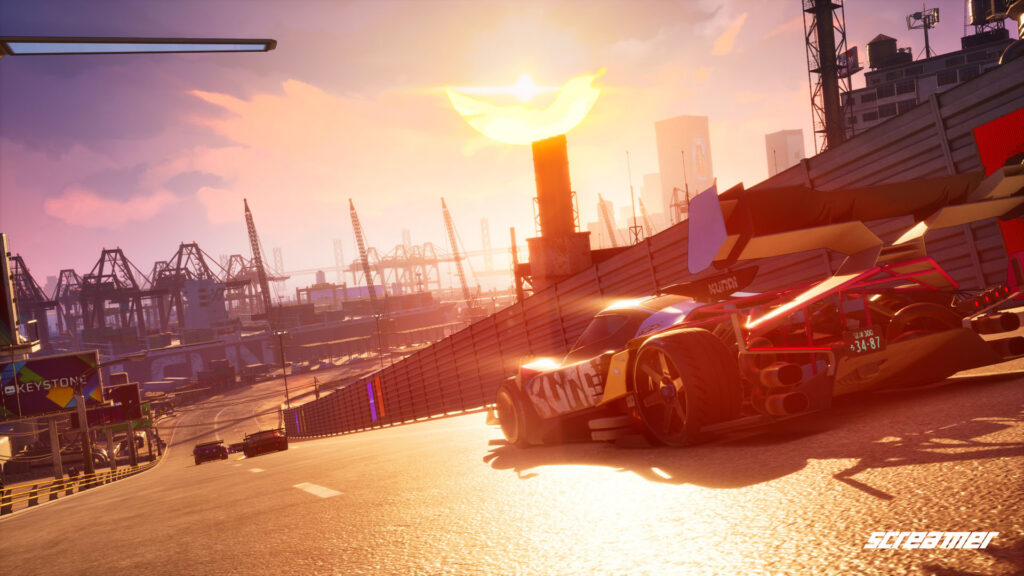
“The drift is central to all arcade racers,” added Caletti. “It works the same in all the games: You use the brakes to trigger the drift. Why not change it and try something different?
“In many games, you’re frantically trying to go fast and master the car, but the drift gets in the way. You can’t trigger it or end it when you want in many games.
“The twin stick solves all these issues in one very elegant stroke. You have one dedicated control to start, manage and finish the drift. That’s why it feels so brilliant when you play it.”
Screamer isn’t the first game to incorporate a twin-stick for driving and drifting. This concept was pioneered in Inertial Drift, an underrated indie racer released in 2020. While both games share similar controls, the execution is noticeably different.
“It’s a great game, but their approach to twin-stick works completely differently from ours because we’ve tried to streamline it,” explained Cardini.
“For them, that’s the [whole] game. For us, it’s the starting ground of everything that comes on top, so it serves very different functions.”
“They’re also trying to sell it like there’s a huge gyroscope inside the car that justifies some kind of inertia when you use the right stick,” added Caletti. “We don’t have that kind of inertia. It’s very different when you play it.”
“It’s very easy to disappoint players”
There’s a consensus that arcade racers are in decline compared to sim racing. With Screamer, Milestone is confident there’s still scope to innovate and reclaim the genre’s former glory.
“It depends on how strong your idea is and how willing you are to innovate. People are saying they want something new very strongly.
“We want to deliver something new, and we don’t want to hit already beaten ground. There are enough simulation racers coming out these days. The bar for quality is set very high, and it’s very easy to disappoint players.
“We want to try to beat our own path and do something very honest, heartfelt and passionate.”
Screamer launches on 26th March for PC, PS5 and Xbox Series X|S. Find out Traxion’s verdict on Milestone’s new arcade racer in our review.