
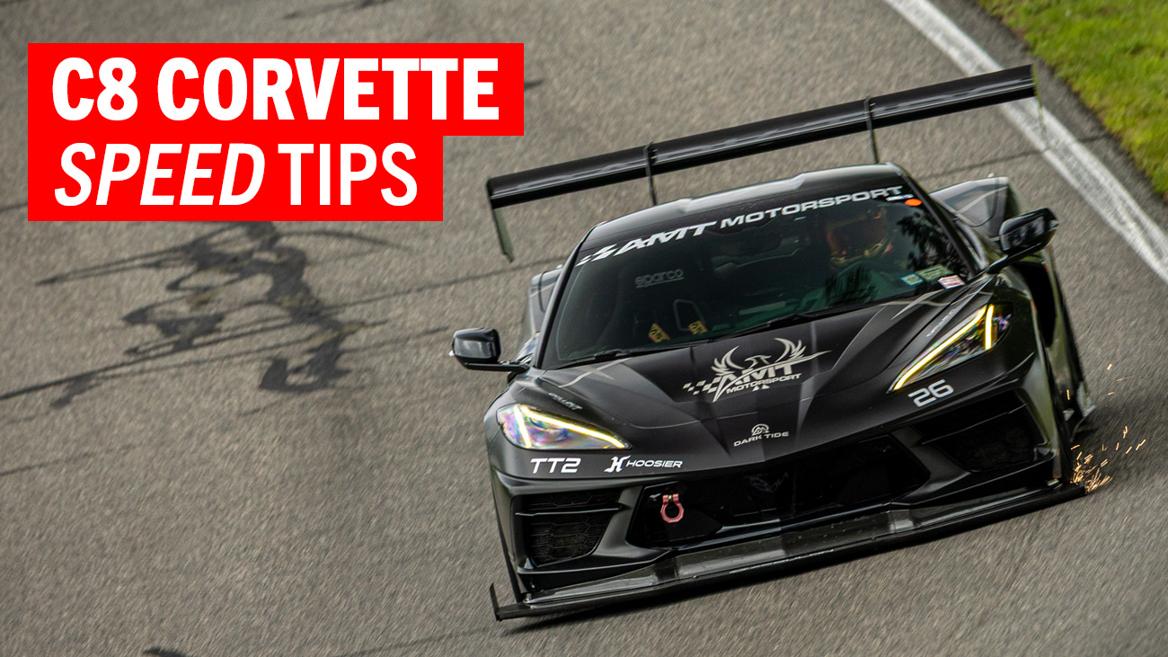
What’s faster than the current Porsche Cayman GT4 RS for half the price? The answer? A C8 Corvette Z51.
And with just a few easy tweaks, explains Mark Petronis, you can then squeeze even more performance out of the Z51 Corvette. How does he know? He races a Z51 and owns AMT Motorsport, a firm specializing in building parts for …
First, Why a C8?
At around $80K new, is the Z51 really a deal? After all, that’s the price of two new Miatas.
Compare that Z51 to something like that 718-chassis Porsche 718 Cayman GT4 RS. The Corvette puts out 490 horsepower; the Cayman’s right with it at 493. The Z51 does zero to 60 in 2.9 seconds; the Cayman lags behind with a 3.2. The Cayman, however, sells for $170,000–more than double the price of the Z51.
You could save a few bucks with a used Z51, too. Last year, Cars & Bids sold a nearly stock Z51 for $60,000.
While most C8 Corvettes will never hit the track, that’s where it can be unleashed and really shine. In November, IMSA Michelin Pilot Challenge driver Allen Patten turned a 1:59 lap around Virginia International Raceway in a bone-stock Z51. That’s in the territory of a purpose-built C6 Corvette GT1 car. The Z51 is that quick.
Straight out of the box, Mark, our Corvette expert, says that the C8 exceeds the needs of most owners. “I spend a lot of timing talking people out of buying stuff,” he explains. “If you’re an intermediate driver, you’re going to be perfectly fine with this car from the factory for a while.”
That doesn’t mean you can’t make it better, though. Aside from stickier tires, Mark shares, he has four tips that transform the C8 with relatively little effort.
Mark Petronis. Photo by J.A. Ackley.
1. Keep Your (Brakes) Cool
Simply put, the faster you go, the stronger the brakes you need. While the Z51 package comes with a stout Brembo setup, Mark still upgraded his brakes. “Personally, I can’t be fast unless I’m 100% confident in my car,” Mark says. “For me, that starts at the brakes.”
Mark strongly recommends a track-oriented package like the ones he sells from AP Racing. The setups include calipers, rotors and brake lines.
Brakes built for performance are bigger and provide more area to dissipate heat–the stock front Z51 rotors measure 345 mm across, while AMT’s smallest offering checks in at 372 mm. Race rotors also have increased surface area–again, to provide better heat dissipation–courtesy of more internal vanes.
The matched race calipers offer better ventilation to whisk cool air in and hot air out, while the seals can withstand higher temperatures. Race calipers also allow quicker pad swaps–just two bolts in this case. The steel braided lines improve pedal feel over standard lines while better fending off debris.
Typically, these kits save weight, too, with the AP brakes shaving 12 to 14 pounds per corner. The trade-off? Figure at least $5000 per axle.
Whether or not you’re running the stock brake setup, don’t forget to upgrade the brake fluid (with a higher boiling temp) and fit track-capable pads.
2. Stop the Roll
“The car’s got a quite a bit of roll, even in the sportiest settings,” Mark remarks. To fix that, he installed bigger anti-roll bars on the front and rear from aFe Power. Furthermore, Mark added Eibach end links to provide easier adjustment.
“The whole setup–aFe Power kit and Eibach end links–will cost you less than $1000,” Mark says. “It will allow three adjustment positions front and rear to tune the body roll of the car.” The increase in front rate ranges from 50% to 103%, while the rear rate increases from 100% to 160%.
3. Eliminate the Slip
After the anti-roll bar, Mark recommends a camber bolt kit. The stock, round eccentric cams in the lower control arms are prone to slippage, which can cause changes in suspension geometry.
This kit addresses that issue, with the bonus of enabling additional camber. Cost? Less than $500 complete.
After an anti-roll bar and camber kit, simply hold the wallet and hit the track. Yes, there are coil-over kits and monoball spherical bearings available, but Mark says to wait until you’re ready to turn your C8 into a track-dedicated machine.
4. Strap in Tight
The seats in the C8 Corvette: Yes, they’re good, but they’re not what you want for driving a C8 at its limit on track.
“People discount or overlook the importance of being held securely in a cockpit that has as much grip as a C8 does,” Mark explains. “The C8 seats are better than what the C5 and C6 ever were. Still, putting a seat in with a harness and harness bar to lock you in translates to actual lap time and certainly enjoyment driving the car, so the interior is really important.”
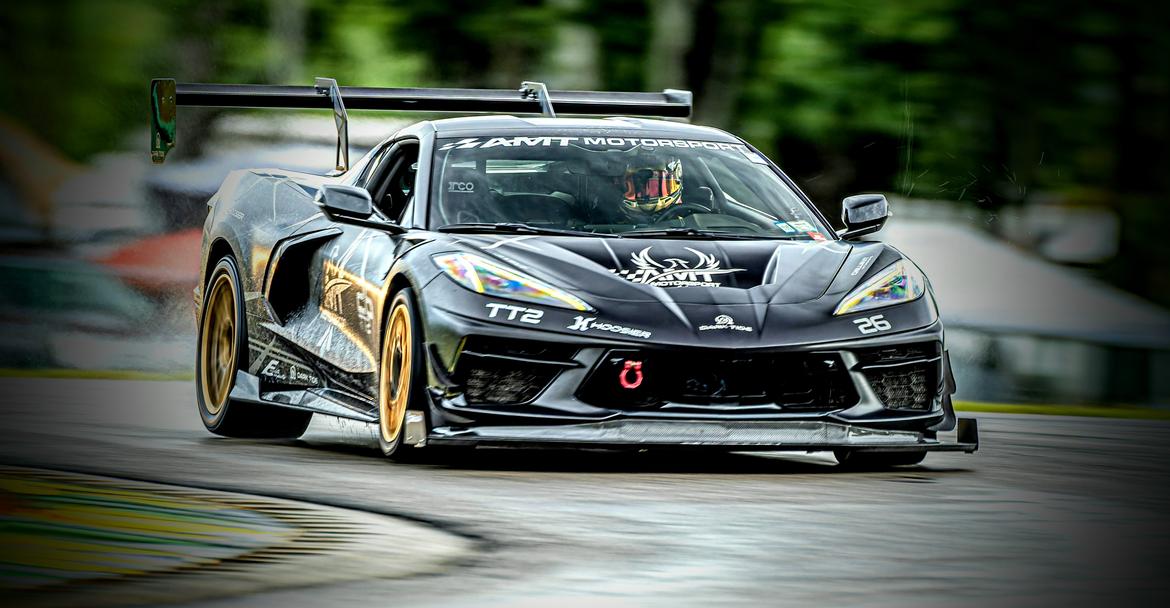
Photo courtesy AMT Motorsport.
Want to Go All Out? Now Add Downforce
The powerplant isn’t next, Mark says. GM warranties the Z51 engine for track use, but modding that V8 may void it. Plus, Mark doesn’t feel you need the extra power at this point.
Instead, he focuses on aero. To come up with the optimal aero setup, Mark and his AMT Motorsport engineers took two trips from north of Albany, New York, to a wind tunnel in Mooresville, North Carolina, to test.
The team’s biggest surprise? What they achieved by simply blocking the brake air ducts.
“We picked up a pretty large margin of downforce on the front end,” Mark says. “It’s also a big deal for reducing coefficient of drag. It was a 30% to 40% bump in front downforce.”
The good news? The brakes you’ve already upgraded will handle that extra heat with no problem. Mark adds that the ducts don’t really drive much effective air into the brakes anyway.
After blocking the brake ducts, it’s time for a wing. Really, you should do a wing and a splitter together, but if you have to pick one, Mark says go with a wing. It’ll induce some understeer at the limit, but it’ll inspire some confidence, reducing lap times, he notes.
The stock Z51 does come with a rear spoiler, but, he explains, a well-designed wing offers so much more. “The stock spoiler made a surprising amount of downforce given its size, like 75 pounds at 85 mph,” Mark says. “But it’s really draggy, and the front end produces a lot of lift from the factory. So, with our mild wing and front splitter package, our car made 25 times more total downforce than the stock Z51 with only an additional 9 horsepower drag.”
Then comes the splitter to create a well-balanced aero package. By this point, however, you’ll need to upgrade your suspension: The stock springs won’t handle all the downforce, and you can’t find stock replacements with a high enough spring rate.
The solution? Coil-overs with stiff springs. In addition to handling the load, they’ll also offer adjustability, which you’ll need because now your C8 is turning into quite the track machine.
Is the aero worth it? Just the wing allowed Mark to run 1.7 seconds faster at Palmer Motorsports Park. Adding the splitter further increased that delta by about another second.
That nearly 3-second gain cost around $12,000 in aero bits–plus the necessary coil-overs–but this is what it takes to squeeze every ounce out of an already potent C8 Corvette. No one said it would be easy, but you always want to go faster, right?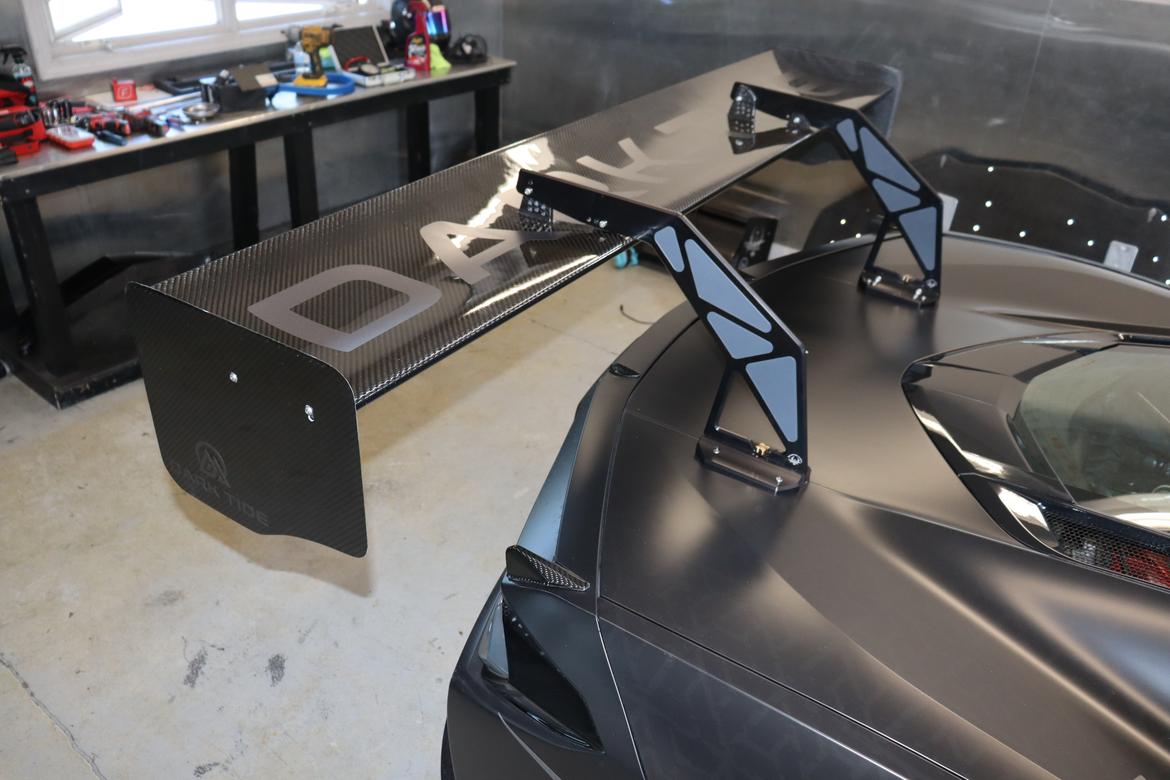
Photo by J.A. Ackley.