| 1 |
Vladimir Guerrero Jr. |
3B |
TOR |
21.2 |
20.7 |
41 |
70 |
60 |
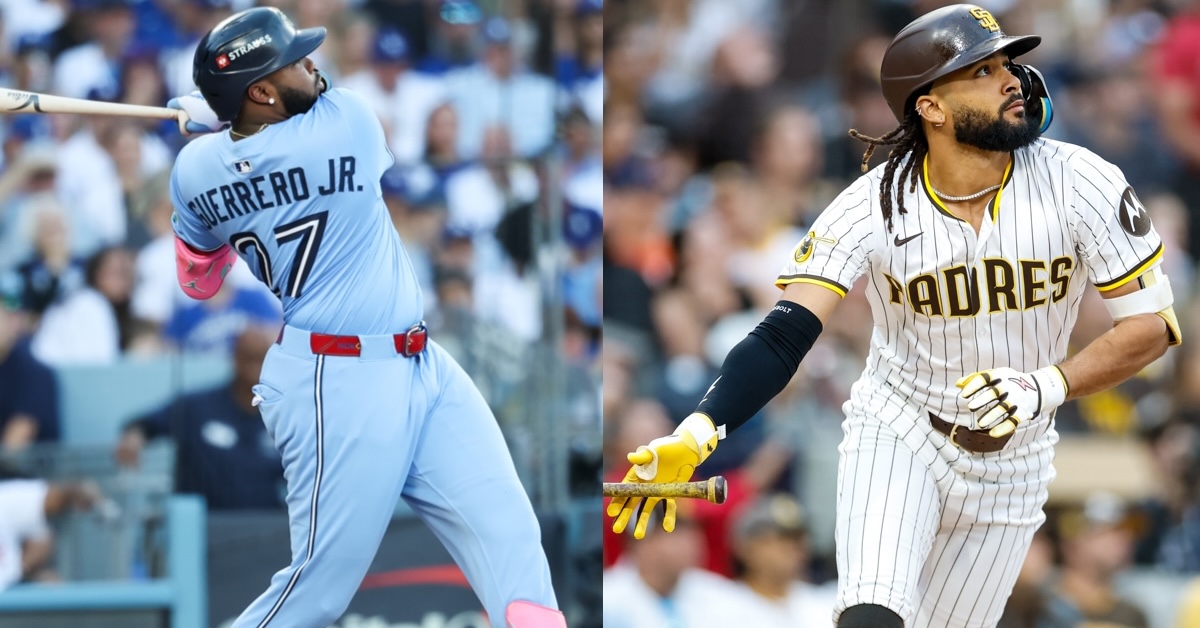
Guerrero had Chosen One aura from the jump and has essentially made good on it. Though he has had a couple of peak years that you could classify as a 70 on the scale, his early-career third base defense and the couple of seasons in which he hit for more modest power (for a first baseman, anyway) relegate him to the 60-grade tier. He is essentially tied for fifth with Pete Alonso for wins among first basemen since 2019, and when you look at the WAR tiers from that span, you can see Vladdy falls pretty comfortably into the third tier. Still only 26, his career is on a special trajectory, and he was arguably the catalyst for the Blue Jays turning into one of baseball’s financial juggernauts and obvious contenders. The fact that he was a 60 during a window that began when he was 20 is very special, even though you might think it underwhelming that he was only a 60. That grade illustrates how thin the margins are at first base more than it indicates that we were a little overzealous grading Guerrero. |
| FG Rank |
Name |
Pos |
Org |
2019 Age |
Career WAR |
WAR Rank |
FV |
Actual Grade |
| 3 |
Fernando Tatis Jr. |
SS |
SDP |
21.4 |
26.5 |
19 |
65 |
70 |
Originally signed by the White Sox in 2015, Tatis was traded to San Diego for James Shields during his first extended spring training in Arizona, before he had even played an official pro game. Three years later, he broke camp with the big league club as a 20-year-old, and had as phenomenal and electric an introduction to the big leagues as anyone since I’ve started doing this. San Diego had lost the Chargers just a few years before Tatis debuted, and the team’s run of contention coincided with his arrival. A mistake-prone shortstop, he made a seamless transition to right field and became one of the best defenders in the sport, regardless of position. He is the 2019 rookie class’ WAR leader even though injuries (some caused by off-the-field thrill-seeking, others because his body is too explosive for its own good) and a PED suspension have limited his playing time. Among the top 30 position player WAR producers since 2019, Tatis is one of just three who have played fewer than 700 games (Bobby Witt Jr., and Yordan Alvarez are the other two). Prorating his production here (same as I did for Ronald Acuña Jr. last year) is why Tatis is a 70 and not just a 65. Good for Keith Law for having Fernando ranked first this year; it was the right call. |
| FG Rank |
Name |
Pos |
Org |
2019 Age |
Career WAR |
WAR Rank |
FV |
Actual Grade |
| 5 |
Victor Robles |
CF |
WSN |
23.1 |
7.4 |
189 |
65 |
40+ |
Robles was billed as a five-tool player and performed like one throughout his minor league career. Beneath the surface, however, he lacked the measurable power of a player who was actually going to hit 20-plus homers in the big leagues. Because we were still in the early stages of gathering and understanding that data, we overrated Victor a little bit. There were team people who alluded to this when providing feedback on this Top 100 list while it was in progress, but Robles had played well in limited big league time and this ranking certainly looked correct after his rookie year. Still, while Robles has had two excellent peak seasons, he has otherwise been a 40. |
| FG Rank |
Name |
Pos |
Org |
2019 Age |
Career WAR |
WAR Rank |
FV |
Actual Grade |
| 7 |
Nick Senzel |
3B |
CIN |
25.0 |
-1.1 |
412 |
60 |
ORG |
Injuries played a role in Senzel’s struggles and also limited his minor league data sample, which made is less meaningful. He ran an absurdly high BABIP at basically every stop. I bought that he had a special hit tool, but it has actually been closer to average. A 50-hit/40-power combo, which is essentially what Senzel turned out to have, is not enough to profile at third base. |
| FG Rank |
Name |
Pos |
Org |
2019 Age |
Career WAR |
WAR Rank |
FV |
Actual Grade |
| 8 |
Eloy Jiménez |
RF |
CHW |
23.5 |
4.2 |
277 |
60 |
40+ |
I was intentionally a little lower on Jiménez (not that eighth overall is burying anyone) because he had already gotten so big and been injured so often as a prospect that I worried he’d be a DH-only player in the majors. His injuries turned out to be even worse than that, and Eloy has only played more than 100 games in two seasons, with his lone near-complete season the shortened 2020 slate. His rate production when he’s been healthy (he’s a career .269/.318/.462 hitter) has been good, and he gets a pretty positive real-world grade as a result, even though it’s well short of his forecast. Entering 2021, Jiménez was on a pace that would have enabled him to hit this grade, but XXL athletes like this often have earlier declines. Jiménez is currently on a minor league deal with the Blue Jays and could still play a consequential role on a good team during his healthy stretches. |
| FG Rank |
Name |
Pos |
Org |
2019 Age |
Career WAR |
WAR Rank |
FV |
Actual Grade |
| 9 |
Bo Bichette |
SS |
TOR |
22.3 |
20.0 |
44 |
60 |
60 |
Like Willy Adames last year, everyone nailed their reports and ranking for Bichette, as we all had him ranked within five spots, from eighth to 13th. Even though Bo has had stretches within seasons where his swing-happy style has caused him to run cold, he’s also had periods when he gets white-hot and carries the offense for weeks at a time, and he’s posted big numbers for a shortstop virtually every year. Does his approach put him at risk of having a Javier Báez career arc? Maybe, but we’re just looking at pre-free agency production here, and Bo was a 60. |
| FG Rank |
Name |
Pos |
Org |
2019 Age |
Career WAR |
WAR Rank |
FV |
Actual Grade |
| 10 |
Kyle Tucker |
RF |
HOU |
23.4 |
25.4 |
24 |
60 |
70 |
Longtime readers might recall that when Tucker was in high school, his swing was being compared to that of Ted Williams. The Splendid Splinter’s place in the game’s history made that feel slightly ridiculous, and you could debate whether Tucker was going to be a great hitter just because his swing looked perfect, but it is perfect. He’s been the second-most productive player from this graduating class and, similar to Tatis, is just a little shy of the raw WAR production of a 70-grade player but comfortably meets it when you account for his injuries and prorate his pandemic season. His 138 wRC+ is 10th in all of baseball since he debuted. |
| FG Rank |
Name |
Pos |
Org |
2019 Age |
Career WAR |
WAR Rank |
FV |
Actual Grade |
| 13 |
Keston Hiura |
2B |
MIL |
23.9 |
2.0 |
347 |
60 |
35+ |
Hiura played the outfield as an underclassman at UC Irvine and then an elbow injury prevented him from playing defense in his draft year. At this time, the risk associated with his prospectdom centered around his speculative defensive fit at second base and potential tumble to left field. While he ended up being a good enough defender to play second in the big leagues, the load-bearing Jenga block in Hiura’s profile was actually a hole in his swing created by the path his hands took back to the baseball. Hiura’s hands are powerful but take too long to get on plane with fastballs. After a productive rookie year during which he K’d a concerning 30.7% of the time, the book was out on this guy, and Kiura managed just a 57% contact rate against pitches 93 mph and above from 2020 through 2023. |
| FG Rank |
Name |
Pos |
Org |
2019 Age |
Career WAR |
WAR Rank |
FV |
Actual Grade |
| 24 |
Luis Urías |
2B |
SDP |
23.0 |
5.5 |
236 |
55 |
40+ |
Urías walked more than he struck out in each of the first four seasons of his pro career, and there was a stretch when Kiley and I wondered if we were underappreciating the possibility that he might be a Mookie Betts type of mold-breaking hitter, one whose special contact feel allows him to hit for power despite limited physicality. About a year before he debuted, Urías started trading contact for power, and ultimately had two good big league seasons in the middle of several below-average campaigns. |
| FG Rank |
Name |
Pos |
Org |
2019 Age |
Career WAR |
WAR Rank |
FV |
Actual Grade |
| 33 |
Austin Riley |
3B |
ATL |
23.2 |
20.2 |
43 |
55 |
60 |
Riley is “only” the eighth-most productive third baseman since he debuted because his peer group during that span is historically significant. Riley’s production was on a 70-grade level for his three complete seasons, but the last two years have been more like a 55 as he’s dealt with injury. In aggregate, his FV grade was pretty close to his actual production, with one difference being that my hit tool grade (45) was bang on in terms of predicting Riley’s strikeout rate (26.1%, a little worse than average) but not his batting average (.270), which has been better than average because of how Riley hits the ball. |
| FG Rank |
Name |
Pos |
Org |
2019 Age |
Career WAR |
WAR Rank |
FV |
Actual Grade |
| 34 |
Chris Paddack |
RHP |
SDP |
24.4 |
7.3 |
111 |
55 |
40+ |
Paddack was an older high school pick out of Texas who the Marlins traded to San Diego for Fernando Rodney before the younger righty broke out. Paddack’s sensational changeup, as well as his above-average velocity and command, made him seem like a good bet to be a mid-rotation starter despite below-average breaking stuff. He performed to expectations during his rookie season, but his fastball turned out to be more vulnerable to damage than anticipated, and Paddack has either been injured or posted bloated ERAs for much of the past half decade. |
| FG Rank |
Name |
Pos |
Org |
2019 Age |
Career WAR |
WAR Rank |
FV |
Actual Grade |
| 36 |
Michael Soroka |
RHP |
ATL |
22.9 |
5.9 |
161 |
55 |
40 |
Soroka ate 174.2 innings during his 4-WAR 2019 season and then spent much of the next half decade dealing with injuries or struggling with walks. The ultra-competitive Canadian righty pitched like a 45-grade starter in 2025 and might still factor in the back of a good rotation, but his first seven years of service time yielded under 1 WAR per season. |
| FG Rank |
Name |
Pos |
Org |
2019 Age |
Career WAR |
WAR Rank |
FV |
Actual Grade |
| 45 |
Alex Reyes |
RHP |
STL |
25.8 |
1.7 |
DNQ |
55 |
INJ |
Reyes debuted in 2016 and was just a few innings shy of graduating from rookie status that year. A marijuana suspension, a Tommy John surgery, and a torn lat would derail his 2017-19 seasons, and then we had the pandemic year in 2020. In 2021, Reyes pitched 72.1 walk-prone frames out of St. Louis’ bullpen, a career high. The following season, he began to deal with shoulder issues that would lead to two more surgeries, which prevented him from ever pitching for the Dodgers, who signed him before the start of the 2023 season. Two offseasons ago, Reyes and the Mets agreed on a two-year minor league deal, which fell through due to what NJ.com’s Manny Gomez reported as “personal reasons.” If you caught peak Reyes on one of his best days, you’d see him sitting 97-101 mph with an absolute hammer breaking ball and plus-plus changeup. His changeup and slider generated plus-plus swinging strike rates (each just over 20%) in the healthy big league innings he was able to throw. So many talented pitchers fall short of our collective expectations for no other reason than injury, and Reyes is among the more prominent of the last decade or so. He was included in last year’s audit as an interesting injury case, but actually graduated in 2019. |
| FG Rank |
Name |
Pos |
Org |
2019 Age |
Career WAR |
WAR Rank |
FV |
Actual Grade |
| 46 |
Brandon Lowe |
2B |
TBR |
25.9 |
16.9 |
63 |
50 |
55 |
Kiley and I were really high on Lowe but not quite high enough, and not quite for the right reasons. We thought he’d have a more balanced contact/power skill set, but Lowe has instead been one of the better power-hitting second basemen of the last decade, with a couple of 30-homer seasons despite elevated strikeouts. Lowe is tied for eighth in WAR production among second basemen since he debuted, seventh if you consider Tommy Edman more of a shortstop or center fielder than a second baseman. Pretty good for a third round pick. |
| FG Rank |
Name |
Pos |
Org |
2019 Age |
Career WAR |
WAR Rank |
FV |
Actual Grade |
| 47 |
Danny Jansen |
C |
TOR |
25.2 |
10.8 |
120 |
50 |
50 |
Jansen is a career .220/.310/.415 hitter with a 100 wRC+, which is enough for him to rank eighth among catchers in WAR since he debuted. He has been a steady producer, with five double-digit home run seasons during that span. Even though his playing time was impacted by the emergence of Alejandro Kirk, Jansen has been one of the 10 most productive players at maybe the game’s most valuable position, a player whose projection we nailed. |
| FG Rank |
Name |
Pos |
Org |
2019 Age |
Career WAR |
WAR Rank |
FV |
Actual Grade |
| 48 |
Pete Alonso |
1B |
NYM |
25.5 |
20.8 |
40 |
50 |
60 |
There was a long stretch where basically no righty-hitting college first basemen turned into a great big leaguer. In between Eric Karros (who was drafted the year I was born) and this recent window of Rhys Hoskins, Alonso, and Christian Walker is a period full of guys like Paul Konerko and Richie Sexson (drafted out of high school), or Paul Goldschmidt and Kevin Youkilis types who played some third base. Alonso was a first baseman from the moment he set foot on campus in Gainesville, and the failure of his demographic was part of why he fell to the second round of his draft even though he was a productive college hitter. He slugged 36 homers in the minors entering the offseason in which Kiley and I ranked him here, and we thought it was bold to predict that Alonso was about to break a long streak of college first base failure, when actually we had underappreciated Pete’s power by a full grade. |
| FG Rank |
Name |
Pos |
Org |
2019 Age |
Career WAR |
WAR Rank |
FV |
Actual Grade |
| 57 |
Touki Toussaint |
RHP |
ATL |
24.0 |
0.0 |
DNQ |
50 |
35 |
Touki’s fastball shape caused that pitch to play down, and it probably also made his excellent curveball easier for hitters to identify out of hand. Reliever-quality command remains part of his game, and Touki has spent most of the last half decade as an up/down arm. |
| FG Rank |
Name |
Pos |
Org |
2019 Age |
Career WAR |
WAR Rank |
FV |
Actual Grade |
| 58 |
Dylan Cease |
RHP |
CHW |
24.5 |
21.0 |
12 |
50 |
60 |
Cease was a hard-throwing high schooler who was given an over-slot bonus in the sixth round as part of a 2014 Cubs draft class that included Kyle Schwarber (signed under slot) and Justin Steele. He was traded to the White Sox in exchange for Jose Quintana in 2017, and debuted on the South Side two years later. He would go on to become one of the better power pitchers in baseball, with time spent in Chicago and San Diego before his big offseason deal with Toronto. Since reaching The Show, Cease ranks fourth in the big leagues in strikeouts and third in average fastball velocity among pitchers who’ve thrown at least 850 innings during that span. He’s also the most walk-prone of the big league starters who have thrown that many innings since he debuted, and in the bottom five in groundball rate. He has performed like someone who justifiably could have been ranked as one of the best couple of pitching prospects in baseball even though the orgs Cease has played for (late Epstein-era Cubs, White Sox, Padres) aren’t paragons of pitching development. He might have another gear in him now that he’s somewhere with a better track record. |
| FG Rank |
Name |
Pos |
Org |
2019 Age |
Career WAR |
WAR Rank |
FV |
Actual Grade |
| 59 |
Francisco Mejía |
C |
SDP |
24.6 |
1.2 |
365 |
50 |
40 |
Mejía was a switch-hitting catcher with nutty bat control and a plus-plus arm who the Padres acquired from Cleveland for Brad Hand. Mejía’s lack of plate discipline turned out to be a problem at the big league level (he has just one above-average offensive season), and his lack of size (5-foot-8, 188 pounds) created hurdles for him as a framer and ball-blocker that he struggled to overcome. |
| FG Rank |
Name |
Pos |
Org |
2019 Age |
Career WAR |
WAR Rank |
FV |
Actual Grade |
| 74 |
Yusei Kikuchi |
LHP |
SEA |
29.0 |
10.2 |
71 |
50 |
50 |
Kikuchi has been homer-prone since coming over from Japan, but that was especially true during his Mariners tenure and in his first campaign with the Blue Jays. Once he and Toronto found an arm slot and delivery that worked for him, Kikuchi was able to turn in his best couple of seasons. He’s made 32 starts and posted at least 2.5 WAR in each of the last three years leading up to this audit, putting his output in line with his projection. Remember that some of the publications simply weren’t ranking foreign pros like Kikuchi at this time, and we’ve stopped including those who aren’t subject to bonus restrictions in our rankings since. |
| FG Rank |
Name |
Pos |
Org |
2019 Age |
Career WAR |
WAR Rank |
FV |
Actual Grade |
| 79 |
José Suarez |
LHP |
LAA |
22.4 |
1.8 |
254 |
50 |
35+ |
In 2018, Suarez had a little velo spike, struck out more than a batter per inning, and reached Triple-A as a 20-year-old; he seemed like a well-rounded, high-floored fourth starter prospect. After two years pitching like a 45-grade arm in a starter/swingman role, Suarez was moved to the bullpen and struggled until he was traded to the Braves for Ian Anderson. He’s ridden the waiver wire from the Braves to the Orioles and back again this offseason. I still like Suarez’s changeup and think he might, at age 28, be able to find a way to be a 45 again with stability in an org that maxes out pitchers, which hasn’t tended to be true of the Angels. |
| FG Rank |
Name |
Pos |
Org |
2019 Age |
Career WAR |
WAR Rank |
FV |
Actual Grade |
| 80 |
Will Smith |
C |
LAD |
25.2 |
22.4 |
33 |
50 |
70 |
Smith was an athletic catcher at Louisville who is really the only semi-rational argument one could make in a “Who Should Have Gone First in the 2016 Draft?” debate, as the other great players (Bichette, Corbin Burnes) went later. Because of Yasmani Grandal’s presence on the big league roster, Smith was deployed semi-regularly on the infield as he approached the big leagues (more than 40 games at third base in 2019) until he seized the job. He’s been the most consistently productive offensive catcher in the bigs since then, leading all backstops in OBP and wRC+ since 2019, though ranking third in WAR because J.T. Realmuto and Cal Raleigh have been better defenders. Gauging catchers purely by WAR can be tricky because the nature of their job means they play fewer games than other position players. Smith’s wOBA is the second best of any catcher since 2010, behind only Buster Posey. Again, he’s not the caliber of defender Posey was, but Smith’s bat makes him an MVP candidate at catcher, a rarity, and his grade reflects that. |
| FG Rank |
Name |
Pos |
Org |
2019 Age |
Career WAR |
WAR Rank |
FV |
Actual Grade |
| 83 |
Cole Tucker |
SS |
PIT |
23.9 |
-2.1 |
DNQ |
50 |
ORG |
We 50’d Tucker as a bet on his physical projection and ability to stay at shortstop because of his arm. We thought he’d grow into more power in his mid-20s, enough to be an impact shortstop toward the end of his pre-free agency window. Instead he stagnated, fell down the defensive spectrum pretty quickly, and struggled to find big league playing time after the pandemic season. People in baseball really like Cole, and he seems poised for a long and lucrative media career. |
| FG Rank |
Name |
Pos |
Org |
2019 Age |
Career WAR |
WAR Rank |
FV |
Actual Grade |
| 98 |
Josh James |
RHP |
HOU |
27.3 |
0.6 |
DNQ |
50 |
INJ |
James was a 34th rounder out of Western Oklahoma who had a prospect breakout when he struck out 171 batters in 114.1 innings spent mostly at Triple-A Fresno in 2018, his third consecutive year with an uptick in velocity. A litany of injuries packed into a three-year span — quadriceps, general arm fatigue, hip labrum surgery, hamstring issues that delayed his rehab from the hip surgery, lat and back issues, and finally flexor tendon surgery — derailed things. He pitched in Puerto Rico a little bit this offseason. |
| FG Rank |
Name |
Pos |
Org |
2019 Age |
Career WAR |
WAR Rank |
FV |
Actual Grade |
| 101 |
Griffin Canning |
RHP |
LAA |
24.1 |
5.2 |
165 |
50 |
40 |
Canning was evaluated as a four-pitch starter with average-or-better offerings and above-average command, but his slider and changeup have turned out to be his only good pitches, and he has struggled to throw his fastball for strikes. He’s pitched more like a no. 5/6 starter than a mid-rotation guy. |
| FG Rank |
Name |
Pos |
Org |
2019 Age |
Career WAR |
WAR Rank |
FV |
Actual Grade |
| 104 |
Isan Díaz |
2B |
MIA |
24.0 |
-3.1 |
DNQ |
50 |
ORG |
I essentially projected that Díaz’s output would look a lot like what Brandon Lowe’s turned out to be. Díaz’s strikeout rates were already in the 22-27% range during much of his minor league career, and that has turned out to be a dicey starting point. He was part of big trades for Jean Segura and Christian Yelich as a young prospect, but he’s a career .177 hitter in over 526 big league plate appearances, and has reached Triple-A journeyman status. |
| FG Rank |
Name |
Pos |
Org |
2019 Age |
Career WAR |
WAR Rank |
FV |
Actual Grade |
| 112 |
Garrett Hampson |
2B |
COL |
25.7 |
1.0 |
384 |
50 |
40 |
Hampson has had a nice big league career as a speedy utility guy capable of playing three up-the-middle positions. His performance has tended to hover on either side of the “replacement level,” well short of this projection, but the fact that he’s played at least a little bit in each of the past eight big league seasons is a feat on its own. |
| FG Rank |
Name |
Pos |
Org |
2019 Age |
Career WAR |
WAR Rank |
FV |
Actual Grade |
| 117 |
Alex Verdugo |
RF |
LAD |
24.1 |
8.0 |
157 |
50 |
45 |
Kiley and I nerfed where we had Verdugo because of reports on his makeup. In retrospect, we were essentially quantifying his behavior in a way that said, “we value these infractions as being worth an 80-spot slide on a prospect list,” which afterward felt crass and icky. After this, my approach has been to rank guys where they belong based on talent alone, and then mention if there is anything potentially disqualifying about the player in their scouting blurb. Verdugo didn’t hit for enough power to be considered an average corner outfielder. We ended up being less wrong than the other publications about where we put Verdugo, but not for all the right reasons. |
| FG Rank |
Name |
Pos |
Org |
2019 Age |
Career WAR |
WAR Rank |
FV |
Actual Grade |
| 120 |
Peter Lambert |
RHP |
COL |
23.1 |
0.4 |
DNQ |
50 |
35+ |
Lambert was picked out of San Dimas High School in Southern California in 2015 and debuted as a 22-year-old. He amassed a 6.28 career ERA in Colorado before venturing abroad for the 2025 season, pitching for Yakult in NPB. He’s back in MLB, this time with Houston on a minor league deal. |
| FG Rank |
Name |
Pos |
Org |
2019 Age |
Career WAR |
WAR Rank |
FV |
Actual Grade |
| 124 |
Josh Naylor |
1B |
SDP |
23.0 |
10.1 |
121 |
50 |
50 |
Naylor was a husky Canadian first baseman originally drafted by the Marlins. In his first full pro season, he accidentally stabbed roommate Stone Garrett in what the Marlins described as a “prank gone wrong,” and then a month later was dealt to San Diego in a trade that became controversial due to deceptive medical record keeping surrounding Colin Rea on the part of the Padres, who then had to return a soon-to-be-awesome Luis Castillo to the Marlins (he was later traded to the Reds and is now Naylor’s teammate in Seattle). Naylor ended up behind Eric Hosmer in San Diego and was traded to Cleveland as part of a big Mike Clevinger deal. It took him until 2022 to break out, and he’s produced like an above-average first baseman each of the last four years. Naylor has been a fan favorite everywhere he’s been because of his intense on-field demeanor and baserunning acumen that belies his build and athleticism. |
| FG Rank |
Name |
Pos |
Org |
2019 Age |
Career WAR |
WAR Rank |
FV |
Actual Grade |
| 125 |
Yordan Alvarez |
DH |
HOU |
23.0 |
23.7 |
30 |
50 |
65 |
This was far too light a Yordan evaluation to feel good about, as he has the second highest wRC+ of any qualified hitter in baseball since 2019. His WAR production has suffered relative to that superlative mark because he’s essentially a DH-only and has missed time with injuries. But he’s one of the most dangerous hitters in baseball when healthy and should have been stuffed in the top 10 overall of this list. |
| FG Rank |
Name |
Pos |
Org |
2019 Age |
Career WAR |
WAR Rank |
FV |
Actual Grade |
| 127 |
Sandy Alcantara |
RHP |
MIA |
24.8 |
18.2 |
18 |
50 |
55 |
Alcantara struggled a bit with walks in the mid-minors but entered 2019 coming off three consecutive seasons with at least 120 innings pitched. He is built and moves like an impact big league starter, and even though aspects of his repertoire weren’t polished a this time, I had sources pleading with me to stuff him on our list because he checked virtually every old school scouting box thanks to his ideal frame and mechanics. He had a window as one of the best pitchers in baseball before a TJ and downturn in strikeout output hampered his performance (and trade value) in 2024 and 2025. It’s why he grades out as a 55 rather than a 60. |
| FG Rank |
Name |
Pos |
Org |
2019 Age |
Career WAR |
WAR Rank |
FV |
Actual Grade |
| 132 |
Shed Long Jr. |
2B |
SEA |
24.8 |
-0.1 |
DNQ |
50 |
35 |
Shed was a converted catcher who packed a pretty good punch for a hitter his size, and he hit well in a 42-game sample as a rookie. But his strikeouts climbed in subsequent big league trials, and he lacked the defensive versatility to shift into a utility role. He last played affiliated ball in 2022. |
|