
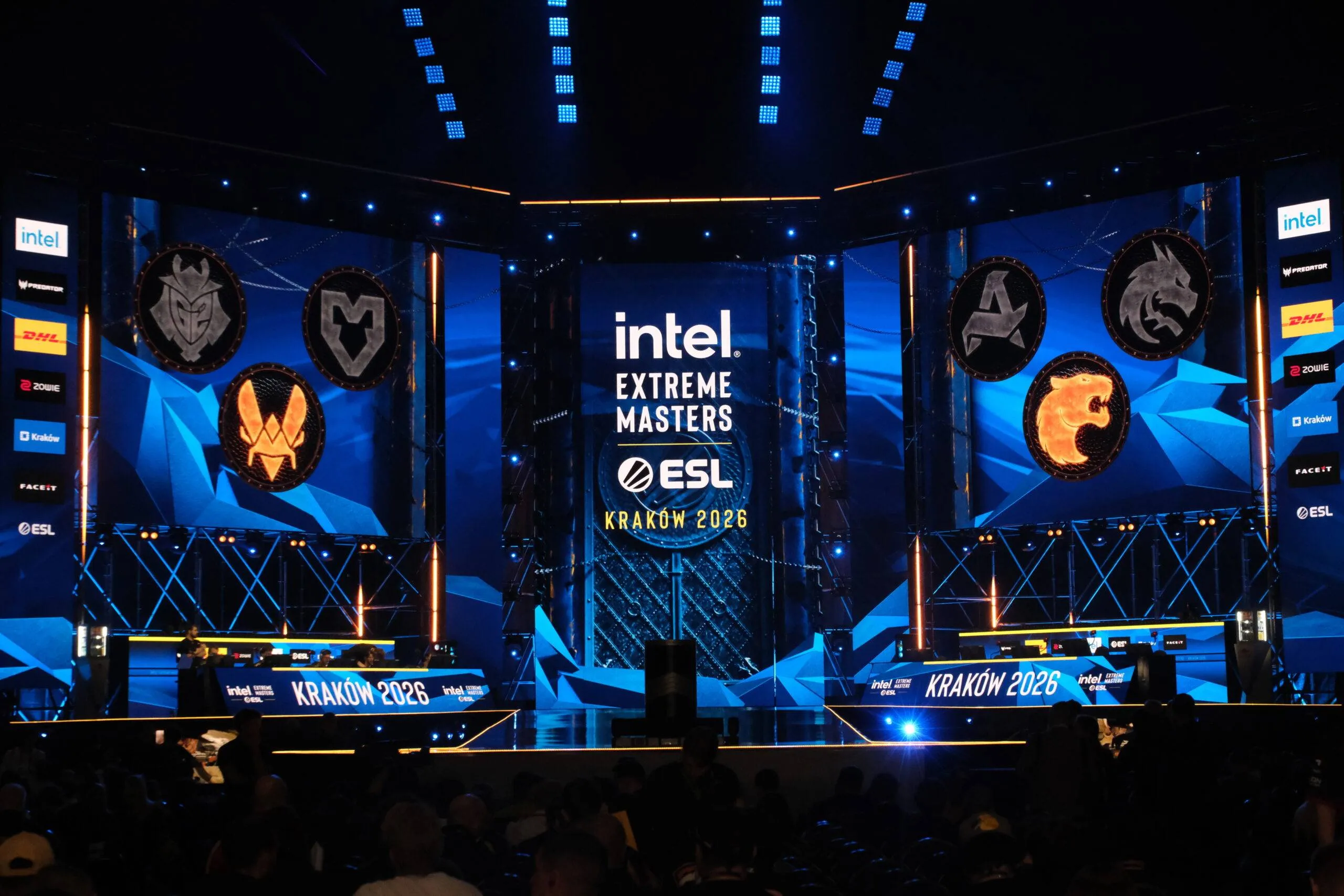
After more than a decade in Katowice, ESL FACEIT Group (EFG) has relocated its flagship winter Counter-Strike event in Poland from the Spodek Arena in Katowice to Tauron Arena Kraków under a multi-year agreement with the host city. The move materially changes the event’s physical and commercial footprint: Spodek lists a total seated capacity of just over 11,000, while Tauron Arena advertises about 15,000 seats for grandstands.
This article is based on onsite observations from both the final edition of IEM Katowice and the inaugural IEM Kraków, supplemented by an interview with Marc Winther, Director of Esports – Counter-Strike at ESL FACEIT Group, on the practical considerations behind the relocation. The focus here is not on match results, but on how the transition is reshaping the offline experience—through venue flow, fan touchpoints, sponsor presentation, and the role of the host city.
What changed immediately: scale, footprint, and density
At a macro level, Kraków delivered the headline promise: more seats and a larger arena, with the EFG press office reporting the inaugural IEM Kraków drew “over 38,000 in attendance from more than 50 different countries” and sold out the final three arena days.
On the ground, however, the larger arena did not automatically translate to a “roomier” experience everywhere. Tauron Arena’s corridor areas concentrated foot traffic more heavily around the bowl, which made crowd density in circulation spaces feel higher at peak times than in Katowice—particularly once the arena approached a full house on Day 3.
Overall onsite operations: smoother basics, slower peaks
From a basic audience operations standpoint, IEM Kraków ran smoothly: entry scanning (QR-code based) was generally efficient on the first couple of days, with the most noticeable friction occurring during peak arrivals on the final day, when queues formed and entry pace slowed.
Accreditation and access control for staff, media, and VIPs remained consistent with established IEM practice. Badges indicated permitted zones, and access points enforced those boundaries. In operational terms, Kraków looked less like a reinvention and more like a venue change executed within EFG’s standard event-management playbook.
Layout and activity design: The Expo gap compresses the experience
The most visible “structural” shift was the absence of the large, dedicated Expo hall on the scale that fans associated with Katowice. In Kraków, partner booths and merchandise sat along the concourses surrounding the main stage, pushing most non-match activity into the same circulation lanes fans use to move between entrances, concessions, and seating.
That creates two second-order effects for stakeholders:
- A more competition-centered onsite rhythm. Without a separate Expo destination, there is less incentive for fans to oscillate between “match-time” and “activation time.” The arena becomes the experience.
- Higher congestion around monetizable touchpoints. Merchandise lines, booth clusters, and crowd moments happen in the same corridors—good for visibility, but riskier for comfort and dwell time.
Fan interaction: more scheduled, more monetized
IEM Kraków’s signing sessions signaled a clearer shift toward structured, ticketed fan access. Non-team-specific signing tickets were sold via Ticketmaster at zł135 PLN ($37.77 USD) per slot. In practice, even for the most in-demand teams, signing-session slots did not consistently sell out, meaning fans were still able to secure tickets for their preferred teams, and queues remained generally manageable.
Compared with Katowice-era experiences—where the signing sessions were free and located in the Expo area, which often resulted in longer queues—Kraków’s model felt more appointment-driven. The trade-off is straightforward: fans get predictability (but randomized access) and capacity control, while organizers gain a cleaner operations load and a direct monetization layer on “meet-and-greet” style interactions.
Commercial representation: distributed booths, consistent broadcast visibility
Kraków’s sponsor presence read as more distributed than centralized. Rather than a single “brand world,” activations were spread across the arena’s concourse footprint, with a mix of endemic and non-endemic brands visible onsite.
Two elements remained especially consistent with prior IEM production:
- In-broadcast and in-arena branding cadence (e.g., repeated partner logo placement via standardized visual systems).
- Branded crowd props as a visibility anchor, including standardized DHL-branded cheering boards that remained prominent in audience shots and arena interactions.
From a commercial standpoint, Kraków’s key difference is not whether partners are visible, but where and how fans encounter them—more “on the way to your seat” than “in a dedicated expo journey.”
Merchandise: strong demand, smaller footprint
Official merchandise remained a major onsite draw. The retail footprint in Kraków felt smaller relative to IEM Katowice. Queues were more apparent and reduced browsing comfort at peak times. Product range leaned heavily into IEM-related apparel and accessories, alongside limited sponsor products.
What EFG says drove the move: capacity, production, and city partnership
In my written interview with Marc Winther, he emphasized that the relocation sits within a multi-year partnership framework and reflects the event’s current scale requirements—relative to what Spodek can comfortably support. The logic mirrors public reporting around the move: ESL’s Kraków partnership was framed as a multi-year agreement intended to establish the city as a recurring home for one of ESL’s two Pro Tour Championship events.
Winther also described the host-city relationship as broadly comparable in intent to the Katowice era: city-level promotion, logistical coordination, and operational alignment that reduce friction for an international live event. (He did not provide specific financial terms.)
On logistics and cost, Winther noted that Kraków’s airport (most teams already traveled via Kraków Airport for IEM Katowice) and hotel market can reduce certain travel and accommodation constraints for international teams and attendees, while venue services and hospitality choices can increase other line items—producing a cost mix that can rebalance rather than simply inflate
Legacy and continuity: familiar IEM cues, new physical reality
Winther also highlighted Spodek Arena’s emotional weight within Counter-Strike culture and described continuity of core IEM elements as a priority during the transition. That continuity showed in how the show is framed: the event remains immediately recognizable as IEM pacing, staging language, and trophy presentation, even as the surrounding fan-activity ecosystem changes.
The key takeaway for stakeholders
Kraków is not a wholesale reinvention of IEM—it is a scale-driven relocation that changes the offline product primarily through space design and fan-activity structure, while keeping the broadcast-facing identity consistent.
The strategic question for future editions is whether EFG can recreate the “festival” feel Katowice audiences associate with the Spodek and its dedicated Expo era—either by expanding auxiliary space, or by executing the “distributed city happenings” concept discussed as a possible direction—without sacrificing the operational benefits of a more concentrated arena footprint.