
Jasper Philipsen survives the chaos Van der Poel and Van Aert create, waits out the peloton’s clinical pursuit, and outsprints them all in Wevelgem. In Flanders Fields 2026 had everything — except the ending everyone expected.
WEVELGEM, Belgium (29 MARCH 2026) — There is a particular cruelty built into the design of In Flanders Fields. Unlike the Tour of Flanders, which gathers its violence into a sequence of famous climbs before releasing it all at the Oude Kwaremont, or Paris–Roubaix, which lays its suffering across cobblestones that punish the unprepared over a hundred kilometers, this race tightens slowly, methodically, across three successive ascents of the same hill. Each passage of the Kemmelberg arrives a little steeper, a little heavier with accumulated fatigue, until the third and final climb via the Ossuaire — the steilste flank, as the locals say, though the gradient tells only part of the story — separates the race for good. The cruelty lies in the fact that you can see it coming the entire time. On a cool, bright Sunday in West Flanders, it announced itself with unusual clarity and then delivered on every promise.
The Morning
Mathieu van der Poel arrived in Middelkerke carrying the residue of a performance in the E3 Saxo Classic that had left his rivals casting around for adequate language. His wattage numbers had leaked into the peloton’s consciousness in the days following; one rider called it madness, another suggested it would give a horse the hiccups. Van der Poel’s response, characteristically, was to lower expectations. He would race defensively, he said. He and Jasper Philipsen would share leadership. He would content himself with seeing how things unfolded. This is what Van der Poel says before he wins.
Wout van Aert, who had watched the E3 from home after choosing not to start, had woken up wanting a fight. He said this was a race that could go either way, that the finale provided enough opportunity for sprinters to come back, that he wanted to race aggressively and see where the day took him. He did not mention his oldest son, who would appear briefly in the post-race debrief as a reminder that this sport carries its disappointments home.
Among the wider field, the pre-race conversations mixed caution with candor. Biniam Girmay, measured and precise, said a podium was possible but a win would be difficult — it was, he explained, a race where you could lose at a hundred different points if your positioning was wrong. Filippo Ganna, who had emerged from Tirreno-Adriatico in poor condition, admitted he was not yet himself and hoped the day would be a fresh start. Matthew Brennan of Visma–Lease a Bike had finished a course of antibiotics only days before and arrived with the cautious optimism of a man who feels better but cannot yet be certain. Jonathan Milan, who had also been ill after Tirreno, said only that he would blow harder later and that he felt confidence.
Only Florian Vermeersch sounded entirely unambiguous. “I’m not going to spare myself at all,” he said. “I have full freedom from the team.” He had woken up feeling good. He had stood on the podium at the Omloop and the E3. He was ready.
Feed Zone, De Moeren, And The Early Break
The race’s first casualties arrived before the first serious test. In the feed zone, with the peloton still compact and the crosswind sectors still ahead, Timo Kielich went down hard and stayed down; the signs pointed to a broken collarbone before anyone had confirmed it. In the same incident Laurenz Rex ended up in the roadside ditch and did not rise quickly. Two Belgian riders, two seasons abruptly reshaped, and the race had not yet reached its defining terrain.
The early break had formed in the usual way — not cleanly or immediately but through two rounds of attempts and recaptures, until finally eight riders found themselves clear with the peloton’s permission: Dries De Bondt and Victor Vercouillie of Flanders-Baloise, Jules Hesters of the same team, Julius Johansen, Frits Biesterbos, Hartthijs de Vries, Wessel Mouris, and the 19-year-old Cofidis neoprof Camille Charret, whose race experience to that point consisted largely of not finishing things. Vercouillie, 23, was an established presence in early moves who had not yet converted his aggression into results at this level. Hesters had won a sub-professional French one-day race a few weeks earlier but had nothing yet on the road that mattered. They would work hard and finish nowhere, as the early break in In Flanders Fields almost always does, but their anonymity in the result does not diminish the labor.
The peloton let the eight go with something approaching indifference. The gap swelled past five minutes as the race moved toward De Moeren, which is either the most important section of In Flanders Fields or a spectacular anticlimax depending on the direction of the wind. Alec Segaert, interviewed before the start, had said the wind was favorable for the break and that De Moeren could split the race even without a proper crosswind. José De Cauwer, from the commentary position, offered the counterpoint that there was just a little too little of it. This small debate — favorable versus just not quite enough — turned out to be the day’s most consequential meteorological disagreement.
The peloton hit De Moeren with Visma–Lease a Bike on the front and Red Bull–BORA–Hansgrohe jostling for influence. There was a furious sprint for position into the narrow entry, teams fanning across the road in anticipation of the crosswind. Hugo Hofstetter ended up briefly in the grass verge at the side of the road, kept his bike upright, and returned to the bunch without drama. For a moment the long flat slab of reclaimed polder opened small gaps at the back, Jan Tratnik among those briefly shed. But the wind never fully committed. The peloton came through De Moeren bruised and nervous but functionally intact, and the race moved on toward what everyone understood to be its real business.
Before the hills, the Beauvoordestraat cobbled section provided a preview of what Alpecin–Premier Tech intended. The team lifted the tempo and the peloton splintered into a first and second group, with a gap of 40 seconds or so between them before the roads allowed a reassembly. It settled nothing definitively but established clearly that Van der Poel’s team was not here to ride conservatively regardless of what their leader had said in the morning. Silvan Dillier, who appears at the front of the peloton in spring classics with a reliability that suggests some contractual arrangement with fate, had been doing the steady work of keeping the break controllable. Now the race was beginning to load itself.
The startlist had its own small subplot worth noting. Burgos Burpellet, a Spanish professional team that had received a wildcard, arrived with a roster drawn from six different countries — alongside the Spaniards, there was a Frenchman, a Uruguayan, a Greek, a Mexican, and a Mongolian. It was the most geographically diverse nine-man team in the peloton, and they would spend the day largely invisible, which is the fate of most wildcard teams in races like this, but their presence was a reminder that the sport’s geography is wider than its Belgian obsessions suggest.
Into The Hills: Plugstreets And The First Kemmelberg
The hills arrived, and with them the race’s first genuine separations. On the first Kemmelberg, approached via the gentler Belvédère flank, Jules Hesters dropped from the front group — eight early leaders became seven before the peloton had even reached the climb. Ben Turner of INEOS Grenadiers briefly accelerated in the peloton, the only rider to do so with any conviction, before being absorbed. At the back of the peloton there was a bottleneck, riders briefly at a standstill on the narrow approach. Wout van Aert, visible in the replay afterward, put a foot down briefly after a minor equipment issue. Had the race chosen that moment to detonate — had Turner’s acceleration found traction, had someone attacked on the left — the afternoon would have been different. It did not, and Van Aert filed the moment away.
The plugstreets came next: three unpaved strips named for the WWI history of this ground, Hill 63 and Christmas Truce among them, narrow enough that position meant everything and any hesitation meant losing ten places at once. Jasper Stuyven had been building through the race and now he showed it, attacking on the smeared gravel with the cheerful aggression that has characterized his spring for years. “I’m not fully satisfied with my spring yet,” he had said in the morning, “but there are still a few nice opportunities.” On the plugstreets he looked like a man creating his own. Matthew Brennan and Filippo Ganna were among those trying to organize a return to the front group; the race was strung over kilometers of West Flemish back roads, everyone simultaneously chasing and being chased.
Paul Magnier’s afternoon ended, for practical purposes, at the exit of the final plugstreet. A mechanical forced the young Soudal–Quick-Step sprinter to take the spare bike of teammate Bert Van Lerberghe — which was too large. He gesticulated furiously for his own machine, losing ground he could not recover. When his bike finally came, he had already needed a second swap. He would rejoin the race but the momentum was gone, and Jasper Stuyven — who was supposed to be the team’s helper and was instead riding like a protected rider — was the better story now.
Ben Turner’s afternoon ended rather more abruptly. The INEOS Grenadiers Brit, who had been the one peloton rider willing to probe the first Kemmelberg, suddenly flew over his handlebars on a flat section — an involuntary dismount that drew at least one startled expletive from the barriers and several anxious seconds before it became clear the damage was limited. Filippo Ganna had been pacing for Turner; with Turner gone, Ganna drifted into a purely personal race, eventually ending up in service of Sam Watson in the finale. It was not the fresh start he had advertised in the morning.
The Second Kemmelberg And The Three-Man Move
At the second passage of the Kemmelberg, the race finally broke open as it had been threatening to do for two hours. Wout van Aert was the one who opened it — a clean, sudden acceleration that carried the clarity of a rider who had been waiting for exactly this gradient at exactly this moment. Two riders went with him: Mathieu van der Poel, who never needs a second invitation, and Florian Vermeersch, whose commitment to the move was underwritten by the work of Julius Johansen immediately before it. Johansen had been riding Vermeersch’s interests from the feed zone onward, and on the Baneberg he went to the front and poured himself out so that his teammate could arrive at the Kemmelberg with something still in reserve. It was the kind of domestique labor that appears in no statistics and takes a particular kind of character to sustain.
The three of them swept up what remained of the break. Mouris, de Vries, and Biesterbos refused to contribute; De Bondt and Johansen, spent, rotated briefly before the first-named dropped. Aimé De Gendt of Pinarello Q36.5, who had been floating in no man’s land between the peloton and the break for several kilometers — a position that demands exceptional commitment for uncertain reward — launched a counter on the Baneberg and caught Johansen, but could not bridge to the three leaders alone. He would finish eighth, which is one measure of what his day cost him.
Behind, the peloton was not reacting with panic. Decathlon CMA CGM had been deliberate throughout, conserving riders in the reduced group rather than committing early, fielding six men in the final peloton and sacrificing only two for the hills. It was the tactical reading of a team that understood the terrain would do the work if they were patient. Now, alongside Red Bull–BORA–Hansgrohe — riding for Jordi Meeus — and Lotto–Dstny Intermarché — riding for Arnaud De Lie — they began to organize a pursuit that would become one of the most efficiently executed chases in recent spring classic memory.
The gap grew anyway. At 22 kilometers to go the three leaders had 42 seconds. Van Aert and Van der Poel were working, and working well, but they were also riding on roads that offered nowhere to hide — long, straight, exposed approaches where the peloton’s cameras could track them perfectly and their diminishing advantage was plain to anyone with a stopwatch. Vermeersch, meanwhile, had been demonstrating the form that had put him on the podium at the Omloop and the E3, matching everything the two leaders asked of him. From behind, it almost looked equal.
The Third Kemmelberg: Ossuaire
The third and final Kemmelberg, via the Ossuaire — the side that measures your legs against what the first two climbs have taken from them — ended Vermeersch’s part in the lead group. Van der Poel went to the front and applied pressure that was not theatrical but simply relentless, the kind of riding that does not announce itself as an attack but raises the cost of following until the cost becomes prohibitive. Vermeersch held for perhaps half the climb. Then the gap appeared: eleven seconds at the crest, growing to nineteen on the false-flat descent toward Ieper.
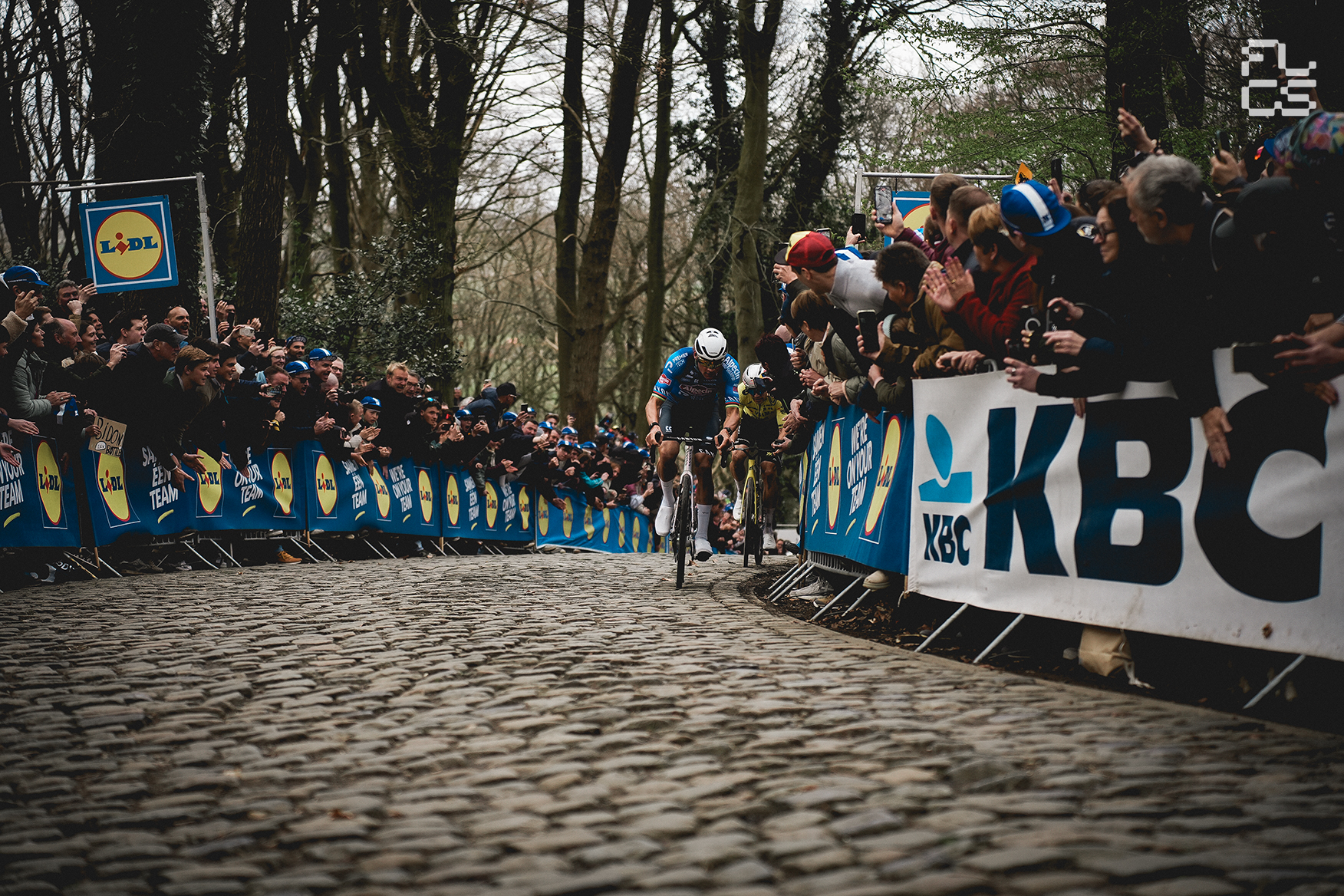
He did not stop trying. On the long roads between the Kemmelberg and Ieper he rode alone with the determination of a man who refuses to accept arithmetic, and coming into Ieper he found himself suddenly and unexpectedly close — close enough that one final effort seemed possible. The road tilted slightly upward. “It’s false flat there,” he would say afterward, “and I just hit my ceiling.” He cracked briefly, then reset and continued, because the peloton was still behind him and the race was still his to lose. “Maybe we would have stayed three up,” he said, “but they decided otherwise.” He was satisfied with his day, he said, even as he was already framing the next one.
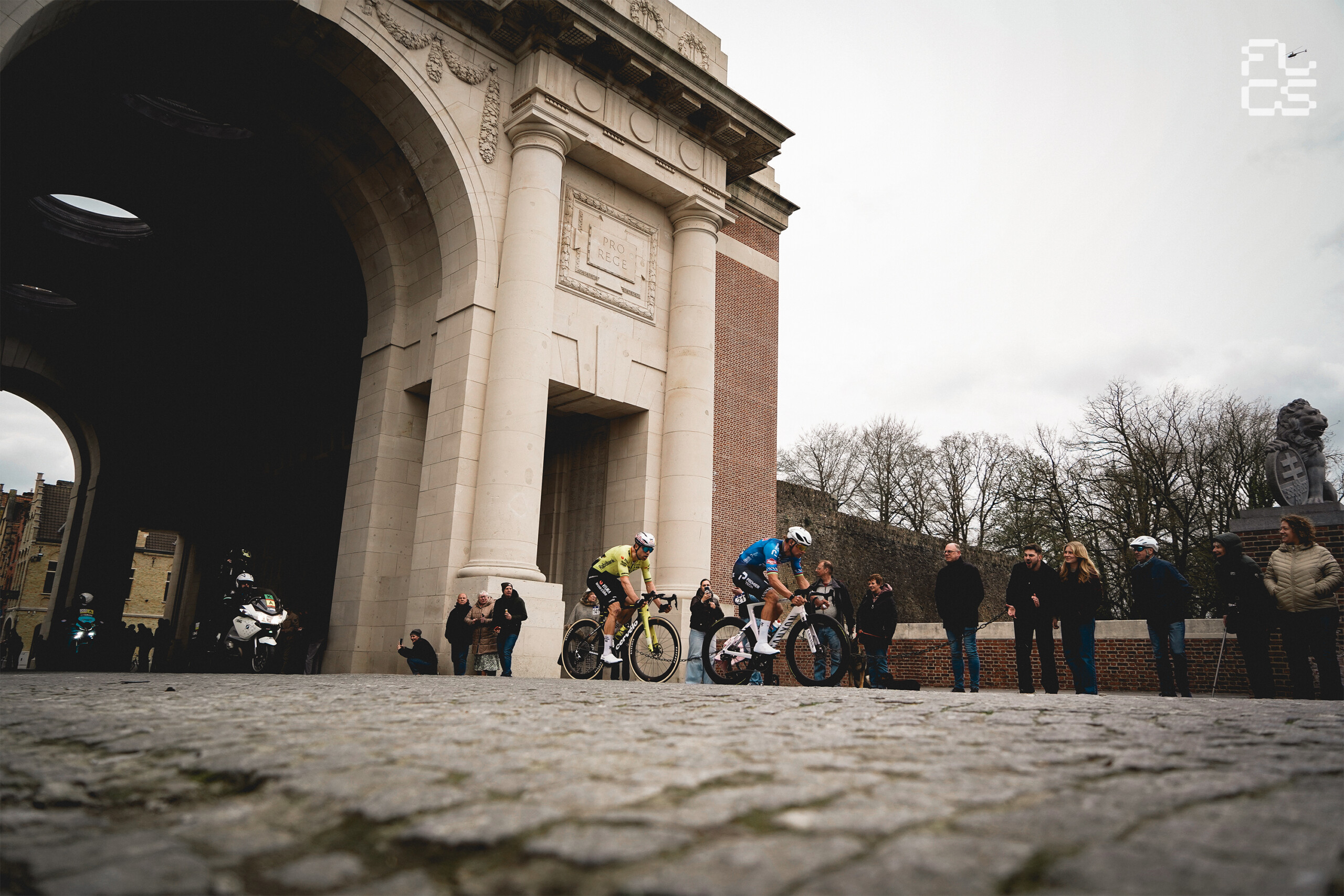
Up the road, Van Aert and Van der Poel were working together. After the Kemmelberg descent, Van Aert tapped his rival on the back and immediately took a pull — the gesture of two riders who have raced each other often enough that half a word suffices. They are not friends in the sentimental sense but they are profoundly familiar with each other’s rhythms, and this cooperation had the appearance of something that might last all the way to Wevelgem. The peloton, watching them on the road ahead, appeared to disagree.
The Chase
Vermeersch was caught at 14 kilometers. Six riders working in concert absorbed him and then continued past, the gap to Van Aert and Van der Poel already down to 35 seconds with 10 to go. The peloton was not a large one — perhaps 40 riders — but it was efficiently organized around three teams that wanted three different sprinters at the finish, and their common interest in the catch made the arithmetic simple.
Jonathan Milan had been the race’s most dangerous sprinter and he was gone. He had needed a spare bike earlier in the race and managed, somehow, to stay in contention. But in the final kilometers he needed a second bike, and a camera operator who attempted to hand him a musette bidon drew a furious response from the Lidl-Trek staff car — the kind of roadside altercation that appears as a footnote in the results but represents, for the rider, the specific rage of a race slipping away. Milan effectively dropped out of the picture. Luke Lamperti, the young American sprinter with the legs to trouble the best on a flat finish, punctured with no team car close enough to help. He watched the peloton ride away from him in a scene cycling offers with punishing regularity to riders who deserve better.
At five kilometers, with the gap at 12 seconds and the two leaders almost certainly to be caught, Alec Segaert of Bahrain–Victorious did something that briefly redrew the race’s possibilities. He accelerated out of the peloton with no lead-out and no guarantee of anything except the knowledge that he was one of the strongest rouleurs in the bunch, and he closed 12 seconds in what felt like moments. He reached Van der Poel and Van Aert, and for approximately 90 seconds there were three riders out front again and the sprint was no longer a certainty.
It was not enough. The peloton behind was not going to stop for sentiment, and the roads between Ieper and Wevelgem are long and straight and merciless to small groups on exposed days. The gap yo-yoed but never stabilized. With just under two kilometers remaining, Segaert attacked alone — one more calculation, one more gamble — and rode clear briefly before the peloton took him back. Van Aert and Van der Poel had already been reabsorbed. The race would end in a sprint, a smaller sprint than anyone had imagined at the start of the day, on a finish line that had been waiting patiently all afternoon.
The Sprint, And Its Aftermath
Jasper Philipsen had been, for the preceding hour and a half, the most invisible important rider in the race. He had Alpecin–Premier Tech working for him, but beyond that he had Van der Poel working for him — the simple fact of his teammate’s presence up the road meant that every team chasing Van Aert and Van der Poel was simultaneously doing Philipsen’s lead-out work. He stayed near the front, moved up when required, and allowed the race to come to him. “It was the ideal situation for our team,” he would say afterward, with the understatement of a man who has learned that the ideal situation does not require commentary.
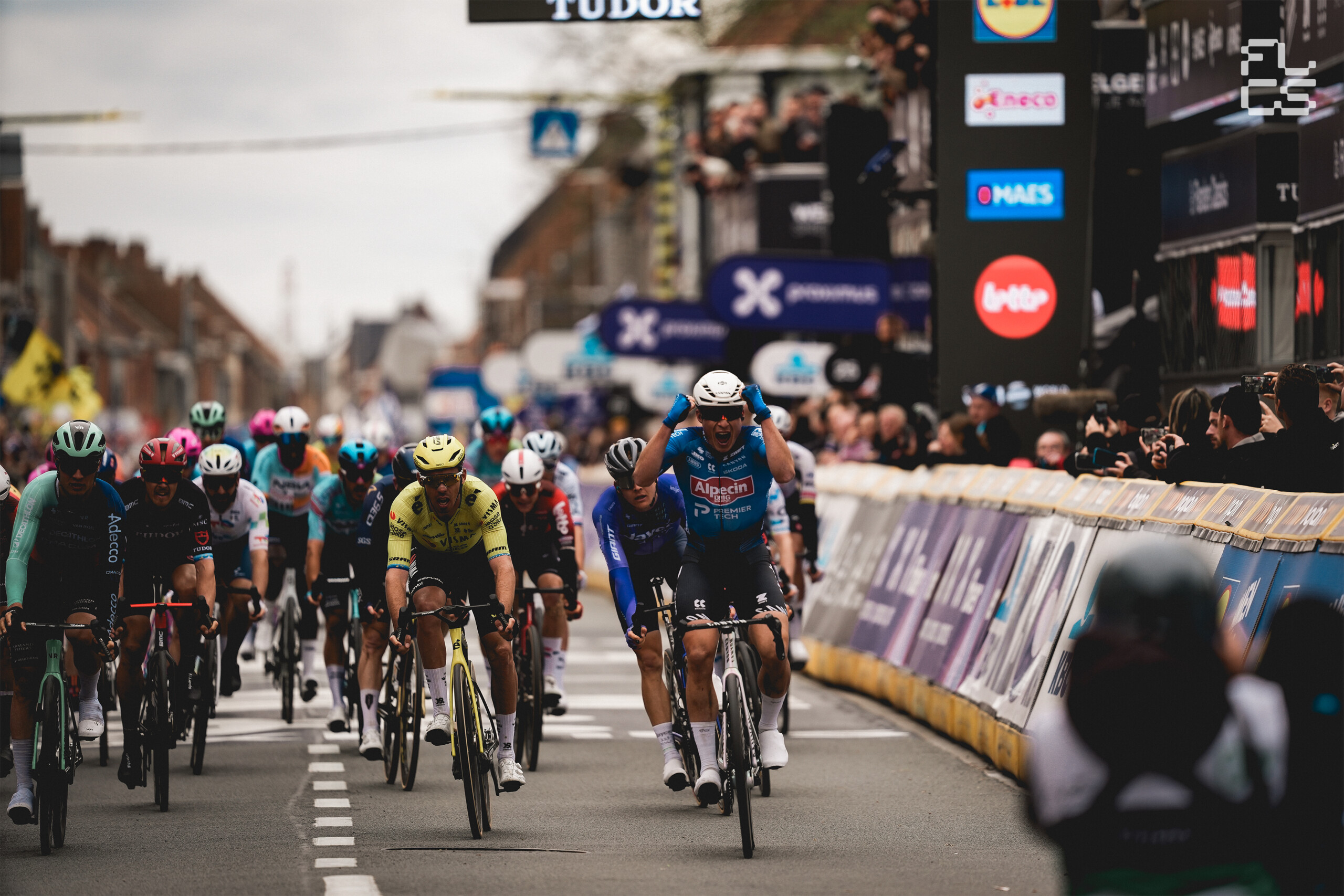
Jonas Geens and Florian Sénéchal delivered him precisely. Cees Bol opened the sprint for Tobias Lund Andresen but positioned himself fractionally off the barriers — not an error, Andresen would insist, simply a line that left a gap. Philipsen found it, drove through it with calm authority, and had Andresen beaten well before the line. Christophe Laporte arrived third. Arnaud De Lie was fourth.
The sprint had one more scene to play. Jordi Meeus, who had been Red Bull–BORA–Hansgrohe’s designated sprinter and who had reason to expect a result after what his team had done in the chase, found himself shoulder to shoulder with Laporte in the final 200 meters, two riders seeking the same space with equal conviction. The space was not there. Meeus was the one who had to brake, who felt the barriers approaching and unclipped rather than crash, who watched his sprint chance close in real time. After the line he went directly to Laporte and delivered his verdict without much editorial polish.
“What the f*ck, man!” he said. “You could have braked a little. You just pushed me into the fencing.” Laporte’s response suggested he held a different view of the sequence of events and of which rider bore the primary responsibility for braking. It was an argument conducted in the heat of a sprint finish and resolved, as these arguments generally are, not at all. Andresen, asked about Bol’s lead-out, refused to apportion blame. “The last thing we should say now is that he did something wrong,” he said. “He didn’t move off his line. You’d think it wasn’t possible to bring those two back — but the team showed how strong we are. Working with the other teams was great.”
Laporte, third, was brief. Van Aert had been very strong, the peloton had come back, he had done everything in the sprint that he could manage and it had not been enough. Van Aert himself, when he found his way to the finish, noted that his oldest son had been disappointed too. It was the kind of detail that lands differently than a tactical analysis — a reminder of who watches this, and what they want from it, and how it feels when the race ends the wrong way.
Van der Poel, who had ridden a calculated race and lost the calculation only in the final kilometers, reflected that he had always ridden with the thought that Philipsen was still coming back. It was the acknowledgment of a man who had done what he said he would do and been beaten by the plan he had said would be the plan.
Vermeersch was, of all the riders who did not win, the most forward-looking. He had ridden better than most men could manage against those opponents on those roads. Decathlon had been clever, he said — they got the race back and there was nothing more he and his two companions could have done against a collective pursuit of that quality. He had finished in the top ten at the Omloop and stood on the E3 podium. He said he was satisfied, and then he looked toward the following Sunday. “Next week Tadej is there for the Ronde,” he said. “I’m looking forward to it.” The smile carried equal parts consolation and threat.
For Philipsen, the victory was the 60th in the race’s history, and one of the purest expressions of the sprinter’s art in a race that does not usually favor that art. He had survived terrain designed to eliminate him, sheltered behind the aggression of a teammate willing to do the suffering on his behalf, and then converted the chaos of a collapsing two-man breakaway into a sprint that suited him exactly. He timed it without apparent difficulty and won it without apparent doubt. It is not the most dramatic way to win In Flanders Fields. On a Sunday like this one, it was the only way available, and he took it.
IN FLANDERS FIELDS • MIDDELKERKE–WEVELGEM • 240.8 KM • 29 MARCH 2026
| Pos. | Rider | Team | Time |
| 1 | Jasper Philipsen | Alpecin–Premier Tech | 5:08:03 |
| 2 | Tobias Lund Andresen | Decathlon CMA CGM | s.t. |
| 3 | Christophe Laporte | Team Visma–Lease a Bike | s.t. |
| 4 | Arnaud De Lie | Lotto–Dstny Intermarché | s.t. |
| 5 | Robert Donaldson | Jayco–AlUla | s.t. |
| 6 | Matteo Trentin | Tudor Pro Cycling | s.t. |
| 7 | Luca Mozzato | Tudor Pro Cycling | s.t. |
| 8 | Aimé De Gendt | Pinarello Q36.5 | s.t. |
| 9 | Jonas Abrahamsen | Uno–X Mobility | s.t. |
| 10 | Jasper Stuyven | Soudal–Quick-Step | s.t. |
(Visited 33 times, 33 visits today)