
Let’s kick this off with a fun stat: the Toronto Maple Leafs are the only team to have not won a hockey game since the NHL resumed after the Olympics. Eight games, eight losses, six of them in regulation, and five of them by three goals or more.
If you look a little deeper, you’ll see that Toronto has actually only won three of their last SEVENTEEN GAMES. To jog your memory, two of those wins were against the league’s two worst teams, Vancouver and Calgary, and the third was against Edmonton in the last game before the Olympics. Not exactly a murderers’ row.
Yet, that three-game winning streak was supposedly enough to convince Brad Treliving and management that perhaps this season could be turned around. That they would ignore the six-game losing streak they had before their Western road trip, and wait to see how the team looked coming out of the Olympic break. As it turned out, the team looked terrible, just as it had all fucking season.
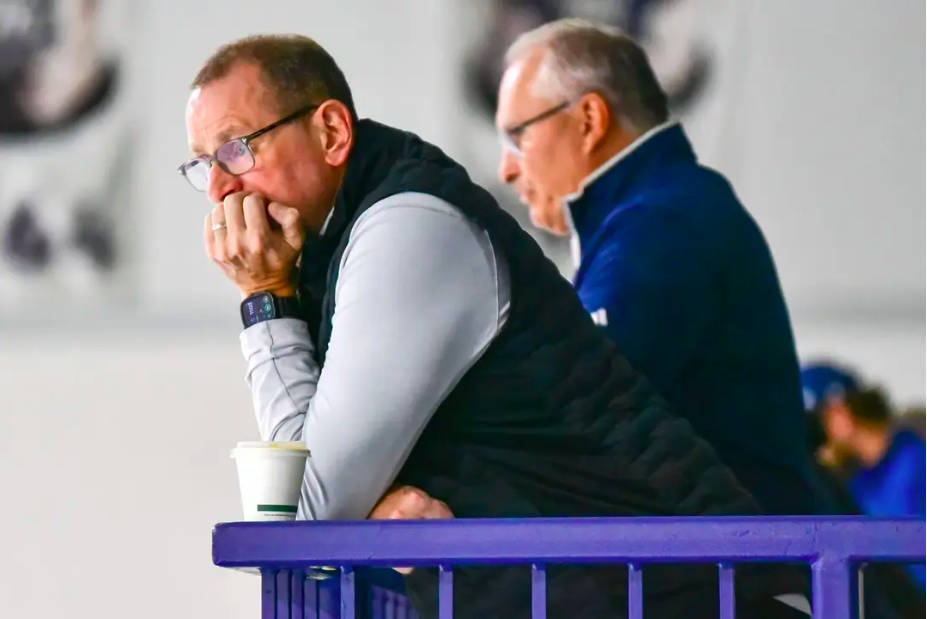
Treliving’s inability to be proactive and make any consequential decision until he absolutely has to is one of the many reasons he should not be the Leafs’ general manager past this season. The trade deadline was a perfect example and represented the Leafs’ on-ice performance this season: weak and uninspiring.
The Leafs’ most-valued pending unrestricted free agents, Scott Laughton and Bobby McMann, were not traded until the absolute last possible second. Left with no other option but to move both players or let them walk for nothing at the end of the season, Treliving backed himself into a corner and got underwhelming returns.
The pick acquired for Laughton, a conditional third-rounder, is especially painful considering Toronto traded a first-round pick and one of their top five prospects, Nikita Grebenkin, for Laughton twelve months ago! Meanwhile, after reports that McMann, who is on pace for 25 goals this season and makes less than $2M annually, could fetch as much as a first-round pick, Treliving received just a second and a fourth rounder for his services.
It is comically poor asset management, and the fact that Nic Roy was traded for a first-round pick the day before the deadline only proves further that Treliving did not maximize the value of Laughton and McMann. By late January, everyone who follows the Leafs knew they would not make the playoffs this season… except those who run the team.
Had Treliving taken charge of the situation and accepted that his team would be sellers, he would have given himself more time to deal with players like McMann and Laughton and, in theory, gotten a better offer. Instead, he had a nice vacation and hoped that the team would magically turn things around after the Olympics.
The 2026 trade deadline was supposed to be a chance to restock the cupboards and give the Leafs assets to quickly retool for next season. Instead, it left them with the exact same number of picks in the first two rounds of this year’s draft as they had before the season: zero.
When you consider just how far Toronto has fallen this season from where they finished last year, the fact that their general manager didn’t make a single trade until the day before the trade deadline is almost unfathomable. Before dealing Nic Roy on March 5th, Treliving’s last deal was on July 17th when he traded for Dakota Joshua.
Not even a bottom-six swap just to shake things up, or a late pick for a depth defenseman. He just kept rolling out the same lineup that has given up the most shots against in the league! No one sits on their hands better than Brad Treliving.
In professional sports, letting things play out is rarely a winning strategy. You have to have a plan, a direction, and it’s clear the Leafs have niether of those things. Treliving said as much when speaking to the media on Friday. He sat back, watched his team be outplayed almost every night, and did absolutely nothing to improve things.
You could excuse Treliving’s reluctance to trade anyone if he made another personnel decision, like firing the coach, but that didn’t happen either. Midseason coaching changes have proven time and time again to work quite well for a struggling team. Just look at the success the Columbus Blue Jackets have had since firing Dean Evason and replacing him with Rick Bowness.
How can you not wonder what could have been if Treliving had done something similar when Toronto went into the Christmas break sitting last place in the division?
The Leafs are in the midst of their third losing streak of five games or more and their longest losing streak in over a decade. Craig Berube is still the head coach. It’s extraordinary.
(Admittedly, at this point, the Berube is doing a perfectly fine job of leading the tank for a top-five pick.)
Toronto has been bad since the season began. There was plenty of time to realize that what they were doing was not working. So, when the president of MLSE, Keith Pelley, issues a letter stating that the team struggled this season due to injuries and a condensed schedule, it’s hard not to worry that the organization is reverting back to the days of the late aughts and early 2010’s.
We’ll know for sure whether the Blue and White are doomed for a dark period similar to the post-lockout, pre-Auston Matthews era based on what happens this summer.
The offseason that lies ahead of the Toronto Maple Leafs could be a franchise-defining one. If the organization makes the right decisions, they have a chance to make this season a blip and get back to contending as soon as next season. Especially if the team manages to land in the bottom five and keep their first-round pick, which is becoming more and more of a possibility with every loss they take.
Craig Berube will be fired once the season ends; I am almost certain of that, but if Pelley and ownership allow Treliving to stick around, they are doing so out of complacency and without any rationale. Treliving has shown zero signs that he is capable of turning this team back into a contender, and given what the Leafs have in terms of assets, you need someone willing to get creative and take risks if the team is to compete again next season. Brad is not exactly someone you would describe as a risk-taker.
Furthermore, consider the situation you’d put yourself in if you decide to fire the coach but keep the general manager who hired him. You’re setting yourself up for more dysfunction.
I’d assume it would go a little something like this: Treliving hires someone to replace Berube. Treliving gets fired because he couldn’t fix the problems he created, leaving the coach he hired as a sitting duck. You bring in a new GM who wants to hire his own coach, and now you have a disconnect between the GM and the head coach, likely leading to the head coach Treliving hired being fired, ANOTHER coach being brought in, and this entire cycle repeating itself.
Does that sound like something a smart organization would do?
Treliving’s had three years to run the team, and not only has the team gotten demonstrably worse under his watch, but he’s also emptied the cupboards in the process.
It’s time to take action and move on.