
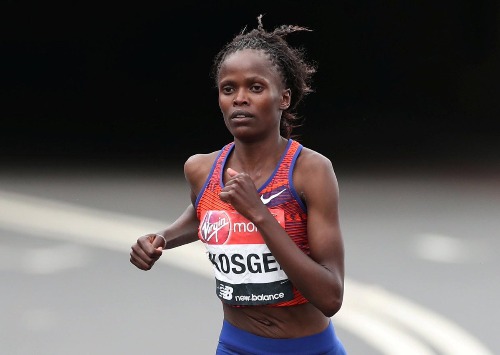
Kebede was there to feel the hard pace that would break her record as she ran with Kosgei up to 30 km, where they crossed in 1:35:53. The hard pace set and maintained by Kosgei through the remainder of the race would cost her as she was eventually overtaken by compatriots, leaving her in fourth. 21-year-old Bertukan Welde secured second place in 2:16:36, and Hawi Feysa outsprinted Kebede for third, both clocking 2:17:39.
The men’s race at the Tokyo Marathon was a showcase for national record-breaking performances. Italy’s Iliass Aouani, fresh off a world championship bronze medal, smashed the long-standing Italian marathon record with a time of 2:04:26, earning sixth place in a world-class field. China’s Feng Peiyou also rose to the occasion, setting a new Chinese national record with a 2:05:58 finish.
These milestones, achieved amid one of the fastest marathon fields ever assembled, underscored the Tokyo Marathon’s reputation as a race where global talent rises to meet formidable conditions—and history is rewritten.
While Japan’s Ryuichi Hashimoto led the early stages of the race, it was the depth of the field and the pace that enabled multiple athletes to achieve record-breaking runs. As the lead pack gradually thinned, the relentless tempo helped push competitors to their limits, resulting in both personal and national bests.
In a fiercely contested finish, Daniel Mateiko, Alexander Munyao, Geoffrey Toroitich, and Takele battled through the final kilometres. Takele’s winning kick secured victory in 2:03:37 as he edged Toroitich, while Munyao and Mateiko followed closely. Muktar Edris set a personal best of 2:04:07 for fifth, adding to the day’s impressive performances.
The Tokyo Marathon once again proved to be a stage where athletes from around the world could chase—and achieve—national records, underlining its status as one of the premier races on the global calendar.