
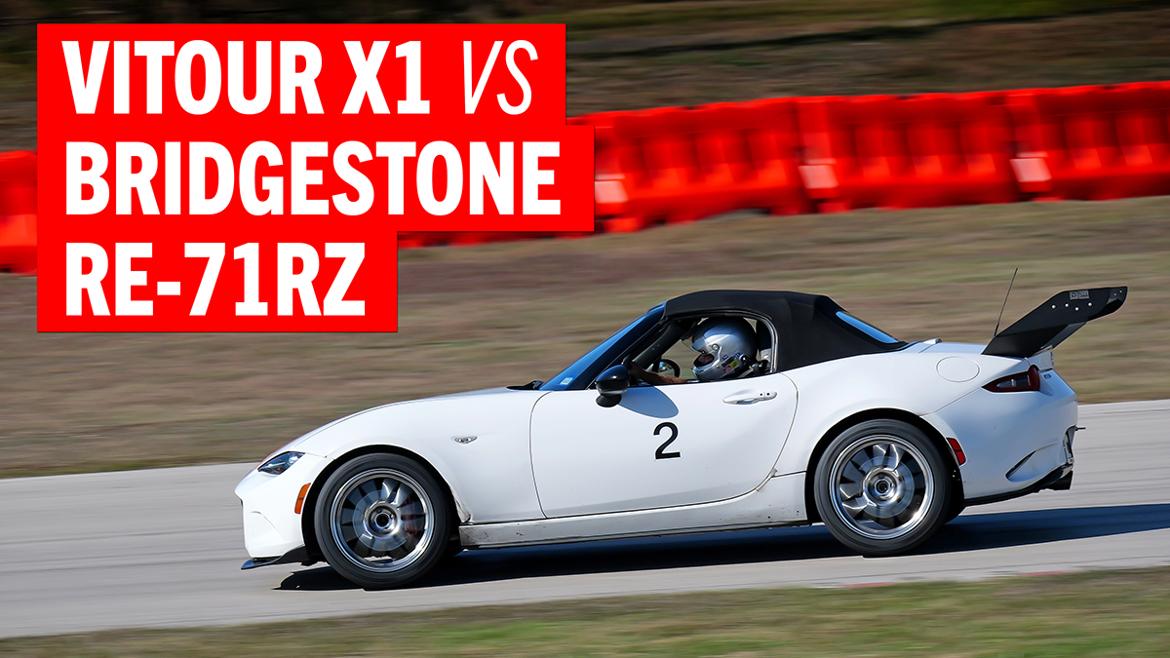
Four characters mark two of the most highly anticipated Super 200 tires for the 2026 season: RZ and X1. Credit the SCCA’s January deadline for new tire eligibility for the timing of these two new releases, the Bridgestone Potenza RE–71RZ as well as the Vitour Tempesta P1 X-01R.
First, a Prequel: Vitour P1 vs. Vitour X1
While waiting for our delayed Bridgestones to arrive, we started with the Vitours. Test conditions were 70 degrees and sunny, so afternoon track temps were close to triple digits.
As the data shows, both tires set identical fast times but did so at different points in the session: While the P1 needed some track time to work up to its full potential, the X1 immediately delivered full grip. In fact, we tip-toed around most of the X1’s out lap so as not to overheat it too quickly while pushing the P1 hard.
Both tires eventually soaked and slowed a bit, but the X1 did so much earlier than the P1. In short, the X1 has the warm-up and consistency traits of a Yokohama Advan A052 with the grip of the P1–a nice combination for autocross and TT.
The Main Event: The Latest Super 200 Tires from Bridgestone and Vitour
Test day dawned mild and cloudy with temps in the 70s. Those clouds started to break by the second session of the rotation, with full sun by the fourth. Temps would climb to mid 80s by the end of the day.
Before starting our actual testing, we did a session on a set of scrubs to clean the overnight dust off the track and dial in our driving to this class of tires. Once things stabilized, we fired up the lap timer and set to work.
Bridgestone Potenza RE-71RS
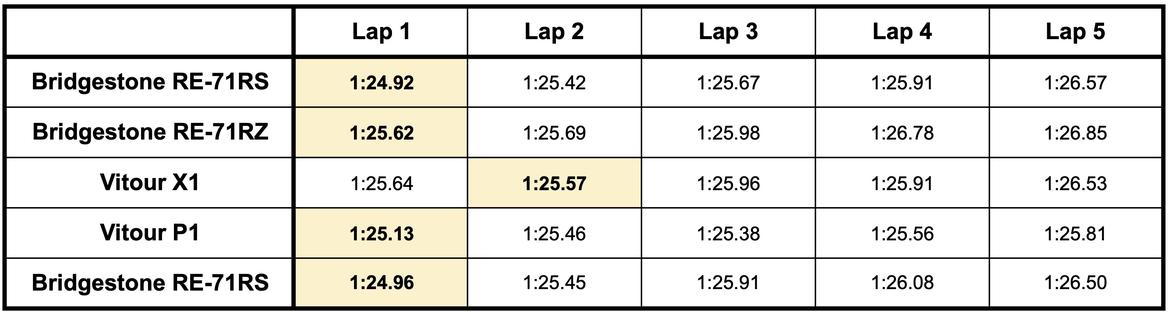
- Fast Lap Round 1: 1:24.92
- Fast Lap Round 2: 1:24.96
On the Road: The RE-71RS provides progressive steering with responsiveness increasing as velocity and load ramps-up. At highway speeds, it exhibits a strong on-center feel for relaxed cruising. Its stiff carcass transmits every bump, though the softer compound soaks up the more minor irregularities. The blocky tread design trades top-of-the-line cornering performance for a constant highway drone that only gets worse as the tread wears.
On the Track: At full tread, the RE-71RS comes up to temp very quickly in warm weather, so we were careful to stay well under the limit on the out-lap. This approach was rewarded with a strong flyer on lap 1 and through the first half of the second lap. Pace then gradually fell off for the next several laps. When cool, the RS is especially good at combined loading events, trail-braking easily and putting power down early on corner exit. As the tire warms, these areas fall off.
Bridgestone Potenza RE-71RZ
- Fast Lap Round 1: 1:25.62
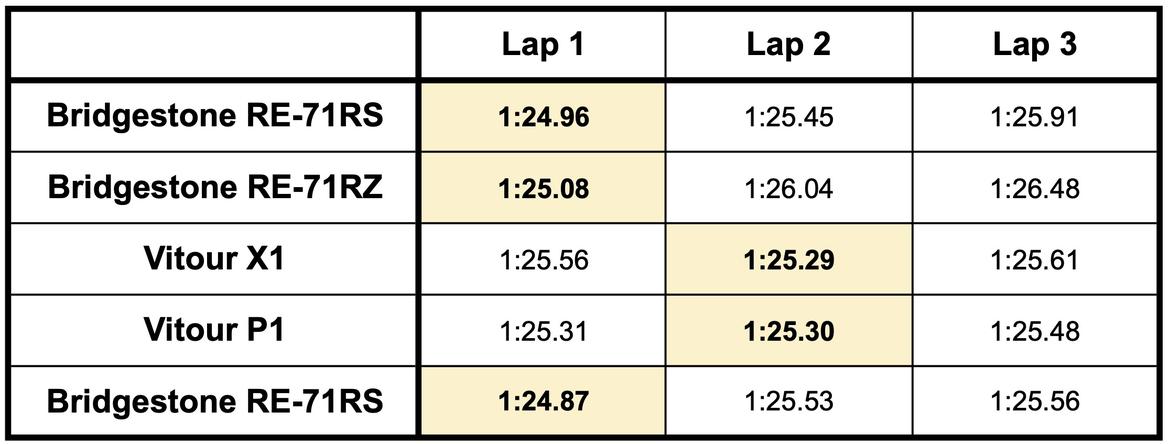
- Fast Lap Round 2: 1:25.08
On the Road: The Bridgestone RE-71RZ was virtually a twin to the RS. Same basic traits, though maybe a touch more responsive and a little less harsh in ride quality.
On the Track: The RE-71RZ delivers a bit livelier feel but is clearly a sibling of the RS. Grip feels higher, though data analysis shows it is not. Instead, there is a handling trait which helps turn the car more as loads approach the limit. This encouraged us to put a bit too much energy into the tire on the out lap in Round 1 and we missed the optimal window for a flyer–more about this and the second round of testing in a minute.
Vitour Tempesta P1 X-01R
- Fast Lap Round 1: 1:25.57
- Fast Lap Round 2: 1:25.29
On the Road: The X1 is taut and responsive on smooth roads, with a medium centering force and small steering dead zone. Its soft compound soaks up road irregularities nicely, and its tread design has no drone.
On the Track: Having driven the X1 already in the prequel, we knew it was best with only moderate energy prep in these warm conditions. After a careful out-lap, we hit it hard onto the front straight only to overcook the first turn, a high-energy, full-throttle 100 mph sweeper right at the limit followed by heavy braking into a slow, downhill run onto a bent straight. We fixed that on the next pass, but corner-exit grip was beginning to fade as heat built up.
Vitour Tempesta P1 P-01R
- Fast Lap Round 1: 1:25.13
- Fast Lap Round 2: 1:25.30
On the Road: The P1’s road characteristics are almost a carbon copy of the X1, with the exception of having a harsher ride quality.
On the Track: Steering response is more immediate with P1 than the Bridgestone offerings, and breakaway a little easier to manage. Having significant experience with this tire, we knew how to prep it perfectly on the out-lap. Further, this particular set was a veteran of several other tests, so it had a little less tread, giving it a bit more consistency. It delivered three and a half solid laps all within a couple of tenths.
Bridgestone Potenza RE-71RS (retest)
- Fast Lap Round 1: 1:24.96
- Fast Lap Round 2: 1:24.87
At the end of this first rotation of testing, we re-ran the RE-71RS to verify that the changing weather had not affected our results. Further, we were not alone on track this day, so track evolution was a risk factor. Fortunately, none of that appeared to have any significant impact as our bracketing session mirrored the opening session almost identically.
Act 2: Should the New Tires Have Been Faster?
New tires present new challenges, and much can be learned during those initial laps. We did not feel that we had given a fair shake to the new Bridgestone, and the prequel testing showed that the new X1 should have run faster, too.
The bracket session ruled out other factors. What to do? Another round, please.
This time we were more careful on the out-laps with both the RZ and X1, basically tiptoeing around. And we were rewarded with better flyers for both.
The Bridgestone RS and Vitour P1 repeated their earlier performances, the former doing so twice as we did a final bracket confirmation at the end. We only did three laps each this time since we were only interested in flyers.
The Sequel
With good comparative data now in hand, we went back to the track two days later for another go. This time, we left out the older Bridgestone RE-71RS and Vitour P1, swapping in a set of Yokohama Advan A052 tires leftover from our long-term test program.
These Yokohamas had been worn to a tread depth of a little under 2/32 inch and were in their prime. That year-long comparison had shown how both the RE-71RS and A052 gained pace as tread was worn down, erasing the full-tread advantage the P1 had once displayed. Note that conditions were much cooler for that initial full-tread data point.
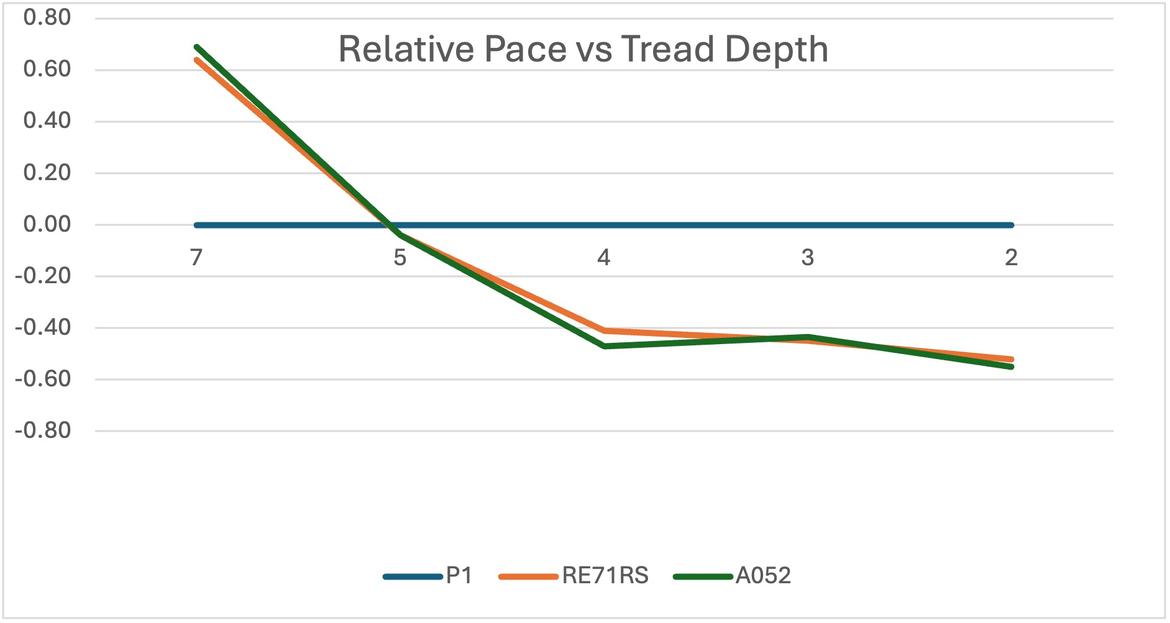
Pace vs. depth chart from the long-term test program.
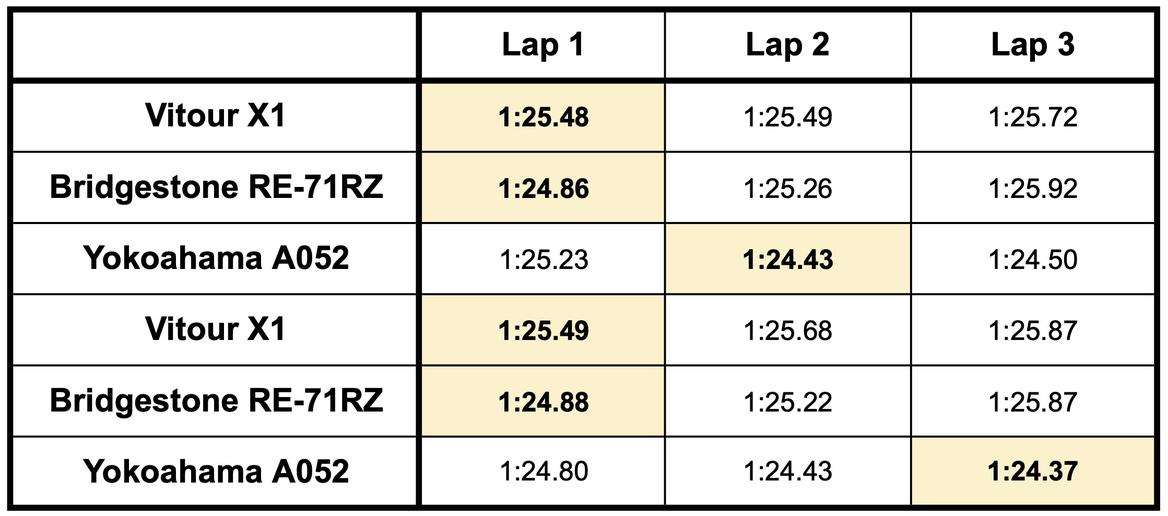
We flipped the run order to cancel out any familiarity bias, and we ended up with very consistent data through two full rotations. Under cloudy skies and mid-70-degree ambients, the delta between the Bridgestone RZ and the Vitour X1 was a little larger on this day.
As expected, though, the worn A052 dominated, although its edgy nature made it a challenge to connect all the dots on any given lap. While we don’t know yet how either the X1 or RZ will perform at lower depths, this follow-up exercise shows there is definitely a gap to be filled.
Conclusions
So, what did we learn?
On pure pace, we’re going to call this one a dead heat. Every tire in this test can deliver a smoking-fast flyer. The real story is in the details.
As we’ve seen in the past, full-tread Super 200 tires are subject to heat soak when pushed hard on track. Getting them in the optimal temperature window and keeping them there is key to best performance.
That’s the basic difference between Vitour’s new X1 and the original P1 P-01R compound. The former turns on immediately, while the latter needs more energy but tolerates it better. Given that, the X1 is going to be the better choice for autocross, with the P1 a better track day tire. Either can work for time trials in the right conditions, delivering enough consistency to provide several fast laps.
At full tread, both the new and outgoing Bridgestones act like autocross tires on track. They need careful prep and deliver a single excellent flyer lap before slowly losing pace as residual energy builds. Previous testing has shown that the RS gets a lot more consistent on track and gains significant pace at lower tread depths at the expense of needing a bit more energy for prep. We expect the RZ to do so as well and will be revisiting to confirm.
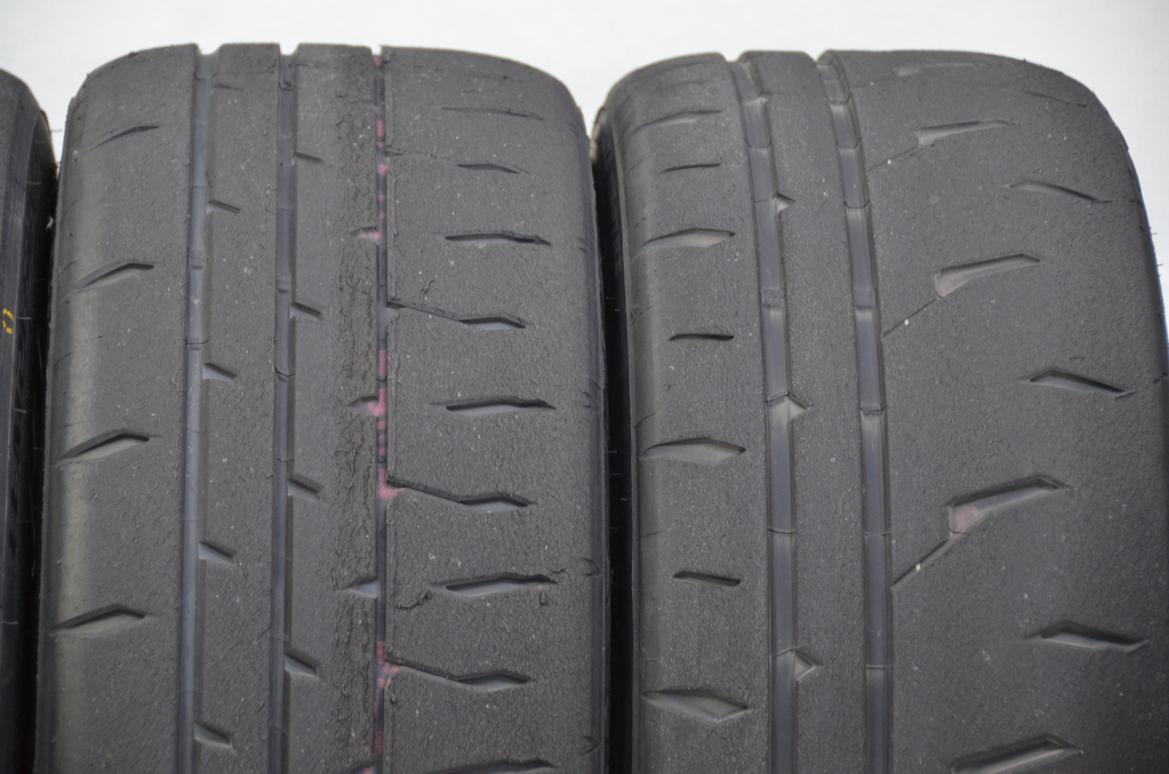
One big thing we noticed with the new Bridgestone: As promised, it seems more durable. We’ve always found the RE-71RS to significantly grain when first put into use, while the RZ resists this. That graining slows the tire’s pace until it wears off. With the new tire, there’s the promise of nailing more fast laps.
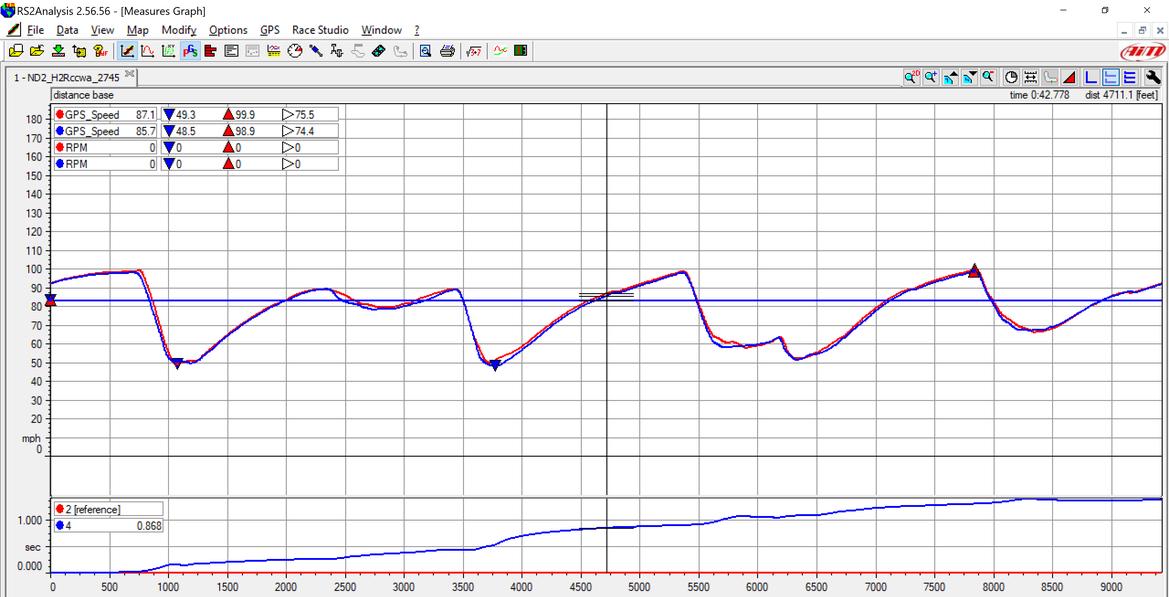
Here’s the first lap flyer for the Bridgestone RE-71RZ overlayed with the third lap. Grip falls off during and after high-energy events like sustained cornering and heavy trail-braking.
Photograph by Andy Hollis
As promised, the new Bridgestone Potenza RE-71RZ doesn’t grain like the outgoing tire.