
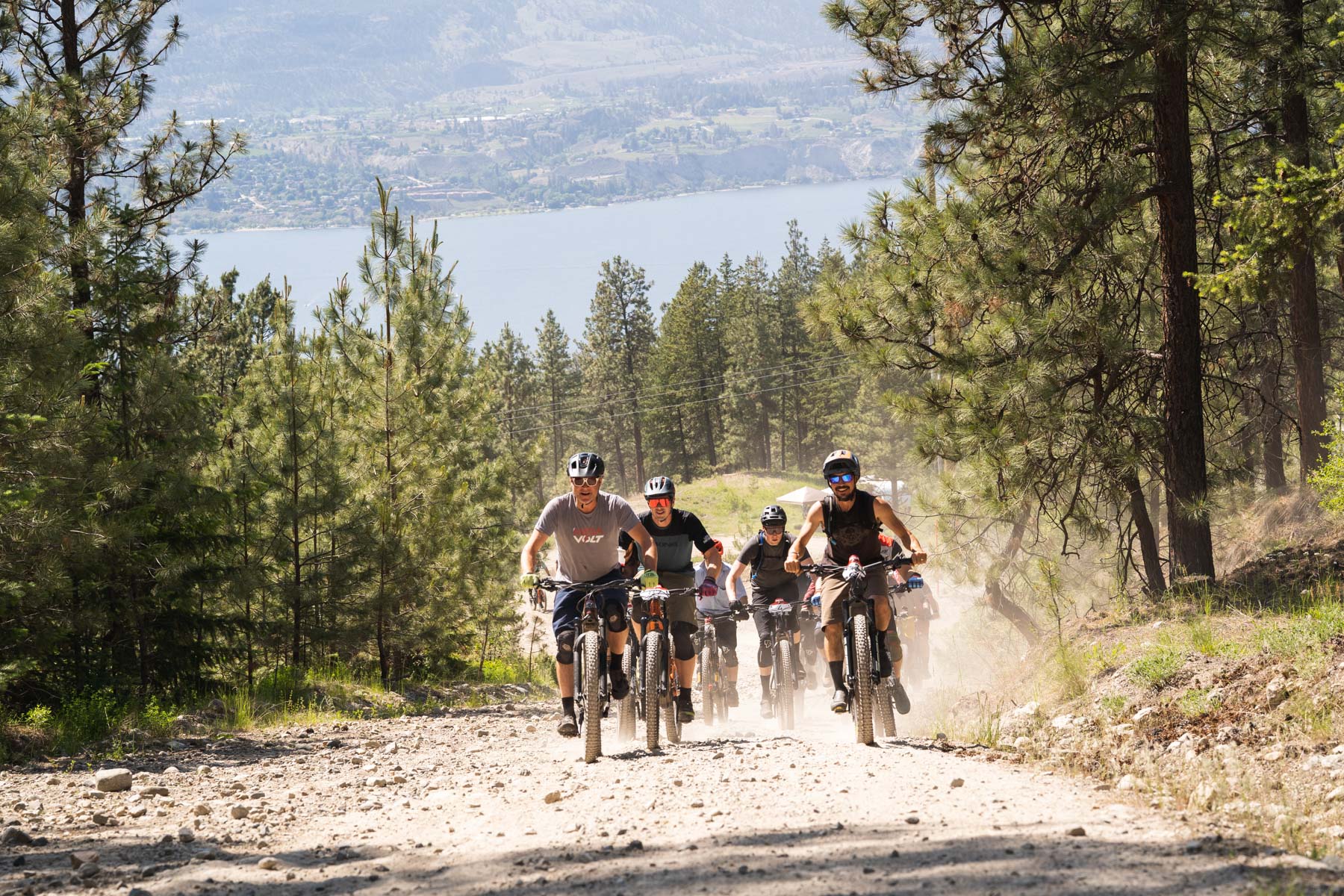
As the world of electric mountain bikes grows and diversifies, it is splintering into different niches. Not just the usual mountain bike divisions, between cross country, trail and whatever “enduro” is. Also between different levels of motor power. That forces riders to figure out what kind of bike they want. Do you want a lot of power, weight be damned? Or do you want less power and a lighter bike that feels more like, well, a bike?
We hit up the growing eMTB festival, MegaVolt (put on by the fine humans at BC Bike Race) and borrowed a couple eMTB’s from Trek to sort out what the advantages of light- vs full-power eMTB’s are, and what the downsides are, too.
Two days, two Treks
MegaVolt delivers two days packed full of riding, with multiple rides each day. That made it an ideal setting to compare the two differently-powered Trek’s back to back. Same sweet Okanagan trails, same conditions, even the same ride buddies.
The bikes? In the lightweight corner: Trek’s Fuel EXe (which is now called Fuel+), the first to use TQ’s diminutive HPR50 system and a bike that helped define the light-eMTB as a category.

For the heavyweight, sorry, full-powered category: Trek’s Rail (Gen 3) with the Performance Line CX system. With similar travel (140mm rear, 150mm front for the EXe, 150mm rear, 160mm front for the Rail), they occupy a similar purpose on trail, but with very different motor systems.
The numbers? The TQ gives Trek’s EXe 50Nm of torque, 360Wh battery, 300W peak power. The Rail nearly doubles all of those numbers, with Bosch adding 85Nm torque, a 625Wh battery and 600W peak power via a Bosch

The lightweight: mini motor versus MegaVolt
I started the MegaVolt weekend off on the Fuel EXe. That ended up being a good call as, even with the assist, keeping up with the mega-powered crowd at MegaVolt required some effort. Well, depending who I wanted to ride with. MegaVolt is part race, part group ride (and 100 per cent party), so there are people going at all different paces.
I started out trying to keep up with the front group, or the back end of the front group. Rallying up climbs in a big group of eMTBers is, if you haven’t tried it, quite the experience. Everyone’s flowing, having fun, talking and still working pretty hard but mostly able to talk. It’s a great time. As one of the few riders on a light-powered bike, though, I was pinned trying to keep up. I soon dropped back to a group where I could match the pace without my heart wanting to jump out up my throat. That was the first lesson of the light bike. It has plenty of power, depending who you’re trying to ride with. But the brute force of the big motors can’t be matched for power, up hill at least.

There were payoffs for the EXe too, though. Any kind of technical climb or fast, rolling section of trail was not only more fun on the EXe, but also not as hard to keep up with the full-powered bikes (and riders). The lighter bike is clearly more agile. The biggest reward was when we pointed downhill for a solid and sustained descent through Naramata’s Three Blind Mice network. The EXe was way more nimble, easier to pick up and move around and way more capable of picking out little doubles and side hits than the big bikes.

Range Anxiety enters the chat
Power isn’t the only factor to consider when picking an eMTB, though. After a riotous descent, the group was left with around five km back on rail-grade to get back to base camp. Everyone on full-power bikes was cruising along with little effort and a good amount of battery left. Me? I was experiencing some not-so-minor Range Anxiety. The battery display on the TQ was dropping perilously towards empty. Then tapped out completely. I was only left a little bit of completely unsupported pedalling. But riding at 30km/h under your own power is very different than with a couple hundred watts of assist. I pedalled the last kilometre out as the group disappeared, then rolled back down the hill to base and plugged the bike in so we could both recover for the afternoon session.

The full-power experience: full steam ahead on the Rail
Next up was the Bosch-powered Trek Rail. Climbing was definitely a more casual affair. It was undeniably more fun to try keep up with the other full-powered riders. Climbing was a little less engaging, and line-choice was more direct than creative. But a lower heart rate and easier breathing turned the climb into an entirely social experience, chatting as we cruised up a significant chunk of elevation.

After taking in the views from the top of Three Blind Mice, it was time to point the Rail back downhill. Compared to the EXe, this as a very different experience. On the upside, the Rail’s extra heft kept it glued to the ground through some sketchy and dusty Naramata corners. But it wasn’t as engaging or lively as the EXe and certainly required more body english to get the Rail off the ground. That’s not a bad thing, but I usually prefer a bouncier, fun-focused route down the mountain than the planted efficiency of the Rail. It was still a great time, of course, but a bit less engaging.
Then again, I wasn’t even sort of worried about making it back to basecamp before lowing power on the Rail. Range anxiety was kept well at bay by the 625Wh battery and I cruised back along the rail-grade connector reliving the afternoon’s descent without having to put in, well, too much effort at all.

Light vs full-power eMTB: Conclusions?
So, what did we learn? Well, it all depends what you want to do with your eMTB, where and who you’re riding with.
If you just want to ride with fitter friends on regular bikes, the light-power bikes give enough power (and then some) to do that and still handle more like a mountain bike. That comes with the caveat that the weight-gap between full-power and light-power eMTB’s is rapidly shrinking.
If you just want to bang out shuttle laps without a truck? Or if all your riding buddies are on full-power bikes? You’re better off matching their power, or you’d better be really fit.