
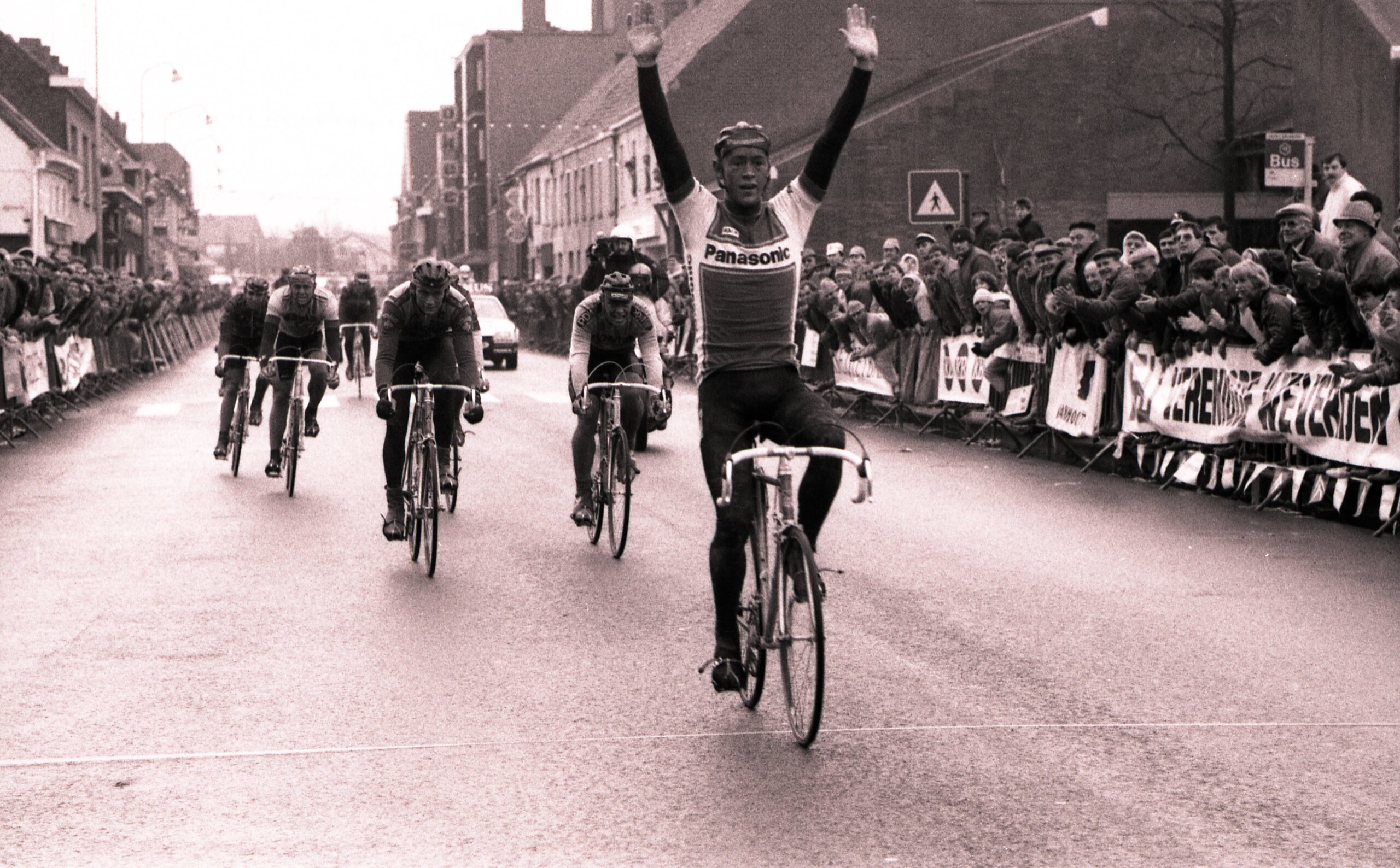
By Steven Sheffield — Every February and March, as the cobbles of Flanders emerge from winter’s grip, the cycling world turns its attention to Belgium for the most demanding stretch of the professional calendar. From the season-opening Omloop Het Nieuwsblad through the brutal bergs and windswept polders to the sacred Sunday of the Ronde van Vlaanderen, a series of races tests riders against terrain, weather, and history. These aren’t just bike races—they’re cultural touchstones in a region where cycling is woven into the national identity. The cobbled climbs have names spoken with reverence: the Oude Kwaremont, the Paterberg, the Kemmelberg, the Muur. The winners join a lineage of Flandriens stretching back generations. The following questions explore the history, heroes, and hallowed ground of the Belgian spring classics, from the season-opening semi-classics through the final dress rehearsals before Flanders’ biggest day.
Q1. Since 1945, Omloop Het Nieuwsblad opens the Belgian cobbled season as the spring classics’ curtain-raiser. Organizers originally named the race Omloop Het Volk after its newspaper sponsor. After Het Volk merged with Het Nieuwsblad in 2009, organizers renamed it. Riders contest the race on the final Saturday of February, often providing the first chance to see who has the form and courage to tackle the hellingen in cold, unpredictable conditions. The Omloop traverses many iconic climbs used in the Ronde van Vlaanderen. Which fearsome cobbled climb, first included in 1979, features gradients over 20% and serves as a decisive selection point in both races?
Q2. Teams contest Kuurne–Brussel–Kuurne on the Sunday after the Omloop, forming the “Opening Weekend” double to assess early-season form. Organizers first ran the race in 1946 to celebrate the region’s post-war recovery. The course loops from Kuurne to Brussels and back. Unlike the hilly Omloop, Kuurne–Brussel–Kuurne favors riders suited to flatter, wind-exposed roads through the Flemish Ardennes and Pajottenland. Which legendary Belgian classics specialist holds the record with three victories?
Q3. Organizers first ran the Bredene Koksijde Classic in 2018, making it the newest early-season race. The course offers coastal racing along the North Sea between Bredene and Koksijde, replacing the defunct Handzame Classic and providing a tune-up the week after Opening Weekend. What notorious weather phenomenon, common along the Belgian coast in early March, repeatedly decimates pelotons and forces organizers to alter courses?
Q4. Since 1968, Le Samyn—formerly the Grand Prix Samyn and now the Ename Samyn Classic—takes place in Wallonia’s Hainaut province, an outlier among Flemish-dominated races. Organizers first called it the Grand Prix de Fayt-le-Franc, then renamed it after José Samyn, who won the 1968 edition and died in a 1969 racing accident. The race honors his memory while giving francophone Belgium its own cobbled classic, featuring the notorious côtes of Hainaut. Which Belgian rider holds the record for most Le Samyn victories, and how many riders have won it more than once?
Q5. Organizers first held Nokere Koerse in 1944 during the last year of German occupation. Named for the small village of Nokere near Kruishoutem, it gained fame for its finale with multiple laps on a local circuit featuring the Nokereberg, a short but punchy climb. What distinctive road surface covers the final stretch to the finish, and why does it produce such dramatic endings?
Q6. Organizers first ran the E3 Saxo Classic in 1958 as Harelbeke–Antwerp–Harelbeke. Over time, it grew from a regional event into a Monument-quality classic, earning the nickname “the little Tour of Flanders.” The race takes its name from the E3 highway, now the A14/A17, which once connected the region. Held on the Friday nine days before the Ronde van Vlaanderen, it covers much of the same terrain as a final dress rehearsal. Ten riders have won both the E3 and the Ronde in the same year. Which Belgian rider holds the record, and in which years did he achieve it?
Q7. Organizers renamed Gent–Wevelgem “In Flanders Fields” in 2024 to honor World War I history and John McCrae’s poem. They first ran the race in 1934 from Ghent to Wevelgem, later moving the start to places like Deinze and Middelkerke. Unlike other Flemish races, it ventures into the Heuvelland near France, where the Kemmelberg and Monteberg provide decisive terrain. The Kemmelberg serves as the signature climb, feared for its savagery more than its length. In which year did organizers abandon its original cobbled south side for safety, and why was it so dangerous?
Q8. Dwars door Vlaanderen (known as the Dwars door België through 1999), held the Wednesday before the Ronde, has run since 1945 as a final test before the Monument. Once regarded as a minor semi-classic, organizers elevated it to WorldTour status in 2019, reflecting its growing importance. The race cuts diagonally across Flanders from Roeselare to Waregem and includes hellingen that appear three days later. Dwars favors attackers rather than sprinters and often produces surprise winners. Only two riders have won Dwars on Wednesday and the Ronde on Sunday in the same week. Name either rider.
Q9. Only a few riders win multiple Belgian semi-classics and Monuments in a single spring. The cobbled season demands so much that even two wins represent a remarkable feat; three or more signals dominance. Which rider assembled the most dominant modern spring, and which races did he win?
See next page for answers.
(Visited 14 times, 14 visits today)