
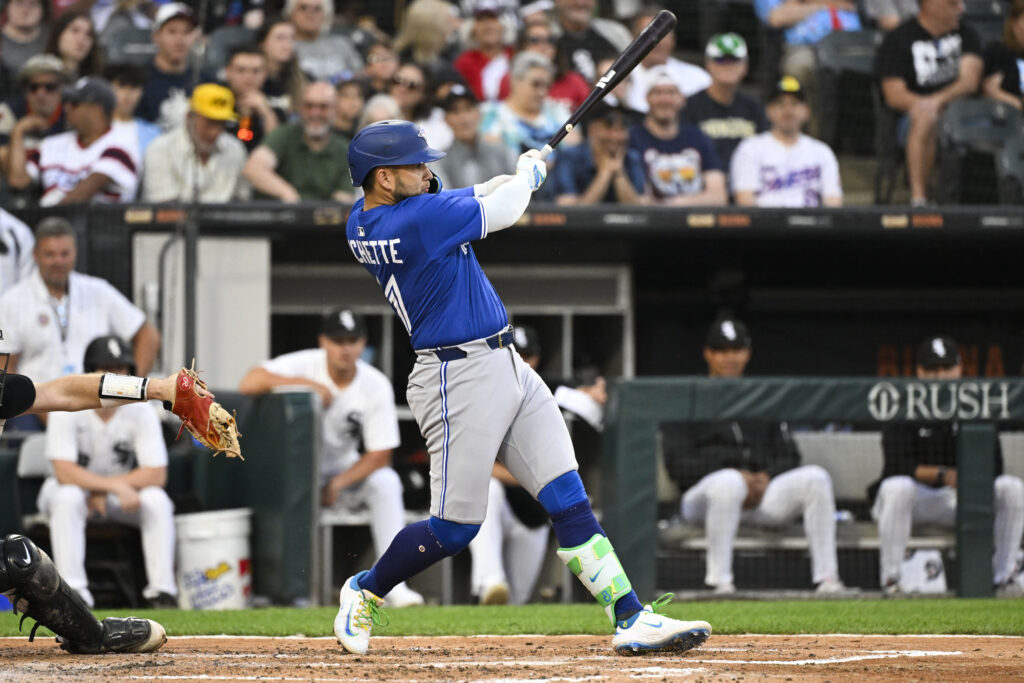
The Mets wasted little time in changing gears after missing out on the offseason’s top free agent. They’ve reportedly agreed to a massive three-year, $126MM contract with free agent infielder Bo Bichette. The Vayner Sports client can opt out of the contract after this season and after the 2027 campaign, and if he chooses to do so he’ll pick up an additional $5MM bonus. The contract, which does not contain any deferred money and affords Bichette a full no-trade clause, is pending the completion of a physical.
It’s a stunning and near-immediate pivot for a Mets club that is barely 12 hours removed from losing out on Kyle Tucker, who just last night went to the Dodgers. Los Angeles outbid the Mets’ reported four-year, $220MM deal with a four-year, $240MM contract that gives Tucker two opt-out opportunities (post-2027 and post-2028). Having missed on that big swing, the Mets now pivot to the market’s next-best bat and next-best all-around free agent, bringing Bichette in on a $42MM annual value that ties Zack Wheeler for the sixth-largest in MLB history.
In landing Bichette, the Mets are not only pivoting from Tucker in arguably the most notable way possible — they’re also keeping him from a division rival that had emerged as the ostensible frontrunner. Bichette met with the Phillies earlier this week, and made him a seven-year offer worth around $200MM. They believed they were close to a deal last night, but the Tucker decision prompted a pivot from the Mets, who swooped in and stole him from their rivals. Bichette now lands a mammoth annual value that could grow even further (via that $5MM bonus) if he opts out and returns to the market next winter, ahead of what would still be only his age-29 season.
Though the fit isn’t necessarily as clean as Tucker would have been for a Mets club that already had a deep infield and was lacking in outfielders, Bichette adds a clear plus bat to manager Carlos Mendoza’s lineup. The 27-year-old (28 in March) has been a well above-average hitter in all but one of his seven major league campaigns — a 2024 season that was cut short by multiple calf injuries and a broken finger standing as the lone exception.
Bichette hit just .225/.277/.322 in 80 games during that awful 2024 campaign. He not only bounced back in 2025 but turned in arguably the best performance of his career on a rate basis, slashing .311/.357/.483 with 18 home runs in 628 plate appearances. By measure of wRC+ (134), it was Bichette’s best season since his late call-up during the 2019 campaign (MLB’s juiced-ball season).
Even on its surface, Bichette’s 2025 season looks excellent. It doesn’t tell the tale of his finish, though, which had both positives and one very obvious negative. Bichette actually had a tepid start to his 2025 campaign. The underlying batted-ball data through his first month-plus was strong, but he hit just .275/.316/.363 through the first week of May. From that point forth, Bichette caught fire. Over his next 457 plate appearances, he laid waste to opposing pitchers at a .325/.372/.528 clip. That was 50% better than league-average, by measure of wRC+, and even that doesn’t fully do justice to Bichette’s jaw-dropping summer; over his final 238 plate appearances, the second-generation All-Star went supernova with a .381/.437/.591 slash (187 wRC+).
Unfortunately for both Bichette and the Blue Jays, that previously mentioned “very obvious negative” struck in early September when he suffered a sprained posterior cruciate ligament in his knee and missed the remainder of the regular season. He was also inactive for the early rounds of postseason play, only returning in the World Series. Bichette was clearly hobbled during the Fall Classic, limping to first base with ’88 Gibson-esque speed when putting the ball in play and displaying a lack of range at a new position: second base. Bichette’s shortstop glovework has been panned for years, and the Jays took the downtime as an opportunity to shift the defensively superior Andres Gimenez over to shortstop in his absence.
Despite the clearly injured knee, Bichette’s bat didn’t miss a beat in the World Series. He went 8-for-23 with seven singles and a titanic three-run homer off Shohei Ohtani in Game 7 of the World Series. Had the Jays’ bullpen managed to hold the lead, that would-be game-winner would have trailed only Joe Carter’s walk-off blast in franchise lore. Of course, that’s not how the game turned out, but Bichette’s 442-foot bomb still served to further underscore that even at less than 100%, he was a clear impact bat.
Bichette now carries a lifetime .294/.337/.469 batting line with him to Queens. He’s been 20-35% better than an average hitter every season of his career with the exception of that 2024 outlier, and this past season’s 14.5% strikeout rate was a career-low. He couples those plus-plus contact skills with above-average power and high-end batted-ball data; Bichette averaged 91 mph off the bat this past season (72nd percentile), and his 48.8% hard-hit rate sat in the 83rd percentile of big league hitters.
The question for Bichette and the Mets is how well he can handle a move to third base. His shortstop deficiencies were largely due to sub-par range. He doesn’t have a plus throwing arm necessarily, but it’s closer to average — at least in terms of the average velocity on his throws, as measured by Statcast — than was the case with his bottom-of-the-scale lateral movement. Bichette averaged 82.3 mph on his throws across the diamond last year — below par in MLB but still an upgrade (at least in terms of pure arm strength) over the man he’ll be replacing at the hot corner, Brett Baty (81.2 mph). Bichette may not be a plus defender at third, but even average defense coupled with his bat and good health would result in All-Star output.
Baty could now bounce between multiple positions. He’s played second base and left field in the past, and the Mets would surely be open to experimenting with him at first base, too. The designated hitter slot provides more opportunities for all. It’s a similar range of possibilities to the one faced by Jorge Polanco, who inked a two-year, $40MM deal last month. Polanco will reportedly be used extensively at first base and designated hitter despite having virtually no prior first base experience.
For a team that has preached run prevention for much of the offseason, lining up with Bichette at third base and Polanco/Baty at first probably isn’t how they drew things up originally — but the offseason is a layered beast that rarely unfolds in alignment with even the best-laid plans. Even if the Mets’ infield defense (and outfield defense, for that matter) is lacking, it’ll be solid up the middle thanks to Francisco Lindor and Marcus Semien. It should also be a highly productive offensive unit — particularly if Semien’s bat can bounce back at all.
Of course, the addition of Bichette also makes a potential trade of Baty — and several other infielders — more likely. Clubs seeking third base help include the Mariners, Angels and Pirates (as explored at length yesterday), among others. Any could show interest in Baty, Mark Vientos, Luisangel Acuña and/or Ronny Mauricio. Acuña, Vientos and Mauricio have all reportedly been available throughout the offseason anyhow. Some form of move seems likely, especially when considering both Acuña and Vientos are out of minor league options and looking to bounce back from poor seasons.
From a payroll vantage point, the Bichette contract is all the more staggering. Not only is the $42MM annual value the sixth-largest ever, it’s also only a fraction of what the Mets will actually have to pay due to this signing. New York was already on the cusp of the top tier of luxury penalization. Bichette catapults them $33MM north of that final cutoff point, per RosterResource’s estimates. They’ll pay a 95% tax on the first roughly $9MM of his annual value and a full-freight 110% tax on the remaining $33MM. Assuming an even distribution of his $126MM over the three-year term, the Mets would be paying more than $86MM for Bichette in 2026 alone. If he triggers that $5MM bonus upon opting out next winter, that’d also be subject to a 110% tax, bringing the Mets’ total bill on Bichette to about $97MM for just one year.
Moreover, the signing underscores the minimal amount that many big-market, CBT-paying clubs care about paying the 110% tax on short-term deals marquee players. The Dodgers’ signing of Tucker — just as will be the case with Bichette’s deal — has rekindled public outcry for a salary cap, but the players will likely only use these deals to illustrate the discrepancy between the middle and upper class of free agents; the union will surely argue that a cap would only further expand that gap and point out that half the money paid by CBT offenders is redistributed to other teams (in addition to standard revenue-sharing). That won’t fly with small-market owners, who’ll argue that they can’t compete with this type of expenditure. Both sides will dig in their heels.
It’s also fair to wonder whether this is a short-term blip or a burgeoning trend. Even big-market clubs seem increasingly against long-term contracts. For years, it was the Dodgers who tended to prefer short-term, high-AAV deals. But we’ve now seen the Mets limit their Tucker offer to four years and go three super-premium years on Bichette — while also declining to go beyond three years for Pete Alonso or Edwin Diaz. The Red Sox clearly prefer the trade market to free agency and surprised onlookers by even extending to five years to sign Ranger Suárez. The Yankees have reportedly been stuck on five years for their offer to Cody Bellinger while he seeks a seven-year term. Giants ownership publicly voiced an aversion to signing any pitchers to long-term contracts.
If baseball is indeed moving more toward NBA-style contracts — short term, ultra-high annual value — it’d mark a dramatic shift for a sport whose top players have overwhelmingly (albeit not always) preferred the stability of long-term arrangements, even if that means sacrificing some money on an annual basis. Time will tell, but that will all factor into both parties’ approach at the negotiating table next winter in an offseason that is widely expected to be impacted by a lockout and transaction freeze.
Turning back to the teams directly impacted by today’s signing, the Mets will part with their second- and fifth-highest selections in the 2026 draft as well as $1MM of space from next year’s bonus pool for international amateur free agents. That’s due to the fact that Bichette declined a $22.025MM qualifying offer. By that same token, the Blue Jays will be compensated with an extra pick. That selection will come after the fourth round of this summer’s draft — the lowest possible compensation — due to Toronto’s status as a luxury tax payor.
For the Jays, parting with Bichette has at least seemed possible throughout the winter but began to look more certain once they signed star NPB third baseman Kazuma Okamoto and plugged him into an already crowded infield. There was still some room for Bichette to return, but Toronto’s focus has reportedly been on Tucker. With Bichette now formally out of the picture, they’re lined up to go with Ernie Clement at second base, Gimenez at shortstop and Okamoto/Addison Barger at third base.
As for the Phillies, they’ve made their own immediate pivot, upping their offer to give longtime catcher J.T. Realmuto the third year he’s sought. Less than two hours after the Bichette agreement broke, Realmuto and the Phillies had a new deal in place. Philadelphia had reportedly only been comfortable signing one of Bichette or Realmuto, with the recent preference seeming to be the former. A Bichette signing would likely have led to Realmuto going elsewhere and one of Alec Bohm or Bryson Stott being traded. Trading either feels less likely — but certainly not impossible — now that Bichette is in Queens and Realmuto is staying put.
Even Bichette himself will now have major questions to consider in the near-term future. With a big season, he’ll assuredly opt out of his contract, cashing in $47MM (or thereabouts, depending on the division of salary) for one year and re-entering the market as a 28-year-old who can’t receive a qualifying offer. If he can do that and prove himself capable of playing an average or better third base, he could come out hundreds of millions ahead. That’s far from a given, though, and he’ll need to make that decision against the backdrop of a looming work stoppage.
It’s a dizzying sequence of interwoven, high-priced payouts for star players — the ramifications of which will reach further than we can accurately predict at this time. It seems clear that the Mets have at least one move coming with regard to their infield glut, and they’re still in search of help both in the rotation and in the outfield. With Tucker and Bichette coming off the board within a matter of 15 hours, Cody Bellinger suddenly stands as the top position player available — possibly with several clubs now keying in on him and providing more pressure for the incumbent Yankees to bridge the gap between their five-year offer and his seven-year ask. Will Bellinger similarly pivot to a short-term, high-AAV contract? If so, will that be in the Bronx or with a new club?
Questions abound, and there are surely several moves yet to be made, but the Mets are a more talented and more dangerous team now than they were this time yesterday — even if it’s not due to the player they were originally targeting. Their pivot is likely only just beginning, but adding a prime-aged, multi-time All-Star who has twice led the American League in hits is a pretty good first step in a pivot.
Will Sammon of The Athletic first reported the agreement and contract length. The New York Post’s Jon Heyman added the total guarantee and no-trade clause. Ken Rosenthal of The Athletic added details regarding the opt-outs and lack of deferrals. Jon Morosi of the MLB Network reported that Bichette was likely to play third base in Queens.