
He crashed in Imperia, lost his team, and arrived in Sanremo having done the impossible anyway. Tadej Pogačar’s victory in the 117th Milano–Sanremo was not the one anyone had written for him. It was something considerably more than that.
They had been talking about it since the autumn. Not about whether Pogačar would win Milano–Sanremo—the world champion had already admitted that himself, with characteristic directness—but about when. “A win would mean more to me than a record six Tour de France,” he had said before the start in Pavia, standing in the pale Lombard morning with the Certosa di Pavia as a backdrop. “Because in my eyes, the gap between zero and one is bigger than the difference between four and five.” He had finished third in the two previous editions. The curse of the rainbow jersey—no world champion had won here since Giuseppe Saronni in 1983—did not apparently trouble him. What happened in the middle of the afternoon on the road to Imperia would have troubled almost everyone else.
The 175-rider peloton had rolled out of Pavia at 10.12, crossing the official KM0 into the 117th edition of the Classicissima. Two hundred and ninety-eight kilometres to Via Roma. Past the Certosa, north toward Milan and back, through the Oltrepo Pavese plains and the Lomellina rice fields—flooded and mirror-still in March, reflecting a sky already beginning to suggest what kind of day it would become—south toward Tortona and the Passo del Turchino, and then west along the Ligurian coast to the finish. The longest Monument. The most unpredictable. The one that, as Pogačar said, “can be lost at every metre.” It nearly was.
Pavia To The Turchino: The Breakaway Game
A nine-man escape cleared the peloton within the opening forty kilometres: Martin Marcellusi and Manuele Tarozzi of Bardiani CSF 7 Saber, Lorenzo Milesi and Manlio Moro of Movistar, Andrea Peron and David Lozano of Novo Nordisk—the all-diabetes squad making their presence felt at the sport’s oldest spring monument—Alexy Faure Prost of Picnic PostNL, and Dario Igor Belletta and Mirco Maestri of Polti VisitMalta, who were racing in their Maglia Iconica, a tribute to the squad’s 1990s colour scheme that gave the early kilometres a pleasantly nostalgic quality.
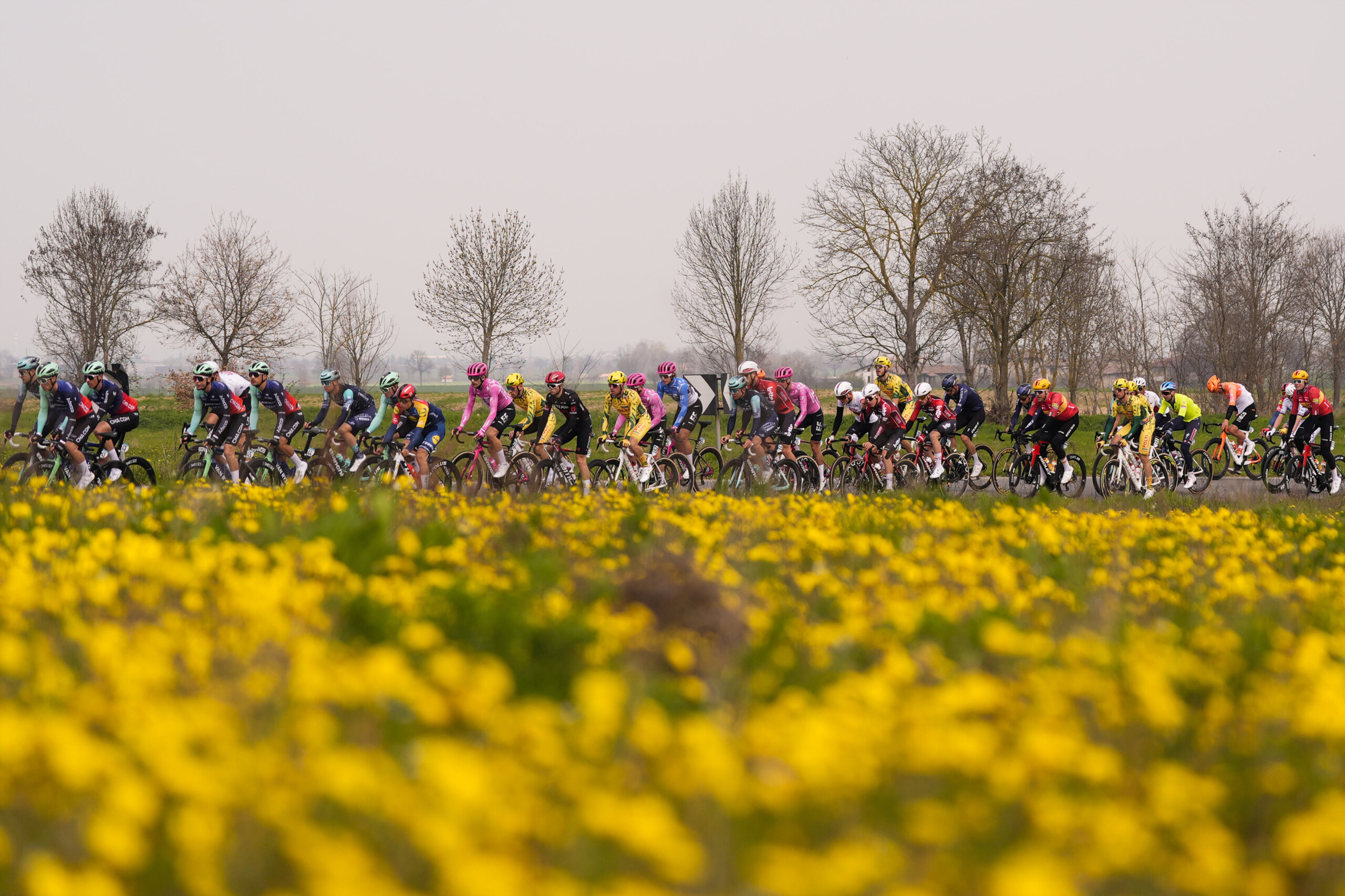
Three riders had inadvertently slipped off the front before the break was established—Silvan Dillier, Johan Jacobs, and Axel Laurance finding themselves with a small gap while the peloton was still organising itself, exchanging glances and sitting up until the bunch closed. Dillier stayed at the front regardless, grinding away on behalf of Alpecin–Premier Tech with the kind of unglamorous consistency that keeps races honest. After two hours of racing the average speed stood at 45.2 km/h; after the first hour it had been 46.5. The break held around four to six minutes through the long Lombard plains.
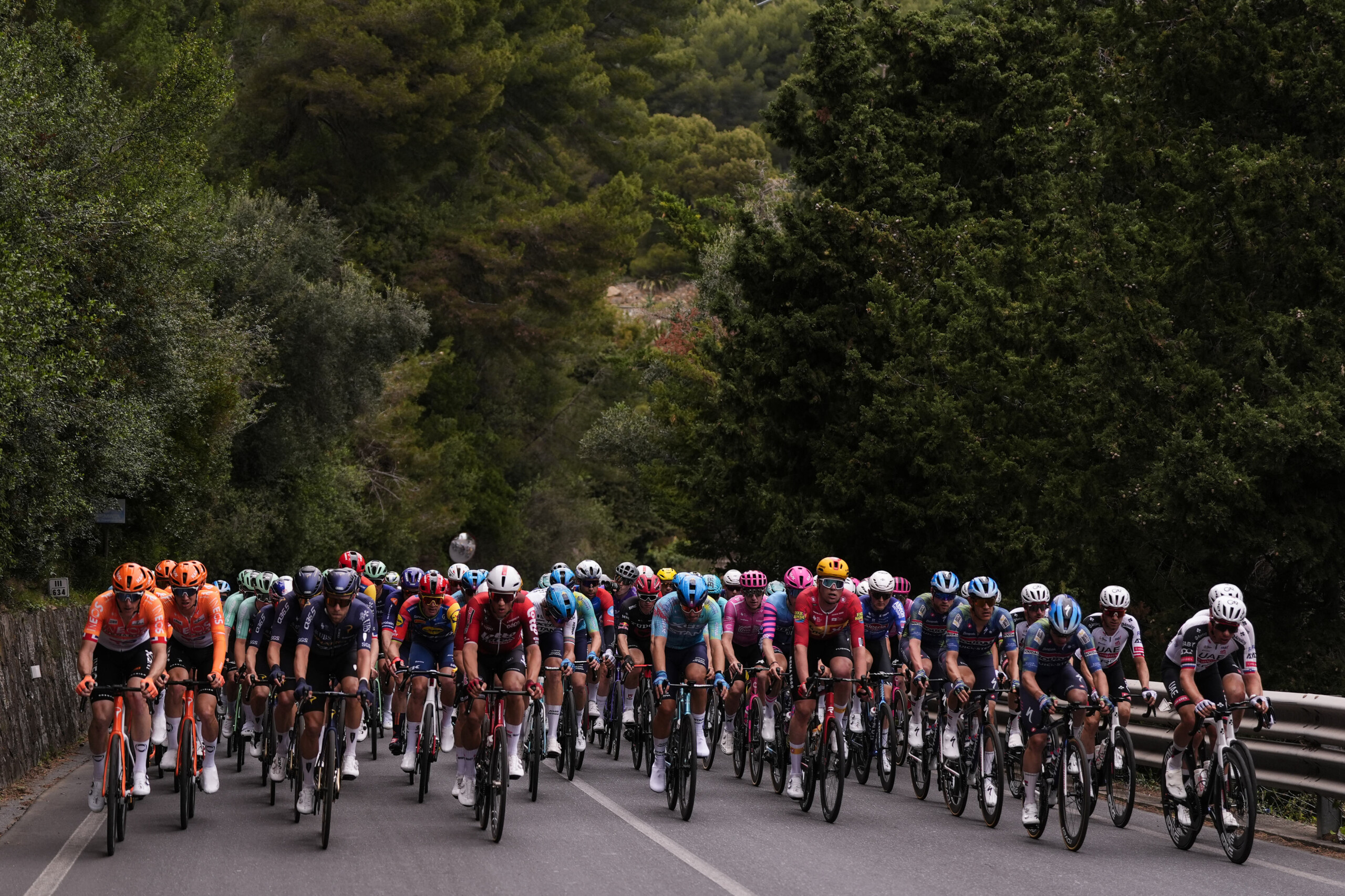
At Ineos Grenadiers, Filippo Ganna had been speaking before the start with the focused candour of a man who had twice come close without converting. “Winning a Monument means making history. That’s my inspiration.” He had been explicit about the tactical problem: if Pogačar attacked on the Cipressa, and if Mathieu van der Poel was not there to chase, then Ganna’s day would likely end before the Poggio. “I hope Pogačar doesn’t drop Van der Poel—that wouldn’t be good news for me.” A crash on a descent took the problem out of his hands before it arose. Michal Kwiatkowski hit the deck, collecting teammates Ben Turner and Connor Swift. Marcel Camprubí of Pinarello Q36.5 also went down. Turner and Swift eventually regained the bunch, sore but mobile. Jan Christen of UAE Team Emirates–XRG, one of Pogačar’s key lieutenants earmarked for Cipressa pace-setting duties, did not—a first significant blow to the defending team’s resources.
The breakaway’s advantage stood at two minutes ten with 42 kilometres remaining as the peloton swept through the Capi sequence—Capo Mele, then Capo Cervo, then the stiffest of the three headlands, Capo Berta. UAE Team Emirates–XRG and Pinarello Q36.5 shared the pacing duties at the front. In front of them, the break was disintegrating. Peron and Lozano of Novo Nordisk lost contact first. Then Faure Prost. Four riders remained: Belletta and Maestri of Polti, and Milesi, and Moro. The gap fell below a minute. The race was about to turn violent, and then the road turned cruel instead.
Imperia: Catastrophe At The Worst Moment
It happened on the approach to Imperia, just kilometres from the Cipressa—the exact worst place and worst moment for a crash of any consequence. The peloton hit a corner and the front disintegrated in an instant. Pogačar went down first. Then Mathieu van der Poel, then Wout van Aert, then Biniam Girmay. Almost every name that mattered on the start sheet found itself on the tarmac or swerving around those who were.
In the pandemonium that followed, it was not yet clear how badly anyone was hurt or how far back the field had splintered. What was clear was that Pogačar, the world champion, was chasing—and that with Christen already out of the race, he now had only Brandon McNulty and Isaac del Toro alongside him. Three riders from the most powerful team in the peloton, the gap to the front still not fully established, the Cipressa beginning in minutes. Van der Poel was also chasing, paced back by Jasper Philipsen. Van Aert was further back still, at a full minute.
“My teammates Florian and Felix gave everything to bring me back to the front. They gave me hope. Without the team, I would have gone straight to Sanremo just to watch the finish.” — Tadej Pogačar
What Pogačar said afterwards was unambiguous about what the crash had meant in the moment. “For a second, I thought it was all over. It happened just before the most important part of the race. Luckily I got back on the bike straight away.” He was generous, immediately and at length, about the two teammates who dragged him back: Florian Vermeersch and Felix Grossschartner. “They gave me hope. Without the team, I would have gone straight to Sanremo just to watch the finish.” By the time the peloton reached the base of the Cipressa, both Pogačar and Van der Poel had made it back. The race was still intact. Just.
The Cipressa: Three Go Clear
Five-point-six kilometres at 4.1 percent. Del Toro hit the front for UAE the moment the road tilted upward and launched Pogačar with the full force of whatever he had left. It was a move constructed for one purpose: to put the world champion at the sharp end before anyone could react. Van der Poel responded. Tom Pidcock of Pinarello Q36.5 latched on immediately—the Briton had spoken before the race with contained confidence about staying “relaxed” through the long approach and trusting that an opportunity would open, and here it was.
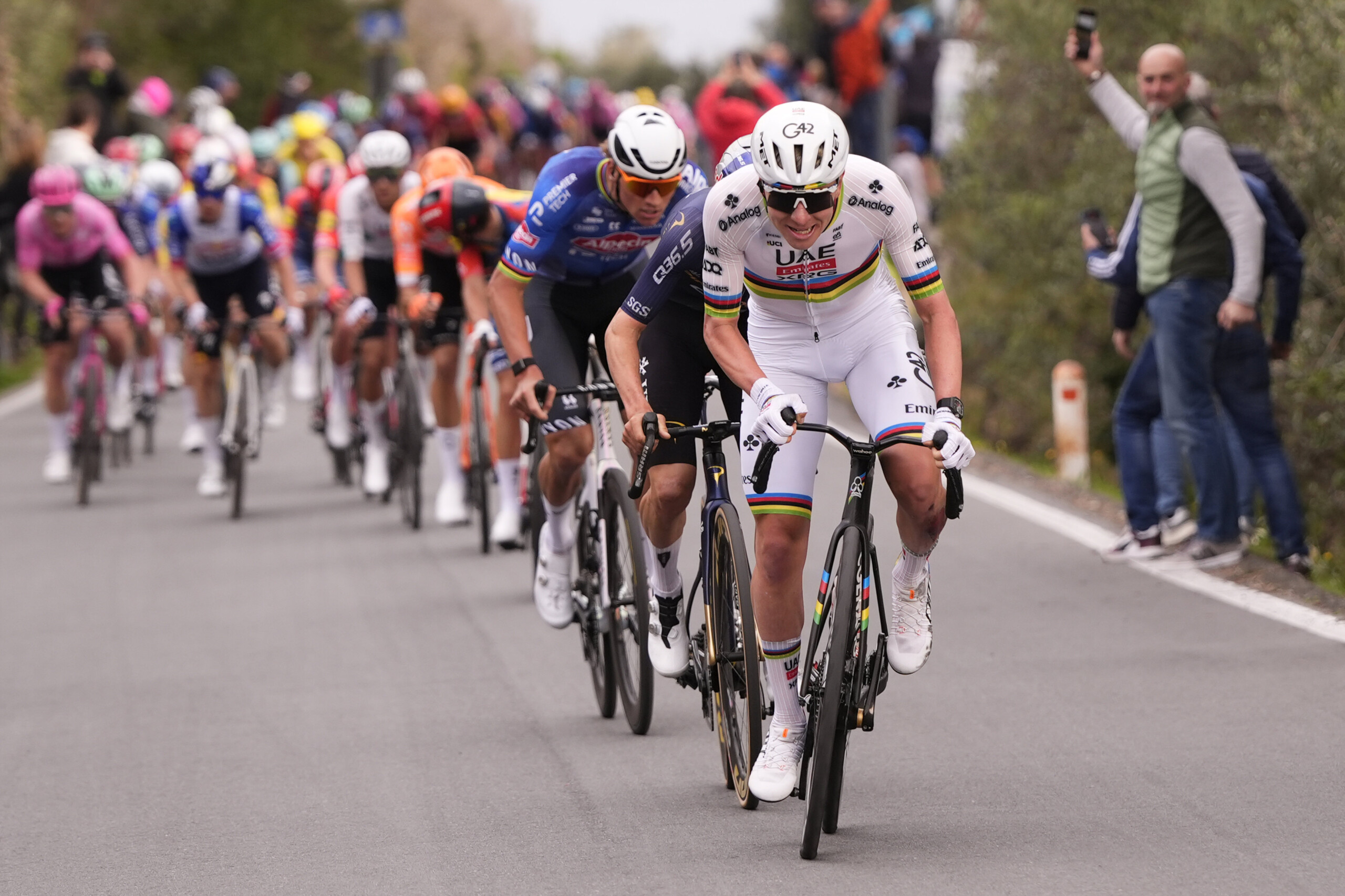
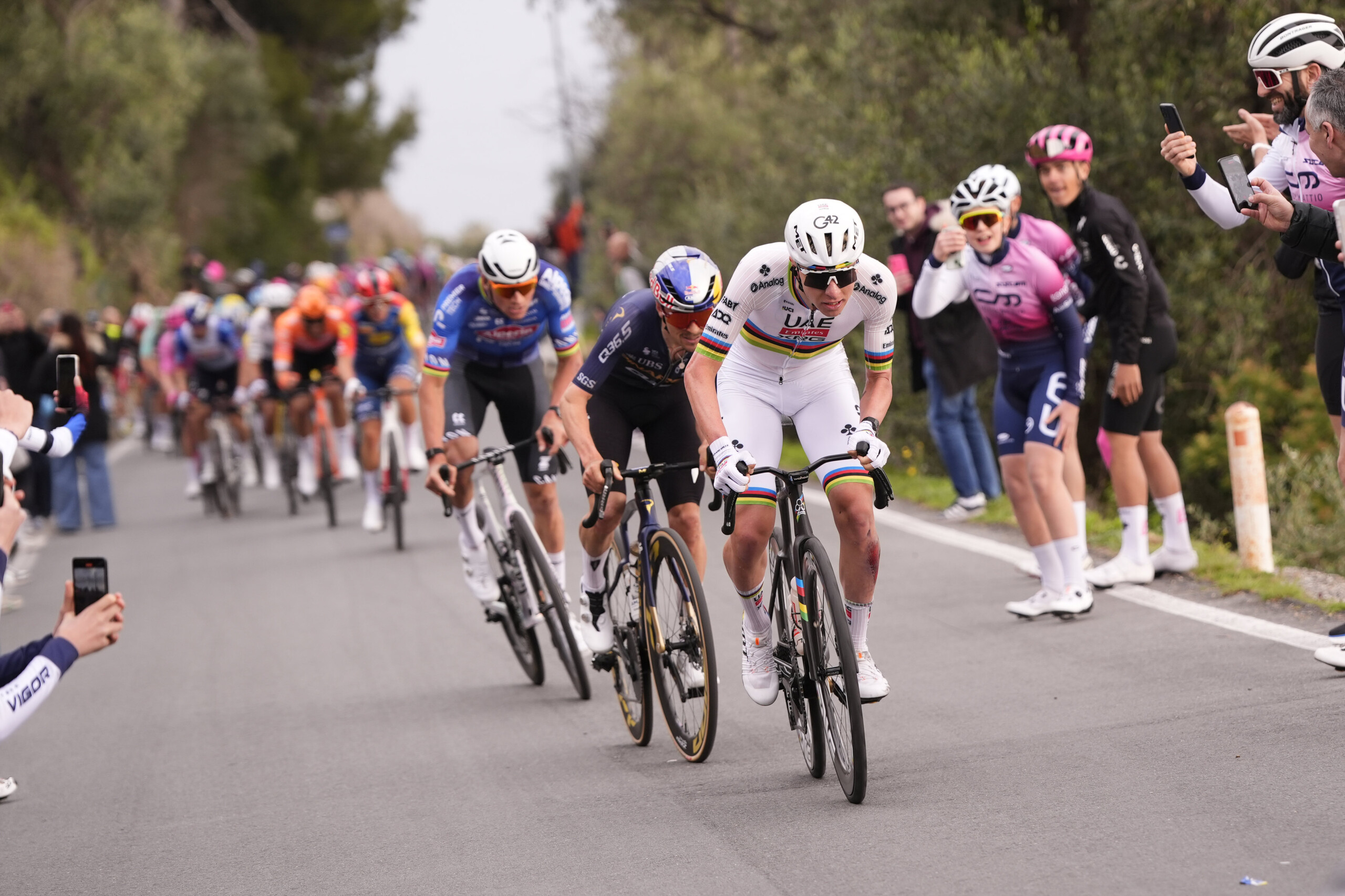
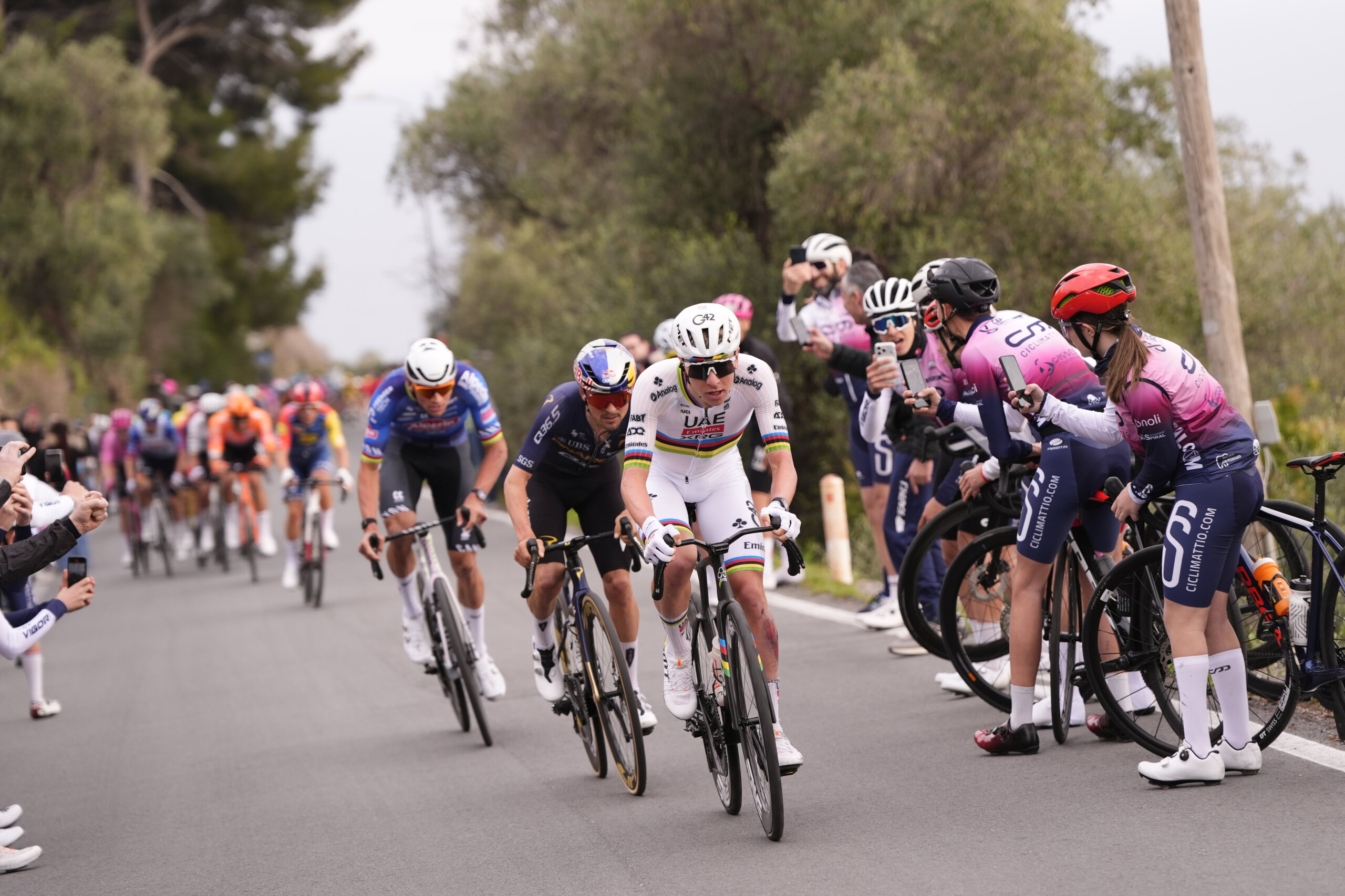
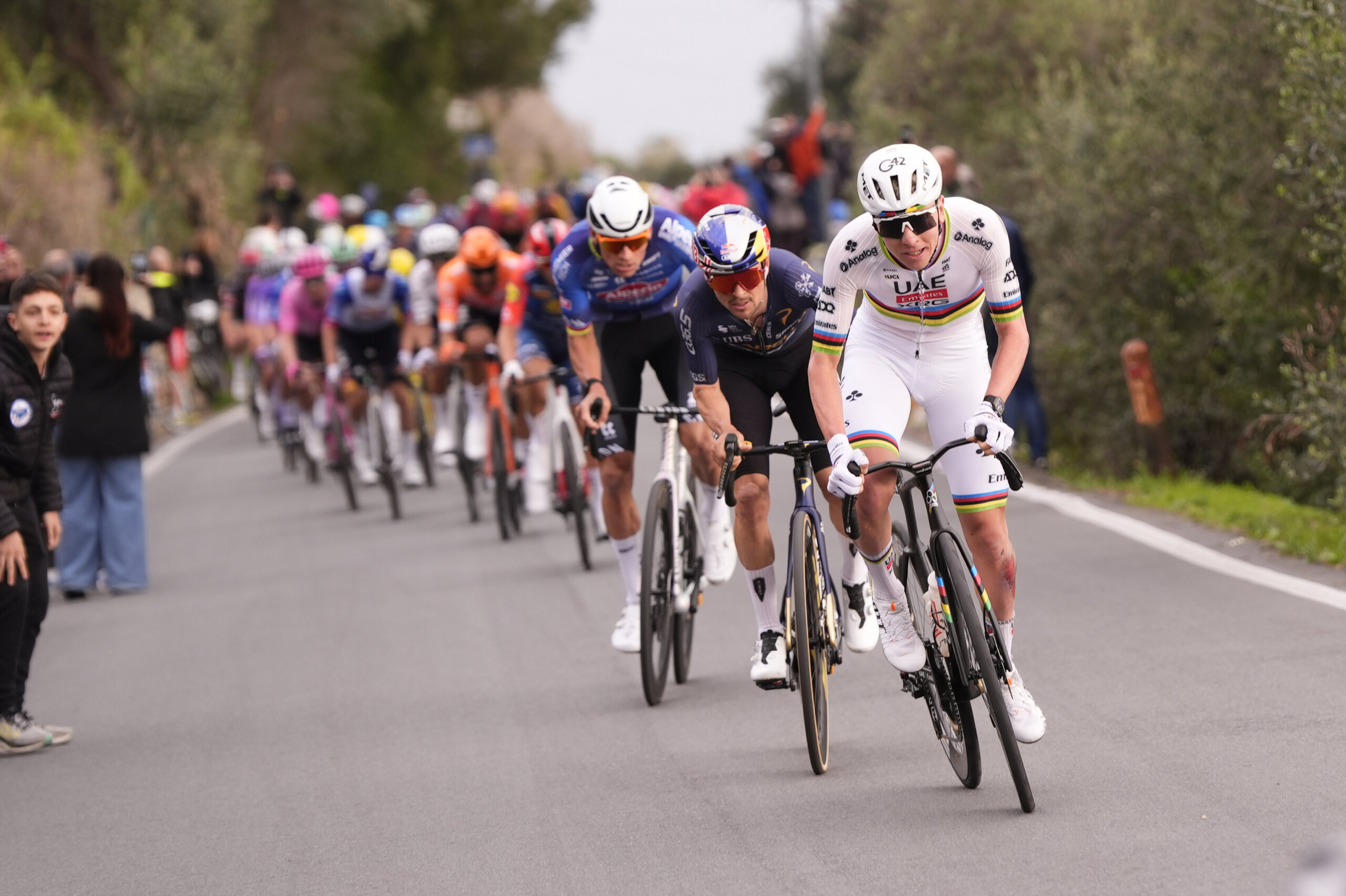
By the top of the Cipressa, three riders had more than thirty seconds on a chasing group led by Lidl–Trek: Pogačar, Van der Poel, and Pidcock, descending together toward the Aurelia with the race in their hands. Van Aert, who had been a full minute down after the crash, performed a finisseur’s resurrection on the descent, eventually finishing in the group that would contest the minor places. For now, though, the race had reduced itself to the only question that mattered.
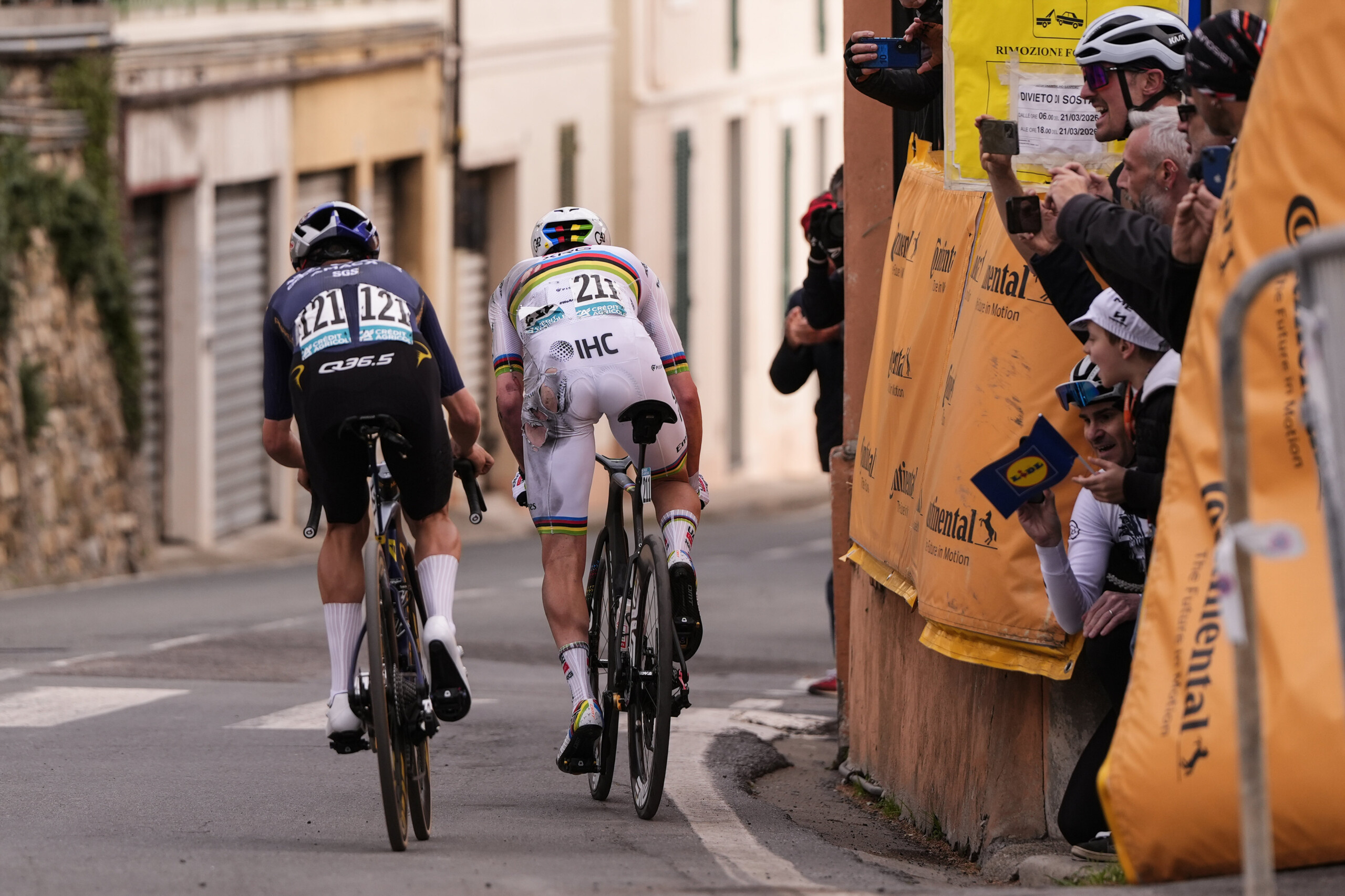
Mads Pedersen, who had been frank before the start about having returned from injury earlier than planned—“We know the numbers are good, but training isn’t the same as racing”—tried to pull the chase back with Lidl–Trek. Visma also contributed. The gap held at around thirty seconds as the Poggio appeared at nine kilometres from the line.
The Poggio: Pidcock Refuses To Be Dropped
The Poggio di Sanremo: 3.7 kilometres, an average of just under four percent, ramps touching eight on the steepest sections, four hairpin bends in the first two kilometres, and a carriageway that narrows just as the effort is at its worst. Pogačar had noted beforehand that a slight headwind in the finale was a concern—“It wasn’t ideal, not like last year.” In 2025, Van der Poel had gone over the Cipressa in the perfect conditions and taken the race apart. This year the wind had taken some of the aggression out of the tactics. What remained was the climb itself, and two of the three leaders who had crested the Cipressa together.
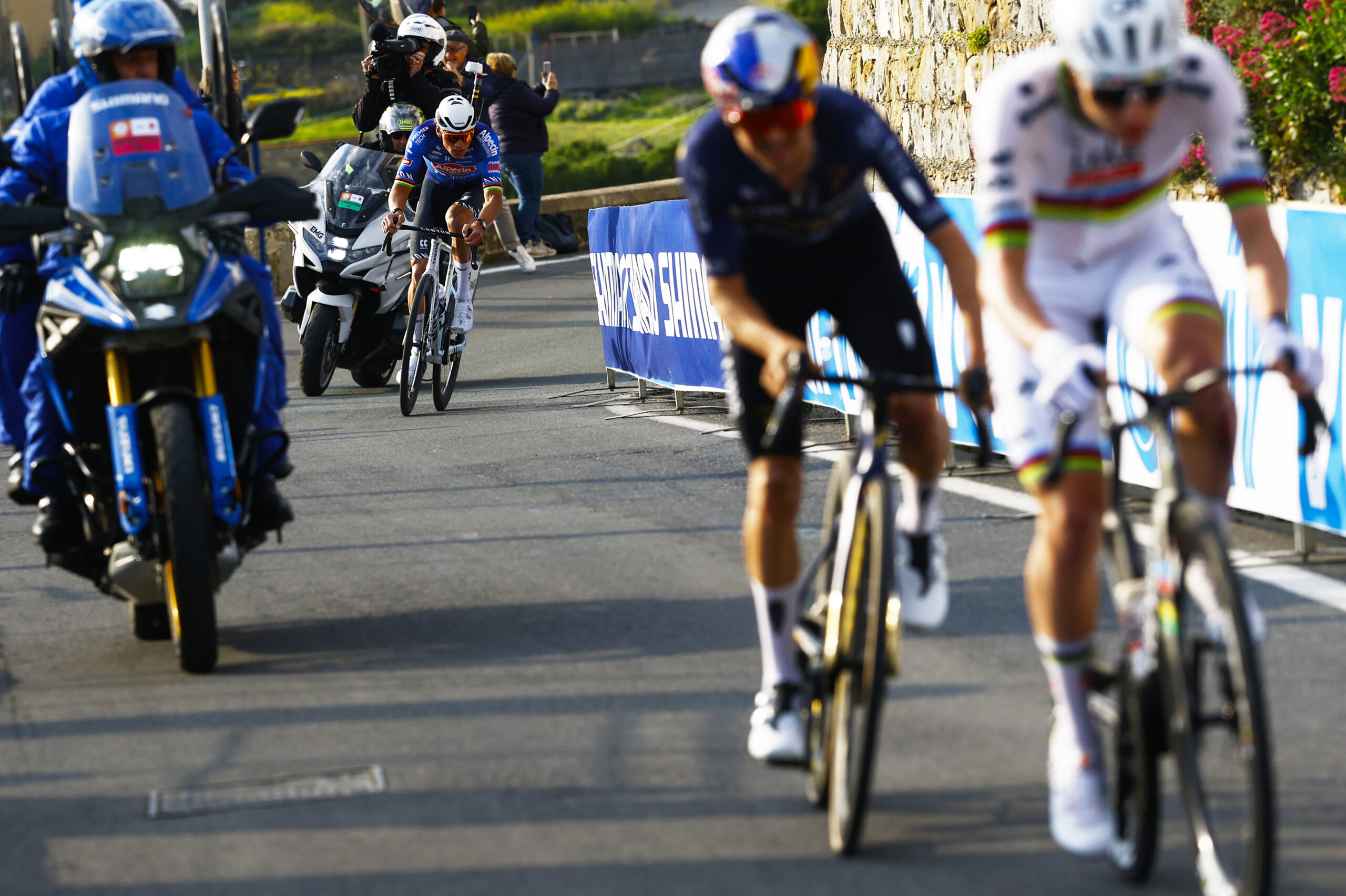
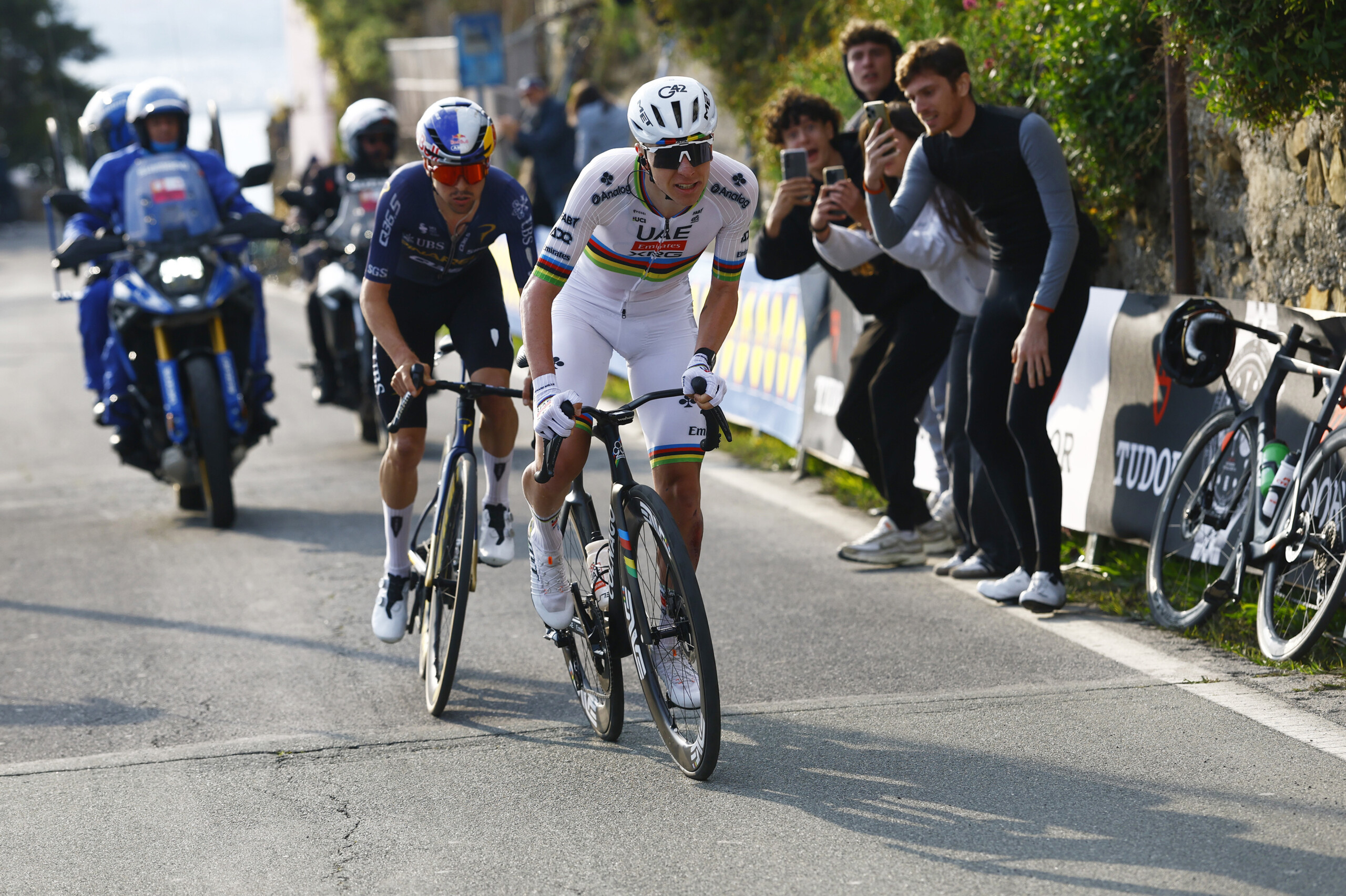
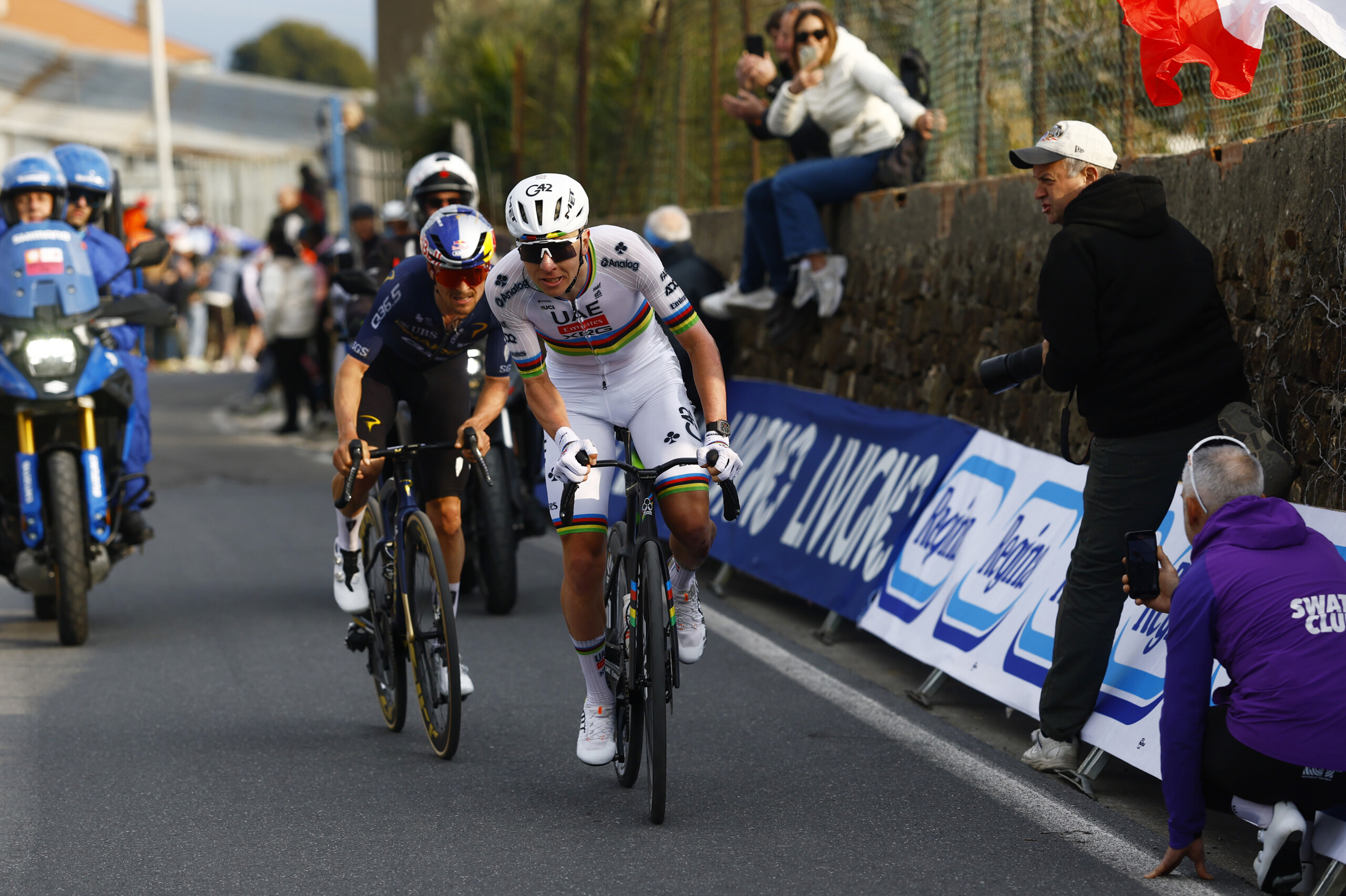
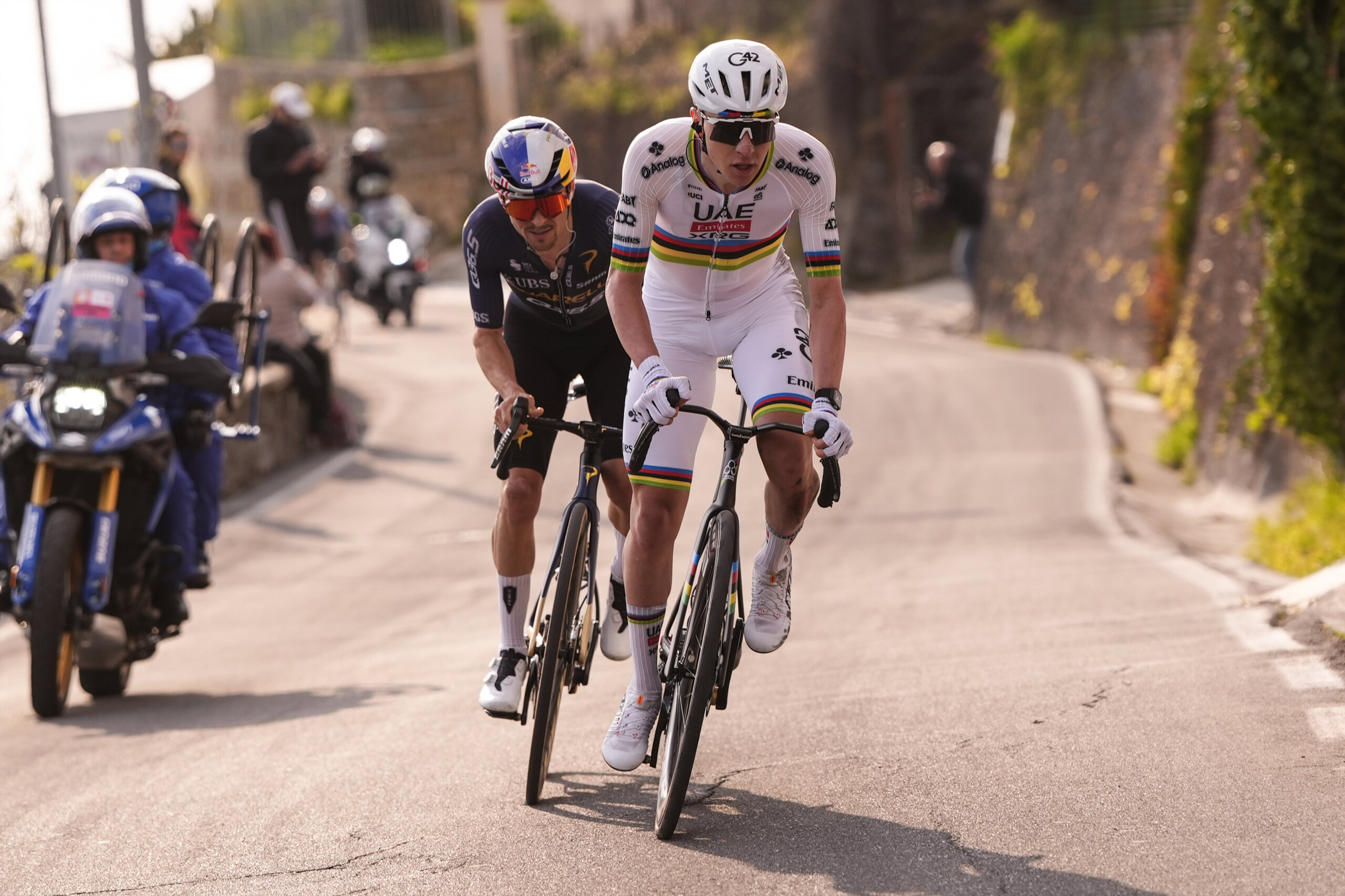
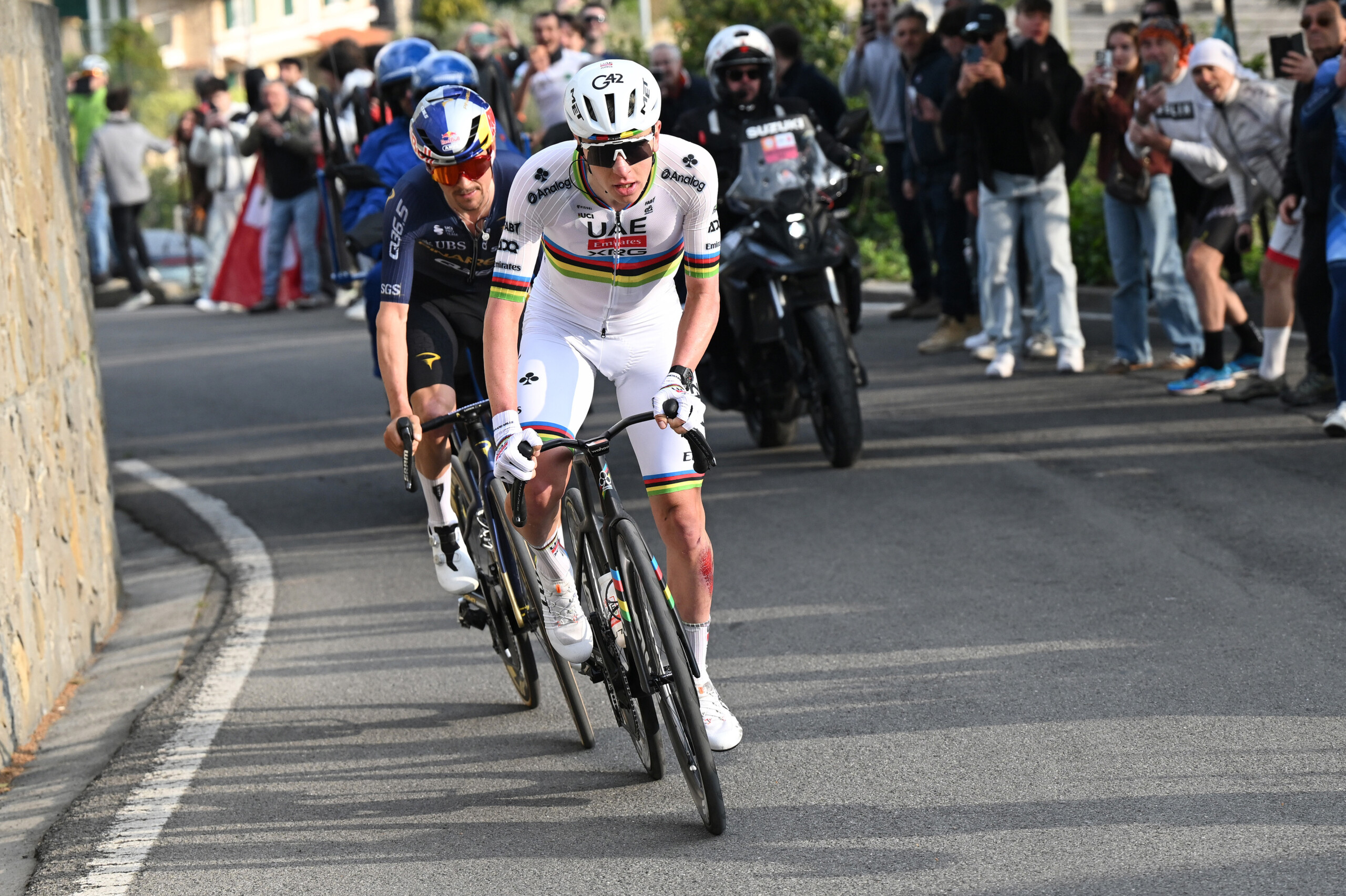
Pogačar attacked. It was the moment the entire day had been building toward, the violence that a race like this demands from whoever wants it most. Van der Poel, twice a winner here and by his own pre-race admission aware that he needed everything at his absolute peak to live with the world champion, found the gap opening. He lost the wheel. It was Pidcock who stayed—Pidcock who, at 500 metres from the summit, was still glued to the rear wheel of the best rider in the world, answering every acceleration with the clenched, furious economy of a rider who had been planning this moment all spring. Pogačar, gaining again and again on Van der Poel, could not shake the Briton. They crested together.
Behind, the peloton had pulled back a handful of seconds but not enough. Van der Poel was at sixteen seconds. The race was down to two.
The Descent And The Sprint: Centimetres Of History
They descended the Poggio together, the two of them working through the sequence of hairpins and counter-bends that make this descent a race within a race. No surprises. At two kilometres from the finish they were still side by side, eighteen seconds clear of Van der Poel, the rest of the peloton strung out behind. The sprint was inevitable, and Pogačar knew it—knew that Pidcock, explosive and fast, could not simply be waited out.
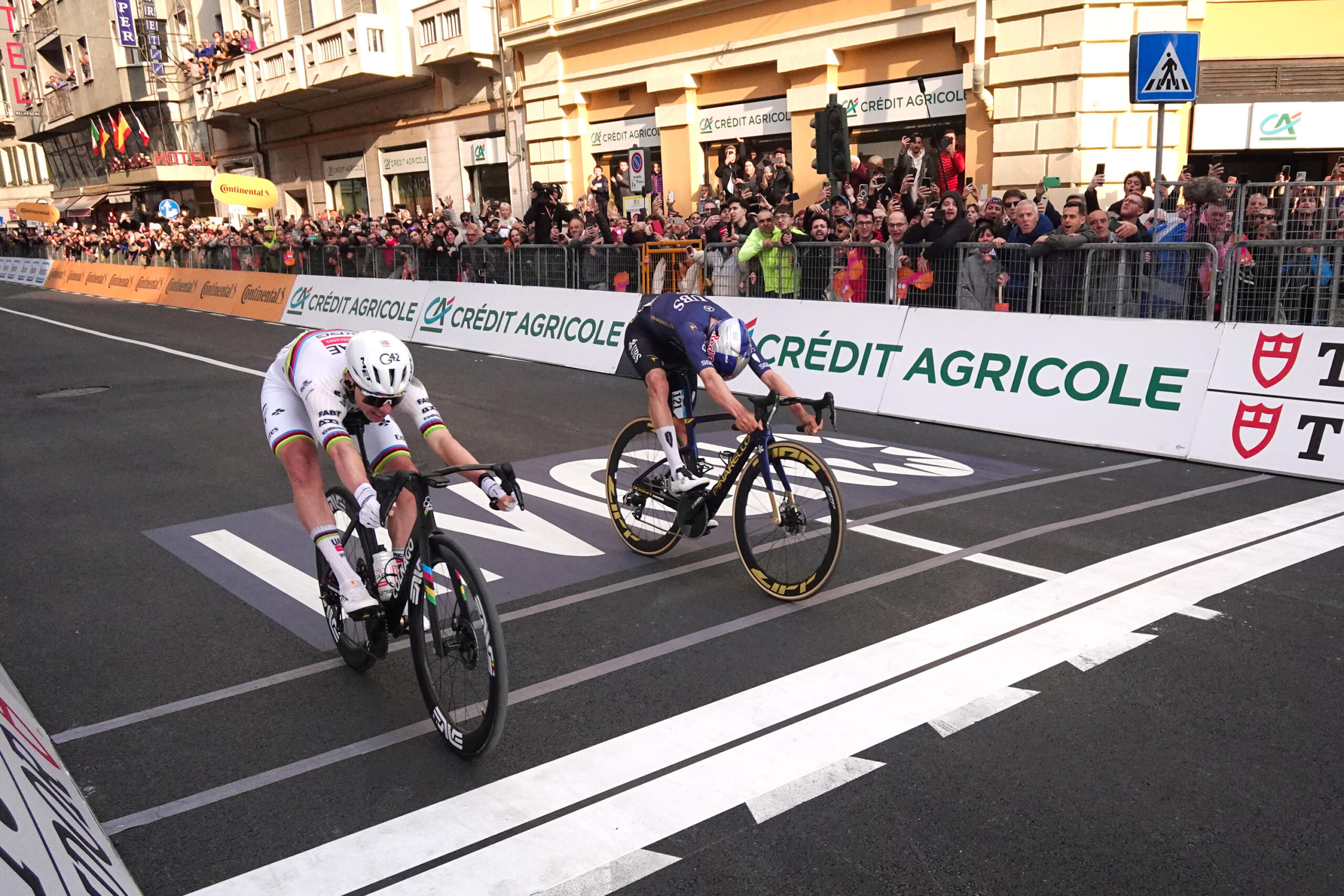
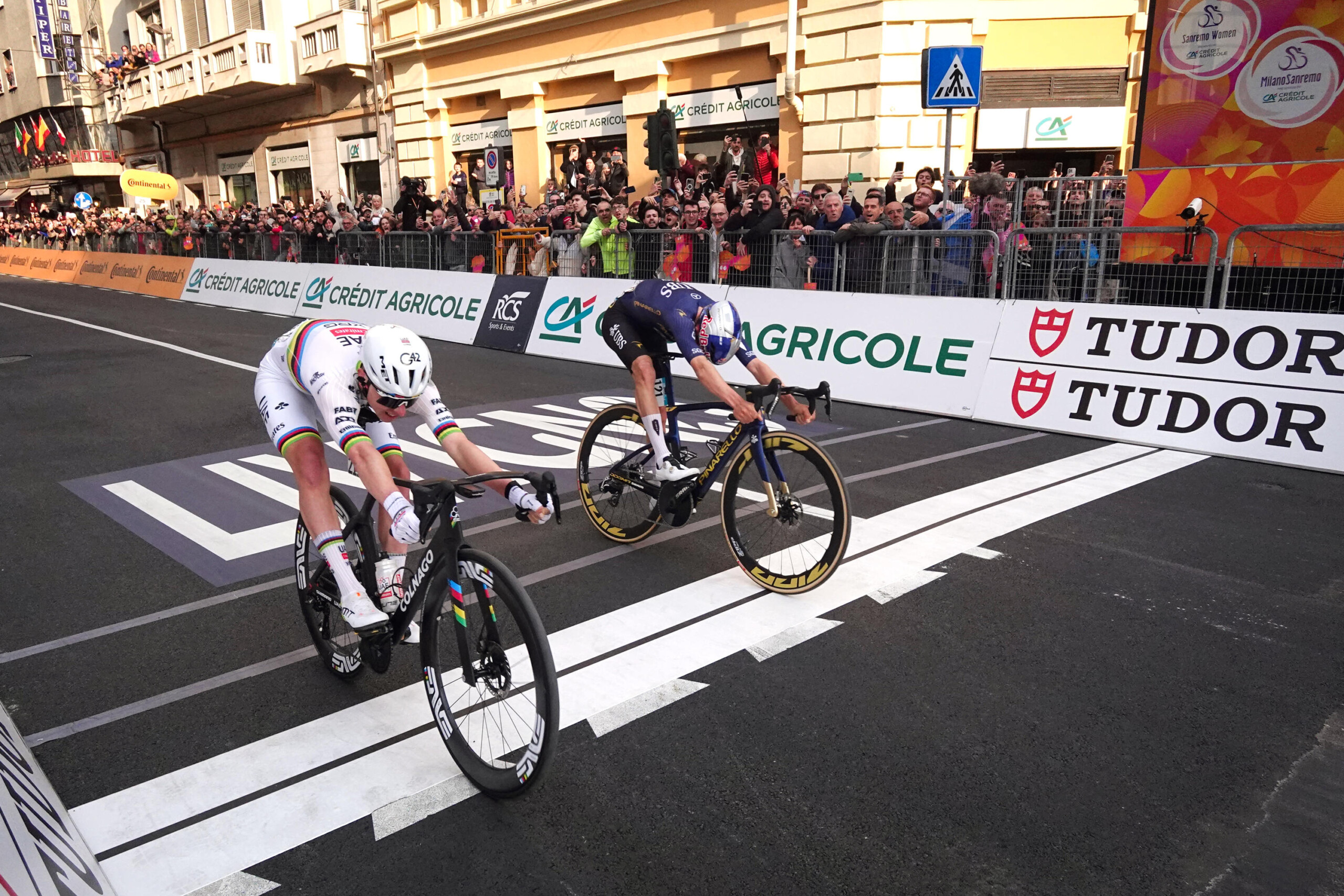
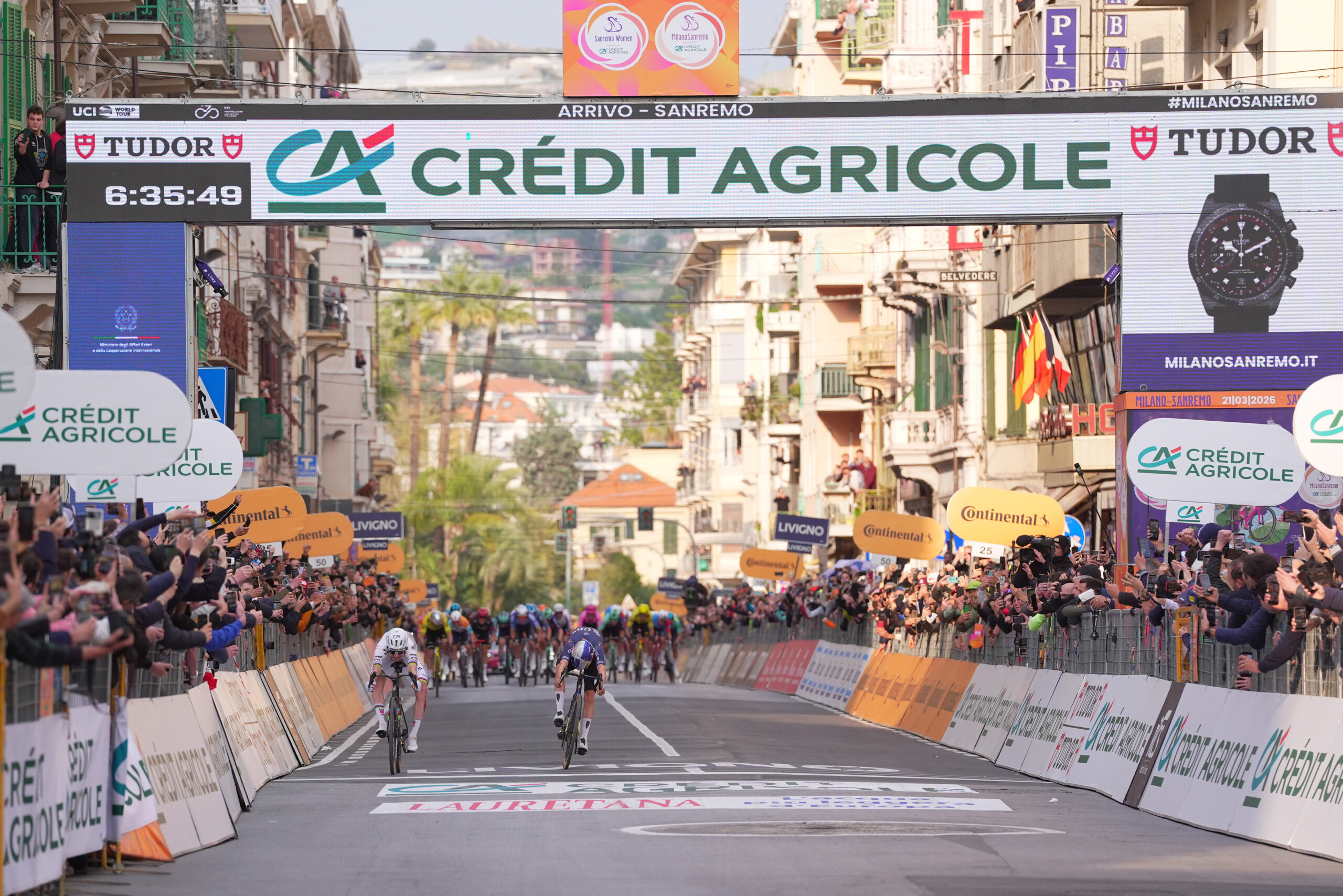
“I was a bit afraid of Tom Pidcock,” he said afterwards. “We all know how explosive and fast he is. I couldn’t wait too long, so I launched my sprint early.” He launched it at the roundabout, 850 metres from the line. Pidcock came back at him, hard and direct, the kind of answer that comes from months of preparation finding its moment. At the line it was centimetres. Pogačar, by a margin that the photographers would spend the next hours measuring. Pidcock second, the race of his career reduced to a handful of centimetres on Via Roma.
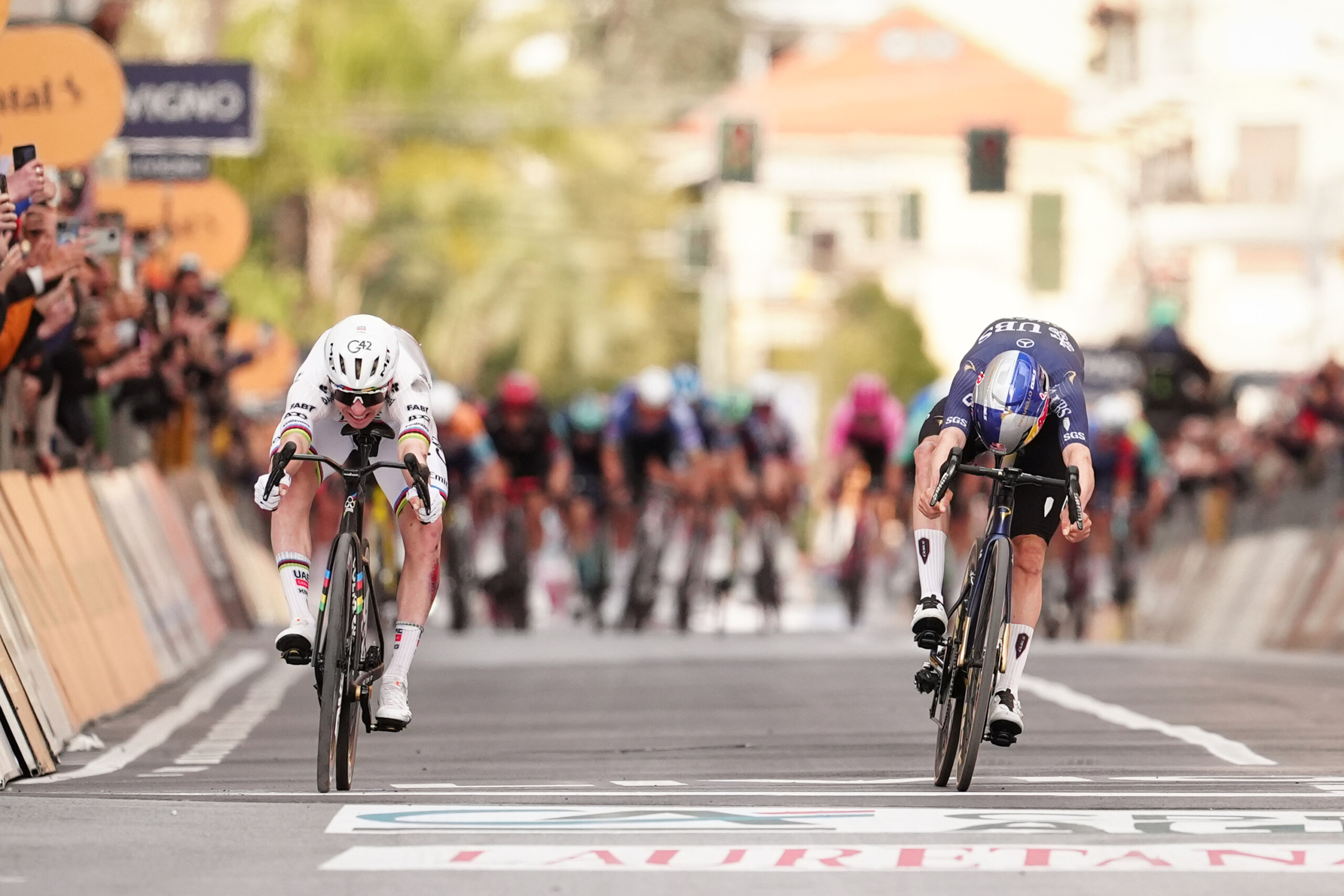
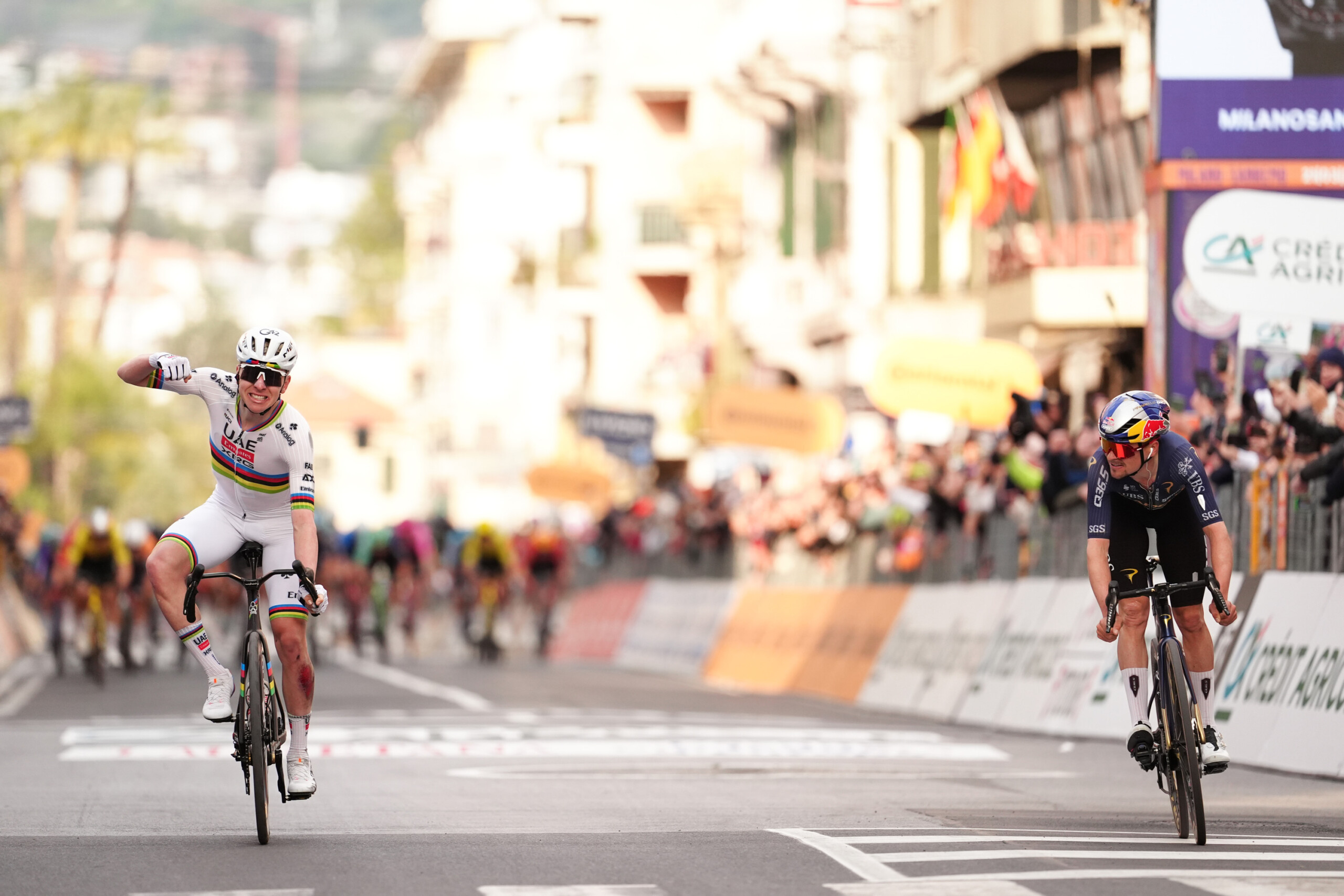
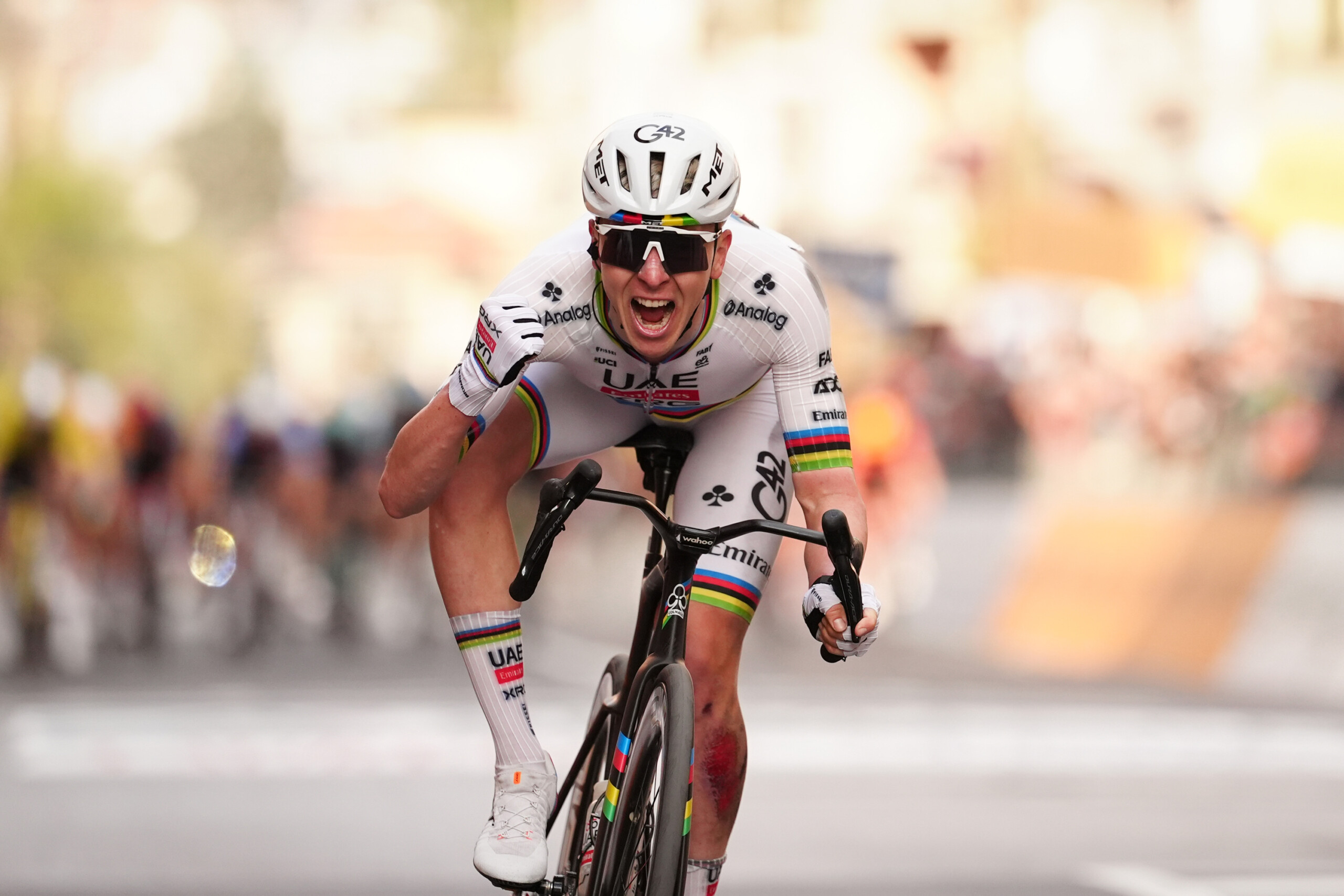
Behind them, Van Aert read the sprint with a finisseur’s intelligence—launching early enough to claim third place ahead of a peloton group that contained Pedersen, Corbin Strong, Andrea Vendrame, Jasper Stuyven, Van der Poel, Matteo Trentin, and Edoardo Zambanini. Van Aert himself, down a minute after the Imperia crash and seemingly out of the race twenty kilometres earlier, made the podium. It was that kind of afternoon.
The Record Books Rewrite Themselves
The numbers assembled themselves in the minutes after the finish with the clean click of things falling into place. Pogačar’s 110th professional victory. His eleventh Monument win—only Eddy Merckx, with nineteen, has more. His sixth consecutive race win, following the World Championships, the European Championships, Tre Valli Varesine, Il Lombardia, and Strade Bianche. And the end of a 43-year drought: the first world champion to win Milano–Sanremo since Saronni in 1983. The only Monument still missing from his collection is Paris–Roubaix. The velodrome in Roubaix will hear about this afternoon for the next several weeks.
In the press conference, Pogačar was composed and generous and precise. He gave Vermeersch and Grossschartner the credit that was plainly theirs—“They gave me hope”—and acknowledged the problem that Pidcock had posed. “Ce race isn’t ideal for my characteristics,” he had said before the start. That morning’s assessment looks considerably different now.
Pidcock accepted his defeat with the gracious directness of a rider who had done everything right and encountered someone who somehow did more. “It would be incredible to win in Sanremo,” he had said before the start. He came closer than almost anyone had expected, at a race and on a day when Pogačar had crashed, lost most of his team, and won anyway. “Chapeau to him as well,” said the winner, and it was well-meant on both sides of the finish line.
Van Aert, who had characterised himself before the race as an “outsider” and said that being one could offer certain advantages, was proved correct in the most sideways way possible. A podium finish on a day when he had been on the ground in Imperia required everything the Belgian had. “There should be a bit of a headwind in the finale,” he had said at the start. “The key thing is that it doesn’t rain.” It didn’t rain. It just got harder than anyone expected.
One hundred and seventeen editions. Since 1907, with gaps only for the wars. The race that, as the old line goes, can be won by anyone on the right day but rarely is—and when it is, by someone who has earned it in a way that goes beyond talent alone. Pogačar had come to Sanremo having won his last six races. He left having won the only one that had eluded him. What he said in Pavia that morning—about the gap between zero and one being the only gap that mattered—was now simply history.
The Classicissima had given him what he wanted. It just made him work for it in a way no one had written in the script.
| POS | RIDER | TEAM | TIME |
| 1 | Tadej Pogačar | UAE Team Emirates–XRG | 6h35’49″ |
| 2 | Tom Pidcock | Pinarello Q36.5 Pro Cycling Team | s.t. |
| 3 | Wout Van Aert | Visma | Lease a Bike | +0:04 |
| 4 | Mads Pedersen | Lidl–Trek | s.t. |
| 5 | Corbin Strong | NSN Cycling Team | s.t. |
| 6 | Andrea Vendrame | Jayco AlUla | s.t. |
| 7 | Jasper Stuyven | Soudal–QuickStep | s.t. |
| 8 | Mathieu Van der Poel | Alpecin–Premier Tech | s.t. |
| 9 | Matteo Trentin | Tudor Pro Cycling | s.t. |
| 10 | Edoardo Zambanini | Bahrain Victorious | s.t. |
NOTES
— Pogačar’s 110th professional victory and sixth consecutive race win (Worlds, Europeans, Tre Valli Varesine, Il Lombardia, Strade Bianche, Milano–Sanremo).
— His 11th Monument victory. Only Eddy Merckx has more, with 19. Paris–Roubaix is now the only Monument missing from his palmares.
— First world champion to win Milano–Sanremo since Giuseppe Saronni in 1983 — a 43-year wait.
— Won despite crashing in Imperia, losing most of his team, and chasing back to the front with only McNulty and Del Toro.
— Pidcock’s result (2nd) is the best by a British rider in the Classicissima’s modern era.
— Average speed: 45.173 km/h over 298 km from Pavia to Sanremo.
— Van Aert took third after being stranded a full minute behind the leaders following the Imperia crash.
(Visited 14 times, 14 visits today)