
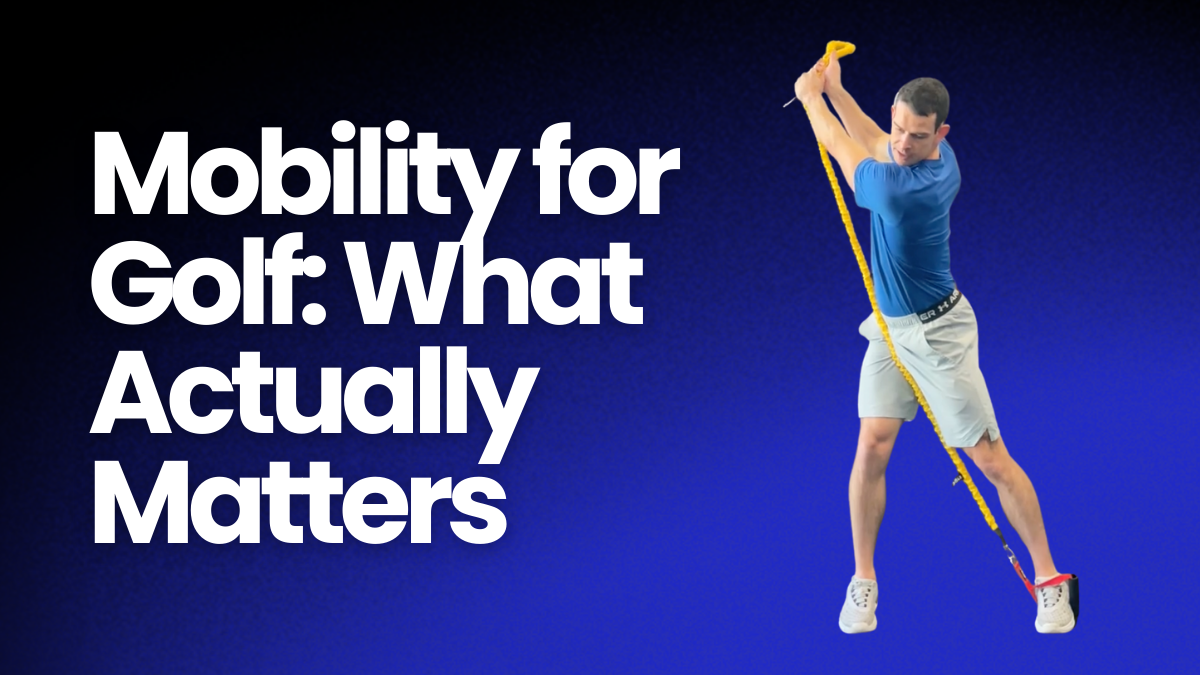
7. Mobility-Based vs Skill Based Limitations
One of the most common mistakes golfers make is assuming that improving mobility will automatically fix a “swing fault”.
A golfer struggles to turn, has a short swing, early extends, or any other example, and the conclusion is often simple: “I’m just not very flexible”.
Sometimes that is true. Most of the time, it is not. In almost all of these cases, with guidance from a good coach, the golfer can make the desired movement pattern once they are given the correct information and guidance.
In many cases, what looks like a mobility problem is actually a concept and awareness problem. The golfer does not lack the physical ability to move into the desired position. They lack an understanding of how to move there, and more importantly, they have yet to develop a motor pattern that allows them to do it reliably in a real swing – with a golf ball and consequences.
Mobility gives you capacity to perform a movement but you need to know what to do with it in the swing. It’s entirely possible for someone with great mobility to have a short swing with little turn. On the contrary, I guarantee you there are excellent senior golfers, with average mobility at best, that have beautiful free flowing looking swings.
Your golf swing is a deeply ingrained motor pattern built through thousands, and often millions, of repetitions, and reaction to the consequences of those repetitions over many years. Once that pattern exists, the nervous system strongly prefers to keep using it.
If mobility improves but the motor pattern does not change, and it won’t without specific training of the actual skill of hitting golf shots, the body will most likely use the swing pattern it has always used. More available range does not mean the brain will change the pattern.
This is why golfers can stretch, feel looser, and then swing exactly the same way they did before.
There are situations where mobility genuinely limits the swing. I am not trying to dismiss the merits of working on mobility. I do so for a few minutes daily. If a golfer physically cannot reach a position even when moving slowly, with focus, and without the pressure of hitting a shot, then mobility may be a real constraint.
A simple way to check if a mobility limitation is the main cause for your swing issue is to remove speed and outcome from the equation. Ask yourself:
- Can I perform the movement with a slow motion swing?
- Can I do it without a ball present?
- Can I do it while hitting a ball into a net, where the result does not matter?
If the answer is yes, mobility is not the main issue. You have just proven to yourself you have the range of motion. Coordination and trust get harder as speed of movement, and desire to hit a functional shot go up. These are technique development or movement learning issues, and they are completely normal.
If the answer is no, and you feel a genuine restriction rather than lack of coordination or simply an “alien” feeling from a new movement, then mobility work is necessary. If the desired movements are right on the limit of your current range of movement, it’s not ideal. We want a bit of a buffer.
Check out this 5 exercise golf mobility routine.
The presence of a golf ball and target changes how you move. Once a target exists and you are trying to hit a functional shot, the nervous system prioritises “survival”, which in this case is an “OK shot outcome” rather than technical change. It defaults to whatever pattern it knows best and is least worried about committing to.
This is why golfers can often perform movements well in drills, rehearsals, or slow swings, and then immediately revert to old habits once speed and outcome return.
Getting specific with mobility training:
Swing drills or rehearsals can be great mobility training. When we perform a swing exaggerating the movement we are trying to implement with focus and control, and slightly larger ranges, our mobility is being trained in the exact movement pattern that needs to change….albeit at a slower speed and without the consequence of hitting a shot.
This has two advantages. Mobility improves in a way that transfers directly to the swing, and the new motor pattern is trained at the same time. We are giving our brain a chance to get accustomed to the new movement. This is far more effective than improving mobility in isolation and hoping it appears later.
That said, some restrictions are easier to address with targeted mobility work. This is why isolated mobility exercises still have value and why there are “swing specific” mobility routines in the Fit For Golf App. The key point is that mobility training does not need to be separate from swing training.
Finally, structural limits still apply. If a limitation is structural and presents as a hard block that does not improve with warming up, slow movement, or targeted mobility work, it is unlikely to change. In these cases, the solution is not more mobility training, but learning to work within what your structure allows. Trying to force movement where anatomy does not permit it is rarely productive and often leads to irritation.
To summarise, before assuming a swing fault is caused by poor mobility, ask a simpler question:
“Can I perform the movement slowly, without pressure, if I know what I am trying to do?”
If yes, the issue is skill and coordination.
If no, mobility is part of the solution.
Understanding this distinction saves golfers enormous time and frustration. It also prevents mobility training from becoming a distraction from the real work, which is learning how to swing the club better.