
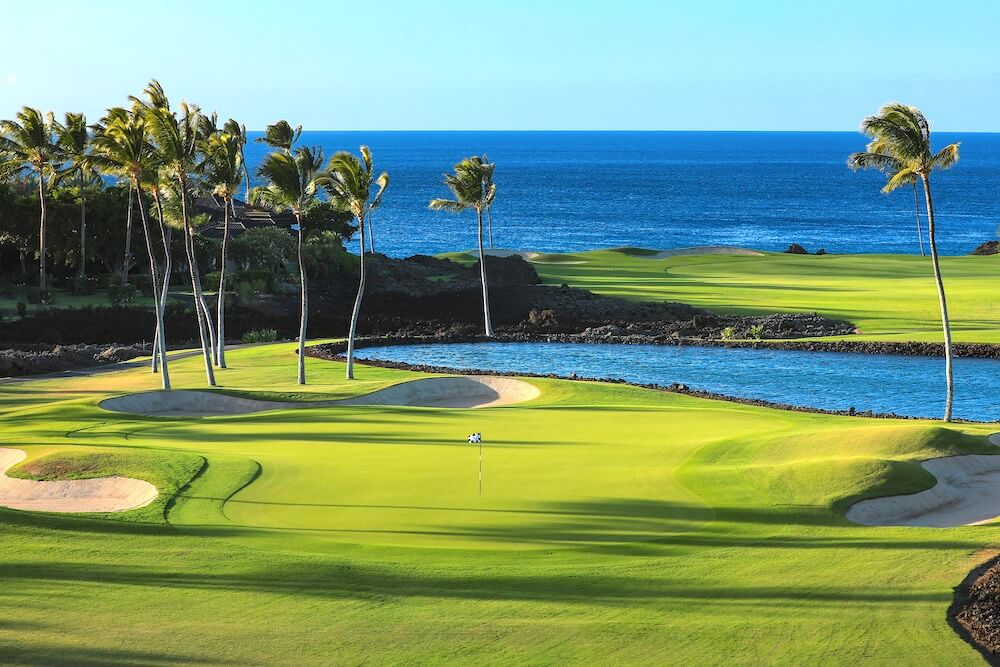
KOHALA COAST, HAWAII | One of the more interesting things about the Big Island, the largest of the 137 that make up the Hawaiian archipelago, is how its size and shape are constantly changing due to the fiery lava that flows from its active volcanoes to the Pacific Ocean and then turns to solid rock once it cools in the water.
After several visits to this tropical paradise, I have noticed that its golf resorts regularly undergo transformations of their own, whether in the form of course renovations or the complete rebuilding of hotels.
One such place on this sun-drenched stretch of land is Mauna Lani, which sits on an oceanfront site and features an Auberge Collection hotel along with a pair of 18-hole courses. The resort has undergone a $280 million restoration over the past several years that allows it to truly live up to its name, which translates from the Hawaiian language to “mountain-reaching heaven.”
Actually, it should be “mountains,” for a couple of Hawaii’s largest, Mauna Loa and Mauna Kea, loom in the distance from different parts of the property. These shield volcanoes, so-called due to their sweeping profiles and gentle slopes, also endow the resort with a pretty heavenly aura, especially when wispy clouds shroud their broad peaks. So does the palm-shaded white sand beach that curves around the point on which the six-story hotel stands. Designed in what the owners describe as a contemporary yet organic Hawaiian architectural style, it boasts 333 rooms, all of which are decorated in rich hardwoods and natural fabrics and feature lanai balconies. The vast majority have ocean views as well.
Connecting the water and that V-shaped white structure is the Great Lawn. That is where the three swimming pools are located, one of which is for adults only and has its own bar. That area is also home to four of the hotel’s five restaurants, with a personal favorite being the wood-sided Surf Shack, from which guests can grab snorkeling and paddleboard gear during the days as well as a bite to eat. The ahi poke bowls are the bomb, especially when savored at a table on the wooden deck, and the fresh fish tacos are hard to beat.
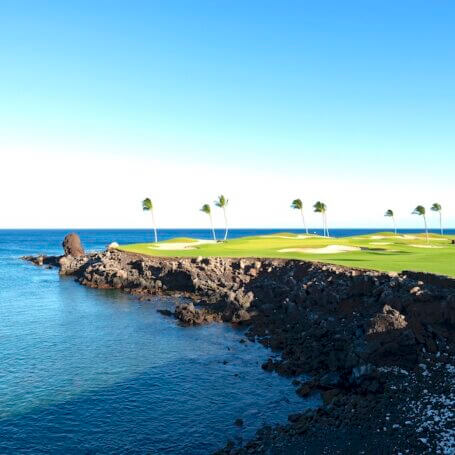
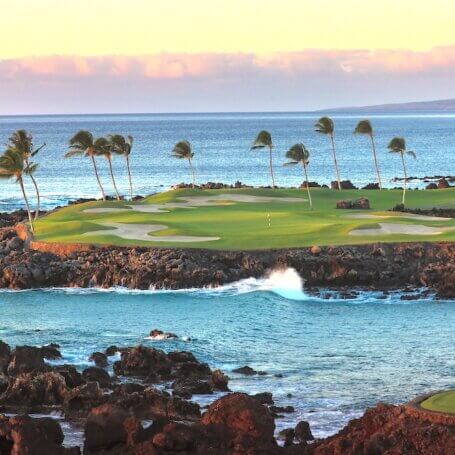
Nos. 7 (left) and 15 are highlights of Mauna Lani’s South Course.
Just to the southwest of that spot is another cultural point of interest, the Kalahuipua’a Fishponds, one of many aquaculture systems built centuries ago throughout Hawaii to farm fish. Historians say that in addition to providing an important source of food for islanders, the most productive of these structures bolstered the social and economic stature of the local chiefs.
Head inland half a mile or so to what friends of mine call “the convenient resort” because the amenities are in such close proximity to the rooms, and you arrive at another extension of the divine at Mauna Lani. Those would be the North and South courses. Homer Flint, Raymond Cain and Robin Nelson share design credit for these layouts, building them on rugged beds of black lava that were formed centuries ago. And they deserve to be ranked among the best pair of resort courses in the 50th state.
The water holes on these layouts, the first of which opened in 1981, understandably receive most of the attention, for their views of the Pacific as well as the different shots the architects ask players to execute on them. Especially when the trade winds are up.
Laid out hard against the Pacific, the black lava edges of the par-3 seventh and 15th on the South contrast nicely with the blue-hued ocean and the verdant green of the tees and putting surfaces grassed with seashore paspalum, creating a color palette that explains why they have frequently graced the pages of leading golf magazines. The par-4 13th, which plays downhill to the Pacific, is another stunner.
Not surprisingly, these holes received more than their fair share of TV time when the course served as the site of the Senior Skins Game from 1990 to 2000, with Jack Nicklaus, Arnold Palmer, Lee Trevino and Gary Player being among those who competed there during that time.
The North is a looker as well but boasts a different type of beauty, routed as it is through forests of kiawe trees. It also has more undulations and changes in elevation than the South. The hunter in me appreciates the presence of francolins on the North, tawny colored game birds that came to Hawaii from Asia and Africa in the 1950s and ’60s. And I delight in the occasional sighting of the feral goats on the property after learning that they are descendants of the domestic caprines that European explorers such as Captain James Cook brought to the islands in the 18th century.
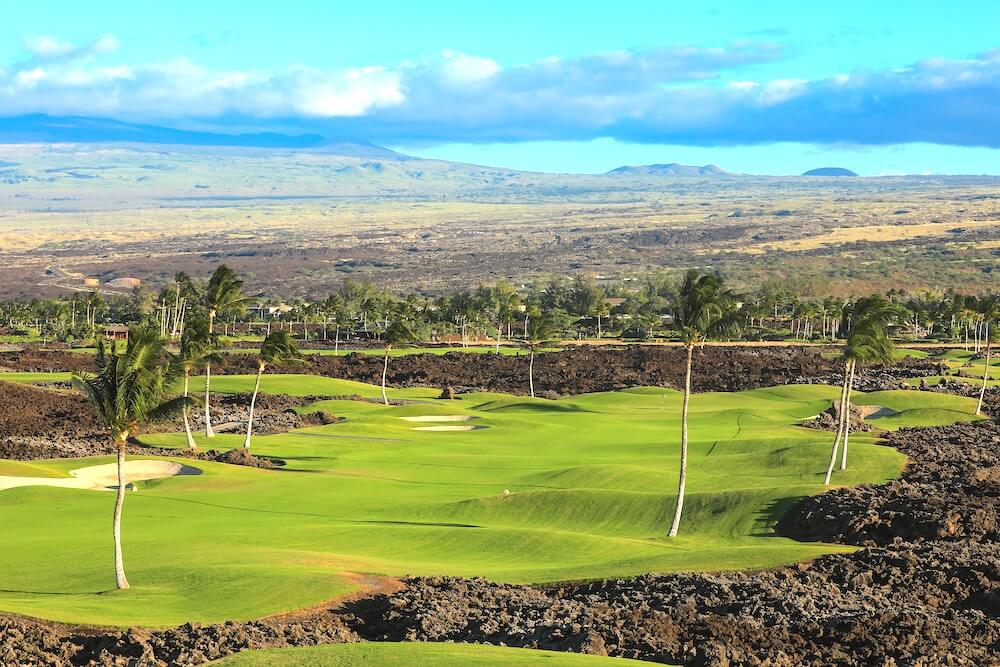
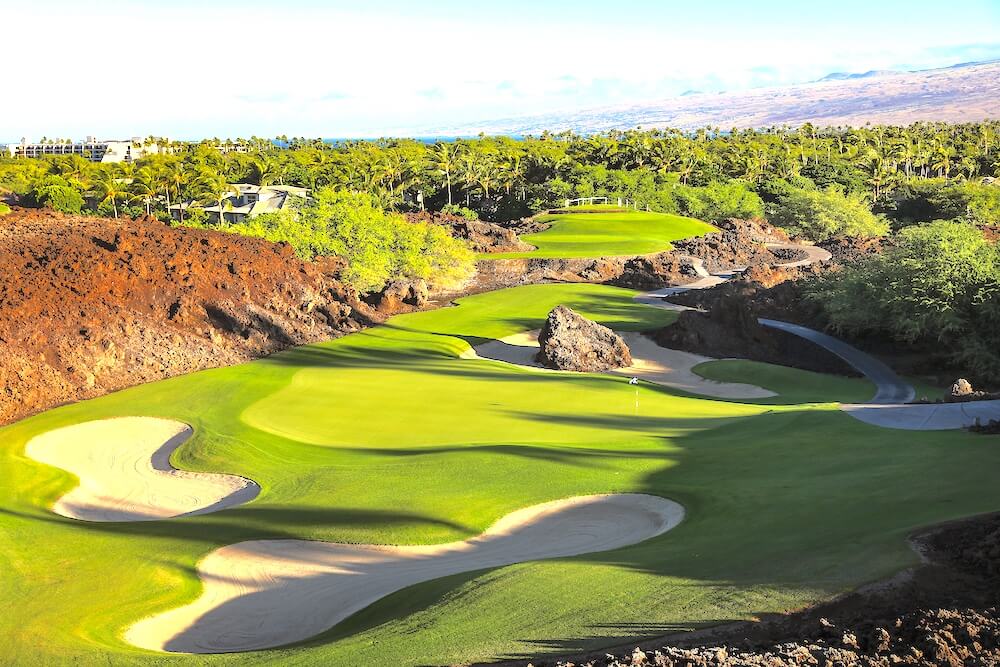
As for the money hole on the North, that would be the par-3 17th, which features a green set in the floor of a lava bowl. This course also offers the most striking views of Mauna Loa and Mauna Kea as well as distant pastureland that is part of the fabled Parker Ranch, which is some 135,000 acres in size and continues to produce some of the finest grass-fed beef in the world.
But the courses at Mauna Lani are as much about the depth of their design as their visual beauty, and they have a way of challenging golfers while making sure that they enjoy themselves at the same time. Fairways are ample. Greens are generous. And each hole features four sets of tees, to accommodate a wide range of players and deliver a pleasing variety of distances and shot values. There is minimal rough, which keeps play moving at a proper pace and the number of lost balls to a minimum.
Another attribute of both these tracks is the sense of place they present, with the lava fields, the strips of fairways running through them and the ocean serving as constant reminders that golfers are teeing it up in Hawaii.
In 1991, 10 years after the first 18 holes at Mauna Lani came on line, the owner opened the first hotel here on roughly the same spot where the Auberge stands today. It received rave reviews for its setting and service as well as the many activities and amenities it offered. Visitors also liked the arid climate of the Kohala Coast and the fact that it rarely, if ever, rained on their vacations.
The hotel also strives to evoke the ethos of the Big Island for its guests, from the staff member who blows a conch shell for all to hear at sunrise and sunset to the dimming of the lights in the open-air hallways at night so guests can better see the stars that fill the sky each evening. There is even a cultural historian tasked with enlightening visitors on things as far-ranging as the petroglyphs that are found all over the Hawaiian Islands, the historic outrigger canoe on display in the atrium known as the Gathering Place on the floor below the lobby, and the history of surfing.
In 1991, 10 years after the first 18 holes at Mauna Lani came on line, the owner opened the first hotel here on roughly the same spot where the Auberge stands today. It received rave reviews for its setting and service as well as the many activities and amenities it offered. Visitors also liked the arid climate of the Kohala Coast and the fact that it rarely, if ever, rained on their vacations.
I first stayed at Mauna Lani a decade ago, by which time the resort had added 18 more holes of golf and a second hotel (which was initially a Ritz-Carlton and is now a Fairmont). The original property changed hands in 2017, and soon after, the new owners began revamping it.
After making a return visit this past December, I can attest that the millions they poured into Mauna Lani was money well spent.
Change can be a very good thing, indeed.
Top: No. 12 on Mauna Lani’s South Course Photos: Courtesy Mauna Lani
© 2026 Global Golf Post LLC