
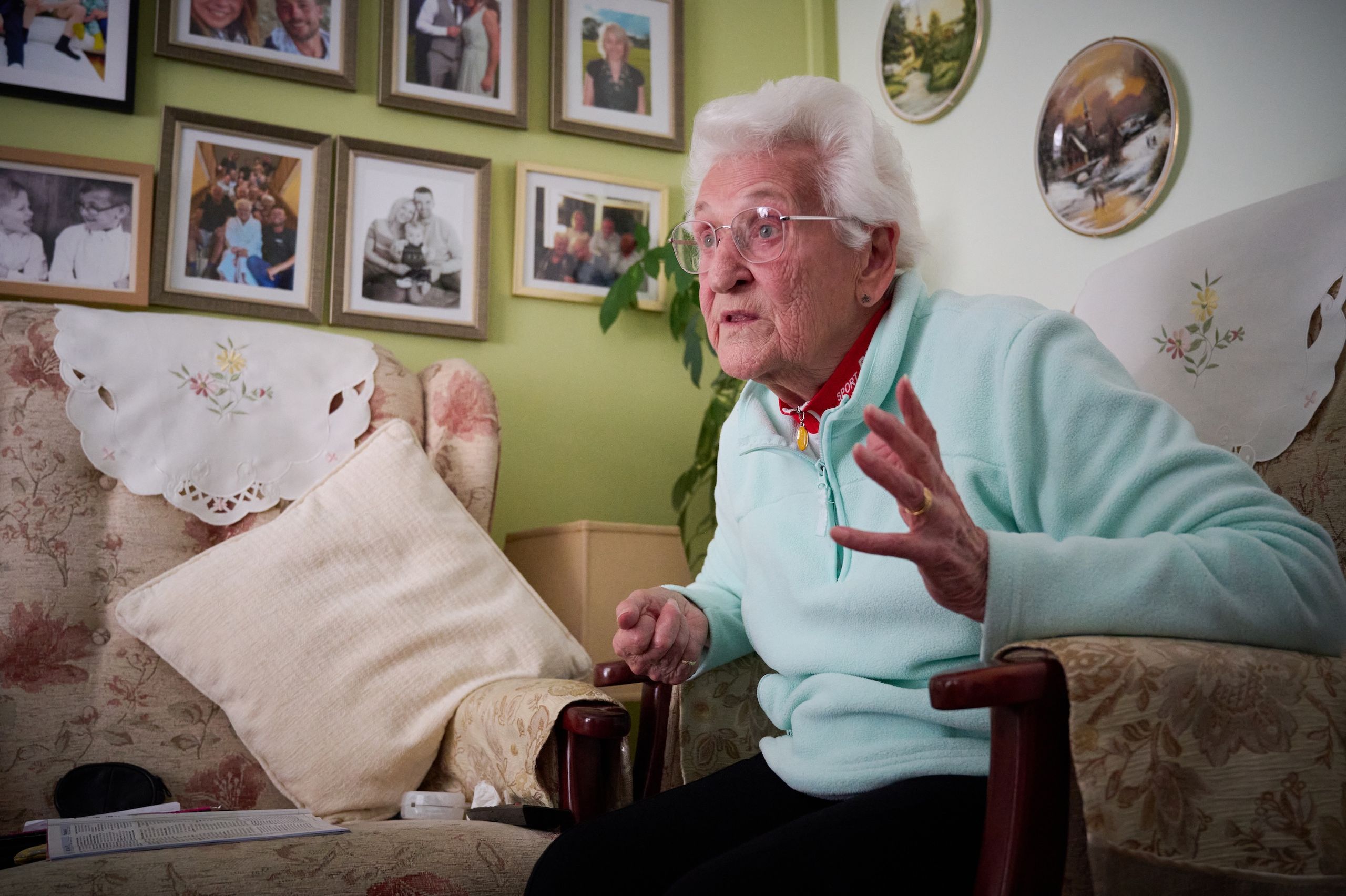
Shirley Hockridge picks me up from Kettering station in a Toyota SUV with no middle seat. She’s removed it, she says, so she can roll her bike in easily after rides with “the Thursday Club”. Yesterday, they went on a 25km coffee ride. When we get to Hockridge’s home – a neat, pretty bungalow with a drawing of Lizzie Deignan in the hallway and a shed in the garden for her bikes – there is a silver envelope sticking out of the letterbox. It’s a birthday card, she tells me. She’s turning 91.
Cycling regularly into her 90s is just one remarkable thing about Hockridge. Another is her racing career: in 1957, Shirley clinched both the national road championships and a podium place in a pioneering race few remember today, an early women’s version of the Tour de France. Fellow Thursday Club member Dorothy calls her “one of the most incredible people I’ve met.” Yet there is another side of Hockridge’s life, too, which any club cyclist can relate to: being part of a community of riders and friends – a support network that matters far beyond the sport.
When Hockridge was growing up in post-war Northamptonshire, “everyone” cycled. Already a runner and table tennis player, she was introduced to bike racing by her brother, who took her to watch meets on the gently sloped concrete track at nearby Wicksteed Park. She followed her brother, too, into the Kettering Friendly club, riding her first race on a second-hand bike which she bought for £7.
Article continues below
“Everything was amateur,” Hockridge remembers. She was “first and foremost” a time triallist, a discipline in which the ban on sponsorship was so complete that well-known racers would tape over their bike’s logos prior to competing. Training was 20 miles before work, and cross-training a weights programme a friend gave her for winter. As for nutrition, Shirley Mayers – as she was then – still lived at home, eating her mother’s suet pudding. Races would start early, and Hockridge remembers out-of-town riders taking “digs” with local cyclists, returning after the event for a cooked breakfast. (To this day, she has never eaten a gel.)
By 1955, the year Brit Millie Robinson won the first women’s Tour de France, Hockridge was good enough to appear in the local Northamptonshire Evening Telegraph under the headline ‘Shirley’s Wonderful Riding’ in an article praising her speed on the famous 100-mile Bath Road course. Before long, she was riding with Robinson, making do with her fixed-gear time trial bike for her first road race. At one national meet at Handsworth Park the pair lapped the field. In 1957, Hockridge won the British National Road Race Championship.
On the podium at the Tour
Today, many regard the 1955 women’s Tour, organised by cycling journalist Jean Leulliot, as a one-off. But newspapers from 1957 show people at the time saw the ‘3rd Criterium Cycliste Feminin’ as a direct continuation. Starting in late July, not long after the men’s Tour, the race was advertised by the French Cycling Union journal La France Cycliste as 600km over eight stages – longer than the 1955 race. There was a King of the Mountains jersey for the best climber, too. French scholar Romane Coadic points out that the organisers even invited Yvette Horner to provide entertainment – the same accordionist who played at the men’s Tour.
“Eileen Gray was the instigator,” says Hockridge. Gray, founder of the Women’s Cycle Racing Association and future British Cycling President, pushed for two teams to go to France in 1957: an A and a B team, with Hockridge riding in the As. A sponsor company contributed brakes, gears and hubs, but not the wheels, which Hockridge had built “at my own expense”.
The ‘Angleterre As’ had a strong start. In the early stages, Hockridge’s team-mates Joanne Poole and Sheila Clarke were near the top of the General Classification. They slipped in the GC – but Hockridge rose. On 6 August, under the headline “British Girls Up With The Leaders,” the London Evening News reported that Shirley Mayers [Hockridge] was in third place “at the start of today’s final stage in the women’s Tour de France.”
The 1957 GC was won by French rider Lyli Herse, with Luxembourg’s Elsy Jacobs coming second. Hockridge rounded out the podium, but not before giving the French a run for their money. In their write-up, Le Parisien Libéré praised Herse for battling “les redoutables Anglaises” – “the formidable English”. The race was sponsored by a furrier, and Shirley’s prize was a stole – “it wasn’t me at all” – which she gave to a visitor from America: her new mother-in-law, who wore it on the voyage home on the Queen Elizabeth.
Hockridge (right) finished third in a 1957 proto version of the women’s Tour de France
(Image credit: Future)
Hockridge had met Mick, another racer, through her local cycling scene. After her exploits in France, she was a local celebrity: a gossip column in the Northamptonshire Evening Telegraph that November wrote about her missing a bus and arriving late to hand out the prizes at a Nene Valley Wheelers dinner. Raising two sons put a pause on her riding, but by the 1960s, Hockridge was racing well enough again to be picked for the international Liberation Races in Belgium. In 1966, she had a daughter, but again soon returned to cycling proper.
Golden memories
When Hockridge wheels out her bike from the shed for Cycling Weekly to photograph, there’s no disguising the racing intent of the low bars and the steeply angled saddle. At 91, Hockridge still talks like a racer, too. “I’d dropped back, then when I got over the top, I was going to close the gap,” she says, recounting a recent Thursday Club ride. She pauses. “Mind you, the person I was trying to catch was in his 80s.”
With husband Mick, Hockridge raced into her 60s: a 1999 race report shows the couple side-by-side under the headline “One-two for the Hockridges”, and a cabinet in the corner of the living room holds his-and-hers trophies from a race in France. A photo from the trip shows them standing together in front of a car with licence plates reading “HOCKRIDGE”, and Shirley recalls the post-race celebrations that went on until 2am.
“He was always on the front,” she says, remembering the hours she spent training on Mick’s wheel. After they retired, the pair would ride together several times a week – “constant companions”. One of their final races was near Leeds one Christmas. “I’d ridden a ‘10’,” Shirley recalls, using the shorthand of a seasoned time triallist. “I did 26 minutes. Mick came in with 28. It was one of the few times I’d beaten him.” A few months later, he was diagnosed with Parkinson’s.
It was the Thursday Club “who kept us going”. After Mick could no longer ride, he and Shirley would go walking with clubmates. When that too became impossible, Shirley would organise club runs which allowed her to ride 10 or 15 miles before joining Mick in his wheelchair. They still went every Thursday. “Even though he began to lose his speech, the other riders knew him and they’d come and chat to him – right up until he went into hospital.” Mick died in 2018, aged 86, and Hockridge has continued to find solace among her clubmates. “They’ve kept me going since.”
“Apart from my family, cycling has been most of my life,” Hockridge says. Her home is a celebration of both. One full wall of her living room is covered in family photos: photoshoots with grandchildren; her 50th and 60th wedding anniversaries. Opposite her bed is a photo of Mick on his bike. Every morning, she sees him race. When she gets out more photographs from every stage of her cycling career, wherever she is on a bike she is beaming. “I find myself riding on my own now when I go out on a Thursday,” Hockridge says. “I average about 12mph now, but when I get to a hill, I’m down between five and six [mph].” Clubmate Carol puts it down to the big gears she still runs. For her part, Hockridge doesn’t mind if she has to climb alone. “I’m out riding my bike, and that’s all that matters.”

Hockridge, now 91, still cycles regularly with her local club
(Image credit: Richard Butcher)
Hockridge on modern racing
On the Tour de France Femmes:
“It’s double what we rode. Now, they’re doing the big cols and everything. You’ve got to be fit, you’ve got to really, really know what you’re doing, and you’ve got to be keen.”
On watching the pros race a local climb:
“I expected them to come up in ones and twos. I’d never, ever ridden up Rockingham hill and made it to the top. These girls came up in a bunch. I couldn’t believe it.”
On the professionalisation of women’s racing:
“I would have liked a manager or a coach. There’s all sorts of things they advise [today’s riders] on: food, drink and all the rest of it. I had to do everything. It’s a different world. I envy the girls of today, but you’ve got to be very fit and very dedicated to do it.”
This feature was originally published as part of the ‘Where are they now?’ series in the 29 January 2026 print edition of Cycling Weekly magazine – available to buy on the newsstand every Thursday (UK only) while digital versions are available on Apple News and Readly. Subscriptions through Magazine’s Direct.