
If you’re shopping for a wedge in 2026, it’s easy to get distracted by one number.
Spin.
Every brand promises more of it and, even in our own test charts, the wedges with the highest rpm stand out first. But after digging through thousands of shots from our 2025 wedge test, one thing became clear.
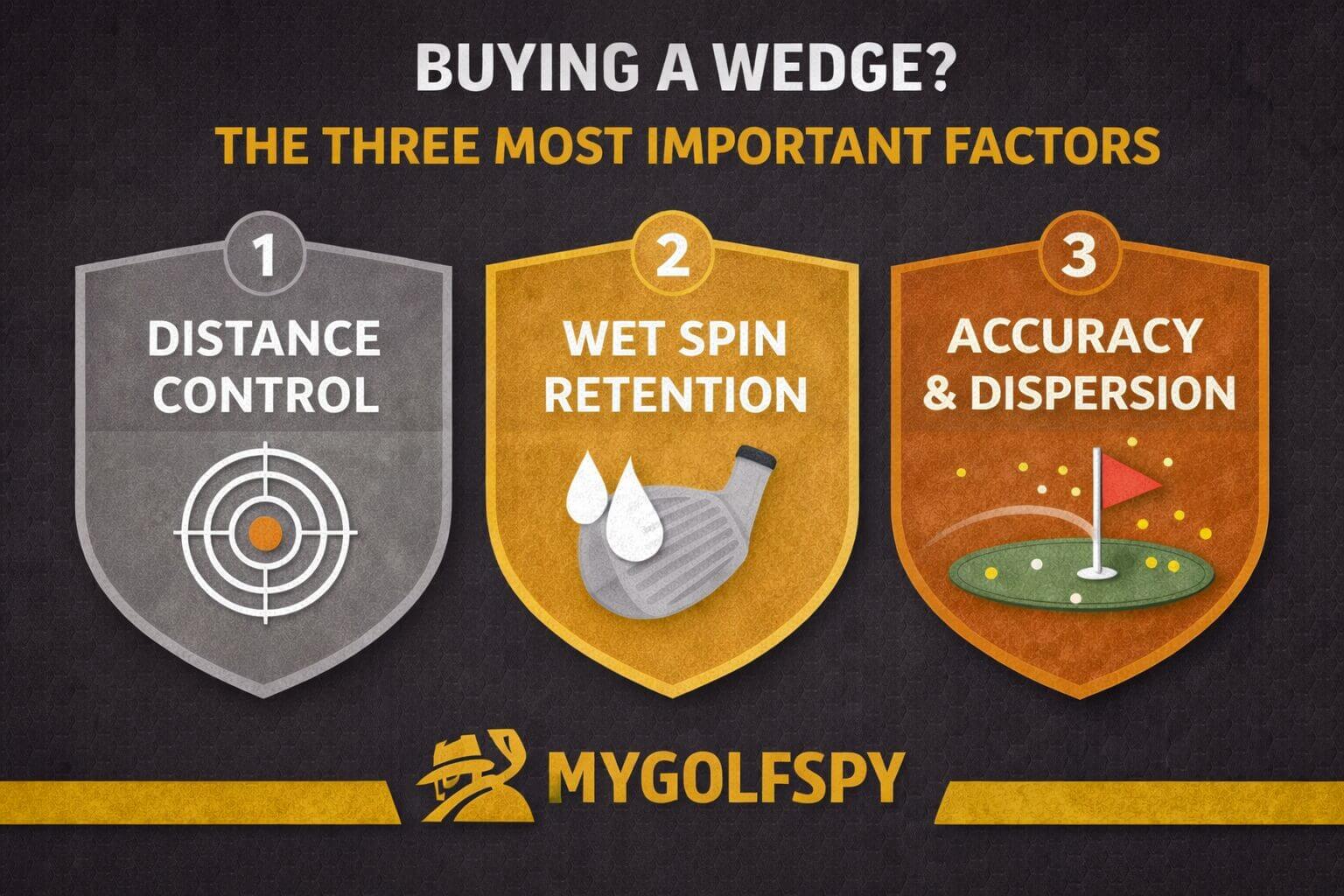
The wedges that help you score are the ones that control distance, minimize dispersion and keep performing when moisture gets involved. Here are the three most important things to look for when buying a wedge.
1. Distance control and descent angle
Carry distance control is one of the clearest performance separators in our wedge test. It’s a major part of the Consistency Score which evaluates how reliably a wedge produces the same carry distance across full swings, 50-yard dry shots and 50-yard wet shots. If a wedge is long on one swing and short on the next, scoring becomes difficult no matter how much spin it produces.
The best-performing wedges, including the Mizuno Pro T-1, Mizuno Pro T-3 and TaylorMade MG5, kept their carry windows tight across all three scenarios. That consistency is a big reason they finished near the top in accuracy and consistency scoring.
When you test wedges, pay close attention to your 50-yard carry pattern. You want shots clustering tightly around your intended distance. Random “hot” shots or flyers are a sign the wedge will be harder to trust on the course.
2. Spin that survives moisture
This is where wedges either shine or fall apart in testing.
Almost every wedge loses some spin when moisture gets involved but the amount varies more than most golfers realize. Some wedges like the Cleveland RTZ gained spin but others lost nearly half their spin. That difference matters when you’re trying to hit a controlled wedge into a soft green at 8 a.m.
Top performers (high retention)
- Cleveland RTZ — 105.3% retention
- Cleveland RTZ Full-Face — 104.9% retention
- Fourteen FRZ — 98.5% retention
- TaylorMade MG5 — 98.4% retention
- Mizuno Pro T-3 — 97.0% retention
Poor performers (major spin loss):
- Takomo Sky Forger 002 — 52.0% retention
- Orka OD — 38.9% retention
A wedge like Orka OD starts with more than 6,700 rpm on dry 50-yard shots but drops to only 2,621 rpm in the wet. Meanwhile, Cleveland’s RTZ lineup maintained or slightly increased average spin during the wet test. If you play in wet conditions, this needs to be part of your buying decision.
3. Dispersion patterns
Most golfers think about dispersion with a driver, not a wedge, but our test shows it plays a major role in wedge performance. Accuracy is the highest-weighted category in the Most Wanted scoring model. It makes up 50 percent of the total score and that score comes directly from Strokes Gained calculations based on where the ball finished.
Across 13,680 test shots, the wedges that ranked the highest weren’t just the ones that spun the ball or controlled carry distances. They were the ones that kept patterns tight on full swings and 50-yard shots.
Spin alone doesn’t guarantee the ball will finish near the target.
As you’re testing wedges look for:
- Shot patterns that stay centered
- Minimal left/right movement on full and partial swings
- A wedge that starts on your intended line consistently
Final thoughts
If you want the right wedge in 2026, here’s the cheat sheet:
- Distance control first: Look for tight carry numbers, especially on 50-yard shots, and a descent angle steep enough to stop the ball quickly.
- Wet-spin retention second: Wedges that maintain spin in wet conditions keep their distance control and flight window intact when it matters most.
- Dispersion third: Spin and distance don’t matter if the ball doesn’t finish near the target. Choose a wedge that keeps shot patterns centered and minimizes left/right variance.
The post Need A New Wedge? Here’s What Our Wedge Testing Says Matters Most appeared first on MyGolfSpy.