
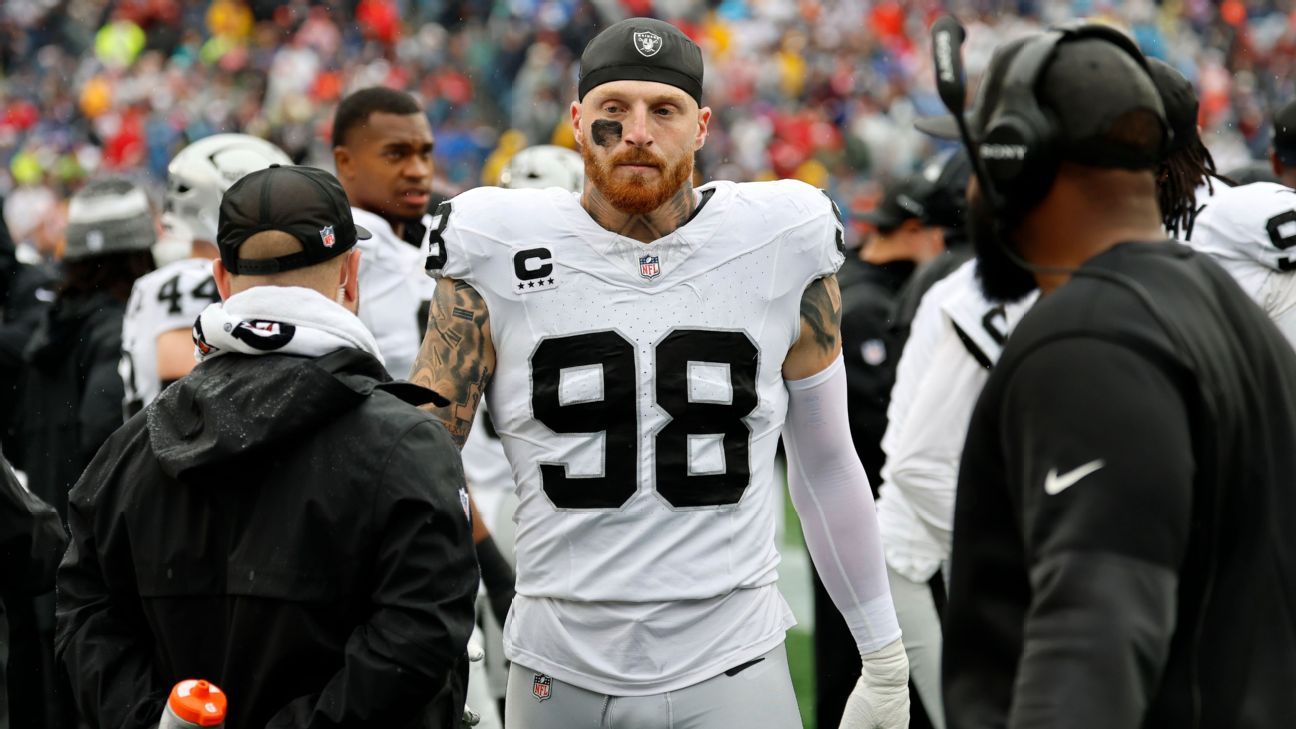
If you purchased a purple-and-gold Maxx Crosby jersey over the weekend, you might be experiencing buyer’s remorse. The team that stunningly traded for Crosby on Friday night also appears as if it might have some. Four days after agreeing to send two first-round picks to the Raiders to acquire the star edge rusher, the Ravens pulled out of the Crosby deal Tuesday, reportedly over concerns about his physical.
Wednesday morning, the Ravens followed up by making the move that will fuel a million conspiracy theories. Having opted out of the Crosby deal, they signed the best remaining pass rusher on the market, Trey Hendrickson, to a four-year, $120 million deal. It was the obvious decision for the Ravens given the circumstances, but there will be no shortage of people outside and even inside the league who wonder whether the Ravens simply got cold feet.
One of those parties will be the team suddenly and unexpectedly left with a superstar it doesn’t really want. The Raiders announced the news in the way you might have posted on your Facebook wall about a breakup as a teenager. “The Baltimore Ravens have backed out of our trade agreement for Maxx Crosby,” the brief statement on social media said. “We will have no further comment at this time.”
Subscribe: ‘The Bill Barnwell Show’
While acknowledging that the Raiders are not exactly the most careful and social media-savvy organization in football, it’s very easy to focus on the wording in that brief message. They could have noted that Crosby failed a physical and that the trade has been rescinded, or described how the trade had fallen through and how happy they were to have Crosby back. “Backed out” is saying a lot. It’s quite clear that the Raiders feel as if they’ve been done dirty.
What happens next? Well, let’s get there in a moment. I want to break down what has happened from both sides, and then we can get to what it means for the Ravens, Raiders, Crosby and the rest of the NFL. The only thing more interesting than the original Crosby trade might be undoing one of the biggest swaps of the past decade four days later. Let’s try to make some sense of this and what comes next.
Jump to:
What happened?
Did the Ravens get cold feet?
Will Crosby still get moved?
Where could he fit?
Who else is impacted?

What happened here?
Let’s start with the simple facts. Every NFL signing and trade is subject to a physical. Nothing’s official until players pass those physicals. Obviously, each team’s comfort with the wear and tear it sees on football players depends on a variety of factors. Nobody’s going to pass a physical with a torn ACL, but teams might be more willing to overlook concerns if they’re signing a 35-year-old veteran to the minimum deal in December for a playoff run than if they’re signing a player to a massive contract in March.
In this case, the Ravens were obviously facing a very important, franchise-altering decision. They were both trading two first-round picks for Crosby and essentially committing to paying the guy who was supposed to be their new star edge rusher nearly $94 million over the next three seasons. Crosby was coming off a season that ended because of an injury, with the 28-year-old suffering a meniscus injury early in the year and playing through it before eventually undergoing season-ending surgery.
Crosby underwent a meniscus repair as opposed to trimming his meniscus, which matters in a couple of ways. A meniscus trim allows a player to recover more quickly than a repair, but teams I’ve spoken to in the past about these injuries generally believe that trims create more complications down the line and shorten careers. Meniscus repairs require longer recovery times, but they’re more likely to produce stable knees after recovery and fewer deleterious long-term effects than the trims. Crosby might very well still be recovering from the surgery he underwent at the end of the 2025 season, given the typical timeframe.
The timing of the trade only made things worse. Both sides wanted to have a Crosby deal done before the weekend and the start of the legal negotiating period Monday. The Raiders were in position to negotiate with the widest range of teams before free agents started flying off the board and teams filled their needs on the edge. The Ravens needed clarity on what their budget would look like with or without Crosby as a number of their standout players hit free agency.
But even though the teams agreed to the trade Friday, the deal couldn’t be officially consummated until the start of the new league year Wednesday, by which point Crosby would need to pass a physical. That felt like a formality until it wasn’t. If the trade had happened in early April or in the middle of October, the two sides could have had the physicals done immediately and finished the deal in a matter of hours if they negotiated quietly enough. Here, there were several days between the decision to make the trade and the decision to undo it, and those happen to be some of the most consequential days of the NFL calendar.
Did the Ravens just get cold feet and change their mind?
That’s a $94 million question. You don’t really need to guess what the Raiders are implying here. The Ravens knew Crosby was recovering from meniscus surgery. He’s 28 years old, and one of his calling cards as a pro has been staying on the field. Since entering the league in 2019, Crosby has played a staggering 6,449 snaps. He has the two highest single-season defensive snap totals of any defensive lineman — having played 1,038 snaps in 2022 and 1,037 in 2023 — and four of the top 21 over the past seven seasons. The Ravens were never going to go into a physical for a player who has worked as hard as Crosby over the past few years and discover that things were perfect.
The Raiders clearly believe that the Ravens are making a meal out of whatever they found and using it as a pretense to change their mind. Is that what actually happened? It would be almost impossible to prove, barring some remarkable smoking gun piece of evidence from inside the Ravens organization. There’s not really any way for the Raiders to hold the Ravens accountable or insist that they follow through on the trade because they’re just pretending Crosby isn’t healthy enough to pass a physical.
Though it doesn’t typically happen in high-profile trades, we do see signings affected and even wiped away by failed physicals. These teams have both had a notable signing fall by the wayside over the past 15 years. In 2017, the Ravens signed Washington wideout Ryan Grant to a four-year, $29 million deal with $14.5 million guaranteed, but a physical discovered that a late-season ankle injury was more concerning than the team expected. Baltimore backed out of the deal.
The Raiders, meanwhile, signed offensive lineman Rodger Saffold to a five-year, $42.5 million contract in spring 2014. While that seems like a modest deal nowadays, Saffold’s $8.5 million average salary would have been the most for any guard in football at the time. The deal was widely panned; at the time, I wrote that it was “mind-boggling and impossible to understand.” It was a massive overpay from an organization that wasn’t attracting many free agents and was more than a decade removed from its most recent winning record.
When Saffold came in for his physical, the Raiders were the ones who got cold feet. They failed the Rams guard over concerns about his shoulder and opted out of his deal. Saffold went back into free agency and signed a five-year, $31.3 million deal to return to St. Louis. The Raiders eventually used a third-round pick on Gabe Jackson and slotted him in at left guard instead.
For what it’s worth, both teams probably had a point. Saffold underwent surgery on the shoulder that concerned the Raiders after the 2014 season and lasted only five games in 2015 before requiring season-ending surgery on the other shoulder. Grant responded to his Ravens rejection by signing a one-year, $5 million deal with the Colts, but he caught only 39 more passes over the next two years before falling out of the league. You could make a case that both the Raiders and Ravens made prudent decisions at the time, even if they weren’t popular choices.
There are three reasons I don’t believe that the Ravens pretended to use the physical as a pretense to opt out of a new deal they no longer wanted to make. One is the reaction to the news. Though there were people who didn’t really love the Crosby trade — myself included — there was no widespread backlash or suggestion that the Ravens had been fleeced. This was generally a popular trade with Ravens fans. If this were a wildly unpopular deal that made the Ravens national laughingstocks, there might be some reason to believe that general manager Eric DeCosta and the Baltimore front office would have given it a second thought. That wasn’t the case here.
Another is that undoing the trade complicates the short term and the long term for the Ravens organizationally. Baltimore players were excited about playing with Crosby. Fans were thrilled to add a superstar. They’re all disappointed now. Even if they don’t believe that the Ravens just changed their mind, teams are going to be more hesitant to talk trades with Baltimore given the perception that it might be more finicky about physicals and prone to reversing deals than other organizations. That wouldn’t stop the Ravens if they really felt that the Crosby deal, the biggest one they’d make over the next decade, would have been a disaster given his health, but it’s not going to make life easier for Baltimore moving forward.
And the third reason is the Ravens essentially sat out the first few days of free agency as they waited for the Crosby deal to be finalized, with their only signing so far being guard John Simpson. They’ve now landed Hendrickson, which we’ll get to in a moment, but the idea that the Ravens were going to string the Raiders along until they decided to sign Hendrickson at the last second doesn’t really hold up under much scrutiny.
If Hendrickson had been a cap casualty Saturday morning and unexpectedly hit the market after the Ravens had agreed to the Crosby deal, there would be a clear case for the Ravens discovering that they had a new alternative available and changing their mind accordingly. When the Ravens made the Crosby trade, though, they already knew that Hendrickson was going to be hitting free agency. If they really preferred signing Hendrickson and not trading away their draft picks to acquire Crosby, why wouldn’t they have just done that from the beginning? Sticking it to a competitor like the Patriots or Steelers might be one thing, but it’s difficult to believe that the Ravens entered into a trade solely to mess up the Raiders’ plans.
On top of that, while they were under the assumption that they were completing a Crosby deal, the Ravens lost a handful of meaningful contributors, led by star center Tyler Linderbaum, who signed with these very Raiders. Isaiah Likely left for the Giants, and he was followed by Jordan Stout, Ar’Darius Washington and Patrick Ricard. Dre’Mont Jones signed with the Patriots. Alohi Gilman joined the Chiefs. Charlie Kolar went to the Chargers. The Ravens probably weren’t going to sign Linderbaum, given that massive contract number in Vegas, but they very well might have been more competitive on young players such as Kolar or Likely if they had more financial flexibility, let alone looking toward other options in free agency.
2:29
Orlovsky stunned Ravens backed out of Maxx Crosby deal
The “Get Up” crew reacts to the Ravens’ decision to back out of the trade agreement for Maxx Crosby due to medical concerns.
Ultimately, nobody outside of Baltimore’s building can ever really know for sure whether the Ravens were strictly reacting to Crosby’s physical, simply changed their mind or some combination of the two. I would argue that the preponderance of the evidence points toward the former. Maybe they wouldn’t have been quite as willing to move on from the Crosby deal if Hendrickson hadn’t been available.
But even if the Ravens hadn’t landed Crosby or Hendrickson, there would have been some alternatives available on the edge, albeit while less imposing. They could have signed Joey Bosa or traded for players like Kayvon Thibodeaux or Jonathan Greenard for something less than the first-round picks they were intending to send to Vegas. Landing those guys wouldn’t have been as satisfying as adding Crosby or Hendrickson, but if the Ravens really didn’t like what they saw in Crosby’s medicals and missed out on Hendrickson, something would have been better than nothing. And those other options might have been better than paying an exorbitant sum to add a player with medical concerns that gave the Ravens pause.
Having signed Hendrickson, though, there are going to be plenty of skeptics who believe that the Ravens finessed the Raiders here, including the vast majority of people in the Raiders facility. I can give the evidence for why I don’t think that’s the case, but feelings might matter more than evidence here. The Raiders are going to be furious, and I’m not sure you can really blame them given the circumstances.
Can a Crosby trade still happen?
With Crosby’s rights reverting back to the Raiders and the Ravens recouping their two first-round picks, both teams can act as if this trade never happened. Having already traded Crosby once, though, the Raiders should still be incentivized to get a deal done as quickly as possible. Though he could theoretically come back and play for another decade in the desert, it’s difficult to imagine either side feeling particularly thrilled about a reunion.
The Raiders needed the picks more than they needed Crosby, given how far they are from contending. Crosby was going to finally get to play for a winner and a perennial contender. This could have been a win-win trade. It could still be one with a different team.
It’s fair to say that the Ravens, for many reasons, are out of the running. (I’m not sure Mark Davis or GM John Spytek will pick up a call from a 410 area code for the next decade.) The Raiders are left with 30 other potential trade partners, though, and there’s still plenty of time to negotiate a Crosby deal. Let’s consider a few scenarios for how that could play out.
1. Another team trades two first-round picks to the Raiders for Crosby this week. Obviously, the best-case scenario for the Raiders right now would be getting a similar haul from another team, one that doesn’t share the same concerns with the Ravens about Crosby’s medical results. Doing so would both get the Raiders the draft capital they want and implicitly suggest that Las Vegas was right to suggest that the Ravens backed out of the trade for reasons unrelated to the physical.
It’s possible that this gets done. If the Ravens were willing to send two first-round picks for Crosby, there were probably other teams that were willing to come close or even match that offer but just pick later in the first round of the 2026 draft than the Ravens (who were sending the No. 14 pick in the tentative swap). Landing a new deal with a team picking in the 20s wouldn’t be quite as appealing, but it would be close enough for the Raiders to feel good about moving Crosby.
But it’s going to be tougher to do this deal now than it would have been a week ago. I’ll get to who might be interested in trading for Crosby in a moment, but teams that felt as if they had missed out on the five-time Pro Bowl selection have already spent some of their resources elsewhere. There won’t be as many franchises in the mix for the Raiders to potentially play off of one another. With teams knowing the Raiders were willing to trade Crosby last week, Vegas won’t have the same sort of leverage it had before Friday.
There will also be general managers and owners with serious questions about whether the Ravens were right. Trading two first-round picks for a soon-to-be 29-year-old making significant money who couldn’t pass a physical is going to be a very risky proposition for any executive. Even if another team doesn’t share the same medical concerns about Crosby on closer inspection, there will be questions in the building about what the Ravens saw and whether it should spook any new Crosby suitor. Teams know this and will try to lowball the Raiders in their potential offers as a result.
2. Another team trades two first-round picks to the Raiders for Crosby sometime in the months to come. This is unlikely, but it’s possible that Crosby’s meniscus looks better closer to the draft or even afterward, leading a team to feel more comfortable trading two first-round picks. If another team waits until after the draft, it could acquire Crosby in 2026 and hold on to its first-round pick this year while sending its 2027 and 2028 first-rounders to the Raiders, which would be a less valuable and more uncertain offer for Vegas.
3. Another team trades a 2026 first-round pick and something that isn’t a 2027 first-round pick to the Raiders to acquire Crosby. This is the most likely scenario to me. It’s going to be very difficult for Las Vegas to land a similarly sized offer to the one it had from Baltimore. Too many teams that would have been interested are out of the running, so much money has been spent elsewhere, and the teams left will be nervous about Crosby’s knee and/or will use the threat of those nerves to bring the trade price down.
At this point, the previous Ravens offer is mostly irrelevant in terms of negotiating. Vegas general manager John Spytek has to go back to the table and land the best possible deal for Crosby right now. Can the Raiders land a top-15 pick and a third-rounder? A late first-rounder in 2026 and a couple of Day 2 picks over the next couple of years? Will they have to settle for a late first-round pick in 2026 and a second-rounder in 2027? A deal in that ballpark seems realistic to me, even given the concerns about Crosby’s physical.
4. Another team acquires Crosby without needing to send a first-round pick. If Crosby’s medical reports are really as concerning as the Ravens’ pivot suggests, there might not be a first-round pick in play. There’s always a point where a team would be willing to take a shot on a player of Crosby’s talent, but teams have already typically been loath to pay premiums on contracts to acquire players as they approach 30. Any team sending a first-round pick to acquire Crosby is hoping that it’s landing a player who can make an impact on this contract and on a second deal into his mid-30s.
At that point, though, I have to believe that the Raiders would simply call things off. The organization seemed ready to move Crosby, but this wasn’t a situation in which the Raiders were going to be willing to simply take the best available offer if what was on the table wasn’t any better than a Day 2 pick. It was always going to take a splashy offer for the Raiders to move their most popular and successful player.
It would be awkward bringing Crosby back, but if the Raiders can’t land a first-round pick, they would have to add their veteran edge rusher back into the fold for 2026. They could always explore a trade at the deadline or after the season if Crosby returns to his usual form and plays well next season.
1:20
‘Wild … unprecedented’: Schefter reports on Ravens nixing Crosby trade
Adam Schefter reacts to the news of the Ravens backing out of their trade for Maxx Crosby due to medical concerns.
At some point, Crosby’s value will drop. Panthers fans will remember Carolina turning down two first-round picks from the Rams for Brian Burns before they eventually accepted a second-round pick from the Giants for their star edge rusher, but that process took a couple of years. If Crosby is still on the Raiders’ roster in 2027 or 2028, Vegas might not be in position to command a first-round pick in a trade. For now, though, I can’t imagine the Raiders sending Crosby away without landing at least one first-round pick in return.
Which teams would be interested in trading for Crosby?
It might be more meaningful to start with the teams who wouldn’t be as interested as they were a week ago. That list starts with the Cowboys, who sent a fourth-round pick to the Packers to acquire Rashan Gary after missing out on a Crosby trade. Gary will make $18 million in 2026. There are rumors that the Cowboys are listening to offers for defensive tackle Osa Odighizuwa, and trading the 27-year-old tackle would free up $16.75 million in cash. Dallas still has plenty of draft capital, but even if it were to trade Odighizuwa, it would be difficult to pay Crosby, Gary, Quinnen Williams and Kenny Clark up front on defense before even considering how much this team has committed to the offensive stars.
Teams that made a big splash on edge-rushing talent also aren’t likely to be in the Crosby sweepstakes. The Panthers just gave Jaelan Phillips $30 million per season. The Commanders paid Odafe Oweh $25 million per year. The Bengals might have considered Crosby as a Hendrickson replacement, but they’re now on the hook to give Boye Mafe $20 million per year. The Patriots gave Dre’Mont Jones only $12.5 million, but that locks him in to start across from Harold Landry III. Other long shot options, like the 49ers, Saints and Seahawks, have spent significant money elsewhere. And though the Chiefs could use a star edge rusher, well, I don’t see the Raiders trading Crosby to a division rival.
Who’s left? There’s no obvious front-runner, but then again, the Ravens also weren’t exactly the favorites to land Crosby a week ago. In no particular order …
The Jaguars were reportedly in Crosby discussions earlier this offseason, only to come up short of Baltimore’s offer. They don’t have a first-round pick to offer the Raiders in 2026 after sending that to the Browns in the deal to move up for Travis Hunter, and that probably cost them in relation to other offers and opportunities.
What the Jaguars do have, though, is young talent that might be appealing to the Raiders. If the Jaguars did trade for Crosby, his spot in the lineup probably would come at the expense of 2022 No. 1 pick Travon Walker, who will be entering his fifth-year option in 2026 before hitting unrestricted free agency. Walker is coming off a disappointing 3.5-sack season, but his underlying metrics have been more consistent than his sack totals, and he would step in as a meaningful replacement for Crosby on the edge.
The other Jaguars player who would undoubtedly interest the Raiders is wideout Brian Thomas Jr., who would give presumptive No. 1 pick Fernando Mendoza a young No. 1 receiver. ESPN’s Adam Schefter reported Tuesday that the Jaguars aren’t interested in trading Thomas, but the Crosby news could change things. If the Raiders prefer picks, though, the Jaguars aren’t going to be a great fit.

The Lions have been quiet in free agency, with former Panthers center Cade Mays as their only meaningful addition so far. Al-Quadin Muhammad and Marcus Davenport are both free agents, leaving a significant hole across from Aidan Hutchinson on the edge. The Lions have the 17th pick in 2026, which would be in the same ballpark as the selection the Ravens were sending as part of their deal. And I don’t need to tell you how Crosby and Dan Campbell would fit together.
The Lions, however, might have bigger concerns elsewhere. Taylor Decker was granted his release, and Detroit is rebuilding an offensive line that wasn’t up to its standards last season. The 2023 draft class just became eligible for extensions, which could mean significant raises for Jahmyr Gibbs, Jack Campbell, Sam LaPorta and Brian Branch as early as this offseason. I love the fit on paper, but Crosby might be too expensive for Detroit.

The Bills made a big splash by acquiring DJ Moore from the Bears, a deal that added $24.5 million to their bottom line in 2026 and 2027. They still need to rebuild on defense, where Joey Bosa and AJ Epenesa are free agents on the edge. Buffalo is already committed to Greg Rousseau at one starting spot, but Crosby could step in on the other side, giving Buffalo the star pass rusher it has craved for years.
This doesn’t really feel like a Bills move to me. The attempt to make that all-in move for Von Miller in free agency was a disaster, and GM Brandon Beane shouldn’t be desperate to go down the same path. The Bills arguably have bigger needs along their offensive line and in the secondary, and after sending their second-round pick to the Bears, it’s tough to believe that they would then send their first-round pick and additional future draft capital for another veteran. After all of the dramatic changes Beane and ownership made following the heartbreaking loss to the Broncos, though, I’m not sure we can rule anything off the table in Buffalo.

The Bears freed up all of that cash as part of the Moore trade. When I wrote my mock trade column last month, I had the Bears sending Moore to the Raiders as part of a deal for Crosby, using the savings at wide receiver to help add all the money owed to Crosby over the next three years. I thought the Bears would need to send only one first-rounder alongside Moore to get that deal done, but in light of what the Ravens offered, that seems low.
The Bears already have $37 million invested in their starters on the edge between Montez Sweat and Dayo Odeyingbo, the latter of whom is still recovering from an Achilles injury. General manager Ryan Poles has cleared out cash by trading Moore and releasing Tremaine Edmunds, but the Bears have signed Coby Bryant to a three-year, $40 million deal and made a series of smaller signings. They have the draft capital to make a deal work and a core of young talent on offense that should allow for spending heavily on defense, but are they really ready for an all-in move?

The most tantalizing landing spot for Crosby would be the Eagles, who let Jaelan Phillips, Nakobe Dean and Reed Blankenship leave before agreeing with Riq Woolen on a one-year deal Tuesday. We know how heavily GM Howie Roseman leans on having great offensive and defensive line play, and the Eagles weren’t great on the edge after losing Josh Sweat last season. Jalyx Hunt had a solid season, but Nolan Smith Jr. mustered only three sacks in an injury-riddled campaign, and low-cost additions such as Azeez Ojulari and Joshua Uche didn’t make much of an impact.
The Eagles already have a ton of money committed to their 2026 roster, but there’s an obvious trade candidate here in A.J. Brown. Roseman has suggested that the Eagles aren’t in the business of trading great players, and Brown is still one of the elite receivers in football on a route-by-route basis, but he seemed to sour on the organization and vice versa a year ago. He would give Mendoza a legitimate No. 1 wideout, and Vegas’ biggest goal in 2026 has to be making its new quarterback’s life as easy as possible.
Financially, a Brown trade really only makes sense after June 1, when the Eagles could push $27 million of the $43 million in dead money that would come from a Brown swap onto their 2027 cap. Fitting Crosby in would require some cap gymnastics, and that defensive line would get very expensive between Crosby, newly paid tackle Jordan Davis and the massive deal probably coming for Jalen Carter, but that’s a place the Eagles have to be comfortable spending their money.
Is a receiver who turns 29 before the year really the best return for Crosby given how far the Raiders are from contention? Probably not. If they get to June and haven’t been able to get a Crosby deal over the line, though, a swap involving Brown (and some draft capital) heading to the Raiders for him will be the rumor of the summer.
0:39
Raiders: Ravens ‘backed out’ of trade for Crosby
Raiders: Ravens ‘backed out’ of trade for Crosby
What happens next for the teams and players most directly affected by the rescinded trade?
Let’s start in Vegas. There have been suggestions that the Raiders might be in a dangerous cap situation after going on an early-market spending spree under the pretense that they weren’t going to have Crosby’s deal on the books. There aren’t many teams that can just add a $35.7 million hit onto their cap unexpectedly right before the start of the new league year and remain cap compliant.
The Raiders, though, are one of those rare teams. Depending on how some of their new deals are structured, they should have between $30 million and $50 million in cap space, even after adding Crosby’s deal back to their roster. And while they probably won’t want to restructure his contract, given the likelihood that he’s dealt again in the weeks to come, the Raiders could clear out $14 million in cap space overnight by restructuring Kolton Miller’s deal and adding void years. There’s not going to be a cap crisis here.
Financially, though, the Raiders are probably overstretched in terms of cash spent. This isn’t the most cash-rich organization in the NFL, and the Raiders probably would not have been as active in free agency if they had known they might be spending $30.7 million in cash on Crosby in 2026. If Crosby is traded in the weeks to come, that won’t matter, but if the Raiders do have him on their roster this season, I wonder if they might be less active than expected in free agency next year.
Unless there’s something seriously wrong with Crosby’s medical picture, the most likely scenario will see the Raiders trade Crosby again, but this time for something less than two first-round picks. That’s not ideal, but it doesn’t materially change the short-term plan for the Raiders in 2026.

The Ravens are in a difficult situation, albeit one of their own making. They mostly sat out free agency, and while that was happening, the vast majority of edge rushers available agreed to deals with other teams. The natural pivot was to land Hendrickson, and thankfully for Ravens fans, that’s actually what appears to have happened (pending a physical, of course). And while the Ravens were trading two first-round picks to add Crosby, they’ll add Hendrickson for free (in terms of draft capital), although they’ll miss out on the third-round compensatory pick they were set to add for losing Linderbaum to the Raiders.
Is Hendrickson for a third-round pick better than Crosby for two first-rounders? I would say so, but it’s pretty clear that the Ravens preferred the latter move when they agreed to the Crosby trade on Friday. Crosby is more than two years younger than Hendrickson, who turns 32 in December. Hendrickson also is coming off a mysterious hip injury that lingered and eventually required season-ending surgery. It’s possible that Hendrickson wasn’t exactly willing to rush back into the lineup for a Bengals organization that didn’t give him the contract he wanted during the 2025 offseason, but we’ve had enough conspiracy theories for one day.
Signing Hendrickson was the right move for the Ravens, but this alternative comes with serious risk. Crosby was exiting his prime. Hendrickson is several years past the point when edge rushers typically peak, although he’s one year removed from a Defensive Player of the Year-caliber season in 2024. While there are great pass rushers who fade slowly and smoothly age into their late 30s, there are plenty of counterexamples who fell off a cliff and weren’t the same player at this point of their career, owing to injuries or declining play.
Chandler Jones was a Pro Bowler in his age-31 season, signed with the Raiders in free agency and was out of the league after one year. Robert Quinn had 18.5 sacks as a 31-year-old and recorded one more sack the following year before retiring. Jason Babin had 18 sacks in his age-31 campaign and 16.5 more over four ensuing years. Joey Porter had 17.5 sacks as a Pro Bowler for the Dolphins in 2008 but then fell to nine in 2009, five in 2010 and one with the Cardinals in 2011 before he left the game.
Hendrickson had four sacks in seven games in his age-31 season in 2025, a year in which he was squeezed by sitting out most of training camp and the midseason hip issue. The most likely scenario is that he plays very well. But there’s much more risk of Hendrickson falling off a cliff over the next two or three years than Crosby, given their respective ages.
Alternatively, having spent most of his time with the Saints as a reserve, Hendrickson has actually played 1,400 fewer snaps than Crosby despite entering the league two years before his counterpart, so you could make the case that his legs are fresher than the typical early-30s pass rusher. There’s a reason, though, that the Ravens initially preferred Crosby to Hendrickson, even if it meant trading significantly more draft capital to get the player they wanted.

Hendrickson probably made himself a lot more money overnight without needing to move a muscle. We don’t know where the Hendrickson sweepstakes would have landed if the Ravens hadn’t needed to get involved in the discussion, but it would hardly be a surprise if the Ravens swooped in with a blow-away offer to ensure that they landed the best remaining pass rusher.
We’ll wait to see what the specifics of Hendrickson’s contract look like and whether he managed to land significant guarantees deep into his deal. But there doesn’t appear to have been a robust market for the 31-year-old, given that Hendrickson didn’t agree to a deal in the opening hours of free agency and other teams proceeded to sign alternatives on the edge to significant contracts.
The league has shifted heavily toward prioritizing younger players in free agency in recent years, and it’s telling that Hendrickson’s per-year average salary is in line with that of Jaelan Phillips, who has torn ACL and torn Achilles injuries in his past and has yet to post even a single season with 10 sacks as a pro. Phillips is more than four years younger than Hendrickson, though, and teams are paying for what they believe a player’s production will be in the years to come as opposed to his résumé from the past. Hendrickson might have needed the Ravens as much as the Ravens needed him.
1:49
Stephen A. gives props to Ravens for signing Trey Hendrickson
Stephen A. Smith weighs in on the Ravens signing Trey Hendrickson after backing out of trading for Maxx Crosby.
The rest of the teams in the AFC North were one Hendrickson signing away from the best possible scenario in 2026: a world where the Ravens both didn’t land a star pass rusher and weren’t able to defend their turf in free agency, allowing a handful of useful players to leave in the process. The Hendrickson signing allows the Ravens to line up a potential standout on the edge in 2026, and DeCosta & Co. will still have their first-round pick to build out the roster in April’s draft. The Bengals, in particular, have to be crestfallen after seeing their best defensive player join a division rival.
In the big picture, though, I’d still argue that the Ravens have landed themselves in a very risky roster build by spending so much on an edge rusher, whether that was going to be Crosby or Hendrickson. Lamar Jackson is going to sign a new deal this offseason, one that will likely make the two-time MVP the highest-paid player in NFL history. Hendrickson is going to be making something in the ballpark of $30 million per annum. Ronnie Stanley and Nnamdi Madubuike, whose status for 2026 is uncertain after a neck injury, will take home $22 million each in 2026. Kyle Hamilton and Roquan Smith are the two highest-paid players at their respective positions in football.
Add Marlon Humphrey to the mix and the Ravens have seven players who will earn more than $19 million in cash in 2026. The only other team with more than five at the moment is the Cowboys, who also build their roster around a stars-and-scrubs financial construction. And, well, you know how successful the Cowboys have been with that formula over the past 30 years.
There’s nothing wrong with building a top-heavy roster, and the Ravens will have those two newfound first-round picks to help flesh out the cost-controlled talent portion of the equation after the Crosby deal came off the board, but it’s an incredibly risky approach. If you’re going to tie up that much cash in a handful of players, you need them all to be healthy and productive. In 2025, the Ravens lost Jackson for four games and parts of others with various maladies. Madubuike played just twice before suffering his neck injury. Smith was sidelined for 2½ games. And while he wasn’t on their roster yet, Hendrickson was out for most of the year with his injuries.
The Ravens missed the playoffs in 2025 because their stars weren’t on the field, and if they have those sorts of injury issues in 2026, the same thing could happen again. New coach Jesse Minter will hope to turn some lesser-known and smaller-contract players into standouts as he did with the Chargers, but there’s less margin for error with this roster-building approach than you might think.
The league’s other contenders might not be in position to add Crosby now, but if the Raiders can’t find a deal they like during the offseason, he would instantly become the biggest fish at next fall’s trade deadline. Any team acquiring Crosby in-season would save millions of dollars of salary, making it easier to add the star pass rusher to its roster. The new team also wouldn’t need to give up any 2026 draft capital. It’s impossible to say who will be competing or what they’ll need in late October, but if the Raiders do hold on to Crosby, they could launch another bidding war in the middle of next season. And when they do make a trade for Crosby, you’ll forgive the Raiders star if he wants to rush through the physical.