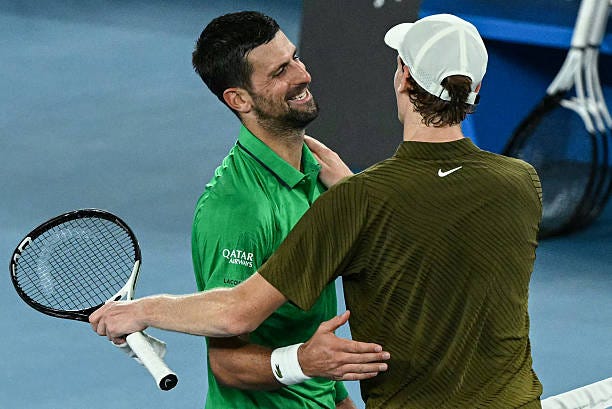
As it turns out, the Olympic gold in Paris was not the last genuine hurrah for Novak Djokovic. As it turns out, he has not been kidding himself and, less importantly, everyone else.
He hammered that point home — bold forehand and clutch serve after bold forehand and clutch serve — on Friday night and into Saturday morning in Melbourne, rocking two-time defending champ Jannik Sinner’s world with an inspired five-set triumph that put Djokovic into his eleventh Australian Open final and made a surprising late addition to his short list of great victories.
No. 1 Carlos Alcaraz awaits, and though it is tempting to write that Djokovic has nothing left to prove, he does not seem to see it that way.
“There’s a lot of people that doubt me,” he said in the middle of the Australian night. “I see there’s a lot of experts all of a sudden who want to retire me or have retired me the last couple of years. I want to thank them all, because they gave me strength. They gave me motivation to prove them wrong, which I have tonight.”
With respect for Djokovic and the hard-earned chip on his shoulder, I’m not so sure about his reading of the press room.
Tennis is often at its best as an intergenerational clash, and Sinner and Alcaraz, for all their yinning and yanging, were just beginning to suck some of the drama out of the men’s game with their intragenerational duopoly. Who didn’t want to see Djokovic rise up, continue to push them and carry the Big Three torch a little farther down the tunnel?
Getting asked (repeatedly) about your retirement plans does not mean that the experts are eager to see you go. They simply feel the question needs to be posed when you are no longer dominating the game; when you are 38 years old and have won everything there is to win in tennis, usually several times over.
Most of us learned long ago not to dismiss aging greats. We have seen Pete Sampras resurrect to win a final major at the 2002 US Open, watched Roger Federer roar back to the fore in 2017 and watched Rafael Nadal find a way to win the Australian Open and a final French Open in 2022.
We certainly know much better than to underestimate Djokovic’s capacity to remain relevant. He sailed back from the doldrums in 2018, saved two match points to beat Federer at Wimbledon in 2019 and won his 10th and perhaps not final title in Australia in 2023, a year after being deported from the country. His emotional Olympic triumph in Paris in 2024, crowned by a a brilliant, locked-in victory over Alcaraz, was a grand masterclass in rising to the occasion and also his only title that season.
“Count him out at your peril” has become a catchphrase.
The only significant tennis line item Djokovic is missing is the calendar Grand Slam, which no man has completed since Rod Laver in 1969. But Djokovic did hold all four major trophies at the same time. He has won 24 Grand Slam singles titles, seven ATP Finals, 40 Masters 1000 titles and spent 428 weeks atop the rankings, finishing as year-end No. 1 on eight occasions.
Those are all records, which he has chased openly and relentlessly, never downplaying how much they meant to him. That clarity of purpose surely played a role in helping him achieve so much, but at this stage, it seems more about the matchups than the math.
Searching for inspiration as he prepared for the 2026 season in Dubai, he found power in projection.
“It becomes, I guess, more difficult for me to motivate myself,” he said on Saturday. “And I ask myself questions: okay, what is it I’m looking for from myself? And I was imagining really playing against Jannik and Carlos in the final stages of the Grand Slam this year and battling it out and really giving it all that I have. And so I’m really fortunate to already get it in the first Slam of the year.”
He has been fortunate in other ways too: getting a walkover from Jakub Mensik in the fourth round and a retirement from Lorenzo Musetti in the quarterfinals after Musetti had won the first two sets.
Mid-tournament breaks in routine and match rhythm can be detrimental and destabilizing, as at the 2011 French Open, when Djokovic, riding a 43-match winning streak, lost to Federer in a classic semifinal after getting a walkover from Fabio Fognini in the quarters.
But Djokovic was well-served this time by the unexpected respite. Two weeks of best-of-five-set tennis have become a great deal to ask. He needed as full a tank as possible against Sinner, and though he often did not look fresh – leaning on his knees with his hands after long rallies or even vomiting into his towel – he certainly played with vim and vigor. He showed Sinner, dubbed Djokovic 2.0, that old software can still get the job done.
Sinner had defeated Djokovic five times in a row, usurping him as the king of Melbourne and hardcourts. But Djokovic beat him at their own game this time.
Against Musetti, Djokovic seemed hellbent on shortening the rallies, gripping and ripping and charging the net. Against Sinner, he certainly went for more than usual on his forehand, trying to keep the Italian off balance and on the defensive. But in general, Djokovic stayed back and successfully traded big blows: rarely a winning formula against the Italian. It could so easily have failed this time, too. Djokovic trailed two sets to one and had to stare down eight break points in the fifth set.
He fended some of those off with undeniable brilliance: precision serves and down-the-line winners. But he also received some surprising assistance from Sinner, who shanked second-serve returns or edgily went for just a bit too much just a bit too soon.
Sinner, for now, is a more effective sprinter than marathoner. He is 6-11 in five-setters (and 0-9 in matches longer than three hours and 50 minutes).
Djokovic, who struggled in long-haul matches in his own youth, is 41-11 in matches that go the distance.
That 79-percent strike rate is fittingly formidable but can’t match Alcaraz’s. The Spaniard is 15-1 in five-setters (93.5%) after conquering cramps and Alexander Zverev in Friday’s first and longer semifinal.
That is a tribute to Alcaraz’s appetite for the big stage and his staying power, but he still has a losing record against Djokovic (4-5) and also lost their last final: the Olympic gold-medal match.
That was a brutal defeat that left the Spaniard in tears and reeling for months. Though Alcaraz trounced Djokovic in the US Open semifinals last year on a hardcourt and is the clear oddsmakers’ favorite on Sunday, Djokovic surely still has a compartment of his own in the Spaniard’s head.
They are both on the brink of significant milestones: a career Grand Slam for the 22-year-old Alcaraz and a 25th major for Djokovic, who would be the oldest man to win a Grand Slam singles title in the Open era.
Let’s see how they both recover, but whether Djokovic prevails or more logically falters, he already has proven his point in Melbourne.
“I never stopped believing in myself,” he said.
CC