
This article unveils OOPSY’s first WAR-based Top 100 prospects list.
Broadly put, OOPSY mirrors the other projections systems at FanGraphs, but it uses its own ingredients, including its own aging curves, regression amounts, recency weights, major league equivalencies, and park factors. In terms of accuracy, it has held its own with the other projection systems, including when projecting rookies.
Since 2024, I have published OOPSY’s top prospect lists over at RotoGraphs with more of a fantasy focus, ranking pitchers by peak ERA and hitters by peak wRC+. In 2025, I began incorporating average fastball velocity into my prospect pitching projections, using data from The Board, as well as Stuff+, provided by Eno Sarris, where possible. Midway through 2025, I started accounting for EV90 in my prospect hitting projections, using data from Prospect Savant; I also include bat speed where data permits. And now that OOPSY accounts for defense as well as baserunning, I can rank prospects by projected WAR, to theoretically align more closely with the valuations used by major league organizations.
Before getting into the rankings, I want to discuss my approach to projecting defense. Previously, OOPSY borrowed its defensive projections from Steamer; now I project it myself. For major league players, the defensive runs above average projections are based on a player’s fielding run value from Statcast, aligning with how FanGraphs’ WAR accounts for defense; OOPSY also uses a positional adjustment, in keeping with FanGraphs’ approach.
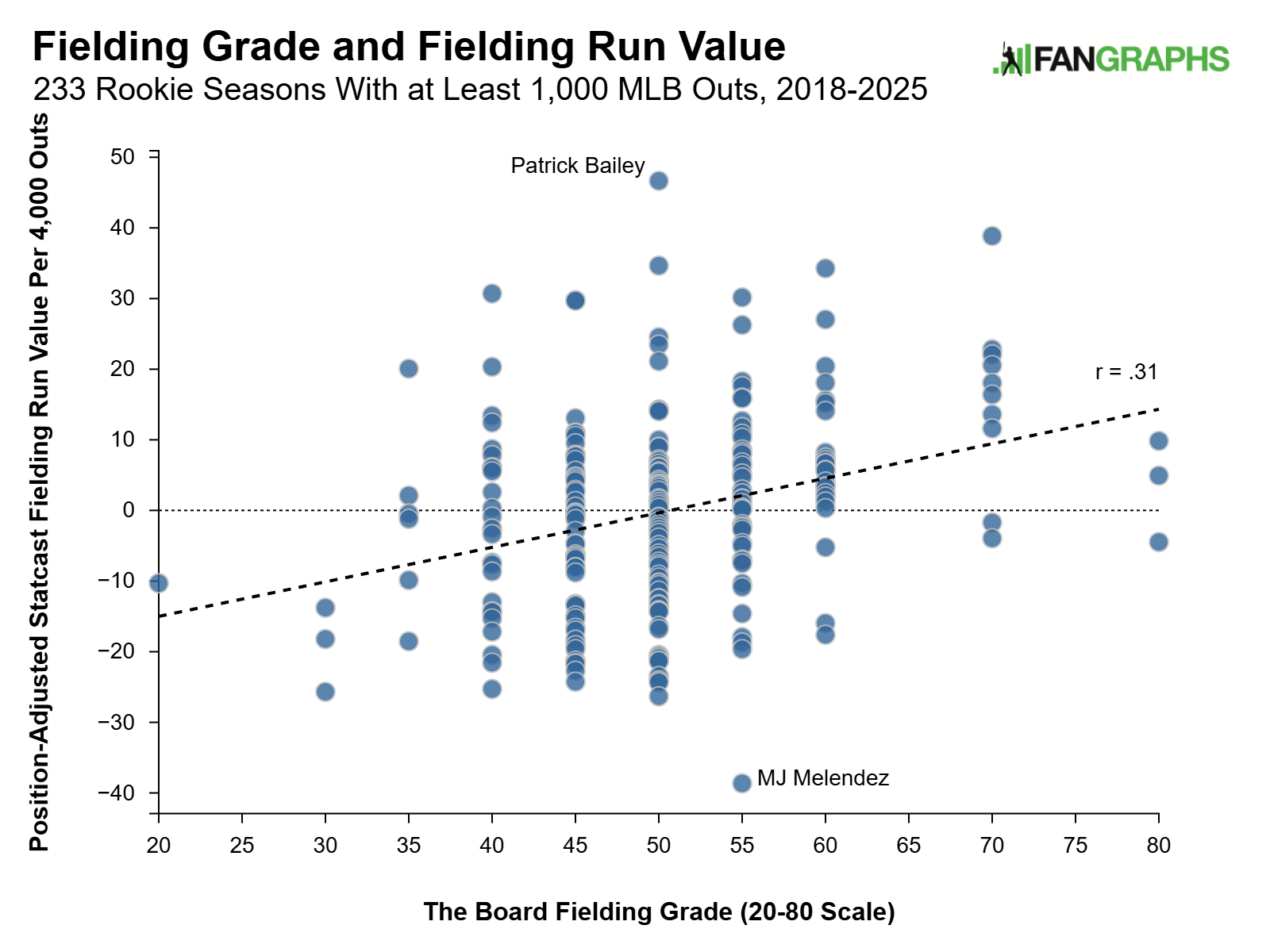
The absence of publicly available Statcast fielding data for minor leaguers necessitates a different approach when it comes to prospects. I use a scouting-based approach, leveraging the listed position and Fielding grades from our prospect team’s essential work on The Board. Using scouting grades to help formulate rookie projections is an old idea in the sabermetrics community. For players not listed on The Board, I’ve assigned a primary position based on where they played the most in 2025, using data provided to me by Thomas Nestico, and formulated a naïve projection that assumes the player will be slightly below average at their primary position at the major league level. For players included on The Board, listed position and Fielding grades work well to formulate a simple defensive projection for rookies, with a 10-point increase in Fielding grade associated with a five-run increase in fielding run value above average per 4,000 outs (i.e., per full season):
You Aren’t a FanGraphs Member
It looks like you aren’t yet a FanGraphs Member (or aren’t logged in). We aren’t mad, just disappointed.
We get it. You want to read this article. But before we let you get back to it, we’d like to point out a few of the good reasons why you should become a Member.
1. Ad Free viewing! We won’t bug you with this ad, or any other.
2. Unlimited articles! Non-Members only get to read 10 free articles a month. Members never get cut off.
3. Dark mode and Classic mode!
4. Custom player page dashboards! Choose the player cards you want, in the order you want them.
5. One-click data exports! Export our projections and leaderboards for your personal projects.
6. Remove the photos on the home page! (Honestly, this doesn’t sound so great to us, but some people wanted it, and we like to give our Members what they want.)
7. Even more Steamer projections! We have handedness, percentile, and context neutral projections available for Members only.
8. Get FanGraphs Walk-Off, a customized year end review! Find out exactly how you used FanGraphs this year, and how that compares to other Members. Don’t be a victim of FOMO.
9. A weekly mailbag column, exclusively for Members.
10. Help support FanGraphs and our entire staff! Our Members provide us with critical resources to improve the site and deliver new features!
We hope you’ll consider a Membership today, for yourself or as a gift! And we realize this has been an awfully long sales pitch, so we’ve also removed all the other ads in this article. We didn’t want to overdo it.
For players included on The Board, I use data from the 2026 Report where available, or else the 2025 Updated Report as a backup. For players with both minor league and major league data, I use Fielding grade in the projections until a player has eclipsed 250 big league innings. After that, I switch to the Statcast-based major league approach. This leads to a rather sharp cutoff at the 250-inning mark, which isn’t ideal, but it offers the advantage of convenience.
A few more things are worth highlighting before getting to the list. First, only domestic minor league (so no DSL) and major league performance is captured. This makes the projections particularly volatile (and thus less useful) for minor leaguers who were drafted in 2025. Because of that, anyone with fewer than 50 career professional plate appearances or total batters faced was excluded from the list. You should check out the ZiPS Top 100 for a system that captures players’ college performance.
Second, these projections are not a substitute for scouting. They cannot account for the diversity of information that a scout can bring to bear when assessing a player. Rather, a projections-based approach can serve as a useful complement by offering a systematic way to incorporate a variety of different numerical indicators at the same time: different measures of performance from different leagues, at different ages, in different seasons. Without the help of projections, it is difficult to summarize all of this information in a consistent, sensible way — or at least it is for me.
Third, prospects are ranked by projected peak single-season WAR, with a player’s peak assumed to occur around age 28, with most of the growth coming before age 25. This differs from the prospect team’s approach, which assigns a Future Value grade meant to approximate a player’s average annual WAR over their first six big league seasons. Naturally, a peak WAR approach results in higher WAR forecasts than the six-year average WAR approach. Peak WAR projections also assume a full season of playing time, which is something to keep in mind for players who may be prone to injury. All projections assume a neutral park in the 2025 major league run environment.
Here are OOPSY’s Top 100 prospects heading into 2026, ranked by peak WAR:
OOPSY 2026 Top 100 Prospects
Projections are for a player’s peak MLB season assuming 600 plate appearances for hitters and 190 innings pitched for pitchers.
Level shows a player’s highest level reached in 2025.
Konnor Griffin, Samuel Basallo, and Kevin McGonigle comprise three of the top four, while 19 of the top 20 prospects also made the FanGraphs Top 100, a good source of triangulation for OOPSY’s approach. Overall, about 60% of my Top 100 ranked on the FanGraphs Top 100, matching the share of agreement between the ZiPS Top 100 and the FanGraphs Top 100. Unsurprisingly, the three lists have greater agreement on the names near the top: Twenty-three of my top 25 made the FanGraphs list, and 37 of my top 50, but only 26 of my bottom 59 made it. Similarly, 24 of my top 25 made the ZiPS list, and 38 of my top 50, but only 15 of my bottom 59.
A few other names in the OOPSY top 30 received a 45-FV grade from our prospect team this list cycle, including Cooper Pratt and Nelson Rada. Alejandro Rosario was a 45+-FV prospect last year, while Emmanuel Rodriguez fell out of this year’s Top 100, mostly due to contact-related concerns. We’ll see where they rank this year when the Nationals and Twins lists come out. The two most notable prospects who failed to make OOPSY’s list are Bryce Eldridge and Ryan Sloan. Eldridge projects well offensively, with a 115 peak wRC+, but his first base defensive home limits his WAR forecast. Meanwhile, the bar for A-ball performance is quite high given it is penalized harshly by my major league equivalencies, bumping Sloan outside the Top 100; he could rise quickly if he continues to dominate at more advanced levels this year.
There are a few players who narrowly graduated from prospect eligibility last year who would have done quite well on these rankings had they still been eligible. Chase Burns would have edged out Griffin for the top spot on this list. Stuff+ darling Grant Taylor would have been the fourth-best prospect arm, slotting in just behind Max Clark, with OOPSY expecting an eventual successful transition to starting full-time; his target for 2026 is roughly 100 innings, but he could enter the rotation in 2027. Marcelo Mayer would have slotted in next to Bubba Chandler on the Top 100, with OOPSY viewing him as an above-average infielder at peak. Finally, Jordan Lawlar would have ranked just ahead of Caleb Bonemer. At peak, OOPSY views him as a below-average, but still passable, shortstop, with a slightly above-average wRC+ and lots of stolen bases. He should get a chance to play all over the diamond for the Diamondbacks this year.
The incorporation of defense led to a lot of movement among the prospect hitters compared to OOPSY’s September 2025 fantasy-focused prospect ranking, bringing this list closer to scouting wisdom:
OOPSY 2026 Top Hitting Prospects
| # | Name | Team | Age | Pos | BB% | K% | HR | SB | wRC+ | Def | WAR | Rel |
|---|---|---|---|---|---|---|---|---|---|---|---|---|
| 1 | Konnor Griffin | PIT | 20 | SS | 7% | 22% | 23 | 38 | 128 | 4.0 | 5.0 | 57% |
| 2 | Samuel Basallo | BAL | 21 | C | 10% | 20% | 29 | 2 | 141 | 0.0 | 4.9 | 80% |
| 3 | Rainiel Rodriguez | STL | 19 | C | 10% | 20% | 31 | 3 | 136 | 3.1 | 4.8 | 46% |
| 4 | Kevin McGonigle | DET | 21 | 3B | 12% | 13% | 24 | 13 | 134 | 0.0 | 4.5 | 68% |
| 5 | Emmanuel Rodriguez | MIN | 23 | CF | 17% | 30% | 20 | 14 | 124 | 3.2 | 4.1 | 68% |
| 6 | Leo De Vries | ATH | 19 | SS | 11% | 20% | 24 | 7 | 127 | 0.8 | 3.9 | 67% |
| 7 | Colt Emerson | SEA | 20 | SS | 11% | 18% | 17 | 10 | 122 | 2.4 | 3.9 | 71% |
| 8 | Sebastian Walcott | TEX | 20 | SS | 10% | 21% | 19 | 23 | 118 | 4.0 | 3.9 | 74% |
| 9 | Max Clark | DET | 21 | CF | 13% | 19% | 19 | 11 | 124 | 0.0 | 3.9 | 72% |
| 10 | Josue Briceño | DET | 21 | 1B | 11% | 20% | 25 | 1 | 127 | -0.1 | 3.9 | 68% |
| 11 | Eduardo Quintero | LAD | 20 | CF | 12% | 24% | 19 | 30 | 116 | 3.2 | 3.8 | 66% |
| 12 | Jesús Made | MIL | 19 | SS | 10% | 21% | 17 | 29 | 112 | 5.6 | 3.8 | 55% |
| 13 | Alfredo Duno | CIN | 20 | C | 13% | 22% | 21 | 2 | 121 | 3.1 | 3.7 | 58% |
| 14 | Carter Jensen | KCR | 22 | C | 12% | 24% | 22 | 5 | 121 | 1.0 | 3.6 | 82% |
| 15 | Moisés Ballesteros | CHC | 22 | C | 9% | 15% | 21 | 1 | 125 | -1.1 | 3.6 | 82% |
| 16 | Franklin Arias | BOS | 20 | SS | 8% | 14% | 19 | 8 | 117 | 4.0 | 3.6 | 71% |
| 17 | Jett Williams | MIL | 22 | CF | 12% | 23% | 18 | 27 | 117 | 0.0 | 3.5 | 73% |
| 18 | JJ Wetherholt | STL | 23 | 2B | 11% | 17% | 18 | 14 | 118 | 0.0 | 3.5 | 61% |
| 19 | Sal Stewart | CIN | 22 | 3B | 10% | 17% | 22 | 9 | 124 | -3.2 | 3.5 | 78% |
| 20 | Cooper Pratt | MIL | 21 | SS | 10% | 17% | 16 | 21 | 109 | 4.0 | 3.4 | 71% |
| 21 | Nelson Rada | LAA | 20 | CF | 12% | 19% | 10 | 38 | 109 | 3.2 | 3.4 | 79% |
| 22 | Carson Benge | NYM | 23 | CF | 10% | 20% | 19 | 11 | 117 | 0.0 | 3.4 | 58% |
| 23 | Luis Peña | MIL | 19 | SS | 7% | 18% | 21 | 36 | 113 | -0.8 | 3.4 | 53% |
| 24 | Aron Estrada | BAL | 21 | 2B | 8% | 17% | 18 | 26 | 115 | -0.8 | 3.3 | 72% |
| 25 | Aidan Miller | PHI | 22 | SS | 12% | 23% | 16 | 40 | 113 | -0.8 | 3.3 | 70% |
| 26 | Michael Arroyo | SEA | 21 | 2B | 10% | 21% | 20 | 7 | 124 | -3.2 | 3.3 | 76% |
| 27 | Luis Lara | MIL | 21 | CF | 10% | 16% | 11 | 30 | 108 | 3.2 | 3.3 | 79% |
| 28 | A.J. Ewing | NYM | 21 | CF | 11% | 22% | 14 | 32 | 109 | 3.2 | 3.3 | 68% |
| 29 | Justin Crawford | PHI | 22 | CF | 8% | 18% | 12 | 37 | 111 | 0.0 | 3.3 | 79% |
| 30 | Ryan Clifford | NYM | 22 | RF | 13% | 26% | 27 | 2 | 126 | -7.1 | 3.1 | 77% |
| 31 | Dauri Fernandez | CLE | 19 | SS | 7% | 18% | 20 | 27 | 107 | 2.4 | 3.1 | 36% |
| 32 | Caleb Bonemer | CHW | 20 | 3B | 11% | 23% | 20 | 14 | 115 | -1.6 | 3.0 | 51% |
| 33 | Harry Ford | WSN | 23 | C | 13% | 21% | 16 | 13 | 111 | 2.0 | 3.0 | 82% |
| 34 | Walker Jenkins | MIN | 21 | CF | 11% | 18% | 18 | 15 | 120 | -5.5 | 3.0 | 68% |
| 35 | Kaelen Culpepper | MIN | 23 | SS | 8% | 21% | 21 | 14 | 104 | 5.6 | 3.0 | 62% |
| 36 | Nate George | BAL | 20 | CF | 8% | 20% | 17 | 46 | 112 | -1.6 | 3.0 | 49% |
| 37 | Sam Antonacci | CHW | 23 | 2B | 10% | 17% | 12 | 27 | 113 | -3.2 | 3.0 | 59% |
| 38 | Owen Caissie | CHC | 23 | RF | 11% | 28% | 22 | 4 | 121 | -3.9 | 3.0 | 82% |
| 39 | Carson Williams | TBR | 23 | SS | 10% | 31% | 24 | 22 | 107 | 3.3 | 2.9 | 81% |
| 40 | Yeremy Cabrera | TEX | 20 | CF | 9% | 22% | 19 | 25 | 105 | 1.6 | 2.9 | 63% |
| 41 | Kendall George | LAD | 21 | CF | 12% | 19% | 10 | 63 | 101 | 1.6 | 2.9 | 71% |
| 42 | Eduardo Tait | MIN | 19 | C | 6% | 21% | 24 | 1 | 111 | 1.0 | 2.9 | 67% |
| 43 | Edwin Arroyo | CIN | 22 | SS | 7% | 20% | 15 | 9 | 104 | 5.6 | 2.9 | 81% |
| 44 | Adrian Santana | TBR | 20 | SS | 7% | 14% | 13 | 42 | 97 | 4.0 | 2.9 | 71% |
| 45 | Roldy Brito | COL | 19 | CF | 8% | 22% | 16 | 29 | 107 | 1.3 | 2.9 | 47% |
| 46 | Lazaro Montes | SEA | 21 | RF | 12% | 27% | 28 | 1 | 124 | -7.1 | 2.9 | 75% |
| 47 | Eli Willits | WSN | 18 | SS | 9% | 21% | 18 | 5 | 103 | 5.6 | 2.9 | 12% |
| 48 | John Gil | ATL | 20 | SS | 9% | 18% | 15 | 38 | 99 | 4.0 | 2.8 | 68% |
| 49 | Dax Kilby | NYY | 19 | SS | 10% | 19% | 16 | 38 | 107 | -2.3 | 2.8 | 17% |
| 50 | Starlyn Caba | MIA | 20 | SS | 12% | 18% | 13 | 29 | 90 | 11.9 | 2.8 | 58% |
| 51 | Bryce Rainer | DET | 20 | SS | 9% | 24% | 19 | 15 | 103 | 4.0 | 2.8 | 25% |
| 52 | Demetrio Crisantes | ARI | 21 | 2B | 9% | 18% | 15 | 16 | 106 | 1.6 | 2.8 | 64% |
| 53 | Gabriel Gonzalez | MIN | 22 | RF | 7% | 17% | 18 | 3 | 112 | -0.7 | 2.8 | 82% |
| 54 | William Bergolla Jr. | CHW | 21 | SS | 7% | 8% | 11 | 24 | 106 | 2.4 | 2.7 | 77% |
| 55 | George Lombard Jr. | NYY | 21 | SS | 12% | 24% | 13 | 25 | 103 | 2.4 | 2.7 | 71% |
| 56 | Ethan Salas | SDP | 20 | C | 10% | 20% | 17 | 8 | 102 | 5.2 | 2.7 | 66% |
| 57 | Juneiker Caceres | CLE | 18 | RF | 9% | 16% | 19 | 5 | 117 | -3.9 | 2.7 | 43% |
| 58 | Samuel Zavala | CHW | 21 | CF | 13% | 22% | 18 | 7 | 109 | 1.6 | 2.7 | 77% |
| 59 | Chris Suero | NYM | 22 | C | 11% | 27% | 19 | 20 | 105 | 2.0 | 2.7 | 67% |
| 60 | Ty Southisene | CHC | 20 | SS | 11% | 18% | 13 | 27 | 100 | 2.4 | 2.6 | 48% |
| 61 | Dylan Beavers | BAL | 24 | LF | 13% | 22% | 17 | 20 | 114 | -5.8 | 2.6 | 80% |
| 62 | Jefferson Rojas | CHC | 21 | SS | 9% | 18% | 18 | 14 | 105 | 0.8 | 2.6 | 75% |
| 63 | Arjun Nimmala | TOR | 20 | SS | 9% | 24% | 20 | 12 | 102 | 2.4 | 2.6 | 68% |
| 64 | Hao-Yu Lee | DET | 23 | 2B | 9% | 20% | 17 | 16 | 110 | -3.2 | 2.6 | 80% |
| 65 | Angel Genao | CLE | 22 | SS | 8% | 18% | 14 | 6 | 104 | 2.4 | 2.6 | 79% |
| 66 | Jacob Reimer | NYM | 22 | 3B | 10% | 22% | 19 | 4 | 114 | -3.2 | 2.6 | 71% |
| 67 | Jeferson Quero | MIL | 23 | C | 8% | 17% | 20 | 2 | 106 | 1.0 | 2.6 | 75% |
| 68 | Brice Matthews | HOU | 24 | 2B | 11% | 30% | 21 | 36 | 101 | 0.4 | 2.5 | 67% |
| 69 | Ryan Waldschmidt | ARI | 23 | LF | 12% | 21% | 15 | 18 | 109 | -2.3 | 2.5 | 60% |
| 70 | Joe Mack | MIA | 23 | C | 9% | 26% | 22 | 4 | 100 | 5.2 | 2.5 | 80% |
| 71 | Alex Freeland | LAD | 24 | SS | 12% | 25% | 17 | 18 | 100 | 2.7 | 2.5 | 79% |
| 72 | Pedro Ramirez | CHC | 22 | 3B | 7% | 18% | 14 | 14 | 104 | 1.6 | 2.5 | 82% |
| 73 | Devin Fitz-Gerald | TEX | 20 | 3B | 10% | 20% | 19 | 7 | 104 | 1.6 | 2.5 | 29% |
| 74 | Kane Kepley | CHC | 22 | CF | 11% | 20% | 15 | 24 | 103 | 0.0 | 2.5 | 23% |
| 75 | Tre’ Morgan | TBR | 23 | 1B | 11% | 17% | 14 | 8 | 109 | -1.5 | 2.5 | 69% |
| 76 | Asbel Gonzalez | KCR | 20 | CF | 8% | 20% | 12 | 53 | 94 | 3.2 | 2.5 | 62% |
| 77 | Josue De Paula | LAD | 21 | RF | 14% | 22% | 17 | 22 | 112 | -7.1 | 2.5 | 74% |
| 78 | Wyatt Sanford | PIT | 20 | SS | 9% | 23% | 15 | 36 | 92 | 5.6 | 2.4 | 38% |
| 79 | Henry Bolte | ATH | 22 | RF | 10% | 31% | 17 | 32 | 105 | -3.9 | 2.4 | 75% |
| 80 | Kevin Alcántara | CHC | 23 | CF | 9% | 27% | 20 | 10 | 105 | 0.0 | 2.4 | 82% |
| 81 | Hayden Alvarez | LAA | 19 | CF | 10% | 20% | 15 | 31 | 101 | 0.0 | 2.4 | 42% |
| 82 | Wilder Dalis | COL | 19 | 3B | 9% | 22% | 17 | 11 | 101 | 2.4 | 2.4 | 46% |
Projections are for a player’s peak MLB season assuming 600 plate appearances.
Projections assume a neutral park in the 2025 MLB run environment.
Rel = reliability, the proportion of a player’s projection that is comprised of performance rather than regression.
Def = defensive runs above average, fielding runs plus positional adjustment.
Lazaro Montes and Ryan Clifford continue to project well offensively, but weak defense projections knock them out of the top 25 here. Luke Adams’ 40-grade projected defensive ability at first base drops him off the list entirely, though he still rates well offensively, with a 123 peak wRC+ projection. On the flip side, Jesús Made slots in as 12th-best hitter now, whereas he failed to crack the top 30 in the September update. As a forecaster, this is the sort of change I like to see, bringing OOPSY more in line with industry wisdom. Starlyn Caba and Tre’ Morgan also join the list after receiving 80 FV Fielding grades at shortstop and first base, respectively, last list cycle. Druw Jones is the only other prospect on The Board with an 80 FV Fielding grade, but his offensive projection (80 peak wRC+) is weak enough to keep him off the list. He looks like a surefire major leaguer, however.
The biggest surprises among the hitting prospects are Aron Estrada and Wilder Dalis, two players who did not make the 2025 in-season update of The Board. Our lead prospect analyst, Eric Longenhagen, covered Estrada last April, highlighting his defensive issues, while anticipating that a projections-based approach would probably like him, saying, “This is a prospect where my visual eval is a good bit lower than whatever a model would likely spit out given Estrada’s TrackMan data.” Dalis is a teenage Rockies prospect who has performed well in a limited sample. Eric discussed him in January 2025, citing his strong hard-hit data. I look forward to seeing how both of those guys stack up on their respective lists later this cycle.
On the pitching side, there aren’t any major surprises in the top 10, with OOPSY endorsing prospect arms also beloved by scouts, although a few have significant health concerns, including Rosario, who is recovering from Tommy John surgery, and Jarlin Susana, who is recovering from surgery on his right lat. Our prospect team believed enough in the stuff to rank Susana 29th on Monday’s Top 100, injuries be damned. Here is how the pitchers shake out:
OOPSY 2026 Top Pitching Prospects
| # | Name | Team | Age | Pos | K% | BB% | HR/9 | FIP | ERA | WAR | Rel |
|---|---|---|---|---|---|---|---|---|---|---|---|
| 1 | Trey Yesavage | TOR | 22 | RHP | 29% | 9% | 1.00 | 3.46 | 3.31 | 4.3 | 60% |
| 2 | Jonah Tong | NYM | 23 | RHP | 28% | 10% | 0.90 | 3.46 | 3.42 | 4.1 | 73% |
| 3 | Travis Sykora | WSN | 22 | RHP | 28% | 9% | 0.95 | 3.46 | 3.47 | 4.0 | 54% |
| 4 | Payton Tolle | BOS | 23 | LHP | 27% | 7% | 1.18 | 3.68 | 3.57 | 3.8 | 59% |
| 5 | Connelly Early | BOS | 24 | LHP | 25% | 8% | 0.94 | 3.59 | 3.60 | 3.7 | 71% |
| 6 | Nolan McLean | NYM | 24 | RHP | 23% | 8% | 0.85 | 3.63 | 3.62 | 3.6 | 75% |
| 7 | Alejandro Rosario | WSN | 23 | RHP | 24% | 7% | 0.99 | 3.60 | 3.67 | 3.5 | 54% |
| 8 | Jarlin Susana | WSN | 22 | RHP | 25% | 11% | 0.88 | 3.78 | 3.76 | 3.3 | 66% |
| 9 | Thomas White | MIA | 21 | LHP | 26% | 9% | 1.07 | 3.80 | 3.76 | 3.3 | 67% |
| 10 | Robby Snelling | MIA | 22 | LHP | 22% | 6% | 1.05 | 3.74 | 3.79 | 3.2 | 76% |
| 11 | Bubba Chandler | PIT | 23 | RHP | 23% | 8% | 1.09 | 3.88 | 3.82 | 3.2 | 77% |
| 12 | Ricky Tiedemann | TOR | 22 | LHP | 26% | 10% | 1.02 | 3.83 | 3.86 | 3.1 | 49% |
| 13 | Yordanny Monegro | BOS | 23 | RHP | 23% | 8% | 1.01 | 3.88 | 3.96 | 2.8 | 57% |
| 14 | Ty Johnson | TBR | 24 | RHP | 25% | 8% | 1.16 | 3.96 | 4.01 | 2.8 | 67% |
| 15 | Logan Henderson | MIL | 24 | RHP | 24% | 7% | 1.26 | 3.99 | 4.02 | 2.7 | 70% |
| 16 | Luis Perales | WSN | 23 | RHP | 23% | 10% | 1.15 | 4.19 | 4.04 | 2.7 | 43% |
| 17 | Mitch Bratt | ARI | 22 | LHP | 21% | 5% | 1.32 | 4.03 | 4.05 | 2.7 | 74% |
| 18 | Trey Gibson | BAL | 24 | RHP | 22% | 9% | 1.02 | 3.96 | 4.06 | 2.6 | 71% |
| 19 | Ben Hess | NYY | 23 | RHP | 24% | 10% | 1.06 | 4.05 | 4.07 | 2.6 | 58% |
| 20 | Coleman Crow | MIL | 25 | RHP | 22% | 7% | 1.07 | 3.89 | 4.07 | 2.6 | 43% |
| 21 | Johnny King | TOR | 19 | LHP | 25% | 10% | 1.11 | 4.07 | 4.09 | 2.6 | 47% |
| 22 | Carlos Lagrange | NYY | 23 | RHP | 24% | 11% | 1.08 | 4.20 | 4.09 | 2.6 | 68% |
| 23 | Brandon Sproat | MIL | 25 | RHP | 20% | 8% | 0.96 | 4.06 | 4.10 | 2.5 | 74% |
| 24 | Didier Fuentes | ATL | 21 | RHP | 22% | 7% | 1.35 | 4.22 | 4.12 | 2.5 | 63% |
| 25 | Robert Gasser | MIL | 27 | LHP | 21% | 7% | 1.25 | 4.11 | 4.12 | 2.5 | 62% |
| 26 | George Klassen | LAA | 24 | RHP | 22% | 10% | 1.13 | 4.22 | 4.14 | 2.5 | 70% |
| 27 | Gage Jump | ATH | 23 | LHP | 21% | 7% | 1.16 | 4.09 | 4.15 | 2.4 | 61% |
Projections are for a player’s peak MLB season assuming 190 innings pitched.
Projections assume a neutral park in the 2025 MLB run environment.
Rel = reliability, the proportion of a player’s projection that is comprised of performance rather than regression.
There are a few surprises outside the top 10, namely Ben Hess, Ty Johnson, Yordanny Monegro, and Coleman Crow. Our prospect team views Monegro as having relief risk, an outcome that became more likely after he underwent Tommy John surgery last June. Per The Board, Johnson touches 97 mph, but a weak changeup as his third pitch gives him heightened relief risk if he is unable to improve it. Hess possesses a four-pitch mix and can get the fastball up to 98. Per this year’s Brewers list, Crow’s lengthy injury history and corresponding lack of innings point to a bullpen future, though our prospect team notes that he has a chance to be a very good reliever if his velo ticks up.
You can find peak projections for all major league and minor league players here, as well as daily updates to the projections in-season. We are also working on displaying preseason peak WAR forecasts for all players for FanGraphs Members in the coming weeks, an OOPSY counterpart to the ZiPS three-year forecasts.