

In the cycling world, there aren’t many who have worn more hats (or should that be casquettes?) than Brian Smith.
Over four decades in and around the sport, the 58-year-old has raced as a professional, including for Lance Armstrong’s Motorola team, won the British road race championships twice, managed a number of top teams, been involved in race organisation, co-founded the Braveheart Fund, and served as a mentor for young Scottish talent.
Smith has also, of course, spent the last 15 years dissecting every bike race on the planet to within an inch of its life as a pundit for Eurosport, GCN, and now TNT Sports.
And now, for 2026, he’s acquired another new cap by stepping into the world of ‘cycling brand and tourism consultancy’ courtesy of Robert Thorpe’s Wordsmith Studio. This new role sees him work with bike brands and up-and-coming races, such as the Czech Tour and the Tour of Hellas, to help get the word out there, thanks to some good old-fashioned, and some new-fangled tech age, promotion.
And while Brian has been involved with the Czech Tour for a few years now, his relationship with the Tour of Hellas was something of an accidental discovery.
Greece’s national tour, a 2.1 ranked five-day stage race taking place in early May, has what you may call a meandering, intermittent history. It was held on and off as an amateur race between 1968 and 2004 (Matt Stephens finished third back in 1998), before turning pro as part of the Europe Tour in 2005.
Pavel Brutt won in 2006, while Davide Rebellin finished second in 2012, the last race before another decade-long hiatus. It was eventually revived in its current guise in 2022, and won last year by Astana’s Harold Martín López.
 Tour of Hellas 2025 (credit: Tour of Hellas)
Brian admits he didn’t know much about the race until last spring, when Irish commentator Declan Quigley presented him with a rare solo comms opportunity at the race.
“What I do as a pundit is possibly the easiest job in the world,” Brian tells the road.cc Podcast.
“I’ve got over 40 years of experience, involving teams, events, everything, and I find it quite easy because it’s something I love doing and I think anybody that really loves what they do thinks it’s the easiest job in the world.
“But being a commentator is a bit of a challenge, and I always get nervous when I do it, because I always want to do my best. So, I went out to the Tour of Hellas, and I was blown away.
“Most people when they think of Greece, they think of going on holiday to a Greek island. But I didn’t know that Greece has a ski area, that 80 per cent of the country is hilly or mountainous. Some of the places I was in felt like the Alps, in Switzerland.
“And what blew me away as a commentator – because you have to do a little bit of homework around points of interest they’re going to show – is that there’s so much, there’s too much, all the temples and history. It was surreal seeing Athens, the home of the Olympics, the Acropolis, the blue line.
“So, when I joined the Wordsmith Studio, I thought we could work with them and help them out.”
 Tour of Hellas 2025 (credit: Tour of Hellas)
However, despite Brian’s optimism about the Tour of Hellas’s potential as a fledgling stage race – and as cyclo-tourism advertisement for Greece, which he reckons has the tools to rival Mallorca in the ubiquitous cycling holiday stakes – he admits the race is “up against it for various reasons”.
One of those is what many deem to be cycling’s congested calendar, a problem not helped by the organisers’ bizarre decision to move the race from April to early May – placing it in direct conflict with the Grande Partenza of the Giro d’Italia in neighbouring Bulgaria.
That clash, Brian says, means any hopes of attracting more teams and marquee names to the race have essentially vanished, with WorldTour squads unlikely to stretch their already thin resources even further at a time when staff will be split across Bulgaria and Italy at the start of the Giro.
“I genuinely think a lot of bike riders want to come to the race, everyone who was here last year, Matt White for Jayco, Pete Kennaugh at Astana, told me how much they loved it. But unfortunately the race is going to struggle to attract anybody because of the logistics.
“They want to step up. They’ve got ambition to step up to the next level and to be able to do that, and you have to tick different boxes. You have to invite star riders, you have to invite better teams. It’s got great potential. But moving it to May was a big mistake – and it was never flagged up by the UCI, surely they knew there was going to be clash.
“It’s dog eat dog when it comes to races and dates. I remember the Tour of Britain going up against the Vuelta and it did attract good teams and good riders, because the details were good, the stages were good. So it’s what teams are looking for.”
One of the other barriers facing the Tour of Hellas is the lack of an ingrained bike racing culture in Greece – something Brian again compares to the early days of the Tour of Britain.
“It’s always a major fight. I was involved with the Tour of Britain back in these days when we were fighting with traffic on the roads, and the general public in the UK weren’t educated in bike racing,” he says.
“We were trying to keep the bunch safe, and there were cars driving towards us. In 1994, when I was national champion, a rogue driver pretty much drove me off the road, and almost ended my season.
“And that’s all changed now. I’ve seen the evolution of the Tour of Britain in the years that I worked in race control from almost hand out the window, flashing lights, trying to move cars out the way to cars actually stopping now. And instead of the ‘window down taking a picture’, they’re getting out of the car.
“They’re starting to engage with the race. And the whole education of a bike racing culture has changed massively since I worked with the Tour of Britain.”
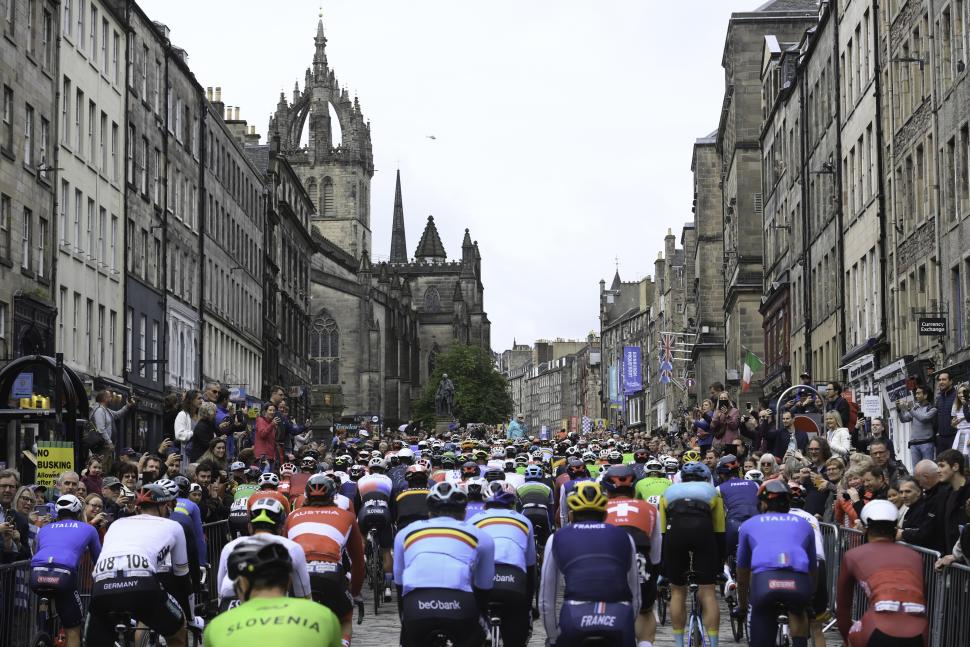 Royal Mile, 2023 UCI Cycling World Championships, Men’s Elite Road Race, Edinburgh to Glasgow, Scotland (credit: Alex Broadway/SWpix.com)
Of course, that embrace of cycling culture in the UK has resulted in the news that the Tour de France will visit Britain for the third time in two decades in 2027 – with a groundbreaking double Grand Départ for both the men’s and women’s races, and crucially for tartan-wielding Brian, an unexpected first stage in Edinburgh (though he admits he would have preferred a Paisley start for cycling’s biggest race).
“It’s great. When Gary Verity brought the Tour to Yorkshire in 2014, I spoke to British Cycling about the potential of one day taking the race to Scotland,” he says.
“And I was told it would never happen because of the logistics. So it was quite a surprise, and Paul Bush really championed the fact we can get Scotland on the map – this has been 20 years in the making. And how times have changed.
“The start of the Tour de France, the biggest sporting annual event in the world, to come into Scotland’s just huge. We’ve had the worlds, now we’re getting the Tour de France. I’ve got some friends in the Borders, and they’re absolutely over the moon. They were just pleased when a stage of the Tour of Britain passed by.”
Pressure
The Tour’s inaugural visit to Scotland has also coincided, as fate would have it, with the emergence of Scotland’s first bona fide grand tour contender since Robert Millar (now Philippa York) in the 1980s: Oscar Onley, following the 23-year-old’s revelatory fourth place at last year’s race.
“It couldn’t come at a better time for Oscar, could it? Especially going through the Borders,” says Brian.
However, the 58-year-old isn’t convinced that Onley’s big-money move to the Ineos Grenadiers was the right decision for Britain’s next big Tour hope – despite the transfer to Ineos marking a homecoming of sorts.
 Oscar Onley on Superbagnères, stage 14, 2025 Tour de France (credit: Zac Williams/SWpix.com)
“Pressure. Pressure’s the word. If I was giving him a bit of advice before he made that move, I’d have suggested that he should stay at Picnic-PostNL. And the team could have invested in two or three riders, which they did with James Knox.
“I was led to believe that this was so late in the day this happened that Oscar’s flight to the Tour Down Under was already paid for [by Picnic], that’s how late it went.
“Okay, it’s big money. But I think it’s a desperate move by the Ineos Grenadiers, because they’re under severe pressure to deliver in grand tours, especially at the Tour de France. If the figures I’ve seen published are true, it’s a huge amount of money to buy a rider out of their contract.
“I feel as if Picnic-PostNL developed him and it’s a group he enjoyed being part of, more of a family team who were there to support him, asking him to do the best he can.
“And now he’s been taken out of that environment, to an environment where it’s ‘we have to deliver’. And there’ll be huge pressure on him to deliver a big performance. Can he do it? I hope he does. But he’s up against some anomalies in cycling, probably the best ever era of grand tour riders.
“Can Oscar Onley beat Pogačar, Vingegaard, and Evenepoel? That’s the big question. I think he’s better looking at a Giro or a Vuelta if he wants to win a grand tour for them. And the big thing he’ll have, which I don’t think he would have had with Picnic, is the pressure.”
> British cycling is on the cusp of a new golden era in 2026… But will anyone in the UK care?
Pressure, Brian notes, is endemic throughout the cycling world, creating a culture, he says, in which riders are “used and abused” by teams desperately trying to eek out that last percentage point – or marginal gain.
The pressure of life as a pro cyclist, both internally and externally, led Brian to suffer with bulimia during his racing days and later osteopenia, the result of minimal weight bearing and poor education, he says.
 Brian Smith with Sweetspot’s Rob Kennison (credit: Allan McKenzie/SWpix.com)
It is also, Brian points out, leading to a spate of early retirements and the proliferation of cycling’s word of the 2020s: burnout.
“Was Simon Yates retiring a surprise? Probably not,” he says. “They go away to these training camps for weeks, Tom Pidcock’s in Chile – there’s nothing there.
“It’s pressure, pressure, pressure the whole time and some people just say that’s enough. What did Pogačar say at the Tour de France? He’s not doing the Vuelta, and there was talk of one word: burnout. Burnout. They’re racing 80 days a year – in my day we raced 120.
“But there’s no place to hide now. I can totally understand it. The teams are abusing these athletes, it’s abuse. They’re looking at riders as Formula One cars.
“Any tweaks they can do to help performance, they’ll do it irreverent of whether the car crashes, is it going to save the life of the driver? They’re probably not thinking about that. They’re just thinking about performance and speeds.
“The bike riders don’t help themselves either. I think most bike riders think like, if you do this training, have this diet, and take these supplements or don’t take these supplements, and then you’ll have health problems down the line, they don’t care, especially the youngsters. And they’re relying on their teams to look after them.
“And cycling, at the top end of our sport, is not healthy.”
The road.cc Podcast is available on Apple Podcasts, Spotify, and Amazon Music, and if you have an Alexa you can just tell it to play the road.cc Podcast. It’s also embedded above, so you can just press play.