
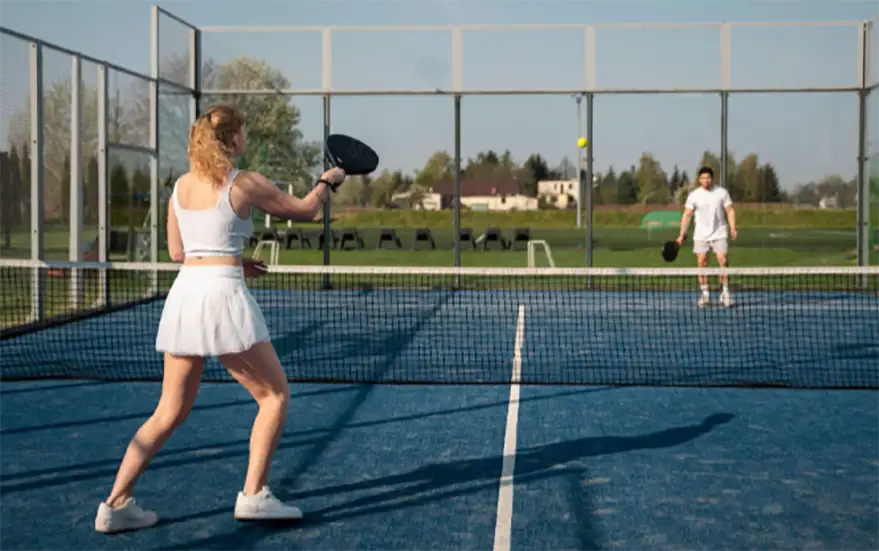
Padel has gone from being a nearly unknown sport to one of the favorite ways to have a good time with friends, disconnect, and move a little in a very short time. Its magic lies in the fact that you don’t need to be an expert to enjoy it from day one. You just need to learn a few basic rules and take a chance on the court.
How is a padel match organized?
Padel is always played in pairs, which makes the atmosphere more social and fun. The court is rectangular, surrounded by walls or glass, and that feature is an essential part of the game. The dimensions (20 meters long by 10 meters wide) are designed so that the pace is fast without being too difficult for beginners.
The scoring system is the same as in tennis: 15, 30, 40, and game. To win a set, you need six games with a two-game difference. If both teams reach six, a tie-break is played to decide. In recreational matches, it is usually played best of three sets, although they are often shortened to make better use of the court time.
When starting out, it’s normal to pay attention to equipment such as the racket, the balls, and even finding accessories like the best padel bags to carry everything comfortably.
The serve is the beginning of every point
The serve is the first real action of the game, and, although it seems easy, it has its tricks. The server must stand behind the service line and bounce the ball before hitting it. That hit must always be done below the waist. This helps prevent too much power and lets the point begin in a controlled way.
The ball must land in the diagonal service box on the opposite side. If it grazes the net but still lands in the correct place, it is simply repeated.
And if you miss, there is a second attempt available. Over time, the serve stops being a worry and becomes an opportunity to take the initiative.
If you’re just starting, coordinating the bounce, posture, and direction may feel difficult, but a few minutes of practice before each match is enough for the movement to flow naturally.
Ball movement: what counts and what doesn’t
One of the aspects that makes padel so entertaining is the possibility of using the walls. As long as the ball first bounces inside the opponent’s court, it can then bounce off glass or walls without any problem. If it touches a wall before bouncing on the ground, then the point goes to the opposing pair.
On your own court, you can also use the wall to return difficult shots. This leads to smart plays, surprising recoveries, and points that feel endless.
The ball may only bounce once. If it bounces twice and no one returns it, the point ends. And if, after bouncing inside the limits, it goes out of the court due to the effect of the shot, the point is still valid.
There are even courts where you’re allowed to leave through the door to return a ball that has gone outside, a spectacular resource usually seen from more advanced players.
The net and the body: boundaries within the court
The net marks the limit between both teams and is untouchable. If someone touches it, even slightly, the point is lost. It is also not allowed to place any part of the body or the racket into the opponent’s side while hitting a shot. What is allowed is to pass the racket over the net as long as there is no physical contact with it.
These small rules keep the game orderly, safe, and respectful. Since padel is a fast sport and sometimes played very close to the net, it’s important to maintain these boundaries to avoid confusion or unnecessary collisions.
Communication and positioning as a pair
Coordination between teammates is one of the secrets for the match to flow. Simple vocabulary is often used to avoid confusion… words like “mine,” “yours,” “I’m going,” or “switch” help organize play without shouting or misunderstandings. With a bit of practice, communication becomes almost automatic.
As for positioning, the ideal is usually to move forward toward the net because from there it’s easier to dominate the point. Even so, knowing when to go up or when to stay at the back depends on the rhythm of the game and the style of each pair.