
The Carolina Panthers made one mistake in free agency, but they have many directions they can go in the draft. And here is their seven-round 2026 NFL Draft, according to the PFF mock simulator after free agency.
With the No. 19 pick in the first round, the Panthers will have a chance to address their biggest needs. That includes wide receiver, tight end, center, and defensive line.
So let’s see how the PFF simulator spent the Panthers’ draft capital. One note: The simulator seemed to get a little wonky with this draft, spending three picks on tight end.
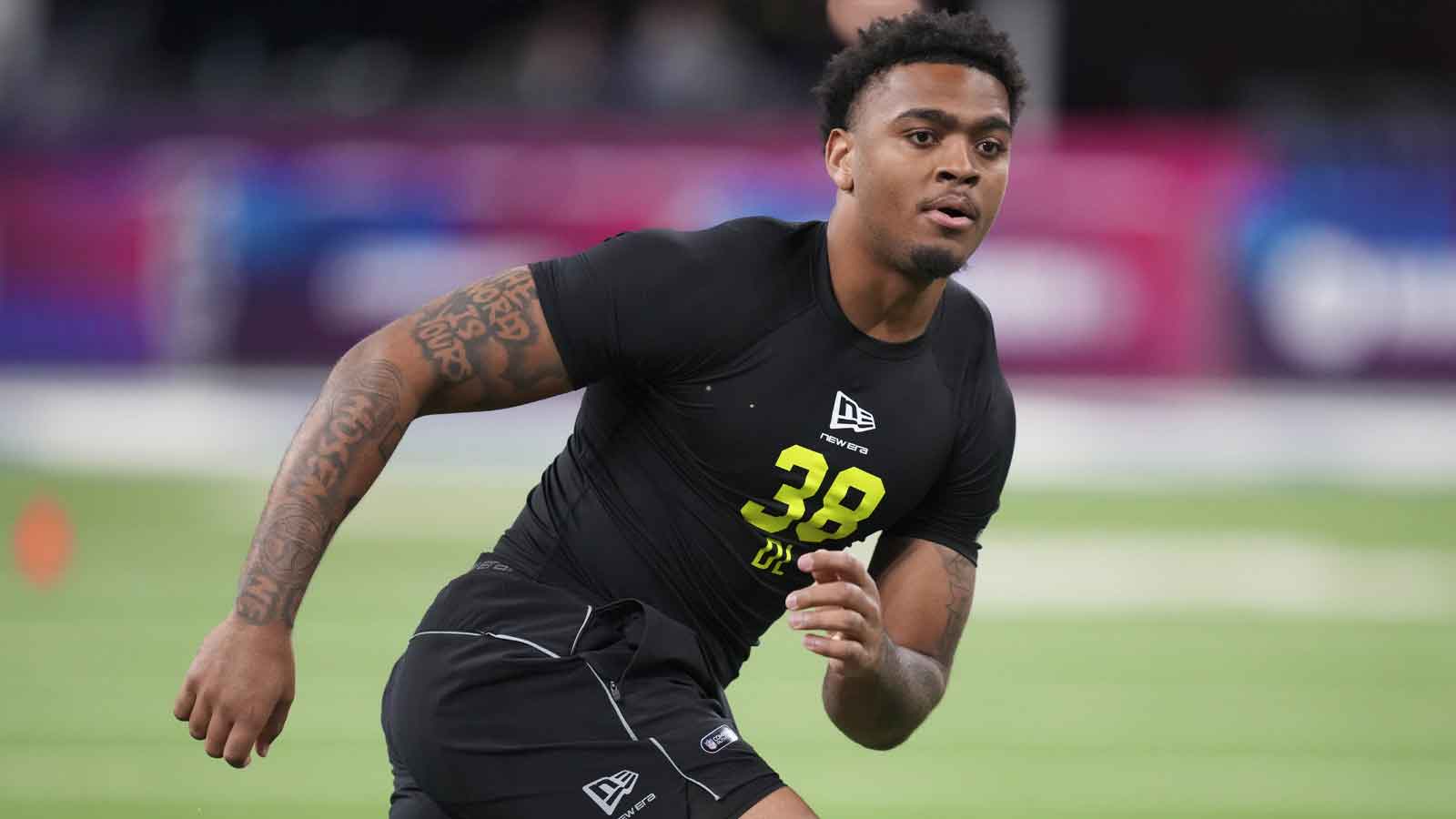
Round 1, Pick 19: EDGE Keldric Faulk, Auburn
This would be a potential steal for the Panthers. Faulk has been mocked higher. And that’s why it makes sense that the Panthers would go this direction despite not needing an edge rusher from the draft.
Faulk should develop into a strong starter quickly, according to NFL.com.
“Faulk has a long, developing frame, good movement skills, and the potential for odd or even fronts once he gains more muscle mass,” Lance Zierlein wrote. “He’s a culture player with high character who earns a grade bump based on his age (turns 21 in September), traits, and advanced foundation. A fluid athlete with good movement skills, he works around blocks with finesse but needs more assertive initial strikes to set firmer edges in gap control.”
Bleacher Report tabbed Faulk as a first-year starter. But he might not stick as an edge rusher.
“Faulk is a 6’6″, 275-pound defensive line prospect whose impressive size and age at only 20 years old give him the necessary tools to be an impact player at the next level,” Matt Holder wrote. “While some project the former Tiger as an edge defender, he’s at his best as a 4i-technique in odd fronts and has a physical profile that fits better as a ‘defensive lineman.’ ”
Round 2, Pick 51: EDGE R. Mason Thomas, Oklahoma
Thomas could become a linuep fixture in the league if he lives up to his potential. However, his size (6-2, 241) could be an issue against big tackles, according to NFL.com.
“Twitched-up rush linebacker whose lack of size and length at the point of attack could be offset by his rush talent,” Lance Zielein wrote. “Thomas has added good mass over the years, but still gets engulfed and displaced by big, downhill blockers. He’s more dangerous on the move, slipping into gaps and disrupting edges before they’re set.”
Round 3, Pick 83: TE Max Klare, Ohio State
The No. 3-ranked tight end, according to NFL Draft Buzz, Klare’s size (6-4, 246) is good enough to give him a shot at making an impact as a pass catcher.
“This is a guy who can threaten vertically, win on intermediate crossers, and make defenders pay when they guess wrong in zone coverage,” NFL Draft Buzz wrote. “His feel for route stems and leverage manipulation is advanced for a college tight end, and his ability to line up from multiple spots gives offensive coordinators real flexibility. The move to Ohio State did not showcase him the same way. But anyone who watched both years of tape understands the production dip had more to do with target share and scheme than regression as a player.”
Maybe this ding is why the PFF simulator backed him up with other tight end picks.
Round 4, Pick 119: WR CJ Daniels, Miami
His size (6-2, 202) suggests he could find his way into a lineup somewhere. But NFL.com tabbed him as a backup, and an average one at that.
“Daniels has a tremendous feel for creating catch opportunities with varied route tempo, body control, and late separation tactics,” Lance Zierlein wrote.
That sounds pretty good. However, good defenders could give him problems.
“He will struggle against a quality press and might need to be schemed into releases against certain corners,” Zierlein wrote.
He’s also average after the catch.
Round 5, Pick 158: TE Joe Royer, Cincinnati
This pick seems to make more sense than the previous one. Royer is rated as a guy who could develop into a starter, and has better size at 6-5 and 247 pounds. Quickness also enters the picture, according to NFL.com.
“Two-year starter at Cincinnati after three uneventful seasons at Ohio State,” Zierlein wrote. “Royer is low-cut with a long torso and good foot quickness. He is better over the first two levels, with a more basic route tree allowing him to flow. He’s physical as a pass-catcher when needed and makes combat catches that others might drop.”
Round 5, Pick 159: WR Josh Cameron, Baylor
Excellent size (6-2, 220) should give Cameron a fighting chance to make the roster. But lack of speed could hold him back, according to NFL Draft Buzz.
“Cameron is not going to be the guy who takes the top off a defense or runs away from anyone in the open field,” NFL Draft Buzz wrote. “That much is obvious the moment you look at his testing. What he will do is catch everything thrown his way, fight through contact like he’s insulted by it, and find ways to move the chains in the ugly, physical possessions that decide games in November and January. His calling card is his body and how he uses it, not his feet and how fast they move.”
Round 6, Pick 200: TE Tanner Koziol, Houston
Maybe Koziol can turn into a steal. He comes with good college numbers, according to Pro Football Focus.
“Koziol led all tight ends in the class in receptions (74) and contested-catch percentage (74.1%),” Jordan Plocher wrote. “He lined up in the slot on 50% of his snaps in 2025, and his best NFL role will be as a big slot receiver where he can use his athleticism to get open and his size and giant catch radius to keep defenders away from the ball.”