
Paris–Nice 2026 | Full Stage-by-Stage Report
Stars and Stripes at the Summit
MARCH 8, 2026 · STAGE 1 · ACHÈRES → CARRIÈRES-SOUS-POISSY · 170.9 KM
America has made the opening act of Paris–Nice its own. In 2025 it was Matteo Jorgenson and Magnus Sheffield who ruled the Promenade des Anglais. In 2026, barely a week into March and a long way yet from the sea, Luke Lamperti announced his country’s continued dominion over the Race to the Sun with a forceful, impeccably timed sprint in Carrières-sous-Poissy. The EF Education-EasyPost rider, twenty-two years old and still building a palmares to match his ambition, crossed the line first in a finale so laden with climbs and crossroads that the pure sprinters were stranded somewhere behind him. This was not a gift. He had to earn it.
The 84th edition convened under a grey ceiling in Achères — 154 riders, one early abandonment. Kelland O’Brien of Jayco AlUla didn’t even reach the neutral zone before calling it a day, the cruel arithmetic of professional cycling reducing a week of preparation to a morning of nothing. The clouds broke with surprising speed, and by the time the peloton had shed its neutral veil, the sun was out — provisional, March-thin, but present — as if the race itself had willed the weather into something approximating its own name.
The initial aggression was considerable. Teams jabbed and probed through the opening kilometres, none willing to let a move go unchecked, all acutely aware of the four categorized ascents embedded in the final circuit. At kilometre seven, the racing settled into its early geometry: six riders off the front — Casper Pedersen of Soudal-Quick Step, Luke Durbridge and Patrick Gamper from Jayco AlUla, Max Walker of EF Education-EasyPost, Mathis Le Berre of TotalEnergies, and Sébastien Grignard of Lotto Intermarché. A functional, experienced group, not one given to extravagance.
Biniam Girmay’s NSN Cycling Team and Casper van Uden’s Picnic PostNL governed the tempo behind them, keeping the gap within the gravitational range of sprint ambitions. The break’s maximum advantage never crested 1’45” at the halfway mark, and then the peloton turned up the flame. The finale — a 16.6-kilometre circuit to be completed twice, punctuated by the Côte de Chanteloup-les-Vignes, a 1.1-kilometre wall averaging 8.3%, the old battleground of the Polymultipliée — required the kind of collective vigilance that turns team directors pale.
On the first passage of the circuit, Casper Pedersen made the mountains his private territory. He crested the Côte de Gargenville first, then reeled in Le Berre’s surge over the Côte de Vaux-sur-Seine to collect more KOM points. He was not merely accumulating points; he was constructing a case for the polka-dot jersey. At the top of Chanteloup-les-Vignes, he went first again. The jersey was effectively his.
Into the final lap, the gap stood at 1’15”. It was Bruno Armirail of Visma-Lease a Bike who drove the chase with the kind of relentless, metronomic power that makes other riders’ lungs ache in sympathy. The gap fell through 45 seconds at the base of the final ascent, and Le Berre threw one more card across the summit — an acceleration that put him ahead of the bunch by 30 seconds. Not enough. Not today.
With five kilometres remaining, the lead shrank to ten seconds. Inside two kilometres, the break was absorbed, swallowed whole by a peloton that had been hunting it all afternoon. EF Education-EasyPost moved to the front with the precision of a team that knows exactly which rider it’s delivering. In the final kilometre, Marijn van den Berg laid down a lead-out of complete conviction, and Lamperti came off his wheel and drove through the line — ahead of Vito Braet of Lotto Intermarché and Orluis Aular of Movistar, with Girmay fifth and a yellow-and-white jersey changing shoulders for the first time in this edition.
Lamperti was still catching his breath when the words started coming. “It means a lot to me,” he said. “It’s a super special win, for sure the biggest in my career so far. It’s hard to describe how nice it is to be here, on the podium, wearing that jersey.” He reached back for context. “It’s my first Paris-Nice. Matteo has won the last few years and Sheffield has won a stage, so maybe it’s good luck for the Americans here.” He was careful about his self-assessment — not a pure sprinter, he insisted, more of a Classics rider — but he understood precisely what had happened. “The climbs today before the finish made it super hard and there were less sprinters. It was a bit hectic before the final corner and we had to go really long. Marijn was great. It was an incredible lead-out. We are quite similar. To have his belief and full commitment was super nice. It takes a lot of things to win in cycling, everything has to go right, and I think it was the case today.”
Casper Pedersen sat in the polka-dot jersey and found philosophy where others might have found frustration. “We had the ambition to go for the stage as well,” he said, “but it’s very hard and in the end I think we did the best we could. We had a plan. We wanted to accelerate in the last 50 kilometres to try and challenge the bunch as much as possible. We had a really good collaboration in the breakaway. It was a strong group. In the end we get caught with 2 kilometres to go — we took a really good shot but it’s really hard to finish it off in a race like Paris-Nice.” He set his sights clearly on the days ahead: the jersey would be worth defending at least through the time trial. Beyond that, the climbs would be the judge.
Mathis Le Berre hadn’t even been scheduled to start. He’d been called in at the last minute to replace Emilien Jeannière, and arrived at the line with something to prove and nothing to lose. “It’s my very first day in this race and I’m delighted that the team has placed its trust in me right away,” he said. “I wanted to break away and my ambition was to take the polka dot jersey, but I found myself with Casper Pedersen, who was stronger than me on the climbs. I sensed he was struggling a bit on the last one, so I attacked and got ahead of him, but it wasn’t enough. However, I haven’t had my final say yet — I’m going to keep fighting.” He would be true to his word.
Kanter’s Finest Hour
MARCH 9, 2026 · STAGE 2 · ÉPÔNE → MONTARGIS · 187 KM
Montargis has a reputation for separating ambition from capacity. The town has hosted Paris–Nice sprint finales before and it tends to produce them with a kind of theatrical generosity — a long, relatively uncomplicated run-in that seems to invite the fast men, and then a finale chaotic enough to deny half of them. Max Kanter arrived there on March 9th as a man who, by his own admission, had barely felt capable of turning pedals in recent days. He left it as a winner of one of the most prestigious bike races in the world.
The stage from Épône ran 187 kilometres south into the Loire valley, carrying 1,270 metres of elevation over three categorized climbs before the flat finale. Crosswinds had been forecast as mild, perhaps ten kilometres per hour, and the weather held. The sprint teams were present and calculating. So was Casper Pedersen, who woke up in polka dots and had every intention of wearing them into Tuesday.
The breakaway took shape through the familiar grammar of early racing: Jasha Sütterlin of Jayco AlUla attacked from the gun, and after seven kilometres of hard selection, he was joined by Pedersen, Le Berre, and Matteo Vercher of TotalEnergies. Sütterlin lasted twelve kilometres before the road had its verdict and he drifted back. Three remained. Pedersen and Le Berre, their KOM rivalry already established on stage one, resumed hostilities at the Côte des Mesnuls at kilometre 30.3 — Pedersen over first, three points, Le Berre second, two, Vercher third and gone.
EF Education-EasyPost and NSN held the peloton in check throughout the morning. The duo’s advantage peaked at 2’25” near kilometre 45, and then the road began doing the work the teams required. Through the valley they rode, the two principals of this minor competition within a competition, and at the Côte de Villeconin and again at the Côte du Pressoir, Pedersen’s climbing superiority told. “On the kind of climbs we had yesterday and today, I knew I was more explosive and had an advantage,” he would say later, with the careful honesty of a man who understood the limits of that advantage. “I don’t know if that would be the case on longer climbs — it might have been different.” By the final ascent his KOM tally stood at eighteen, Le Berre’s at fourteen.
The mathematics of the afternoon took a new shape at the intermediate sprint in Fromont, with 46.1 kilometres remaining. Lotto Intermarché had driven Pedersen and Le Berre back to the bunch in the final kilometres of their escape, and now Vito Braet turned the field at the sprint line and collected six bonus seconds — enough to draw level with Luke Lamperti in the overall classification. Behind them, Juan Ayuso of Lidl-Trek took four seconds and eight seconds back in time. The winner of the stage would take ten more bonus seconds. The afternoon’s personal stakes, already high, had just climbed.
Then came the crash, with 34 kilometres to go, and the race’s arithmetic was temporarily replaced by its physics. Phil Bauhaus, Cees Bol, and Sandy Dujardin all went down on the approach roads, and while all three regained contact with the bunch, the damage to Bol’s readiness for the sprint was already done. Daan Hoole, his lead-out man from Decathlon CMA CGM, surveyed the situation with cool pragmatism. “Normally we would have sprinted with Cees Bol,” he said afterward, “but he crashed. He was suffering a bit, so the team said he was not gonna sprint and he would recover for tomorrow. They asked me what I wanted to do.” The answer he gave was direct: he went.
With 21 kilometres remaining, Hoole launched himself out of the peloton and opened a gap of thirty seconds within minutes. Movistar reacted, then Tudor, then Red Bull-Bora-Hansgrohe and EF Education-EasyPost joined the chase. The gap came down as the kilometres fell away, and inside the final kilometre, Hoole — brave, committed, ultimately alone against the combined horsepower of teams protecting their sprinters — was finally caught. “In a race like this, you need a bigger gap,” he said. “But it was nice to give it a go.”
Mike Teunissen of XDS Astana had found position, and in the closing metres he delivered Max Kanter to the line with the economy of a man who had done this many times and intended to keep doing it. Kanter came off his wheel, opened his sprint, and the day was done: Kanter first, Laurence Pithie of Red Bull-Bora-Hansgrohe second — Pithie had finished second at Montargis two years earlier and managed to do it again with what seemed like ironic precision — Jasper Stuyven of Soudal Quick-Step third.
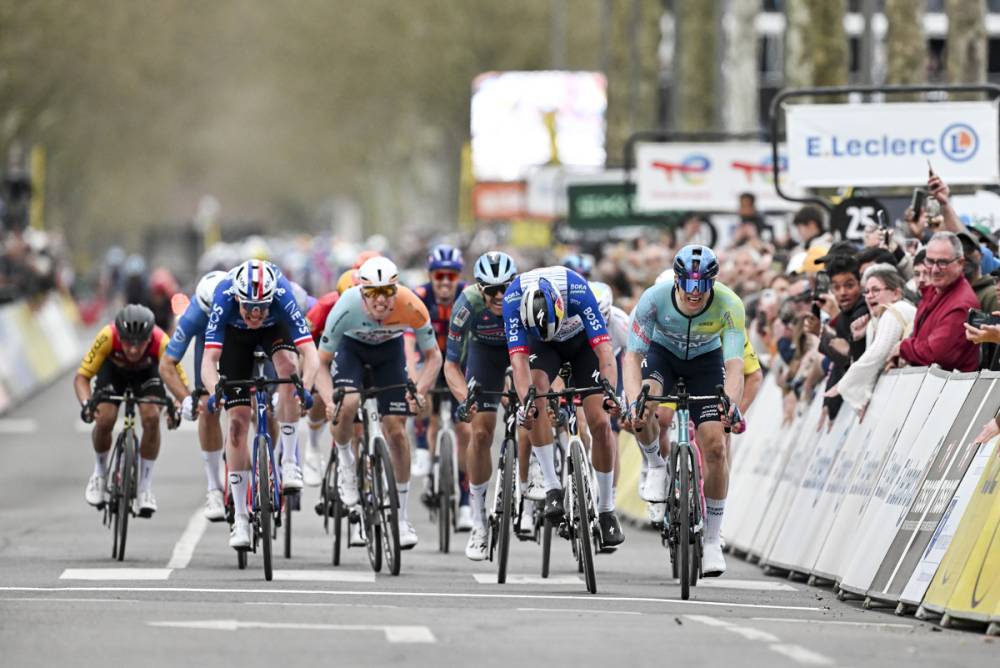
Kanter’s reaction in the finish area had the texture of genuine disbelief. “It’s a dream to win in a race with such a high prestige,” he said. “Paris-Nice is one of the biggest races in the world. I’ve been fighting for this for a long time. It’s my first World Tour victory, it’s kind of unbelievable.” He had boarded the team bus that morning uncertain whether he could finish. “The last couple of weeks haven’t been the best. I didn’t have the biggest confidence. But I gave it all in the last 200 metres.” He gave full credit to Teunissen. “With 2 kilometres to go, we were not in the best position but he did an unbelievable pull towards the last roundabout and then he did an incredible lead-out. He gives me a lot of confidence.”
Lamperti finished fifth and kept the jersey by the narrowest of margins — Braet level on time, the outcome to be determined Wednesday on the short drag of the team time trial. He had enjoyed the day in yellow more than he let on. “Today was super special. I enjoyed it from kilometre zero. It’s not often you get to wear a jersey like this. For me, it’s the first time.” On the tactical situation with Braet: “I knew that before the finale, but we also just wanted to ride for the stage. I told the guys: ‘We just ride normal, we don’t ride to try to beat him, we see what we can do.’” Both sprint finales had been chaotic, he noted, and today he’d been boxed. “We wanted a bit more from the sprint, but it’s also nice to keep the jersey for tomorrow.” His team would ride last in the TTT, an advantage he intended to use.
Ayuso Claims Yellow, Ineos Take the Stage
MARCH 10, 2026 · STAGE 3 · COSNE-COURS-SUR-LOIRE → POUILLY-SUR-LOIRE (TTT) · 23.5 KM
The team time trial has become one of Paris–Nice’s most reliable generators of drama, and the 23.5-kilometre test between Cosne-Cours-sur-Loire and Pouilly-sur-Loire delivered it in full. By the end of the afternoon, Ineos Grenadiers had taken the stage, Juan Ayuso had taken the yellow-and-white jersey, and the general classification had its first proper shape.
The format was the same one that had been used on this race before, and would later serve as a template for the Tour de France opener in Barcelona: stage time set by each team’s fastest rider, with GC time credited to any rider who finishes alongside their team leader, and individual times thereafter. The incentive was clear — put your man at the line as fast as possible, and make sure as many others as possible are with him when he crosses.
Picnic PostNL and Jayco AlUla went early and set reference points before Groupama-FDJ United came through at 51.5 km/h to erase them. Brandon McNulty and Marc Soler finished as a pair four seconds ahead of the French team — a fine time for UAE Team Emirates XRG, but not the race-winning performance that had handed McNulty the leader’s jersey two years before in Auxerre.
Visma-Lease a Bike came through strongly, Jonas Vingegaard pacing Armirail, Davide Piganzoli, and Victor Campenaerts over the line together, 21 seconds ahead of UAE. Then Decathlon CMA CGM moved to the front — they led at the intermediate checkpoint but seemed to falter in the final stretch, until Daan Hoole, still apparently full of sprint and stubbornness from his Montargis adventure the previous afternoon, rode the last five kilometres alone and arrived four seconds ahead of Visma. One day after being caught inside the final kilometre of a stage, Hoole had somehow improved.
Lidl-Trek erased those marks. Mathias Vacek, Soren Kragh Andersen, and Jakob Söderqvist propelled Ayuso to the line in 26’42” — nine seconds ahead of Decathlon. It was a formidable collective performance, built through shared training and meticulous pacing. Ayuso had four bonus seconds banked from his intermediate sprint victory the previous day. The stage win, however, would depend on Ineos Grenadiers.
The British squad were thirteen seconds faster than Lidl-Trek at the halfway point. The gap diminished through the second sector as Ineos’s protective layers were progressively spent, until Kevin Vauquelin crossed the line in 26’40” with Oscar Onley a wheel-length behind. Two seconds over Lidl-Trek’s time. Two seconds, and four bonus seconds, and the yellow jersey went to Ayuso rather than Vauquelin.
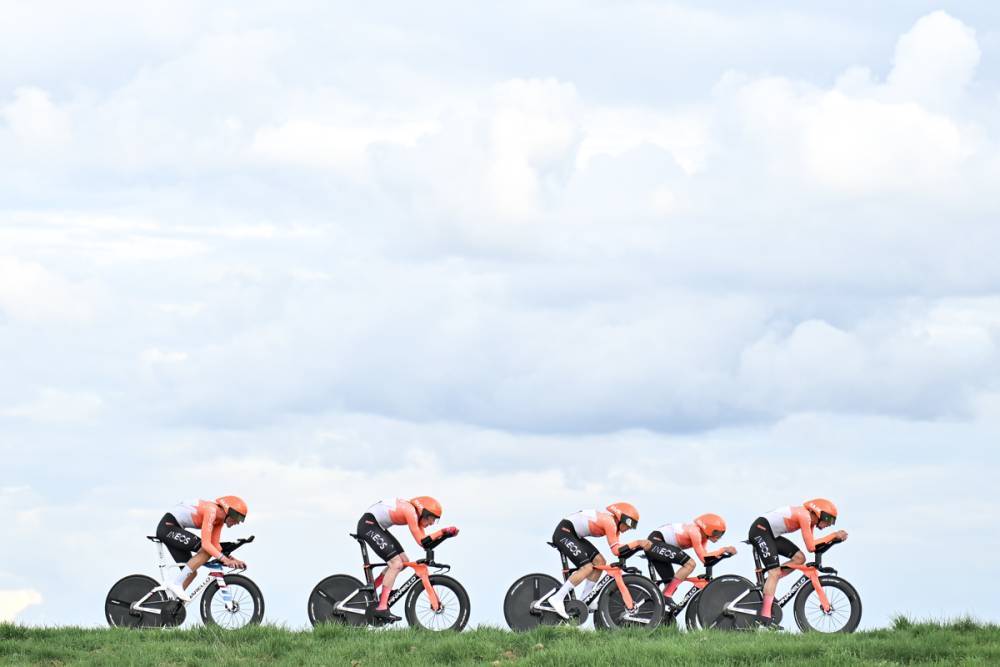
“We were really motivated this morning,” Ayuso said, working through the logic of a day that had delivered something both gratifying and slightly wrong-shaped. “Me and the team really thought it was possible to win, and to lose for just 2 seconds, it hurts. The guys deserved the win.” He found a way to hold both feelings at once: “I wouldn’t say there’s disappointment, but a bit of sadness. I would have preferred not to have the jersey but to win the stage.” He was realistic about the road ahead. “In Paris-Nice, things can change very quickly. Tomorrow will be bad weather and a really hard stage.”
Vauquelin absorbed the two-second sting with the discipline it required. “I was really looking forward to testing myself with Ineos Grenadiers,” he said. “I knew it could work to our advantage. And I’m really happy to show off our work.” On the jersey: “I would have liked to take the Maillot Jaune. There was the bonus yesterday… You can find those two seconds anywhere on a course like this. But we can be happy and there’s still a very tough second part of the race ahead with the weather and the course. I like difficult conditions, so we’ll see what happens tomorrow.”
Wind, Rain, and the Road to Uchon
MARCH 11, 2026 · STAGE 4 · BOURGES → UCHON · 195 KM
Stage four of Paris–Nice began as a race and became a survival exercise almost immediately. Before the peloton had crossed the Cher and found its southward rhythm, the weather had intervened with the decisive authority of a commissaire tearing up a rulebook. Crosswinds from the south, gusting to 45 kilometres per hour, tore the field to pieces before the first categorized climb appeared on the horizon. By the time the riders reached Uchon and its savage final kilometre — gradients to sixteen percent, wet roads, the cold that had been building since morning — Jonas Vingegaard was alone at the front of it, and Juan Ayuso was somewhere far behind, injured and out of the race.
The riders were warming up before the start with an intensity that had little to do with April muscles and everything to do with anxiety. Twenty to thirty kilometres per hour from the south, sustained crosswinds on open Burgundian roads — the mathematics of echelons was visible to everyone before a pedal had been turned in anger. Sure enough, within five kilometres the road split. Ayuso was in the right place, alongside Vingegaard, Oscar Onley, Brandon McNulty, and a Red Bull-Bora-Hansgrohe train four riders deep built around Dani Martinez. Kevin Vauquelin, second overall at the start of the day, was caught in a third group that scrambled back to the second before the damage became permanent.
Red Bull-Bora-Hansgrohe drove the front, the pace oscillating but never merciful, the gap to the chasers swelling between 55 seconds and 1’40” as the race threaded through the Morvan. Lenny Martinez of Bahrain Victorious and Vauquelin drove the chase on the Côte de la Croix des Cerisiers at kilometre 127, bringing the gap to 45 seconds. Then the lead group accelerated on wet roads, and Ayuso hit the ground on the descent.
He tried to continue. The injuries made that impossible. Brandon McNulty was also caught in the incident, and the front group — already reduced — exploded. Five riders remained at the front: Martinez with teammates Nico Denz and the Van Dijke brothers, Mick and Tim, and Vingegaard. They pressed the Côte de la Croix de la Libération with the collective energy of men who understood the opportunity in front of them. Behind, Joshua Tarling paced Onley — who had already changed bikes on an earlier crash descent — but the gap only widened.
Vauquelin and Lenny Martinez eventually bridged to the chasers sixteen kilometres from the finish, trailing the lead group by 2’40”. Mick van Dijke cracked with 6.5 kilometres to go. Tim set tempo all the way to the flamme rouge. And then, as the road kicked into its final, brutal kilometre, Vingegaard released everything.
The gap to Dani Martinez at the line was 41 seconds. The gap in the general classification — Vingegaard wearing yellow-and-white for the first time in this race — was 52 seconds over Martinez. Georg Steinhauser of EF Education-EasyPost, who hadn’t originally been on the Paris–Nice roster, was third overall, 3’20” back, followed by Vauquelin at 3’39”.
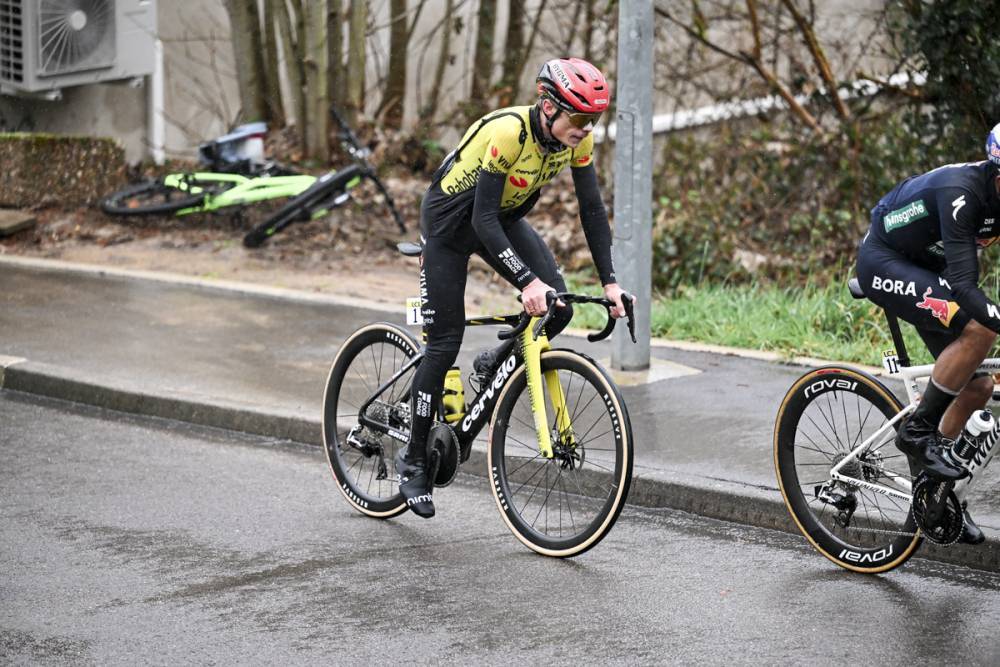
Vingegaard stood in the finish area and worked through the day’s arithmetic with a kind of grateful incredulity. “I wouldn’t say we expected such a crazy day — we expected it to be crazy, but definitely not like it ended up,” he said. He noted the previous year’s abandonment — the crash on this same race, the weeks lost. “Last year, I had to abandon the race. Then, I had the leaders jersey and I crashed. Coming back and winning a stage, my first in Paris-Nice outside of the TTTs, it’s really nice to start the season this way.” On the conditions: “First of all, it was crosswinds straight from the gun. Already there, a few guys were caught behind. And later on, a lot of guys were freezing today. I didn’t, because lot of clothes on, which is also the reason I couldn’t take them off.” He looked ahead with characteristic directness. “Now our goal will be to try to take the yellow jersey to Nice. I can defend — but if I feel good, it’s always nice to win more stages.”
Georg Steinhauser was still processing what the week had become. Two weeks earlier, he hadn’t expected to be at Paris–Nice. Now he was on the podium of one of the most prestigious stage races in the world. “Days like this are not easy. Crashes, crosswinds — it had everything. I managed to survive all of this and I still had the legs for a good effort.” The white jersey felt significant. “Last year was not my best year. So to be back and to wear a leader’s jersey in a World Tour race like Paris-Nice is special.”
Revenge on Familiar Roads
MARCH 12, 2026 · STAGE 5 · CORMORANCHE-SUR-SAÔNE → COLOMBIER-LE-VIEUX · 206.3 KM
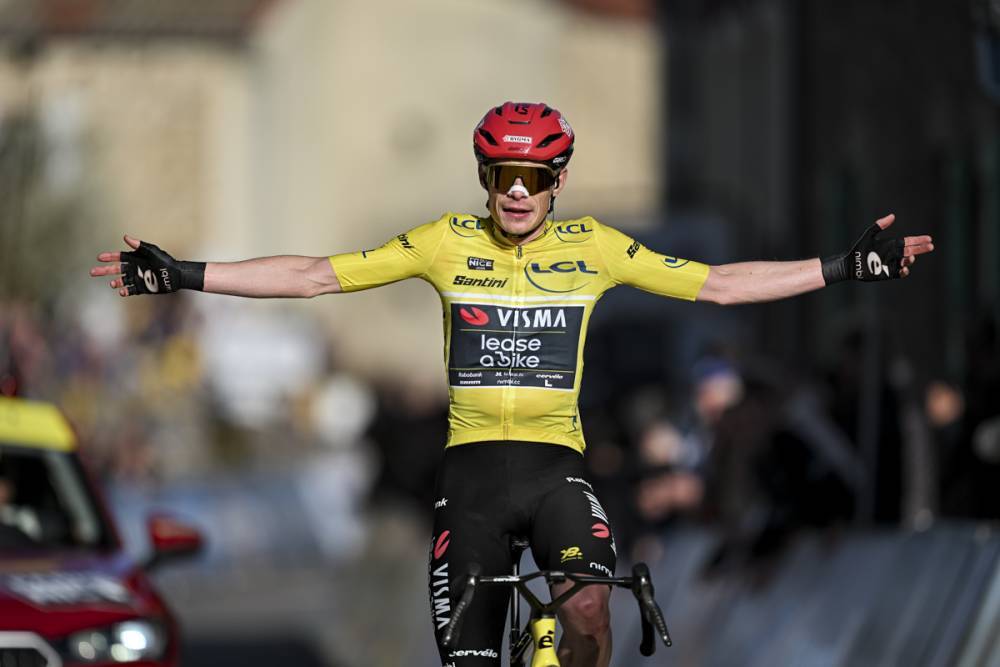
Twelve months earlier, Jonas Vingegaard had been lying somewhere on the Côte de Trèves, the yellow jersey no longer relevant, the season’s ambitions revised in the seconds it takes a bicycle to stop being a bicycle. On stage five of Paris–Nice 2026 he rode back over that same climb with the quiet authority of a man who has settled a debt with a particular piece of road, and then continued up the Côte de Saint-Jean-de-Muzols to take his second consecutive stage victory by more than two minutes. The margins were growing. The message was unambiguous.
The stage from Cormoranche-sur-Saône to Colombier-le-Vieux was the longest of the race at 206.3 kilometres, and the most demanding in terms of raw elevation — 2,950 metres, with gradients reaching sixteen percent in the finale. Teams stripped of general classification ambitions threw their most durable climbers into the early attacks, the first 63 kilometres producing skirmishes without resolution before Aleksandr Vlasov of Red Bull-Bora-Hansgrohe made his move on the Côte de Lentilly. He was first over the summit, pressed on, and at kilometre 70 collected four companions: Joshua Tarling of Ineos Grenadiers, Rémi Cavagna of Groupama-FDJ United, Jefferson Cepeda of Movistar, and Nicolas Prodhomme of Decathlon CMA CGM. A qualified group.
Visma-Lease a Bike kept the gap at approximately 1’40” without obvious strain. David Gaudu of Groupama-FDJ had been fifth overall at the day’s start; by the time the Côte de Trèves appeared on the horizon at kilometre 106.7, he was gone, the parcours having made its judgment. Ivan Romeo and Lorenzo Milesi of Movistar counter-attacked toward the second group of five, Victor Campenaerts of Visma joining them. The eight combined with 90 kilometres remaining, and the gap never exceeded 2’05” thereafter. Visma held the tempo with the patience of a team whose leader had not yet needed to show his hand.
On the Côte de Sécheras, the first of three sharp kickers in the finale, the break splintered. Cepeda went alone; Vlasov and Prodhomme gave chase while the rest were absorbed by a rapidly accelerating peloton. Tarling and Campenaerts were back with their respective teams as Cepeda pushed over the crest of the Côte de Saint-Jean-de-Muzols — 2.2 kilometres averaging eleven percent, sixteen percent at its worst — with the combined weight of Ineos Grenadiers and Visma-Lease a Bike close behind.
With a kilometre remaining on the climb, Vingegaard attacked. Seven riders scrambled after him — Martinez, Steinhauser, Vauquelin, Lenny Martinez, Mathys Rondel of Tudor, Harold Tejada of XDS Astana, Valentin Paret-Peintre of Soudal Quick-Step — and not one of them could hold his wheel. He crossed the summit alone and descended toward Colombier-le-Vieux at his own pace, the race behind him a different race entirely.
Paret-Peintre attacked over the final climb, the Côte de Saint-Barthélémy-le-Plain, and reached the finish line 2’02” behind Vingegaard. Tejada took third at 2’20”. Dani Martinez’s deficit in the general classification was now 3’22”. Steinhauser sat at third, 5’50” down. Vauquelin, who had been second only days before, was 6’09” adrift.
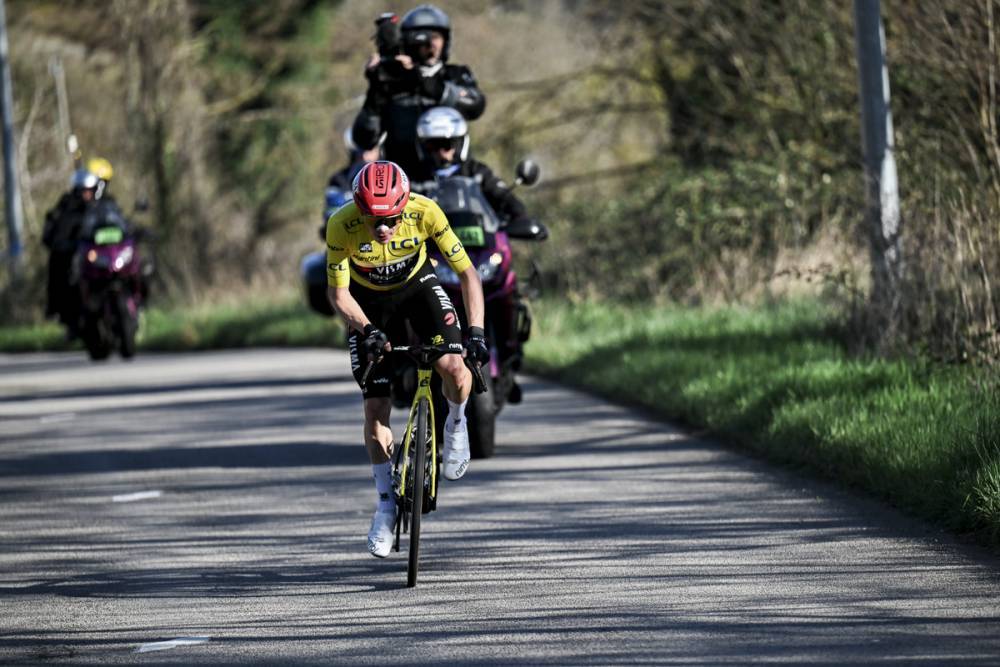
Vingegaard allowed himself the pleasure of naming the road. “I realised at one moment: ‘This looks like the road where I crashed last year,’” he said. “I didn’t know we were coming back but it’s nice to take revenge on such a beautiful day.” He acknowledged what his teammates had contributed. “They did an amazing job, making sure it was a good group in the front and keeping the gap tight. Everyone sacrificed themselves for me and I’m happy I could repay their efforts. My teammates deserve champagne tonight.” On the tactical evolution: “We had to adapt the plan a few times. Victor did an amazing lead-out and I already had a gap without needing to go all out. Then you can stay within your limits.”
Georg Steinhauser was quietly startled by his own resilience. “I had good legs. I was a bit afraid when I looked at the profile yesterday but I’m super happy with how I could defend the third place in GC today. I have to say I’m surprising myself a bit. Two weeks ago, I wasn’t even supposed to do Paris-Nice.” He set a modest, competitive tone for the days ahead. “It’s still three days to go. It’s not gonna be easy but I’m in a good situation. Today, the tactic was to do my own pace in the climbs. To be honest, I didn’t think I would be able to keep up with a rider like Vauquelin. This gives me confidence.”
Tejada Flies in Provence
MARCH 13, 2026 · STAGE 6 · BARBENTANE → APT · 179.3 KM
Harold Tejada had been having a complicated week. He’d lost time in the crosswinds on stage four, a result that reframed his ambitions even as it left him free to race aggressively. He’d finished third at Colombier-le-Vieux on stage five, which was the kind of performance that reminded a rider — and a team — of what was possible. In Apt on Saturday, the roads winding through the Luberon toward the Côte de Saignon’s punchy finale, he put the week in context with a counter-attack so well-timed and so committed that the peloton — exhausted, shattered by Victor Campenaerts’s tempo at the front — couldn’t respond.
The stage from Barbentane ran 179.3 kilometres through Provence, 2,100 metres of climbing, four categorized ascents, and a cat-2 finale over the Côte de Saignon — 4.5 kilometres to go. Of the 129 riders who had started the race on Sunday in Achères, only 125 signed on. Oscar Onley had withdrawn overnight, joined by Ivan Romeo, Julien Bernard, and Rick Pluimers.
The battle for the breakaway consumed forty-two kilometres and a considerable quantity of goodwill. When it finally resolved, Joshua Tarling of Ineos Grenadiers, Igor Arrieta of UAE Team Emirates XRG, Staff Cras of Soudal Quick-Step, and Arthur Kluckers of Tudor were clear. Counter-attackers tested the wire; NSN and Cofidis closed the gap. Benjamin Thomas of Cofidis drove tempo in the bunch, and the pace was high enough to keep the break’s advantage below 2’10” for most of the afternoon.
The race’s real mechanics became apparent on the Col de l’Aire Deï Masco with 33 kilometres remaining. Soren Kragh Andersen of Lidl-Trek had gone solo in pursuit at kilometre 37, and at the summit he trailed by 30 seconds with the bunch a further 20 behind him. Arrieta accelerated on the descent; Cras was dropped and swept up by Kragh Andersen. The two chasers couldn’t close the gap and sat up. The race approached Saignon with Tarling and Arrieta out front, the bunch behind them measuring its resources.
Lidl-Trek began driving hard through the valley — Kragh Andersen, Söderqvist, Lennard Kämna taking turns — and the gap fell to 25 seconds at the base of the Côte de Saignon. Arrieta and Tarling pushed again: 35 seconds. Then Campenaerts took the front of the bunch and turned the dial, and the break evaporated. Lenny Martinez attacked immediately below the summit, and Tejada watched.
Martinez’s move was nullified — caught, absorbed, the peloton condensed in the closing kilometers of the ascent. And there was Tejada’s moment. He went over the top with ten seconds and everything he had, descending toward Apt with the focused velocity of a man who has rehearsed this scenario many times. The peloton reacted, but not quickly enough. He took the line six seconds ahead of Dorian Godon of Ineos Grenadiers — the French national champion, fastest from the reduced bunch — and Lewis Askey of NSN. Vingegaard, protected and composed throughout, retained his jersey with enough margin to contemplate the final weekend without alarm.
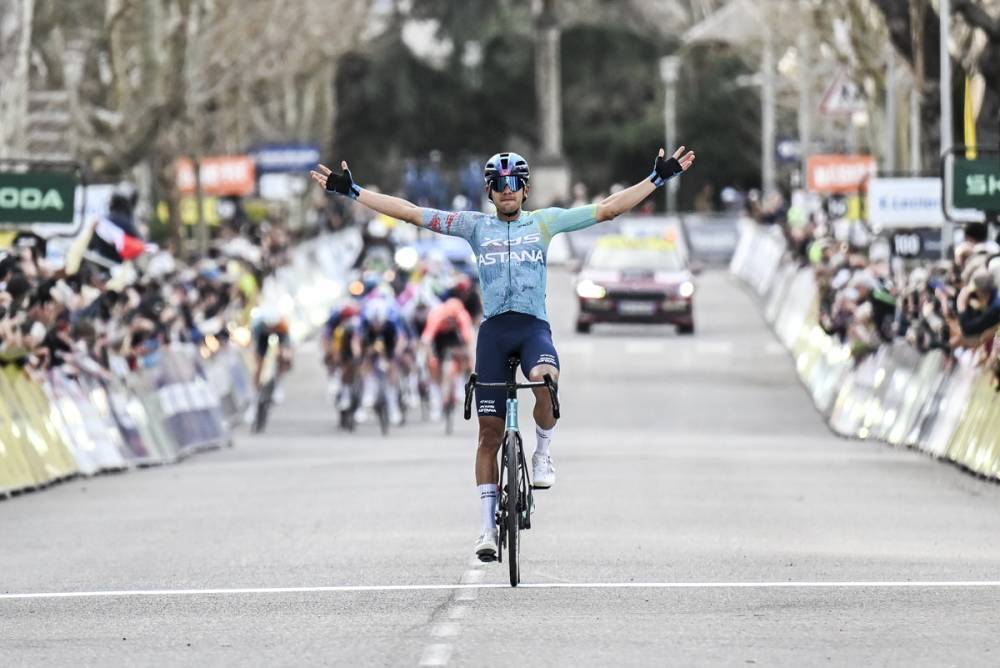
“It’s a very emotional moment for me, my first World Tour win with the team,” Tejada said, the words coming quickly. “It’s huge for me to win in Paris-Nice, a race of high calibre with riders such as Jonas, Dani… I’m delighted to raise my arms.” He noted the afternoon’s complications — a mechanical on the penultimate climb, a bike change — with a shrug. “My teammates did an amazing job and I was at the front for the final climb. I knew it was up and down all the way to the line so I gave it everything I had when I made my move.” On the week’s balance sheet: “We were aiming for the podium but I lost a lot of time on the crosswind day. That’s cycling. And on the other hand, we have two stages under our belt, with Max’s and mine. Champagne!”
Vingegaard gave a measured account of a day that had required more management than the previous two. “Today ended up being not an easy day, quite hard all day, but we made it to the finish.” He named Axel Zingle as part of the tactical calculus. “We wanted to catch the breakaway but we were on thin line, because we wanted Axel to be up there.” He was clear about where his form sat in the broader season. “I think my shape is pretty good. It’s not my best yet, but hopefully I can get there for the Giro and the Tour.”
Steinhauser spoke in the careful language of a man who has learned to protect what he has rather than claim what he hasn’t. “I’m happy with how today went. I’m happy with my legs. The last climbs were a bit steeper and nastier than I expected. When I saw Victor Campenaerts pull, I knew what would happen, but I’m happy I managed to keep up.” He acknowledged the difficulty honestly: “I’m a realistic guy and I know it’s gonna be really hard for me to stay on the podium, but I’m not gonna give up without giving it a big fight.”
Lamperti, holding his yellow jersey with diminishing certainty as the climbs accumulated, was direct about his situation. “I’m a bit at Vingegaard’s mercy with this jersey. But Georg is in the white, and we also heard on the radio Michael Valgren won in Tirreno Adriatico, so for the team it’s a super nice week. We’ll race full gas, we have nothing to lose.” Josh Tarling, having spent the day in the break only to be caught with five kilometres to go, was honest about the frustration. “For sure I’m a bit disappointed. We knew they were coming, but I didn’t know they were that fast.” He redirected quickly: “Now we just go all in for Kevin. He’s in a good place, he feels super good, so whatever he needs we do.”
Godon’s Gift, Vingegaard’s Crown
MARCH 14, 2026 · STAGE 7 · LE BROC → ISOLA-VILLAGE · 47 KM (MODIFIED ROUTE)
The final mountain stage of Paris–Nice 2026 had been planned as a summit finish at the Auron ski resort, 1,614 metres above sea level. The weather had other intentions. Over the preceding days the forecasts had darkened, and on the evening of March 13th the organisers confirmed what most had suspected: the rain-snow line at approximately 1,100 metres made the ascent to Auron inadvisable, and the stage finish would be moved to Isola-Village. By the following morning the situation had deteriorated further. Rain in the valley, ice on the roads in the upper sections, made even the original start location in Carros unsafe. The riders were loaded onto team buses and transported to Le Broc, to a new start on the Louis Nucéra bridge, 73 kilometres into the original route. What remained was 47 kilometres.
It was still Paris–Nice. It was still racing. One hundred and ten riders signed on during the team presentation on the Promenade des Anglais and filed onto buses with the philosophical acceptance that racing in the mountains in March sometimes requires. Visma-Lease a Bike took control from the moment the flag dropped — Campenaerts, Armirail, Affini, and Kelderman rotating at the front while Axel Zingle stayed on Vingegaard’s wheel with the focused attention of a man guarding something genuinely valuable.
The attacks arrived with the arithmetic of a shortened stage: less time, greater urgency, the same ambition. After a dozen kilometres, Tim Marsman of Alpecin-Premier Tech slipped away on his own. The tall Dutchman was in his first World Tour race, riding on adrenaline and something harder to name, and he pushed his advantage to fifteen seconds at the halfway point before the peloton, orderly and purposeful, began reducing him. Inside the final ten kilometres, Marsman was caught. Nicolás Vinokurov of XDS Astana counter-attacked with seven kilometres remaining — he was closed down within moments. The sprint was coming.
There were crashes. There are always crashes. The Ineos Grenadiers train absorbed the disruption and kept its formation, and in the final straight, with Carlos Rodríguez having driven forty kilometres of the stage and the rest of the team having contributed everything they had, Dorian Godon launched inside the final two hundred metres. The French national champion — unable, in the rain, to show the tricolor jersey that the title entitles him to wear — drove through the line ahead of Biniam Girmay of NSN and Cees Bol of Decathlon CMA CGM. His first victory with Ineos Grenadiers. His first win in Paris–Nice.
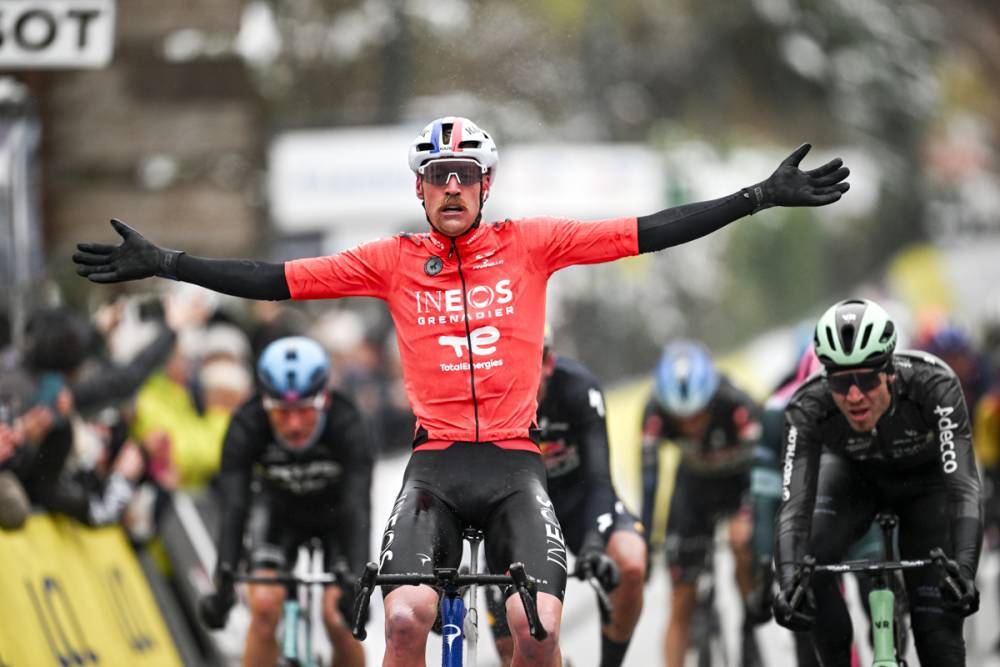
“I never thought I’d win a mountain stage on Paris-Nice,” Godon said, allowing himself the irony. “More seriously, I’ve been close all week long. We were really motivated today, with full focus, and it made the difference.” He described the collective performance with precise gratitude: “Carlos pulled for 40 kilometres, everyone led me out in crazy fashion. I was sitting on the sofa, and I just had to sprint for 30 seconds in the end. It was an amazing job from the guys.” He looked ahead to the final stage. “Tomorrow, I’ll give myself at 300% to help Kevin get on the podium.”
Marsman, standing on the podium of his first World Tour race after 35 kilometres alone against the collective patience of a peloton, found the register that the moment called for. “It’s my first World Tour race, so to be on the podium, with the names that are here — it’s really special. It’s a childhood dream.” He was clear about the arithmetic of his solo effort: “Just me against the peloton, it was really hard on these roads. But it was fun.”
Vingegaard had backed off at the right moment when the crashes came, and arrived at the finish unscathed and unmoved from the summit of the general classification. He kept his statement brief. “I think it’s very important to race. This is one of the biggest races in the world, but it was quite slippery in the end. I backed off at the right moment and made sure I wasn’t caught in a crash.” He permitted himself one forward-looking sentence: “I just hope that I can keep the jersey all the way to the end.”
Steinhauser, nineteen seconds clear of Vauquelin in the fight for the final podium, faced one more day. “Today was another special Paris-Nice day,” he said. “Tomorrow is gonna be super hard. I know it’s only 19 seconds to Vauquelin. My goal is to keep this advantage. Let’s see how it goes.”
Somewhere below them, in the Alpes-Maritimes valley, the rain was still falling. The Promenade des Anglais waited. Paris–Nice was heading home.
Sun King
MARCH 15, 2026 · STAGE 8 · ALLIANZ RIVIERA → ALLIANZ RIVIERA (NICE) · 129.2 KM
There is a particular cruelty in arriving at the finish of a great stage race as the rider who was almost good enough. Kévin Vauquelin had been chasing Georg Steinhauser’s nineteen seconds for a week, through the mountains of Burgundy, through Provence, through the shortened Alpine stage where the weather had rearranged everything. On the final day of the 84th edition of the Race to the Sun — a 129.2-kilometre loop from the Allianz Riviera stadium packed with 2,300 metres of climbing and three cat-1 ascents — Visma-Lease a Bike and Ineos Grenadiers rode the last stage of Paris-Nice 2026 as though it owed them both something. In the end, only Vingegaard collected.
The course was not designed for conservation. Three categorized climbs, the last of them the unprecedented Côte du Linguador — 3.3 kilometres at 8.8%, gradients to fourteen percent — placed inside the final twenty kilometres, with a further descent and drag to the line. The peloton, reduced by a week of attrition to its most resilient constituency, attacked from the opening kilometres. Fabio Van den Bossche, Benjamin Thomas, Matteo Trentin, Alexandre Delettre, and the increasingly irrepressible Tim Marsman got clear at kilometre nine. The peloton gave chase with intention: the gap never reached 1’15” at kilometre 21, and as the road tilted toward the Col de la Porte — the first cat-1 summit, at kilometre 50.7 — both the break and the peloton began to fracture under the pressure.
From the wreckage of the col, Valentin Paret-Peintre of Soudal Quick-Step emerged as the day’s most enterprising actor. Having bridged to the early attackers, he went again six kilometres from the summit and crested it 25 seconds ahead of Marc Soler, with the reduced peloton 45 seconds behind. He pressed on down the descent and into the valley, where Soler was caught by the bunch, and began the Côte de Châteauneuf-Villevieille — the second climb — with his advantage intact at 45 seconds. There are riders who exist to make races harder, and Paret-Peintre, who had already reached the finish at Colombier-le-Vieux in second place on stage five, was deploying that talent fully.
Ineos Grenadiers had their own agenda. With Vauquelin sitting nineteen seconds behind Steinhauser in the white jersey fight, they pushed the pace on the second ascent with the focused urgency of a team that has run the numbers and understands that the opportunity is narrowing. And then, on that same climb, the race’s cruelest moment arrived: Dani Martinez, second overall and riding with the controlled energy of a man who has kept his deficit to four minutes over seven stages, was taken down by a teammate. His crash wasn’t his fault. His injuries were real. He climbed back on his bike and began chasing 1’30” behind the men he needed to beat.
The peloton did not wait. Ineos drove through, and then Visma-Lease a Bike took over with 21 kilometres to go, Victor Campenaerts setting the brutal tempo that has been his contribution to Vingegaard’s victories all week, winding up the elastic until only one man could follow it to its natural conclusion. On the Côte du Linguador’s slopes, Campenaerts put everything into the lead-out and Vingegaard came off his wheel. One rider went with him: Lenny Martinez of Bahrain Victorious, the twenty-two-year-old Frenchman whose season had been building toward exactly this kind of moment.
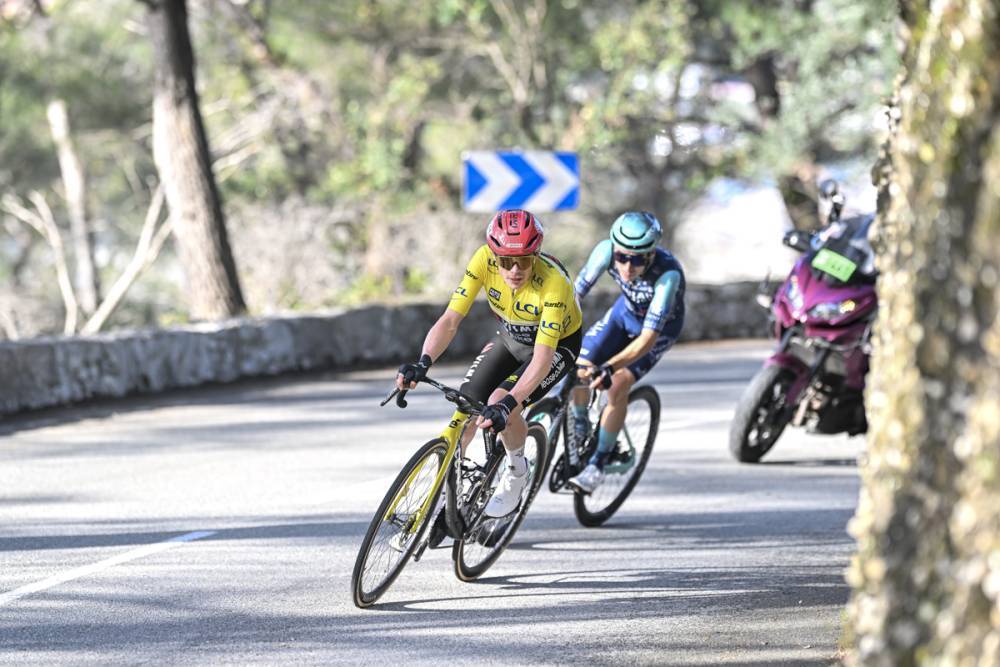
The two of them — the Dane who owns the Tour de France, the young Frenchman who may one day challenge for it — descended together and rode the final kilometres in the pragmatic alliance of men who each want second place to stay where it is. Into the final kilometre, neither moved. It was Martinez who blinked first, launching the sprint that Vingegaard answered but could not quite match. The Frenchman took the stage — the first French winner of a Paris-Nice final stage since Arthur Vichot in 2014. Behind them, Paret-Peintre had long since been caught, and the peloton was sorting its own hierarchy.
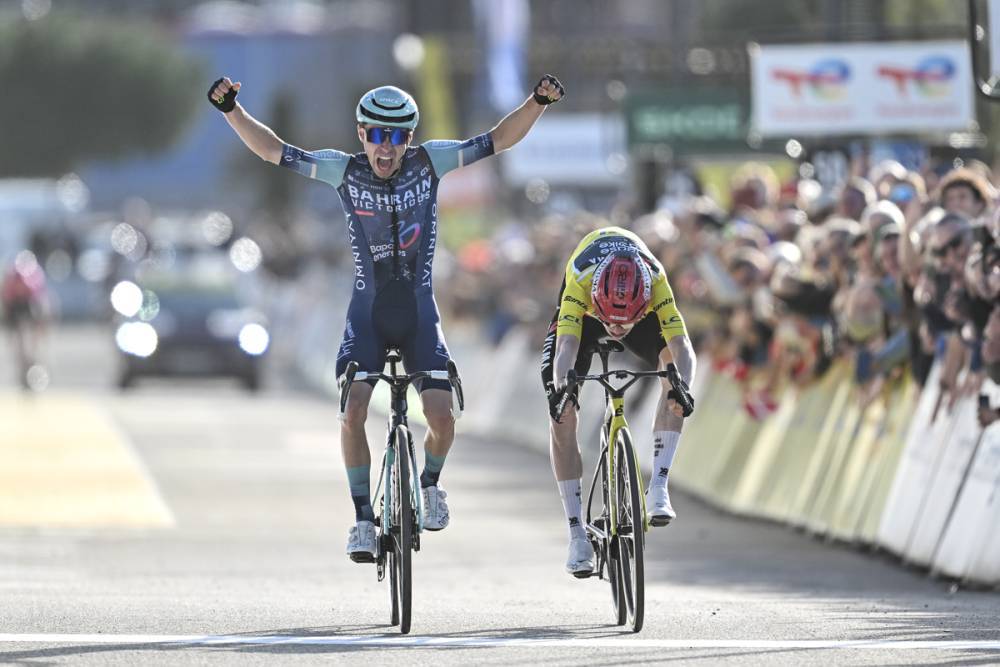 Steinhauser survived. The white jersey stayed on his shoulders. Vauquelin, who had felt superb through the first two climbs and then hit a wall on the Linguador’s steepest ramps, finished seventeen seconds adrift of the young German in the final standings, the gap between them widening to 17 seconds by Nice’s finish line. His Ineos Grenadiers team had won the TTT stage, had won stage seven through Godon, and had propelled Vauquelin to fourth overall — an excellent week by any measure that didn’t account for how close he’d been.
Vingegaard stood on the podium in Nice wearing three jerseys: yellow-and-white for the overall classification, green for the points standing, and polka-dot for the mountains classification. The margin over Dani Martinez — 4’23” — was the largest recorded between winner and runner-up at Paris-Nice since 1939, the fourth biggest gap in the race’s entire history. It was also his first Paris-Nice title, a race that had repeatedly refused to cooperate. Last year the crash. Previous editions, a stage win in a TTT but never the overall. “Actually, to win Paris-Nice means a lot to me,” he said, and the simplicity of it was striking from a rider who has two Tour de France victories to his name. “It was the one that I just couldn’t get right. Finally, I get it right. I’m extremely happy.”
He had spent the week in something close to a different register from the men around him. “It’s my first race of the year and I’m really happy with how we’ve raced all week. I’m definitely in a very very good shape. I still think I can improve for the upcoming races. Hopefully I can do that, especially for the Tour.” This was Paris-Nice as accelerant, not destination. The season’s real chapters were still to be written.
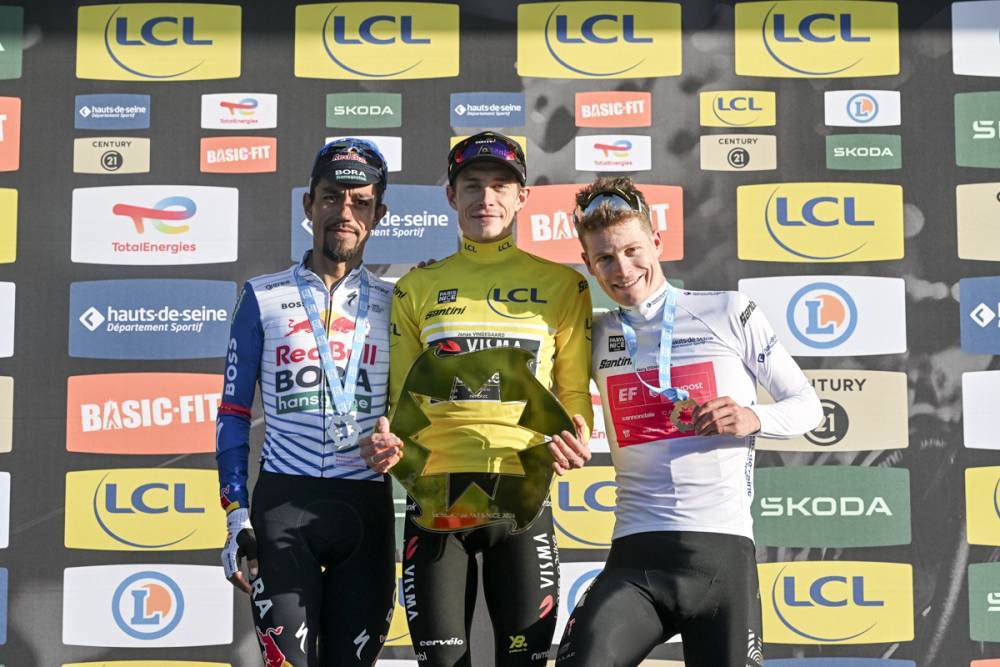
Lenny Martinez arrived at the interview area still processing what the week had been and what the final stage had meant. “I’ve been chasing a win since the start of the season,” he said. “Beating Jonas makes it even sweeter. My family are here too; I saw them on the screen. I couldn’t be happier.” He reconstructed the sprint’s interior drama with the vividness of recent experience. “When Jonas didn’t want to go ahead in the final kilometre, I thought to myself that it was a pity, but that’s the way it goes. I was a bit worried. When I saw the line, I thought: I’ve got to go for it, then I thought it was a bit far away… I saw a shadow closing in, I was really scared, but I didn’t give up and I’m very happy.” He found the week’s significance: “It’s different from last year; I’m much more consistent. And winning a stage at the end shows that I’m improving as the week goes on.”
Dani Martinez, who had finished on the podium of Paris-Nice despite abandoning his bike in pain somewhere on the penultimate climb’s slopes, found a particular kind of grace in the assessment. “This is cycling. Nothing is for sure until you cross the finish line. I had really good legs and everything was under control until the penultimate climb. My teammates were doing a spectacular job. I made a mistake, I went down, and it was quite a hard crash. But I got back up and kept pushing. The team did a fantastic job. They’ve been amazing all week long, including today, and this is a podium we achieved together.”
Steinhauser, who two weeks ago hadn’t been on the Paris-Nice roster and now stood on its final podium, allowed himself something approaching calm. “It’s an amazing feeling. To be honest, I always had on the back of my mind that Vauquelin was gonna overtake me. He’s super strong, but I grew confidence over the days.” He traced the final day’s tension: “I was still nervous ahead of today’s stage, with a gap of just 19 seconds. I just gave it my all, I had a good day, and I made it.” On the Linguador’s crucial passage: “I suffered, but I saw Vauquelin was struggling a little bit too. It was a relief for me.”
Vauquelin, fourth overall, found the balance between honest assessment and forward-looking resolve. “I felt great right up to the final climb, and I don’t know why, but when I really had to push myself to the limit, I hit a wall,” he said. “My body needs to accept that I’m not yet at 100% after spending so much time off the bike due to my injury this winter. I need to keep going down this path.” He counted what the team had achieved through the week — the TTT stage victory, Godon’s win in Isola, the consistent support of a squad that had dealt with Onley’s withdrawal and Rodríguez’s crash and kept racing: “We can be pleased with our week.” He looked ahead with the steady ambition of a rider who has understood something important about himself. “I really enjoy this leadership role; I like competing for the general classification and I feel I’m improving. I need to stay on this path and one day it will pay off.”
FINAL GENERAL CLASSIFICATION — PARIS–NICE 2026
84th Edition · March 8–15, 2026 · Overall winner: Jonas Vingegaard (Visma–Lease a Bike)
| # | Rider | Team | Time / Gap |
| 1 | Jonas Vingegaard | Visma–Lease a Bike | 25:25:11 |
| 2 | Dani Martínez | Red Bull–Bora–Hansgrohe | + 4:23 |
| 3 | Georg Steinhauser | EF Education–EasyPost | + 6:07 |
| 4 | Kévin Vauquelin | Ineos Grenadiers | + 6:24 |
| 5 | Lenny Martinez | Bahrain Victorious | + 7:31 |
| 6 | Marc Soler | UAE Team Emirates–XRG | + 9:09 |
| 7 | Ion Izagirre | Cofidis | + 9:19 |
| 8 | Mathys Rondel | Tudor Pro Cycling Team | + 10:23 |
| 9 | Alex Baudin | EF Education–EasyPost | + 10:33 |
| 10 | Harold Tejada | XDS Astana Team | + 11:40 |
Stage Wins: Lamperti (Stage 1), Kanter (Stage 2), Vauquelin/Ineos TTT (Stage 3), Vingegaard (Stages 4 & 5), Tejada (Stage 6), Godon (Stage 7), L. Martinez (Stage 8) · KOM & Points: Vingegaard · Best Young Rider: Steinhauser
(Visited 67 times, 22 visits today)