
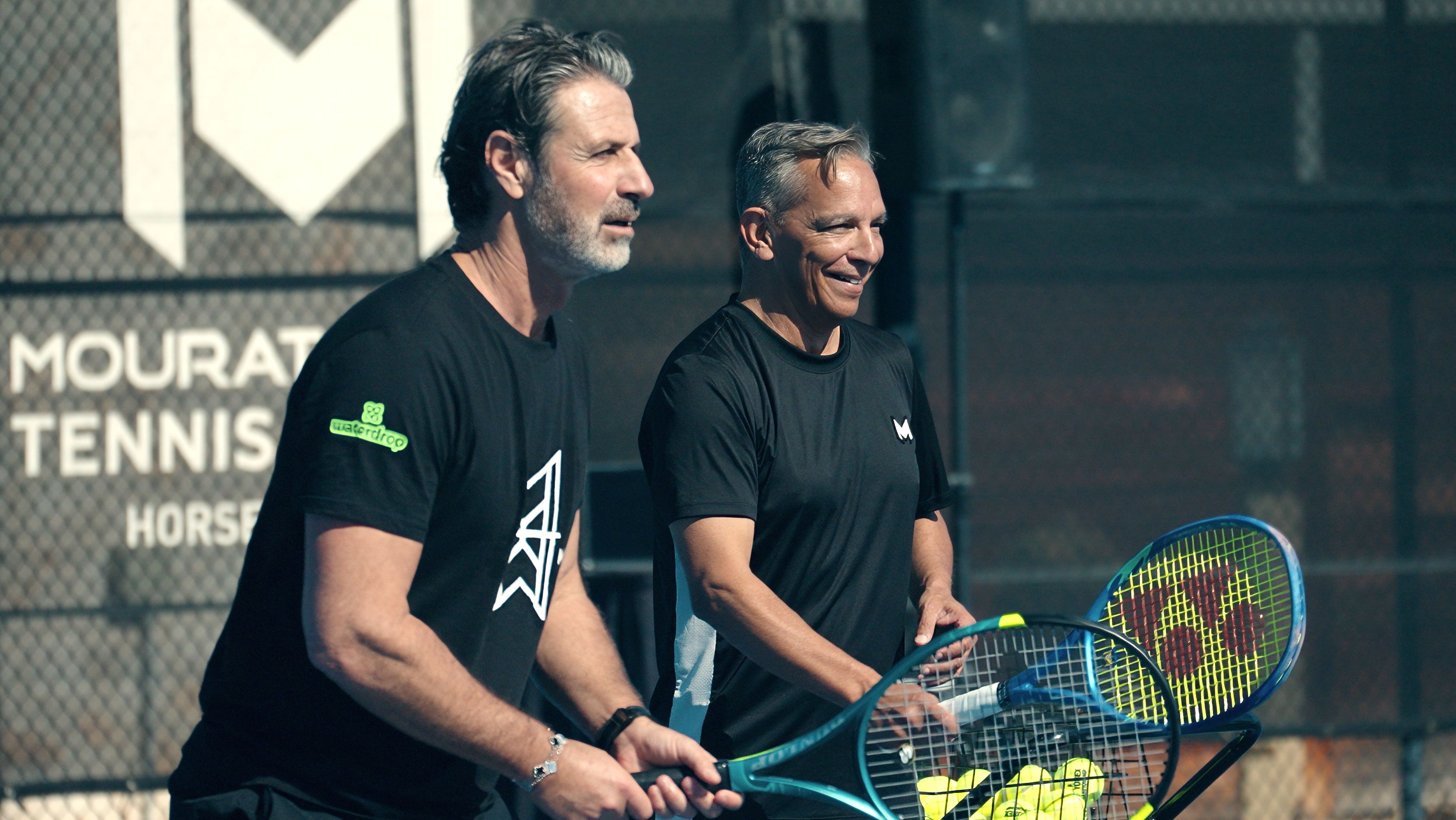
The most famous—and most controversial—tennis coach in the world was seated behind me at the back of a Sprinter van last week, chatting with his wife in rapid French as we drove to dinner on Lake Lyndon B. Johnson.
Patrick Mouratoglou, once the tanned presence in Serena Williams’ camp, the familiar face in Simona Halep’s box, Holger Rune’s on-again, off-again guru and most recently the courtside coach in Naomi Osaka’s entourage, was in Texas Hill Country to promote one of his many business ventures.
Google him—I’ll wait—and you’ll quickly find that he’s a polarizing figure, whose cocksure Frenchness elicits jealousy, perhaps, and ire, definitely, from fellow pundits and anyone with opinions on tennis. He’s been called a huckster; a bad-luck charm for any player who hires him (see: Halep, Rune, Tsitsipas et al); a nepo baby; a loud-mouth. He has a natural ability to campaign and cajole and convince, and he raises a lot of hackles while he does it. He holds opinions about every part of professional tennis, and he gladly broadcasts them far and wide. His 1.8 million Instagram followers willingly take it all, along with a lot of tennis instruction, and—huh—ads for Mouratoglou Apparel in which the Mouratoglou-branded waistband of what might be boxer-briefs peeks out from above the low-slung jeans of the man himself. So apparently he’s an underwear model now as well.
He flew in that day from Boston; he travels for more than half the year, visiting some of his 18 Mouratoglou-branded tennis centers and academies around the globe, with more on the way: after Texas, his team was headed to the Mouratoglou Tennis Center Amelia Island in Florida; then to the Mouratoglou Tennis Center in Guadalajara; and finally on to Brazil, where there’s no current location but clearly some interest on both sides.
This stop was for reaffirming and reconnecting with his tennis center at the 7,000 acre Horseshoe Bay Resort. It’s currently what they call a “drive destination,” in that it’s the kind of place that people drive to (though the resort has its own private airport, which can technically accommodate a 737). In the last 10 years, the owners have spent $350M on upgrades and upkeep; this year alone, they’ll spend $60M more, on a wellness center, racquet clubhouse, padel courts and new infrastructure in an effort to make it a fly destination.
It’s certainly a fly destination for Mouratoglou and his team of fresh-faced bizdev-coaches whose hair lives up to their boss’s high standards; they flew in from Boston, freshened up, and met me in the hotel lobby before we all tumbled into the large van for a quick ride to a team dinner at the resort’s Yacht Club.
Patrick and his wife, Linda, with whom he holds hands whenever they walk, were at the center of the long table. I was at the end with the resident coaches and some of the well-coiffed bizdev guys who sweetened their English chatter with the occasional French aside. I chose the sôle meunière, because I like it and because hey, it’s French, like the accents around me. When someone asked Patrick a question about tennis, or life, all would fall silent; his buttery voice commands a room whether he’s trying to or not: Sam Querrey is a fantastic broadcaster; Those colors on Jannik were awful; Carlos is amazing; Padel will eclipse pickleball in the US. I agree on all counts.
Sometimes I don’t, though, and I’m not alone. He’s said that he disagrees with the WTA’s banning of Rybakina’s (allegedly) abusive coach, arguing that she’s an adult, and that the WTA shouldn’t be in the business of telling people who they can and can’t hire. He has a point—borne out by Rybakina’s recent AO success after her coach was reinstated—but there’s a little too much Gallic shrug there, and not enough attention to the history of sexual, physical, and verbal abuse in the WTA, the organization’s moral imperative to prevent it, and the role any authority should play in the face of patent mistreatment of an albeit-willing subject.

The next morning we convened again, this time at the tennis courts. The Frenchman stood beside mockups of a new clubhouse, which will dominate a growing racquet-sport center. There was also a photo-op backdrop, dotted with the wide M that serves as the logo for his many global enterprises, for the pictures he’d take later. A stack of books—his books—awaited the acolytes who paid to attend a sunny tennis clinic and to bask in his glow—and there is a glow. He’s a little shorter than he looks on tv, but the hair is magnificent. His sun-dimmed blue eyes scanned the crowd as he welcomed them to Horseshoe Bay Resort for 90 minutes of tennis instruction.
They hung on his every word, these members of the Texas country club that, two years ago, made a bet that partnering with Mouratoglou would benefit both parties. They were right; it’s been a boon for the resort’s tennis programs, and for his part, Mouratoglou expects to make the racquet center on this sprawling property his American flagship location. None of them seemed to know, or care, about his reputation as a tennis lightning-rod. Something tells me the clinic attendees would willingly part with the price of three pairs of boxer briefs, plus maybe a jacket in the newest light blue color.
After the clinic, in which I failed miserably to showcase any athletic talent whatsoever because I was nervous—I challenge you to play your best when Patrick Mouratoglou is watching; you won’t—I asked him a few questions about his life, his future and Serena Williams.
WL: The good news is, I’m better at this than I am at tennis. How are you?
PM: I’m a bit tired, because I had two weeks with very little sleep, because I was commentating the [AO] matches during the day and during the night on Twitch. I never used Twitch before that, because it’s for gamers, but now they are trying really to expand it to sports and other activities. I did TV for 10 years; I was on ESPN Eurosport every day during the Grand Slams for 10 years. And with Twitch, in a way, you are your own producer. You do things when you want, as you want, which, for me—I’ve been an entrepreneur all my life, to have people tell me do things is difficult, so in this case, I do what I want, how I want, and it’s my people who helped me do it.
WL: Serena Williams has recently rejoined the testing pool; she’s being cagey about a return to the tour. What do you think her plans are?
PM: I don’t want to speak for her, because I think this question should be asked to her from outside, but I guess, re-entering the drug testing leaves the option open. It doesn’t mean “I know I want to play,” but we know she’s practicing, because she’s posted videos. She feels fit. She probably wants to leave that option open and she will see if she decides to go for it or not.
WL: If she goes for it, are we going to see you in her box?
PM: Who knows? I don’t know.
WL: Anyone’s box?
PM: I’m not going take anyone for a few years. I didn’t stop one minute for the last 20 years. I coached non-stop, and when I stopped with one player, just a month or two after I was starting with another one.
I have a lot of other things to do, developing all those centers around the world. I have UTS, my tennis league that is also a big project for me. I want to keep commentating and doing social media, because I really love it. Each of those is a full time job. And I have five kids.
WL: You won’t, obviously, but if you had all the time in the world and you wanted to, whose box would you like to be sitting in?
PM: Once you’ve experienced being with players and winning grand slams, I think it’s difficult to not to want the same. So I would like to work with someone who has the potential to win grand slams in the next two years. There are not so many.
The real question is, on the men’s side, is there a third guy that can also start winning some, not only the same two? For the moment, we don’t have the guy.
WL: Lerner Tien?
PM: Yeah, I think he’s the most advanced, and he has no weakness. I think he’s very complete. He has a great coach, so I don’t want to throw out his name [as someone I’d like to coach], but he has this potential.
I’m sure it’s great also to coach Alcaraz and Sinner, and on the women’s side, there are some young players coming up that are really good. Victoria Mboko, Iva Jovic, and you have players like [Mirra] Andreeva, who’s still 18 years old—that’s crazy. I think there are some that can win grand slams that haven’t yet, for example, Amanda Anisimova; Coco Gauff can win many more. So there will be a very exciting battle on the women’s side.
WL: After Serena’s blow-up with umpire Carlos Ramos at the 2018 US Open, you admitted to coaching her, saying everyone does it. Do you think your admission affected the recent change in the rules?
PM: Everybody knows on tour—maybe not the spectators or the fans—everybody knew that what I said was true. So everybody realized, I think, because of what happened, that we have a problem. Because we have a rule that’s not respected—never—and in a way, we accept it by letting it happen. We have the same parameters for cramps: the rule says you can’t have treatment for cramps; you can have treatment for injury. But they all have treatment for cramps. It’s important that the rules are respected, so find a way to make the rules be respected; otherwise change them.
I think that [episode with Serena] was probably an opportunity for tennis people, the ones in charge, to re-look at the coaching situation and think, “Is it the right thing to be the only sport in the world where coaching is not allowed?” And they made the right decision. It’s great because, as Nadal said, we’re paying coaches all year long for us to be better; but at the moment we need them the most, they can’t help. Also, I think it was degrading for the coaches, because they were basically told during the matches, we don’t want to see you, we don’t want to hear you.
It’s our job. In every other sport, they can do it. So I’m very happy it changed. I know a lot of people are not, but I don’t care.
WL: They can get coaching as they pass the box, but they can’t walk over to the box. What is that about?
PM: I know, but this is so tennis. They asked me, “Are you happy? Are you happy that we [changed the rules]?” And I said, “Yeah, it’s great, but you have to go much further.” Let’s see if they do other steps. They’re so cautious about change. People are against change in general.
WL: How long is it going to take for padel to overtake pickleball, and can you please make it faster?
PM: Pickleball now has a fan base. There is a lot of infrastructure. I’m not talking about the courts, but even the tournaments and everything. I think it’s great also for people to meet. It’s going to take time, because people want to be part of something. They belong to clubs; they participate in tournaments. That’s all infrastructure that padel will have to build.
WL: Is there anything that’s going on that I don’t know about, that I should know?
PM: That I can say? No. You know how it is. The timing is important. When it’s not signed, it’s not signed.
And now it’s time for lunch, and then another session.
WL: You’re doing god’s work out there.
PM: Thank you. Who has the chance to work in their passion? Not many people.
WL: You and me. Just two.
PM: Exactly.