
Preseason Prep-February 21, 2026
Around the League
Jack Leiter-Rangers-SP
Jack Leiter finished with a 3.86 ERA and 1.28 WHIP across 151.2 IP at the major league level. He showed average skills (22% K, 10% BB, and 4.43 SIERA). Leiter continues to show plus stuff but lacks the control/command to make the jump that many have expected since he was drafted out of Vanderbilt. Diving deeper into Leiter’s season is important because he got better as the season went on. In the second half, he posted a 3.28 ERA and 1.19 WHIP. The encouraging part is that his success was not driven by luck (.265 BABIP) and was the result of improved skills (26% K and 10% BB). There was also a change in his pitch mix as the season went on. Leiter has always had a good fastball and slider, but in the second half, he got away from relying on just those two pitches. He started using all of his offspeed pitches more evenly (SL, CU, and CH). Leiter felt more comfortable with his changeup in the second half, which gave him a weapon to get left-handed batters out. It is unlikely that Leiter ever becomes a true ace due to the lack of natural command, but he could become a valuable fantasy option with strikeout potential and a 3.75 ERA and 1.20 WHIP.
Shoto Imanaga-Cubs-SP
Shoto Imanaga was not able to repeat his excellent 2024 season (2.91 ERA, 1.02 WHIP, 25% K, and 4% BB) in 2025 (3.73 ERA, 0.99 WHIP, 21% K, and 5% BB). He was still able to provide value to fantasy owners because he was extremely fortunate on balls in play (.219 BABIP). The decline in his strikeout rate makes him a volatile asset because his roto success is going to be highly dependent on his BABIP, which is an area where regression is to be expected. Add in the decline in velocity (-0.9 mph), which puts him in dangerous territory (90.8 mph) in today’s game. There is a chance that he bounces back by improving the location of his splitter similar to 2024, but even if that happens, it’s likely going to be near a 4.00 ERA. This makes Imanaga a tough buy on draft day because you are paying a price that doesn’t factor in regression and doesn’t leave much room for profit. Don’t pay for past success or name value here.
Ryan Pepiot-Rays-SP
Ryan Pepiot had a 3.86 ERA and 1.16 WHIP through 167.2 IP. He showed good skills (25% K and 9% BB) to go along with his plus stuff. The fact that he was also able to make 30+ starts sets him up for another full season in 2026. The other factor to consider is that Pepiot is a flyball pitcher (42% FB) who had issues with home runs (1.40 HR/9) in 2025. Digging deeper, 17 of his 26 HR given up were at home. The Rays were playing at Steinbrenner Field, the Yankees’ spring training stadium, which was a very hitter-friendly environment. The Rays will be moving back to Tropicana Field in 2026, which should give their pitchers, especially Pepiot, a nice bump in value. Paying for a repeat of 2025 with the chance of more with a normalized home run rate could make Pepiot a nice value in 2026.
Luis Castillo-Mariners-SP
Luis Castillo has now made 30+ starts in three straight seasons and surpassed 150+ IP in seven out of the last eight seasons, with 2020 (Covid) being the exception. The concern heading into 2026 is that his skills took a nosedive last year. His strikeout rate dropped from 24% to 21%. This follows a four-year drop in velocity from 97.1 mph to 95 mph. Castillo also saw his Stuff+ drop significantly last year, and he posted a career-high 4.03 SIERA. He posted a 2.60 ERA at home last year compared to a 4.71 ERA on the road. He is going to be somewhat insulated by his home park, but expectations should be lowered for Castillo. An ERA closer to 4.00 is what should be expected from him, moving him out of the near-ace territory. The pitchers going around him in NFBC drafts are Bubba Chandler, Trey Yesavage, and Robbie Ray. None has the track record of innings pitched, but all three offer more upside in terms of strikeouts. Chandler and Yesavage are young and could take the next step to the elite tier.
Tyler Glasnow-Dodgers-SP
Tyler Glasnow once again missed time due to injuries in 2025. He has not made more than 22 starts in his career. He had a 3.19 ERA and 1.10 WHIP in 90.1 IP. He still missed bats (29% K) but saw a significant drop in his swinging strike rate (16% to 11%). This also followed a drop in his Stuff+ (108 to 98). Glasnow also struggled with control (11% BB), which is something that we had not seen since his time in Pittsburgh. The other concerning part of his profile is a four-year decline in velocity (97.4 mph, 96.4 mph, 96.3 mph, and 95.7mph). The caveat here is that if he reports to camp completely healthy, there is a high likelihood that none of this matters. He has reported that his back injury last year greatly affected his mechanics. Glasnow believes that he was able to fix that issue at the end of the year and is optimistic about this upcoming season. Reading reports about his velocity and stuff is going to be important because he is going to shoot up boards if everything looks good.
Nick Pivetta-Padres-SP
Nick Pivetta is coming off a career year (13-5, 2.87 ERA, 0.99 WHIP, 26% K, 7% BB, and 3.69 SIERA). This was the season that people have been hoping for from Pivetta for years. He had always shown good strikeout to walk ratios, but was done in by the longball for a higher than expected ERA and WHIP. The unfortunate news is that last season looks like an outlier because his surface stats were great, but everything under the hood took a step back. He was extremely lucky on balls in play (.235 BABIP, 9.7% HR/FB, and 80% LOB). His strikeout rate dropped from 29% to 26%. This was on the heels of a lower swinging strike rate (10.5%) and Stuff+ (96). Pivetta isn’t going to fall off a cliff and be unusable for fantasy, but expecting anything close to last season is going to leave one disappointed. A reasonable expectation is what he did in 2023 and 2024 (4.09 ERA and 1.13 WHIP) with slightly fewer strikeouts.
Spencer Strider-Braves-SP
Spencer Strider is going to be one of the most polarizing draft picks in 2026. He is coming off a down year after surgery (4.45 ERA, 1.40 WHIP, 24% K, and 10% BB). Strider’s velo and rider on his fastball were down, and his slider was ineffective. He was nowhere close to the dominant starter that we saw prior to the injury. This was also reflected in his stuff numbers as well. If he continues that pattern in 2026, he is not close to being an ace and is realistically closer to being a back-end starter in mixed leagues. With that being said, if he comes out in a spring game with improved velocity and shape on his fastball, there is absolutely a world where he could go back to being an upper-tier starter because he is going to miss more bats. Right now, there aren’t any reports about his stuff other than that he feels good. This is going to make staying on top of the news crucial. If the velocity and shape have not improved, he is going to have to show that he can throw multiple pitches instead of being primarily a fastball/slider guy like in the past. There are too many variables right now to feel comfortable saying Strider is a value or bust at his current price.
Gerrit Cole-Yankees-SP
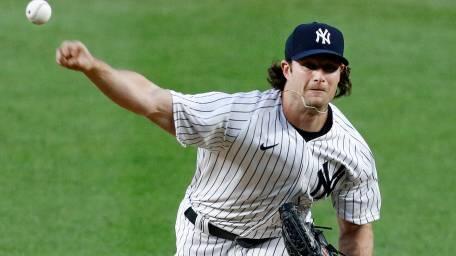
Gerrit Cole faced live hitters for the first time since coming back from Tommy John surgery. He was scheduled for 1 IP or 20 pitches. Cole was able to hit 97 mph with his fastball, which is a very good sign. Before the injury, he was averaging 95.9 mph in 2024 and 96.7 mph in 2023. He is not going to be on the Opening Day roster, but his current timeline is for a May return. The Yankees have postseason aspirations, so they will slow-play Cole so that he is able to be on the mound for them at the end of the season. Cole saw a decline in skills when he was last on the mound (25% K, 7% BB, 10.7% SwStr, and 3.79 SIERA). The tough part is deciding how much was due to the injury because he was trying to pitch through it, or how much was due to natural decline as he ages. Buying a starting pitcher coming off Tommy John surgery is tough because velocity may come back, but control is slow to come back, making it hard to produce value. This makes it hard to draft Cole, not knowing exactly how his stuff is going to look, possible control issues, and an innings cap.
Drake Baldwin-Braves-C
Drake Baldwin burst onto the scene as a rookie in 2025. He hit .274 with 19 HR, 56 R, 80 RBI, and 0 SB in 446 PA. The interesting part is that he got a lot of buzz coming out of camp and then struggled initially, but the underlying skills pointed towards a breakout, which is what happened. He has excellent plate skills (15% K and 8% BB) and hits the ball hard (11% Barrels). Baldwin also doesn’t chase much out of the zone (32% O-swing), which backs up his good approach. The sky is the ceiling for him, with the only thing truly holding him back last year being splitting time with C Sean Murphy. The Braves did not trade Murphy over the offseason, but he is expected to start the year on the IL while he recovers from hip surgery. The concern for Baldwin’s fantasy value is that once Murphy returns, they are expected to split time, which is going to limit his at-bats. Hopefully, Baldwin can sneak some at-bats at DH on days that Murphy is catching to keep his bat in the lineup. This is a classic case of bet on the talent and let the playing time issue sort itself out.
Francisco Alvarez-Mets-C
Francisco Alvarez played well in 2025 (.256 AVG, 11 HR, 32 R, 32 RBI, and 0 SB) but was limited by injuries to 76 GP (277 PA). This offers potential upside because his price has dropped because his overall stats aren’t there, but the underlying skills still point towards an above-average power bat. Alvarez has a good sense of the zone (10% BB, 26% K, and 31% O-swing) and hits the ball hard (12% Barrels and 54% Hardhit). With 500 PA, he could threaten 30 HR, which would be tremendous value for a catcher being drafted outside of the top 10 at the position. The Mets did not sign anyone to threaten his playing time, so he should come close to the 500 PA mark if he stays healthy.
Munetaka Murakami-White Sox-3B
Munetaka Murakami was 2-4 with 2 RBI in the White Sox spring training game against the Cubs. This was Murakami’s U.S. debut. He signed a 2-year, $34 million deal with the White Sox to play third base. His profile coming over from Japan is that of a power hitter. He set the NPB single-season home run record with 56 HR in 2022. However, he has struggled with swing and miss in the seasons since, and there is concern that transitioning to the MLB is going to exacerbate that problem. This is also evident in the contract that he got at 26-years-old. Projection systems have him projected for 25-30 HR, but a sub .230 AVG, which is in line with what scouts believe as well. He started off strong in his debut with a double off Porter Hodge, a quality reliever for the Cubs. The true test will come towards the end of spring when he starts to face major league velocity regularly.
Pirates Rotation
The Pirates’ rotation is projected to be one of the top rotations in the National League. They have three guys locked into a rotation spot right now in Paul Skenes, Mitch Keller, and Bubba Chandler. Paul Skenes is a top-three fantasy option along with Tarik Skubal and Garret Crochet. Mitch Keller has more real-life value than fantasy value because he is a workhorse with 30+ starts in each of the last three seasons. However, it did come with a 4.22 ERA, 1.27 WHIP, 23% K, and 7% BB. Bubba Chandler got a taste of the majors last year (4.03 ERA, 0.93 WHIP, 25% K, and 3% BB). It was a small sample (7 GP/4 GS and 31.1 IP) but Chandler showed an elite fastball and above-average changeup. The development of his slider or curve as a true outpitch is going to determine whether he reaches his elite upside. He threw 130+ IP between the majors and minors, so he should be good for 150+ in his first full season. Braxton Ashcraft had a solid debut for the Pirates last season (2.71 ERA, 1.25 WHIP, 24% K, 8% BB, and 3.61 SIERA). This was after posting 26% K and 9% BB at Triple-A. He is a backend starter with upside if he continues to develop and stays healthy. Ashcraft has five pitches and a pitcher-friendly park. Hunter Barco and Jose Urquidy are battling for the final rotation spot. Right now, Urquidy has the upper hand because he signed a major league deal, and Barco still has options. Urquidy hasn’t started a game at the major league level since 2023. He missed most of 2024 with an injury and only managed 55.2 IP last year between the minors and majors. It was just 2.1 IP at the major league level, but it was his lowest Stuff+ and Pitching+ of his career. How he looks in spring will give us a better idea, but at this point, he shouldn’t be considered outside of 50-round draft and hold formats. Hunter Barco is a more intriguing fantasy option because he is a left-hander with three pitches in a park that is beneficial for lefties. His offerings (sinker/slider/splitter) give him the ability to get hitters from both sides of the plate out. Barco also impressed in the minors last year (2.81 ERA, 1.20 WHIP, 28% K, 12% BB, and 45% GB). Jared Jones missed most of the 2025 season (11 IP) due to Tommy John surgery. He is also expected to start the season on the IL. It is believed to be a way to limit his innings pitched while also having him ready for the end of the season. The last time we saw Jones on a mound was 2024. He showed good skills (26% K, 8% BB, and 3.72 SIERA). Following the reports of his velocity and stuff numbers once games start is going to give us a better understanding of what we can expect from him in 2026. Jones showed a plus fastball and slider, but needed to further develop his curve and change to be able to get hitters from both sides of the plate out.