
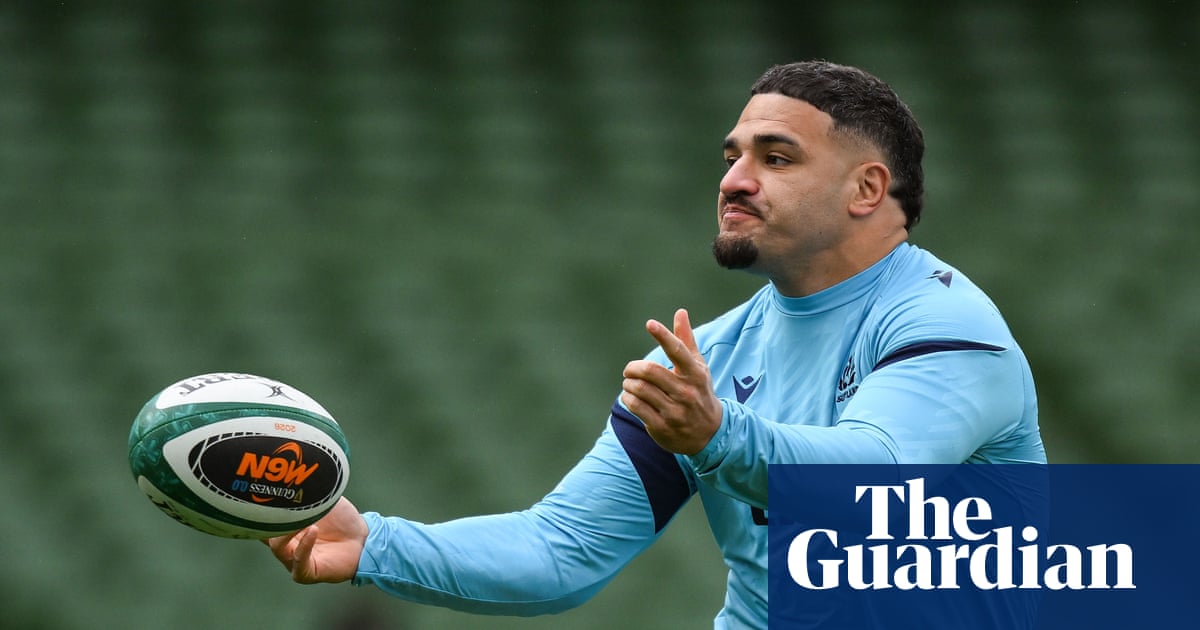
Trusting the process. It sounds like a fine idea in principle: although it really depends if your process was any good in the first place.
Gregor Townsend faced down a familiar cacophony of criticism after Scotland’s opening defeat by Italy last month. The same old shortcomings had been exposed, it was said, and another year of disappointment beckoned. Townsend had insisted the embarrassing capitulation against Argentina in November, from 21-0 ahead, was a “line in the sand moment” – only to see that line swiftly washed away in the sheeting Roman rain.
“I believe in what we’re doing, I believe in the players,” Townsend said after the 18-15 reverse at Stadio Olimpico. “Today it didn’t happen. We’ve got to make sure it happens next week.” The fans, frankly, had heard it all before.
It was a shambolic performance against Italy in many respects, with Scotland’s error count making them unable to recover from the Azzurri’s exemplary start. But Scotland did make it happen the following week and now, after wins against England, Wales and, most spectacularly, France, it seems nothing was irretrievably broken after all.
Credit to the head coach for backing himself and his players, and specifically for the way they have stuck to their attacking principles since, almost literally in Grant Gilchrist’s case, having their pants pulled down by Italy.
If last week’s electrifying display against Les Bleus proved anything, it is that the surest route over the opponent’s tryline is via keeping possession, passing intelligently, and deploying the kind of creative running lines and strike plays that will wrongfoot even the meanest defence.
Looming over the start of this tournament was a growing fear that after World Rugby’s escort defender crackdown, an increasing emphasis on contestable kicks risked ruining the elite game.
While Steve Borthwick and England double down on a one-dimensional kicking strategy, Townsend and Scotland demonstrated against France that passing, pace and attacking intent can conjure the most remarkable results and the most memorable matches.
A first Six Nations title is tantalisingly within reach – but Scotland are likely to face a familiar problem in Dublin. It doesn’t matter how good your backline is, or how well rehearsed your strike moves are if possession is cut off at source.
France were curiously lacklustre in defence at Murrayfield but Andy Farrell, the Ireland head coach, has reverted to the same selection as for England at Twickenham. We know how that turned out, and no team has suffered more in the face of Ireland’s considerable power than Scotland.
Ireland’s back row – particularly the captain Caelan Doris – were at their destructive best against England. If they can raise their collective intensity to similar levels, it will be a very difficult day for the visitors.
But Scotland’s captain, Sione Tuipulotu, explained on Friday why he believes this could be different. “I’ve come to the Aviva in the past where maybe it seemed a little bit more like hope [than expectation],” he said.
“Where our strength comes from as a team is the hard stuff we’ve been through. To be resilient in those times is what gives me the most confidence that we’ll be the best version of ourselves tomorrow.”
Kicking will be important, but the breakdown arguably even more so, given the visitors’ laudable plan to run the ball. If they are to impose their style they will need another big performance from Rory Darge. The back-rower has the most turnovers in the tournament – eight – with Ireland’s Stuart McCloskey (seven) and Tadhg Beirne (six) second and third respectively.
Darge, who will play openside next to Jack Dempsey at No 8 and Matt Fagerson on the blindside, also tops the individual jackalling chart with six (Beirne is second for the Six Nations, with five: he slots into the second row, with Jack Conan covering blindside flanker).
Scotland’s locks, Gilchrist and Max Williamson, are sure to have their hands full against Beirne and Joe McCarthy, who has also been in fearsome form.
It is the team statistics, though, which demonstrate kicking rugby is not necessarily winning rugby. Scotland have the lowest kick metres, the fewest kicks in play, and the joint-most carries at this tournament: 590, level with France.
Ireland, of course, have had quite the journey themselves in recent weeks. Crushed by France on the opening night, they laboured past a fast-improving Italy before marmalising England. Victory against Wales was duly delivered, putting them within striking distance of France, who remain title favourites, and Saturday’s visitors.
It is more than nine years and 11 matches since Scotland experienced anything other than painful defeat against Ireland. If they back themselves to move the ball as they did against France – and achieve a similar result – Townsend’s trust in his process will truly be vindicated.