
Published February 22, 2026 04:40AM
Cyclists are always looking for a way to be 1% faster, whether it is a tweak to diet, nutrition, or aerodynamics. With that drive comes a sense of curiosity to push boundaries. What if we tried something that no one has before? What if there is something out there, something yet to be discovered?
The carbohydrate revolution has changed the sport of professional cycling. So have skinsuits, aero socks, and deep-section wheels. Heat training didn’t really exist 20 years ago, and now almost everyone is doing it. Some discoveries are so good (and controversial) that they get banned: carbon monoxide inhalation comes to mind.
In that tradition of boundary pushing innovations comes a new form of training, one that I had never heard of before 2026. Underwater cycling in hot conditions.
Training in Hot Water Immersion
The study in question, “Training in hot water immersion improved exercise performance in hot and humid conditions in recreational athletes – a randomized controlled trial,” was published in the European Journal of Applied Physiology in 2025.
Before we get into the details of the study, I have to point out some obvious caveats. This study was performed on a sample of two groups of 12 participants (22 males and 1 female). The participants were cyclists and triathletes between the ages of 18 and 50, quite a wide range.
Though the participants were recreational athletes, not professionals, they were much more fit than the general public. The average participant had a VO2 Max of 46 mL/kg/min and a threshold power of 298w. Not bad for recreational athletes.
The authors of the study had a hypothesis to test: can you combine active and passive heat training for a compounded effect? Heat training is a well-known tool nowadays, but it is typically done one of two ways: training in a hot and humid environment, or sitting in a hot and humid environment without exercising (i.e. hot tub or sauna). But, these authors thought, what if you could do both?
The purpose of this article is to determine if there is something real here, a potential training innovation that could make its way into professional cycling. These methods were…interesting, to say the least. Let’s dive into it.
A weird water workout
This study was completed in Montpellier, France in early 2023. The parameters of the study were quite solid, which helps support the study’s potential conclusion. Participants were blinded to the hypothesis, outcomes, and statistical analysis throughout the study to prevent a placebo effect.
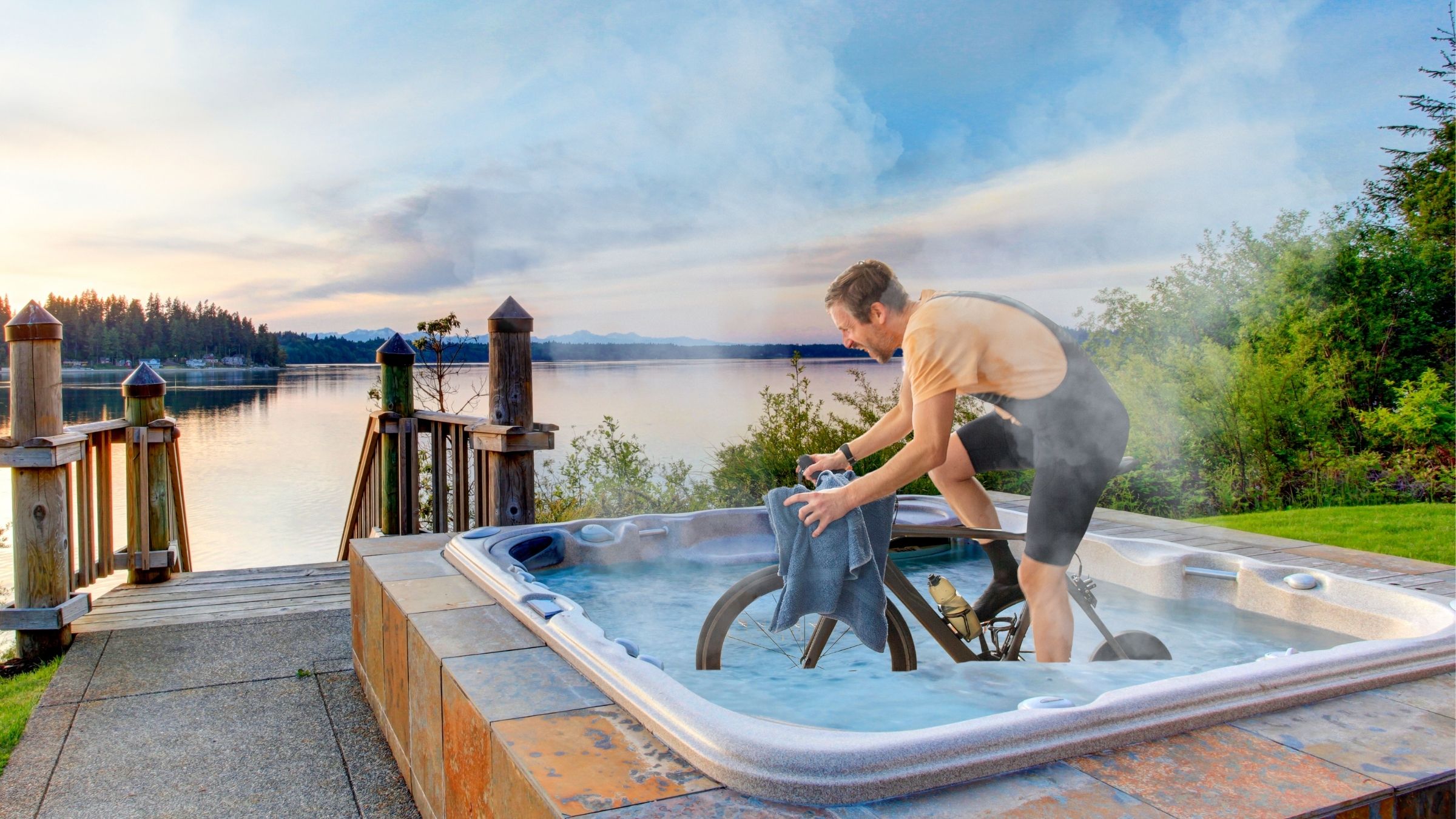
Each participant did 10 one-hour sessions over a 2-week period. But these were not your ordinary training sessions – they were cycling underwater. Each participant cycled underwater with their bodies immersed up to their waist. How this was done practically I’m not sure, and I would love to see a video from one of these sessions.
The experimental group (warm-water acclimation, or HWA) trained in water that was set at 35 °C (95 °F), while the control group rode in water set at 25 °C (77 °F). Those are almost hot-tub-level temperatures for the HWA group, while the control group rode in water temperatures that you would find in an Olympic pool.
The training sessions were simple: ride for one hour at, “a heart rate corresponding to the first ventilatory threshold (VT1)+10%.” Translated: somewhere around your Tempo / Sweet Spot zones. To measure progress, a 30-minute indoor time trial in hot conditions was performed two to three days before, and then again two to three days after the 10 training sessions. This was a very hot time trial effort, with the hot environmental room being held at 38.4°C and 45.3% Relative Humidity.
As for the final results…
The HWA group improved their 30min hot-weather time trial performance by 27w, while the control group improved by 13w. That is a 2X improvement on performance in the heat in less than two weeks. Is this a breakthrough that will change cycling forever? It certainly could be.
What We Can Learn From This Study
As with any scientific study, you cannot rush to conclusions based on a single result. While the TT performance results were certainly promising, we have to remind ourselves that the results are an average. In each group, HWA and control, there was at least one participant who showed no significant improvement in power output after the 10 training sessions (one participant actually lost a few watts).
On the flip side, some participants gained more than 40w, an improvement so profound that you would expect there were other factors that contributed to their two-week performance increase. Perhaps they were more motivated, less stressed, better fueled, etc.
Even with all that said, I truly think there is something here, a physiological training secret that has yet to be fully unlocked. Few people will have access to an underwater bike, and even fewer will have the power and technology to control the temperature of that water. But for cycling’s super teams, anything is possible.
These teams and riders will try just about anything within the confines of the rulebook to improve their performance. Some, you could say, get a bit too close to stepping over that line. But what we’re talking about here is something that operates far from any gray areas, and is technically available to anyone. However, the logistics sound extremely complicated.
Is Underwater Cycling Practical For Anyone?
I don’t anticipate these training protocols to become publicly available anytime soon. Maybe one day we’ll see a company launch an at-home underwater bike. But for the time being, this is something reserved for million-dollar budgets.
It’s also important to remember that the results of this study applied only to hot and humid conditions. The participants were not tested in a neutral environment, so we don’t know how many watts they might have gained in more standard temperatures. Even if underwater heat training only works for hot weather performance, this could certainly be something we see the pros doing before the Tour de France where the air temperature can be upwards of 40 °C (104°F).
I would have loved to see this study being performed in the lab. While I scoured the internet for everything I could, I couldn’t manage to find any photos or videos from this study. If one of the study’s scientists or participants is reading this, please let us know how these sessions looked in real life!