
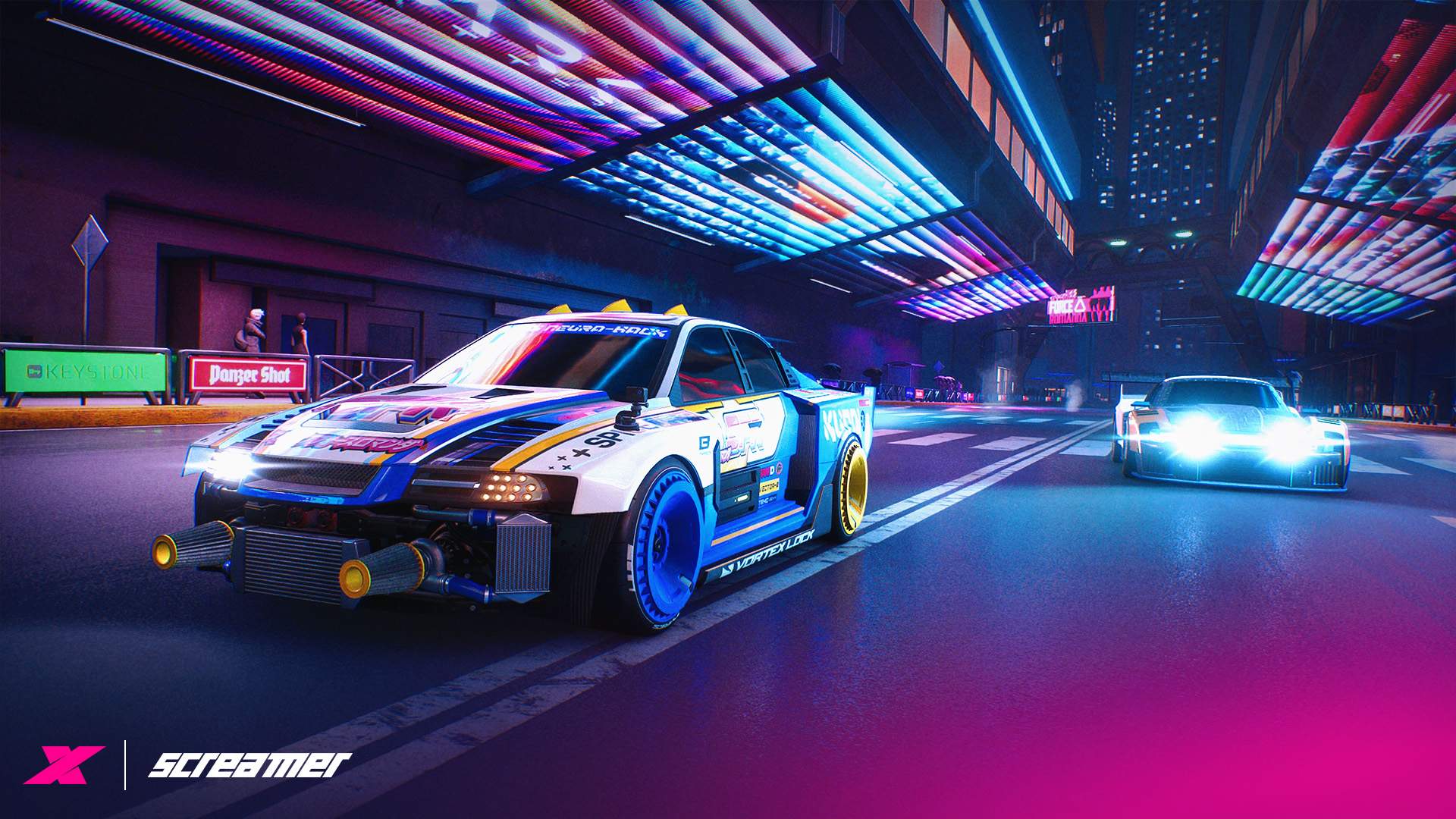
Arcade racing is long overdue for a comeback. Indie developers have attempted to revive the genre, with recent examples including Horizon Chase 2, Hotshot Racing and Inertial Drift. But it’s been a long time since we’ve had a track-focused, pure arcade racer with high production values in the vein of Ridge Racer.
Now, after over 25 years, Screamer has returned to reinvigorate the genre.
For the uninitiated, Screamer was a PC-only racing series, with four titles released between 1995 and 2000, culminating in the 4X4 spin-off. Since then, the franchise has been largely forgotten, overshadowed by more popular 3D racers in the 1990s, such as Need for Speed, Ridge Racer and Gran Turismo.
Its surprise return in 2026 is a complete reimagining, combining an anime-inspired art style with a narrative-focused campaign and surprisingly deep combat mechanics inspired by classic fighting games. The result is an arcade racer like no other.
What’s even more surprising is that Screamer is developed by Milestone, a studio best known for its competent but ultimately safe motorcycle games like MotoGP and Ride. After the Italian developer found success with the Hot Wheels Unleashed games, Screamer feels like a racing game the team has always wanted to make with full creative freedom.
It harks back to an experimental era when developers and publishers weren’t afraid to take risks, resulting in titles like Split/Second and Blur that dared to be different. As a reboot of a franchise unfamiliar to new players, Screamer may struggle to resonate with a wide audience.
Story-focused
Its central mode is an anime-inspired storyline revolving around the titular Screamer tournament, an illegal racing competition run by the mysterious Mr. A with an alluring $100 billion cash prize.
Gage, the tournament’s muscular mechanic, equips each competitor’s car with the Echo, a futuristic technology with supernatural abilities that allows drivers to recover from death. This attracts a range of teams to enter the competition, from vapid pop stars to scientists.
Events within the Tournament range from team races to checkpoint challenges. Winning doesn’t always require finishing in first place, either. Most events require you to complete separate objectives to progress, such as finishing ahead of a specific opponent or performing perfect boosts, but can sometimes feel arbitrary.
Across four chapters, the story is told through lavish animated cutscenes produced by Polygon Pictures, the Japanese animation studio behind Star Wars: The Clone Wars, Tron: Uprising and Transformers: Prime.
There’s an eclectic, international cast of voice actors, from Troy Baker (best known for portraying Joel in The Last of Us), to Fermi, Gage’s canine companion, voiced by an actual corgi dog. The performances are respectable, with several actors speaking their native languages, including Japanese, German, and French.
Foul-mouthed army veteran Róisín is an early standout character, though her fiery attitude and incessant cursing border on Irish stereotyping.
Unlike the dull, sanitised characters in other racing games like Forza Horizon and The Crew Motorfest, the story explores dark themes such as death, murder and revenge, with sexual references and abundant swearing bumping its age rating up to 16.
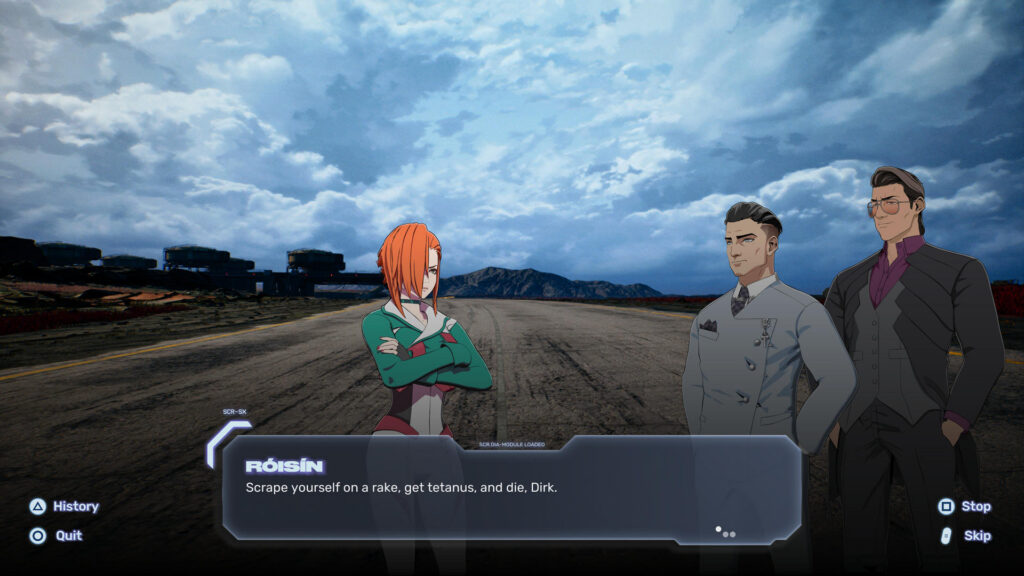
Despite this, Screamer doesn’t take itself too seriously. While it can be too exposition-heavy, the campy dialogue suits the style. This is taken too far sometimes, with crass, cringe-inducing yet consistently entertaining lines that sound like they were written by a teenager desperately trying to seem edgy.
Here are some of our favourite dialogue excerpts out of context:
“Quinn founded the Banshees. A female-led private military company in a field dominated by micro-dicked men.”
“You just entered a certain chocolate factory, and shit’s about to get wonky.”
“Scrape yourself on a rake, get tetanus and die.”
“Listen here, you disturbingly sexy mechanic! Say another word to my friend, and I’ll shove your rag so far up your ass that your intestines will be spotless for weeks.”
“You smell like piss and are as consequential as an ant.”
While the anime cutscenes are slickly produced, they are disappointingly fleeting, with around 30 minutes of footage. Instead, most of the story is presented in largely static, visual-novel-style dialogue scenes that are far less engaging.
With stilted dialogue and long pauses slowing down the pacing, this style of storytelling is an acquired taste that will make some players search for the skip button.
A striking style
Despite the inconsistent presentation, Screamer’s story is well executed in a genre that isn’t renowned for compelling narratives. Characters are well-defined and have more depth than you might expect. Everyone has different motivations for being in the Tournament, resulting in conflicts that create interesting team dynamics, tensions, and story arcs.
The Green Reapers’ Hiroshi, for example, isn’t your typical fearless leader and suffers a crisis in confidence. Similarly, the wealthy Anaconda Corporation’s Gabriel is portrayed as an antagonist, yet you end up sympathising with him.
Each character is assigned a unique car that reflects their personality. With no licensing restrictions, the fictional vehicle designs look ravishing, with brash bodykits and eye-catching liveries. They are characters in their own right.
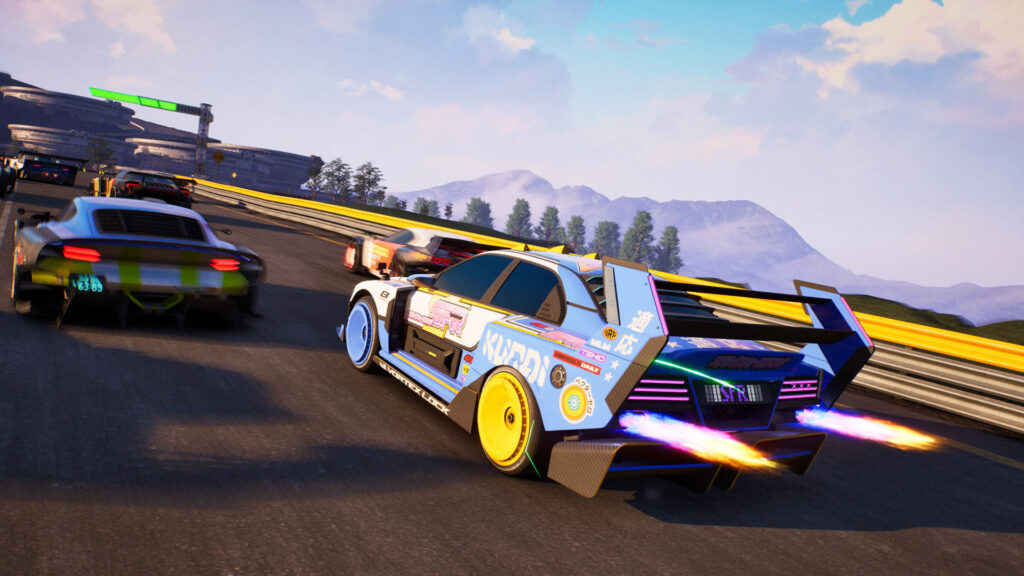
Gabriel’s sinister-looking car is a particular highlight, with its elongated bonnet, retracting spoiler and pop-up brake lights. Cars can also be customised with unlocked parts, allowing you to fit spoilers, splitters and decals.
Likewise, each team has a unique music theme that infuses a perpetual sense of energy. With styles ranging from upbeat electronics to rousing rock, it’s easily one of the best and most memorable original soundtracks in a modern racing game.
Taking cues from 1990s anime and, seemingly, Need for Speed: Unbound, the visuals blend cel-shaded elements with realistic environments, ranging from neon-soaked cityscapes to forests and deserts. Coupled with smooth performance on PS5, the result is striking, giving Screamer a strong visual identity that immediately stands out compared to other generic-looking racers.
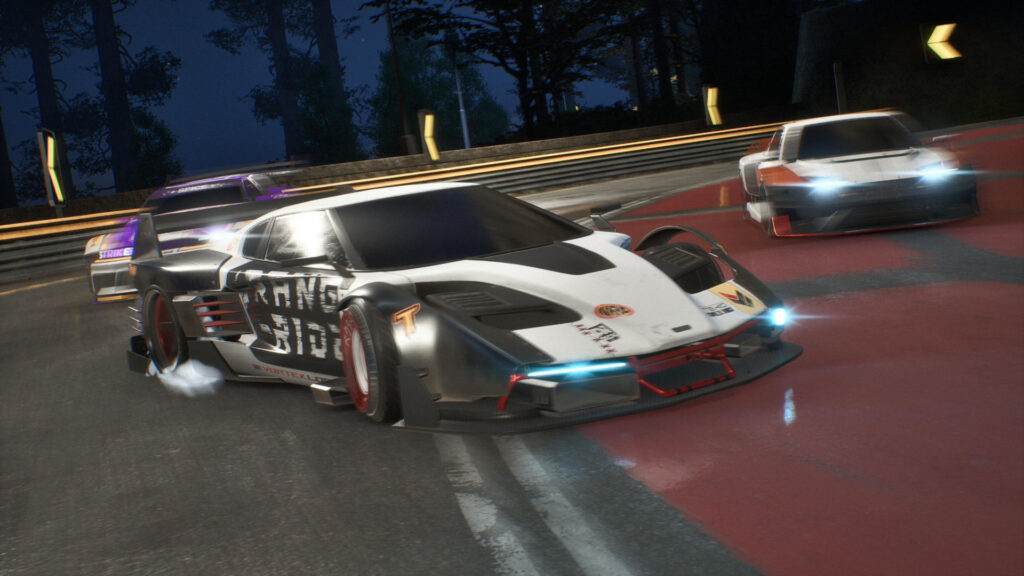
As excellent as the environments look, there simply aren’t enough of them. At launch, Screamer features 32 layouts that unlock throughout the story campaign. However, these are split across only four environments, resulting in repetition, with a secret location revealed in the final chapter relating to Mr. A’s true identity.
With a large cast as overstuffed as a Marvel’s Avengers film, you inevitably invest in some characters more than others. It enriches the world, but a smaller cast would keep the story more focused.
It doesn’t always land, but there is a noble attempt to give the characters personalities and develop their relationships, with an overarching narrative that elevates the race events with dramatic stakes.
It’s lengthy, too, taking roughly 20 hours to complete if you don’t skip the optional events between episodes. Focusing on specific teams, these side episodes can be completed in any order and expand the lore.
Others, meanwhile, like one where you chase after Fermi the dog after they steal your fidget spinner, feel like filler. Main missions, on the other hand, follow a linear path, with no story choices and a definitive ending.
Dual control
Screamer’s story essentially serves as a tutorial for the surprisingly complex gameplay mechanics.
An unconventional control scheme lets you steer with the left analogue stick and control your drift angle with the right.
Fans of the underrated indie racer Inertial Drift will find this setup familiar, yet it feels different, requiring more finesse. That game feels snappier by comparison, with a greater emphasis on speed and prolonging slides. Screamer’s handling is similar in concept but different in execution.
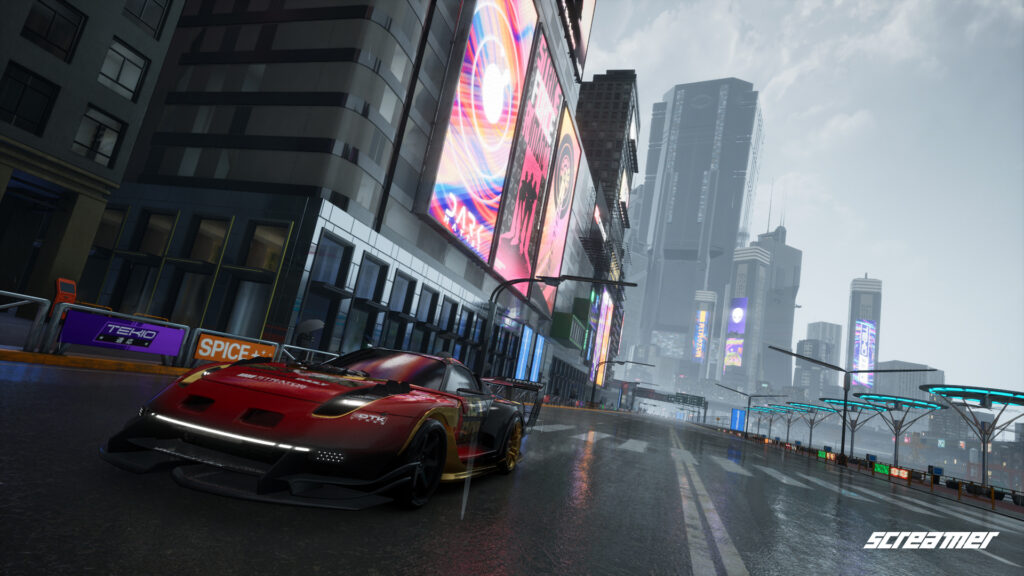
This isn’t an arcade racer where you can keep it pinned and attack corners at full speed absent-mindedly. With no racing line aids and cars that feel heavier than most contemporaries, it’s easy to misjudge a corner and careen into the barriers.
Tighter turns require braking or lifting off the throttle before initiating a drift and reapplying the power. It takes time to acclimatise, much like when dual-stick controls were first introduced in first-person shooters, yet they now feel second nature.
Applying the steering and braking assists hidden in the menus helps prevent you from bashing into the barriers by slowing you down and guiding your trajectory, but the controls could still be tighter. The steering assists also neuter the handling to the point you don’t feel in control. Additional assists, such as stability and traction control, would have been welcome.
It takes skill and practice to perfect, but if you time everything right, swinging the back end out to slide around a succession of corners is immensely satisfying.
Fighting through the field
On top of the unique handling, there is also a multi-layered combat system to manage.
Inspired by fighting games, two energy bars at the top of the screen represent the ‘Echo System,’ which the narrative introduces organically as characters learn how to exploit the technology. Slipstreaming opponents and driving cleanly fill the left bar with Sync, the Echo’s main resource.
Shifting up a gear at the right moment when the bar turns yellow also actively increases Sync. This is entirely optional, as each car has a semi-automatic transmission, but it fills the bar up faster.
Once one bar is filled, holding the L1 button activates a temporary speed boost. Time this perfectly, and you’ll get a longer, more powerful boost.
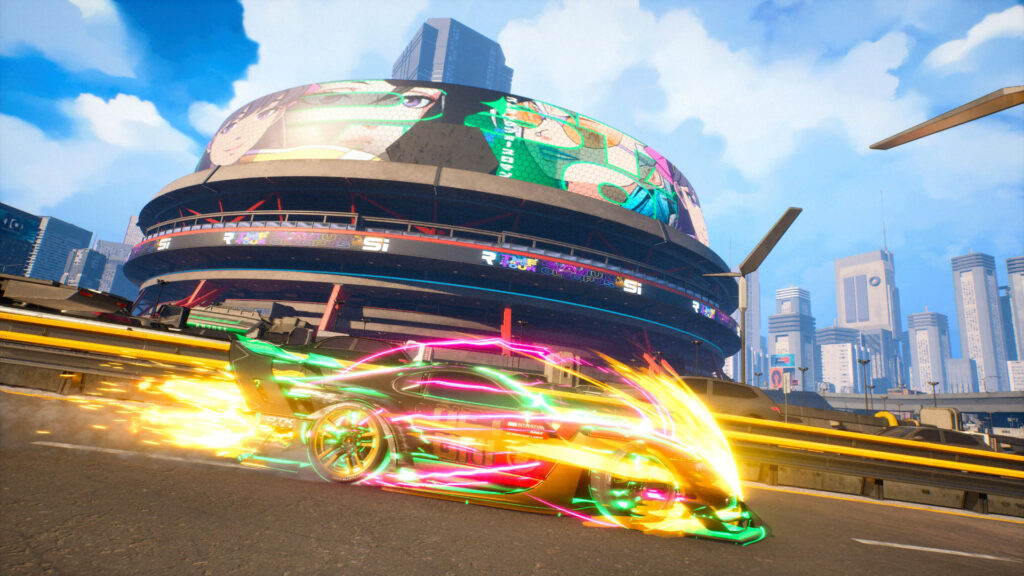
Meanwhile, activating Sync charges up the right bar’s Entropy, the resource used for the fighting mechanics. Filling up two bars lets you activate a Strike attack. This not only provides a short speed boost, but takes out an opponent if you hit them, causing them to explode in a KO.
Filling every bar activates Overdrive, which turns your car into a moving fireball that obliterates any opponent in your path. It’s an effective catch-up system if you fall behind. The catch, however, is that you instantly explode if you touch the barrier.
To keep everything balanced, you can defend against oncoming attacks by activating a shield at the right moment. Executing these moves successfully requires expert planning, rewarding skill, timing and careful resource management.
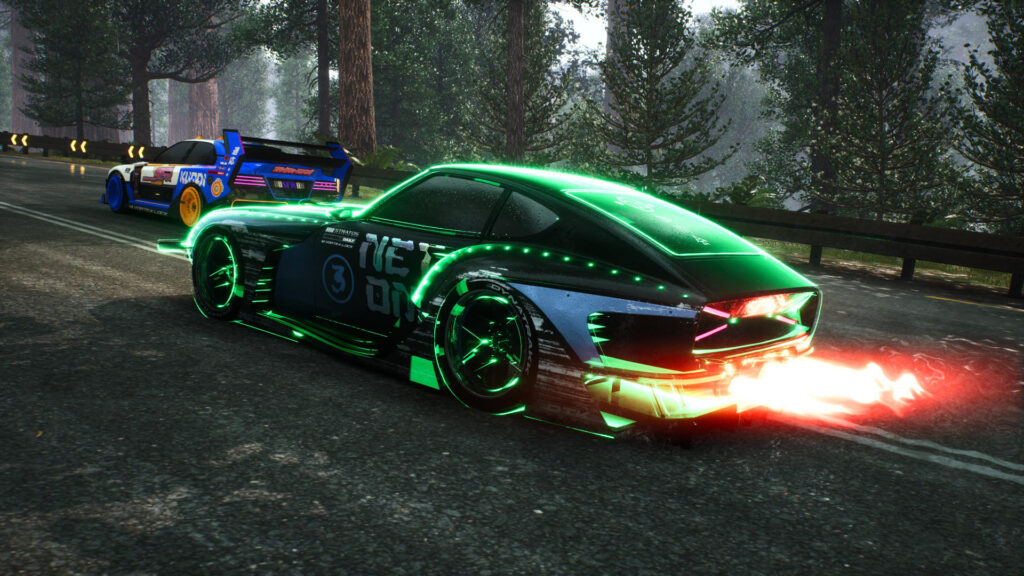
Adding even more depth, each character has their own attack or defensive perks, encouraging different strategies. Aisha, for example, can activate an emergency shield if they are taken out by a Strike. Róisín, on the other hand, requires less Entropy to perform a Strike, reflecting her aggressive style.
With so many disparate elements to juggle, challenging courses and tough AI opponents, Screamer is the new Dark Souls of driving games. There’s a mechanical depth rarely seen in modern arcade racers, but it’s screaming out for reference guides or tutorials outside the brief explainers in the story mode. It asks a lot of the player and may be too convoluted for those with short attention spans seeking instant gratification.
To Milestone’s credit, the Tournament does a commendable job of gradually introducing each mechanic at a manageable pace, with the combat system inaccessible until around the halfway point.
Old-school arcade racing
The same can’t be said for the separate Arcade mode, however. With everything unlocked from the start, the chaotic racing is overwhelming if you dive straight in.
That said, events are highly customisable, with a raft of options letting you set the grid size, change the number of laps, or disable the fighting mechanics. You can also go deeper by enabling or disabling Overdrive, Active Shifts, or Sync generated from KOs.
Beyond the standard races, time trials and checkpoint events, Arcade Mode is fleshed out with two unique modes. Overdrive Challenge is a survival mode where you attempt to drive as long as possible without crashing while in Overdrive, which gets increasingly powerful after each lap.
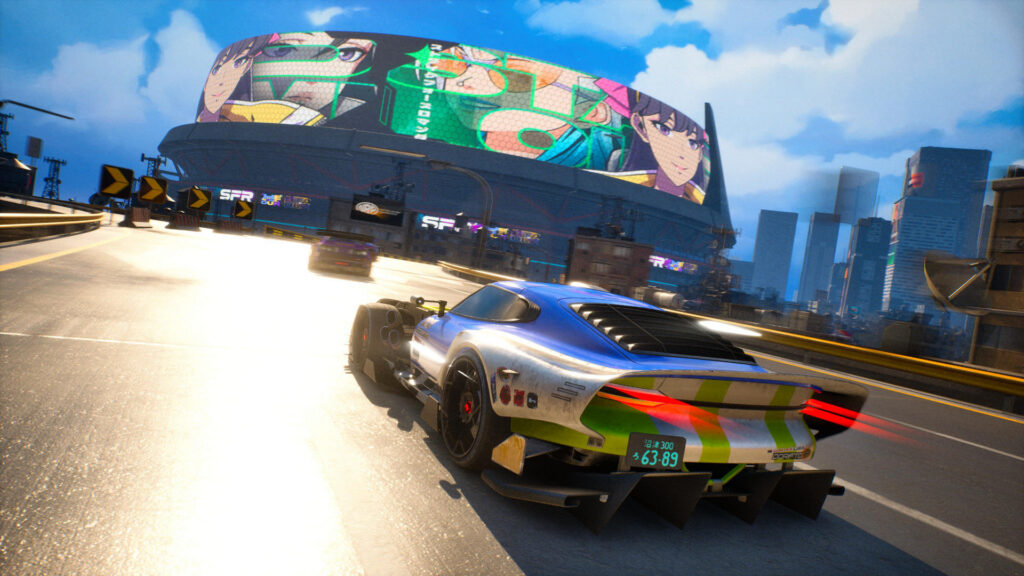
Score Challenge, on the other hand, sees you compete in a leaderboard for the highest score in a series of races.
Outside single-player, Screamer features local split-screen for up to four players. While the action remains smooth despite the chaos, the crowded UI doesn’t translate well to a smaller screen. Online multiplayer, meanwhile, supports up to 12 players, with ranked team races for parties of up to three, private lobbies or quick races.
A risk worth taking
With its anime aesthetic, unconventional controls and unique combat, Screamer is refreshingly risky. In a genre often criticised for playing it too safe, this is something to be celebrated.
Its steep learning curve will no doubt be divisive. As a result, it seems destined to become a cult classic. However, dedicated players who take the time to master the intricate mechanics will find a deeply rewarding racer that boasts both style and substance.
This is the shot in the arm that arcade racing has sorely needed.