

At Rene Herse Cycles, we’ve got a policy: We don’t make anything that exists already. As a small company, our resources are limited. We’d rather use them to create something that’s going to improve the riding experience for us and our customers—not recreate something we already can buy from others.
There’s still plenty of improvement possible in the cycling world—and we’re not talking about ‘marginal gains’ that’ll make you 0.0001 mph faster on a good day. Tires are obviously a specialty for us. We made wide-and-supple road and all-road tires long before others jumped on the bandwagon. We’ve also created dual-purpose knobbies that compelled Cycling Weekly to write: “The knobbed René Herse tyres are praised for their speed.” You could say that tire innovation is part of our DNA.
It’s no secret that we weren’t fans of conventional semi-slick tires. To put it simply: Most existing designs were neither particularly fast nor particularly grippy.
Or as Gerard Vroomen, co-founder of Cervelo and OPEN Cycles, put it: “In general, we find side knobs superfluous on gravel tires. If you’re hanging at such an acute angle, you’re about to hit the ground anyway. Even worse, the only terrain where you could achieve such an angle without falling is on asphalt, and the last thing you want is side knobs hitting the road instead of smoother rubber.”
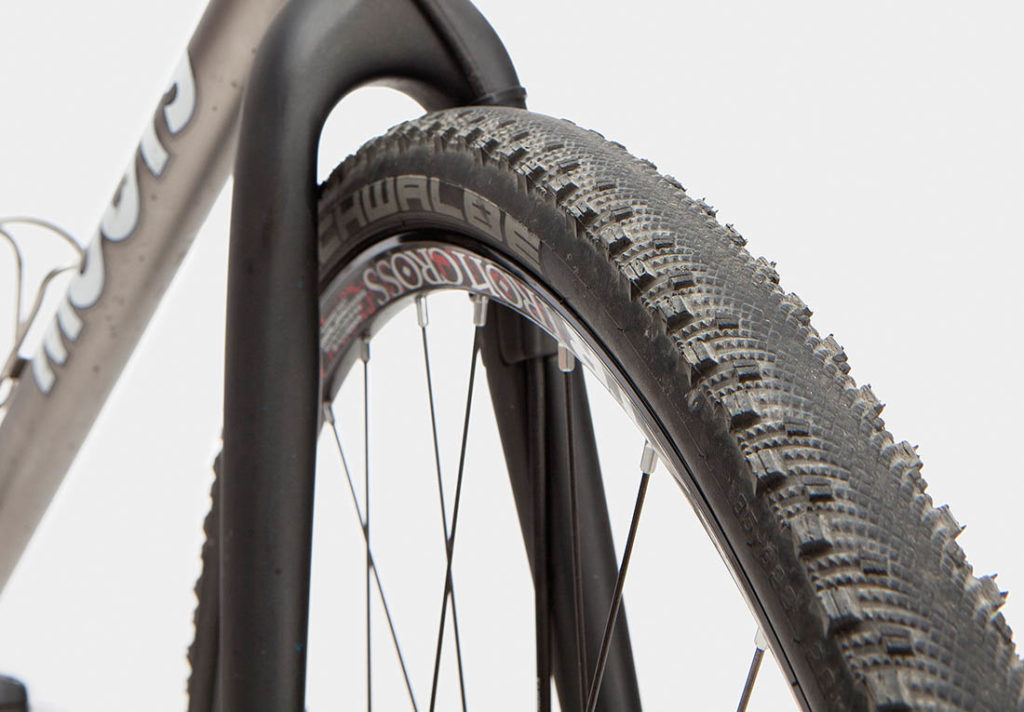
You can see what Gerard is talking about: The semi-slick tire above has knobs stuck onto the surface of the tread. As you lean into a (paved) corner, you’ll suddenly roll onto the knobs, and all hell will break loose.
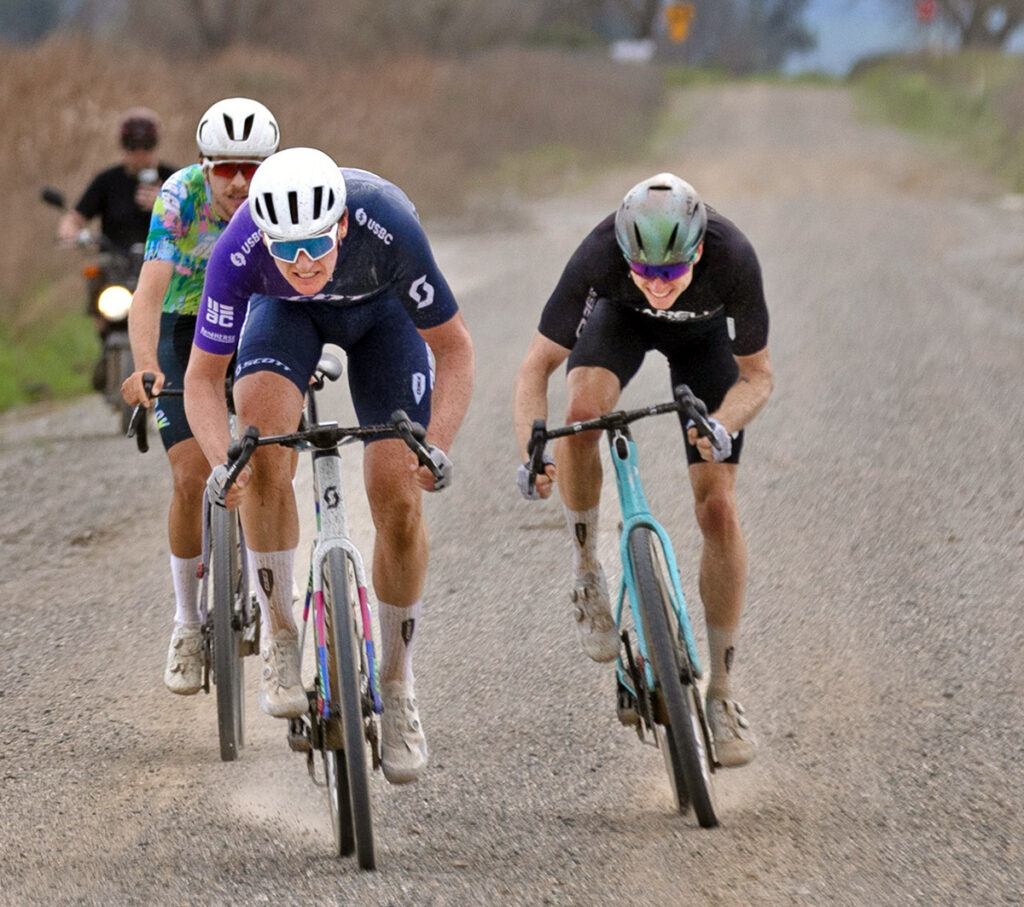
Just because something doesn’t work well doesn’t mean it can’t be improved. Semi-slicks may not offer better cornering on gravel, but the side knobs can be useful when the tire sinks into a loose surface. And when the rider rocks the bike from side to side during a sprint, the extra traction can also be helpful. Above is Brennan Wertz winning the 2026 Huffmaster Hopper on Rene Herse tires.
The problem with conventional semi-slicks is that they are designed with the premise that you’ll use those side knobs when cornering hard—even though you can’t lean over that far on gravel or dirt (as Gerard Vroomen pointed out). As a result, conventional semi-slicks don’t work all that well in the places where they should excel.
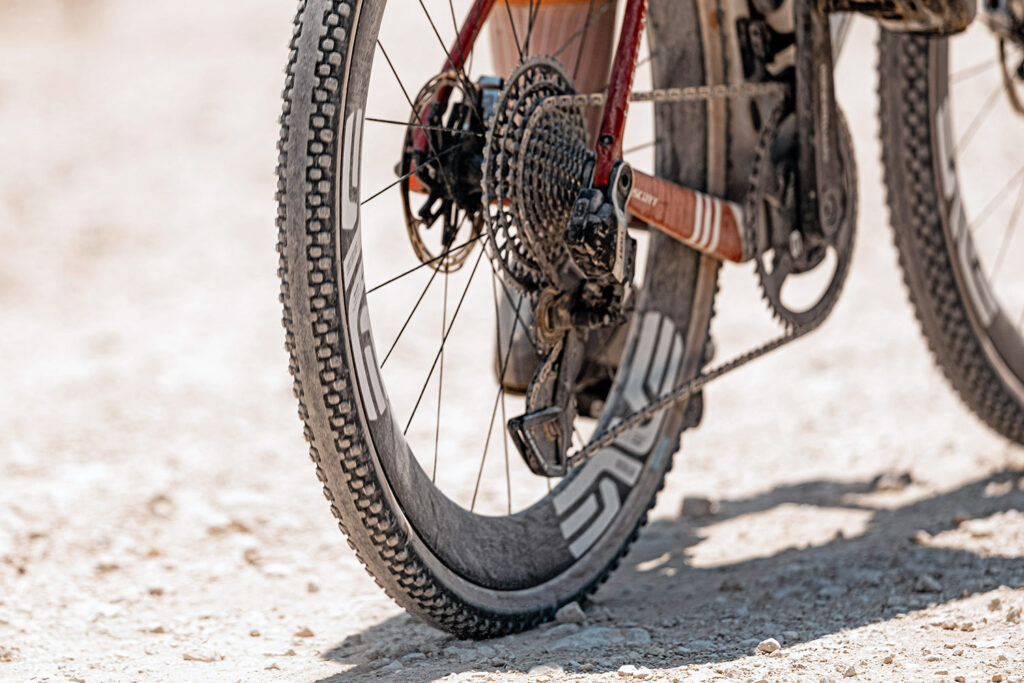
“What if we completely rethink semi-slick tires?” we asked ourselves. What if we start with a clean sheet of paper, and eliminate the pitfalls of existing designs one by one… The result are new tires that look completely different from anything that’s come before. So different in fact that we filed three patents to protect the innovations that make Rene Herse semi-slicks different from other tires. In this mini-series, we’ll look at the patents one by one.
Patent 1: A semi-slick tire with gradual, seamless transition from slick to knobby.
How could we make a gravel tire that doesn’t have the abrupt transition from smooth center tread to side knobs that Gerard Vroomen complained about? A tire that grips and feels the same no matter how hard you lean it into corners…

Sometimes, it helps to look outside of cycling. If we only watch what other bike companies are doing, we’ll never truly innovate. That’s why we often take our inspiration from other sports, from cars and airplanes—and from art.
Since I was in college, so I’ve been a fan of M.C. Escher’s work. My favorites are images where the background is gradually filled in, while the foreground disappears, until—in the drawing above—fish in the water become birds in the sky. There’s no distinct line where the fish switch to birds—it’s a gradual transition.
That’s how I wanted our semi-slicks to feel: As you lean into a corner, there should be no point where you’re suddenly no longer on the slick center tread, but instead on the side knobs. In fact, if you imagine the black part as the tread, you can almost see a semi-slick tread pattern that goes from mostly solid black at the bottom to bird-shaped knobs at the top.
Of course, it’s not simply a matter of translating Escher’s drawing into a tire tread pattern. A tire—even a wide one—offers a lot less area than Escher’s canvas. Escher used nine or ten rows of fish and birds to achieve the seamless transition. We have to make do with three or four rows of knobs. We also need the tread to self-clean, so the knobs should have a simple shape without corners that retain mud, and with a clearly defined amount of ‘negative’ space in between. Knobs shaped like birds would be cute, but they wouldn’t work well!
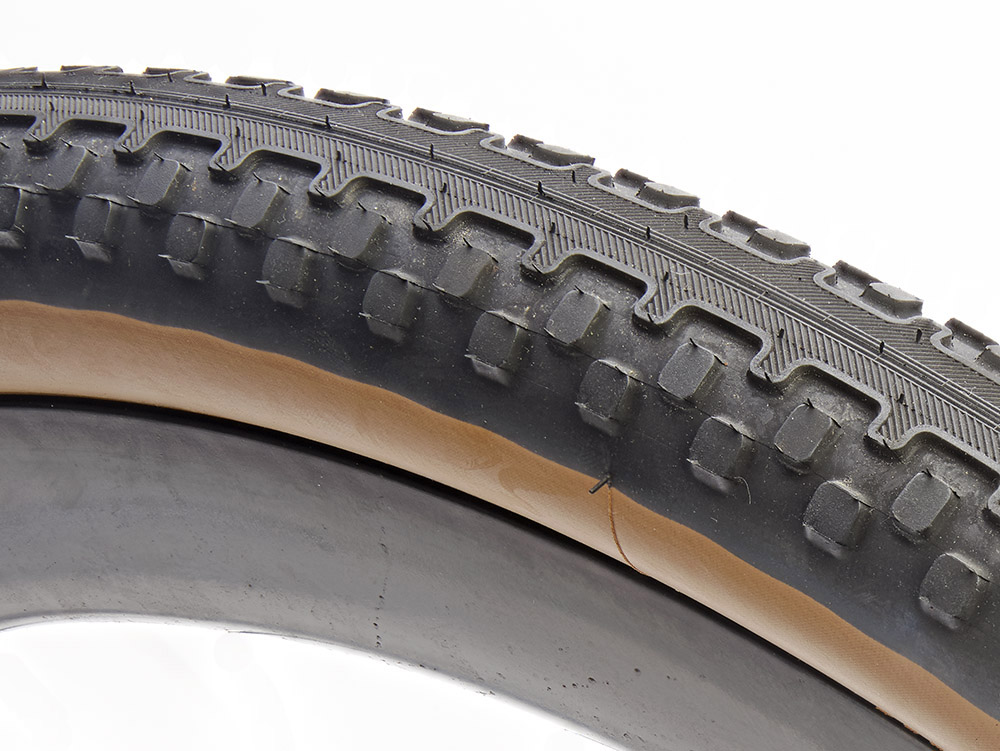
Our knobs aren’t bird-shaped, but you can see the inspiration in our tread pattern. Unlike other semi-slicks, there is no line where you leave the slick center tread and move onto the side knobs as you lean the tire into corners. The transition is gradual, as the slick center tread seamlessly morphs into the side knobs.
The gradual transition is not just reflected in the arrangement of the knobs, but also in the round profile of the tire. Unlike other semi-slicks, where the knobs stick out beyond the surface of the tire, Rene Herse semi-slicks have a perfectly round profile, so they corner predictably. We’ve used the experience from our dual-purpose knobbies to create the side knobs by ‘carving away’ the slick tread profile, rather than by sticking knobs onto of the tire’s surface. We agree with Gerard Vroomen: “On asphalt, the last thing you want is side knobs hitting the road instead of smoother rubber.” The side knobs of our semi-slicks behave like smooth rubber.
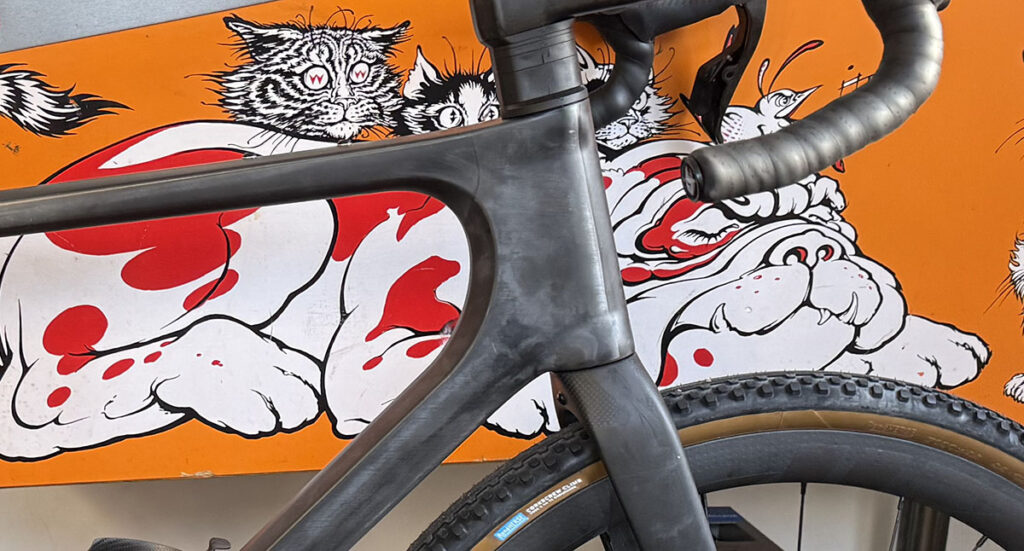
That’s a completely new approach to making semi-slick tires. It shows on the road: These tires grip tenaciously on loose and muddy surfaces, yet they roll and corner like slicks on pavement. We’re not the only ones who think so: Our friends and fellow ‘semi-slick skeptics’ at OPEN Cycles share our enthusiasm. Above is the bike of Andy Kessler (who co-owns the company with Gerard). He’s running our 700×44 Corkscrew Climb semi-slicks. His comment: “Best tyre I have ever ridden.”
That’s just one of the three patents we’ve filed for these innovative tires. We’ll discuss the other two in future posts.
More Information:
Photo credits: Jim Merithew / @tinyblackbox (Brennan at Huffmaster Hopper); Marc Arjol Rodriguez (@velophoto.tx, Brennan’s semi-slicks at Gravel Locos); Andy Kessler (Andy’s OPEN)