
Jannik Sinner defeated Carlos Alcaraz 7/6 7/5 on Sunday to defend his ATP Finals title in front of a home crowd. The Italian has now gone back-to-back in Turin without dropping a set.
Conditions shape rivalries. But watching Alcaraz and Sinner trade their particular brands of violence, you get the sense that any pre-match punditry of balls and surfaces is slowly becoming a futile exercise in materials science; whether it’s red brick or acrylic resins, these two play a version of tennis that is less about building points and more about obliterating plans. Big moment trigger-control has defined their fates thus far.
The result? After 16 matches and 3302 points, they have won exactly 1651 points each.
Perhaps that’s what we should have expected, given they possess pocket Aces from both wings. A quote from the Roland Garros final referencing that iconic 6-5 game in the fifth set springs to mind:
All-in stakes. Sinner’s return trumping Alcaraz’s serve, only for Alcaraz to somehow one-up that shot with end-range defensive magic, before someone pulled an Ace on the river, again and again, in this one pivotal game.
The forehands were firing early in a similar show of one-upmanship.
As were the backhands:

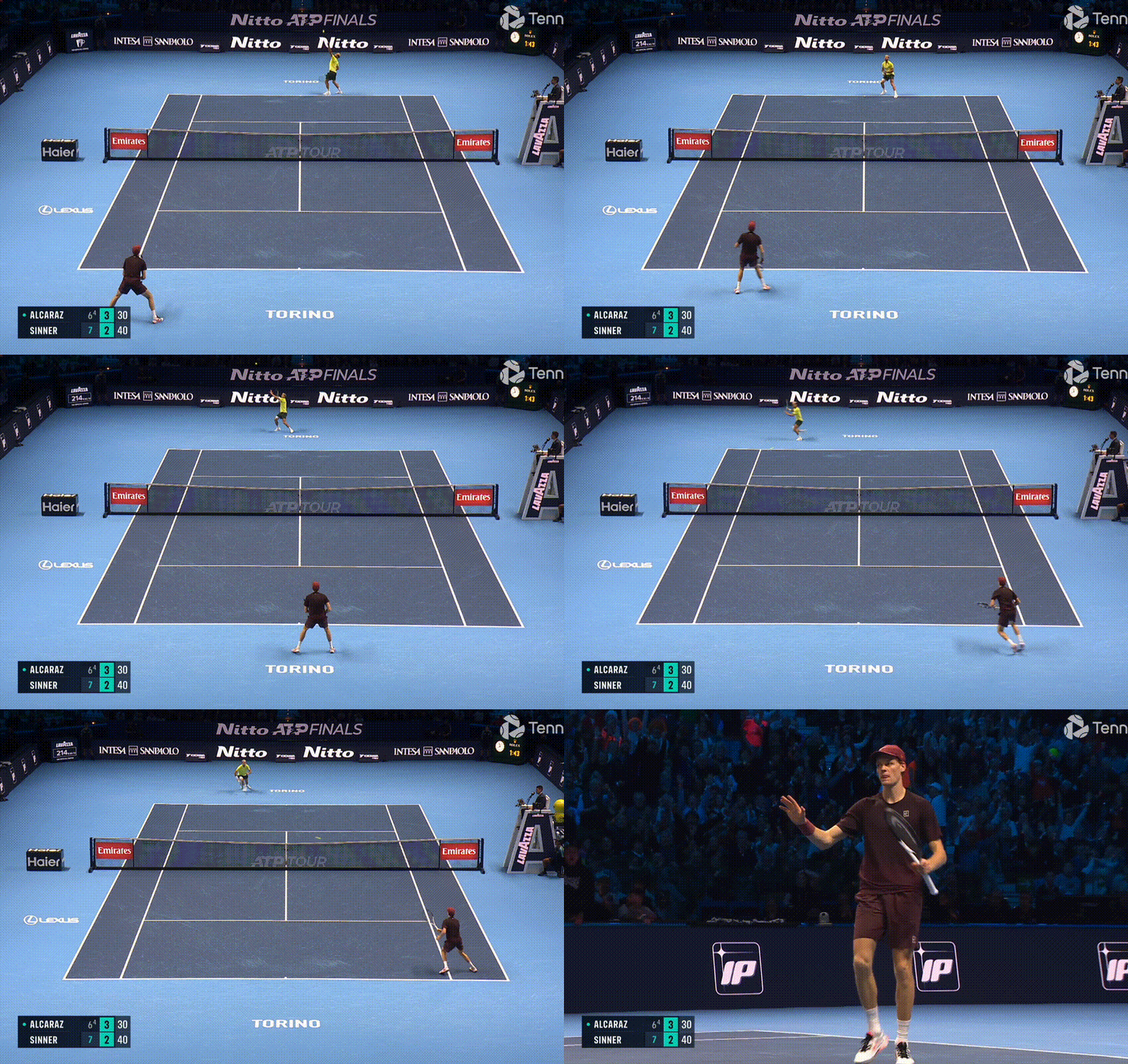
Yet what has perhaps most defined this rivalry so far is Alcaraz’s ability to be unpredictable with intangibles: slice, drop shots, fake drop shots, angles, bazooka forehands. In the biggest moments you just don’t know what he will do. After his US Open defeat, Sinner swore he would add similar strings to his bow, and he displayed some of that here early on, breaking the sideline with a wickedly angled forehand, before playing the sneak volley a little heavy-handed:
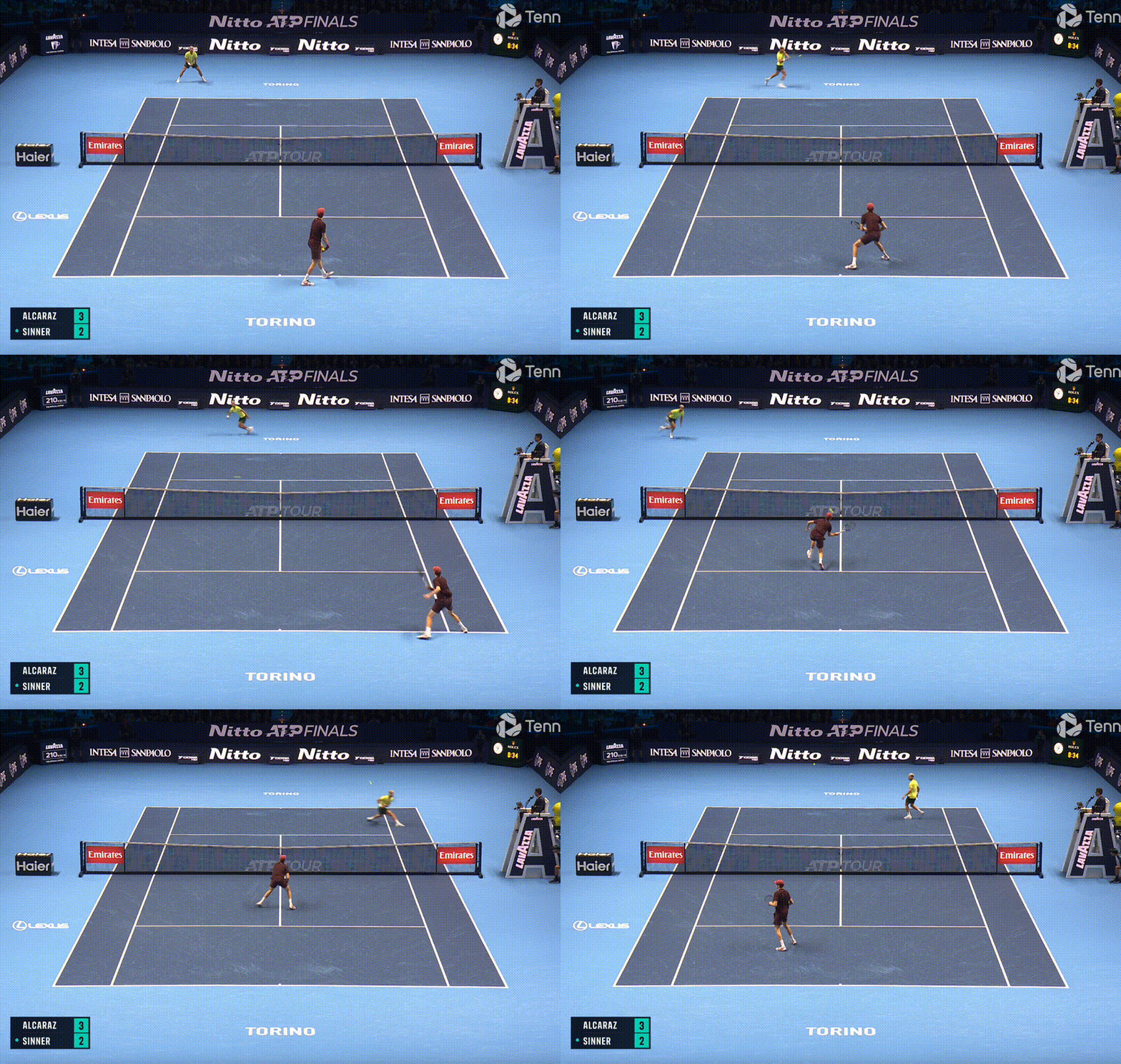
The volley in modern singles tennis has slowly become more about feel and deft touch rather than confident deep punches. Volleying deep is begging your opponent — especially the elite defenders — to hit a topspin pass. The short volley neuters this: the deep position is exposed, and players must hit up from low contact points — often with a continental grip.
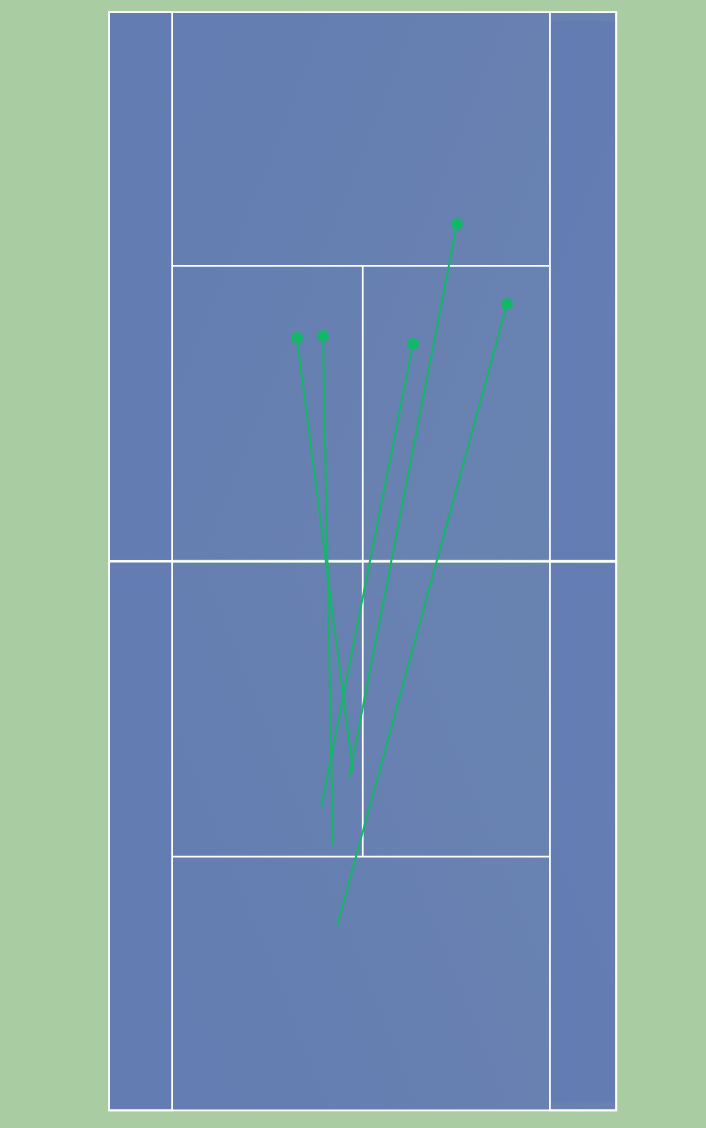
A look at Sinner’s placement epitomises the modern volley chart. Against the best steal-score player in the game, he made it that much harder:
Technically, I still think Alcaraz is a superior volleyer to Sinner (there are entire fan videos dedicated to his forecourt acumen). If we compare Sinner’s above inside-out forehand drop volley technique — one of the hardest to hit when receiving a ball from the deuce side — we can notice how Alcaraz prepares his feet and body to get side-on in a much more natural position to cut the inner meridians of the ball:
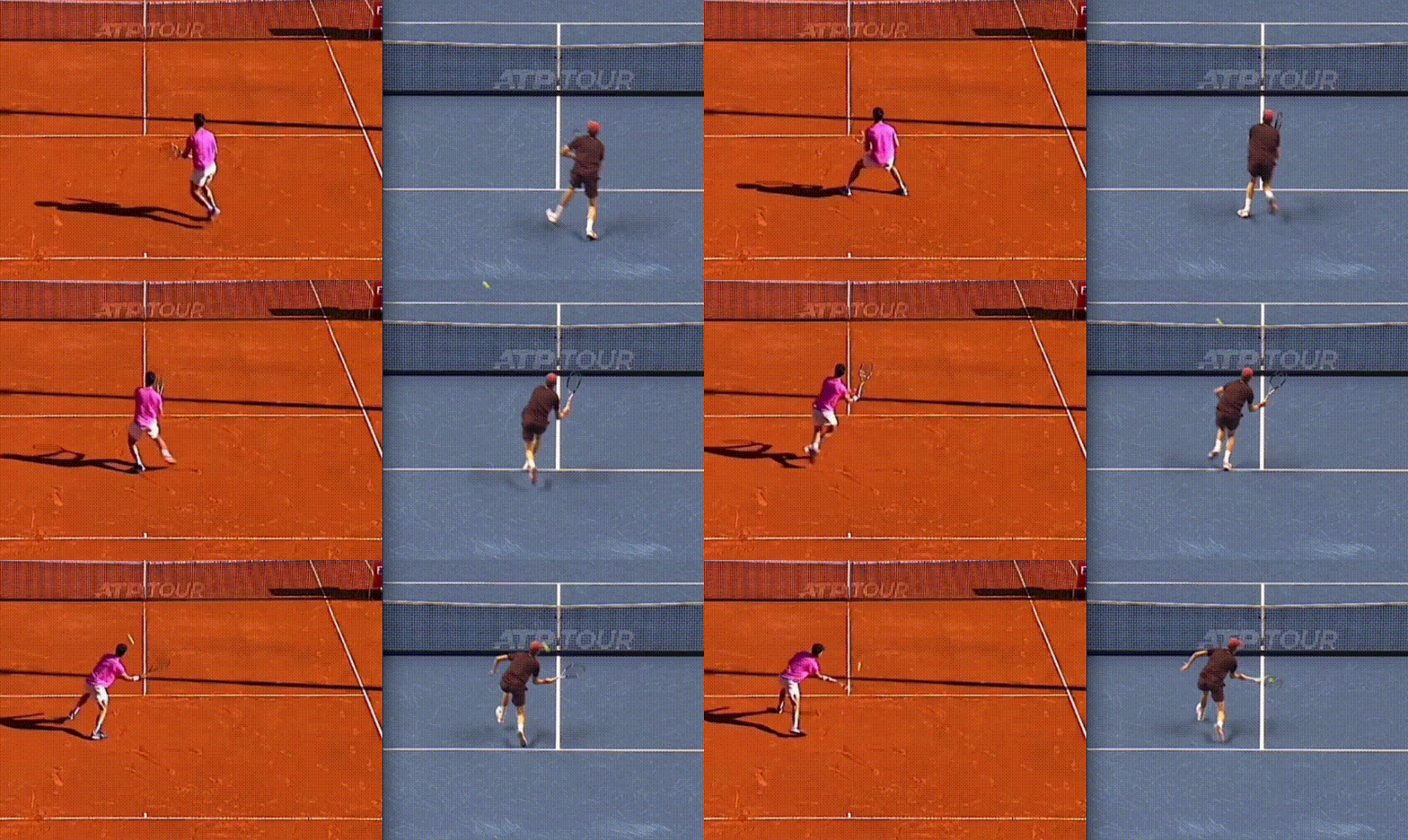
Again, look how Alcaraz’s right foot steps out and the non-dominant arm stays straight and low — a death move for a topspin forehand — precisely because it makes upper body rotation difficult:
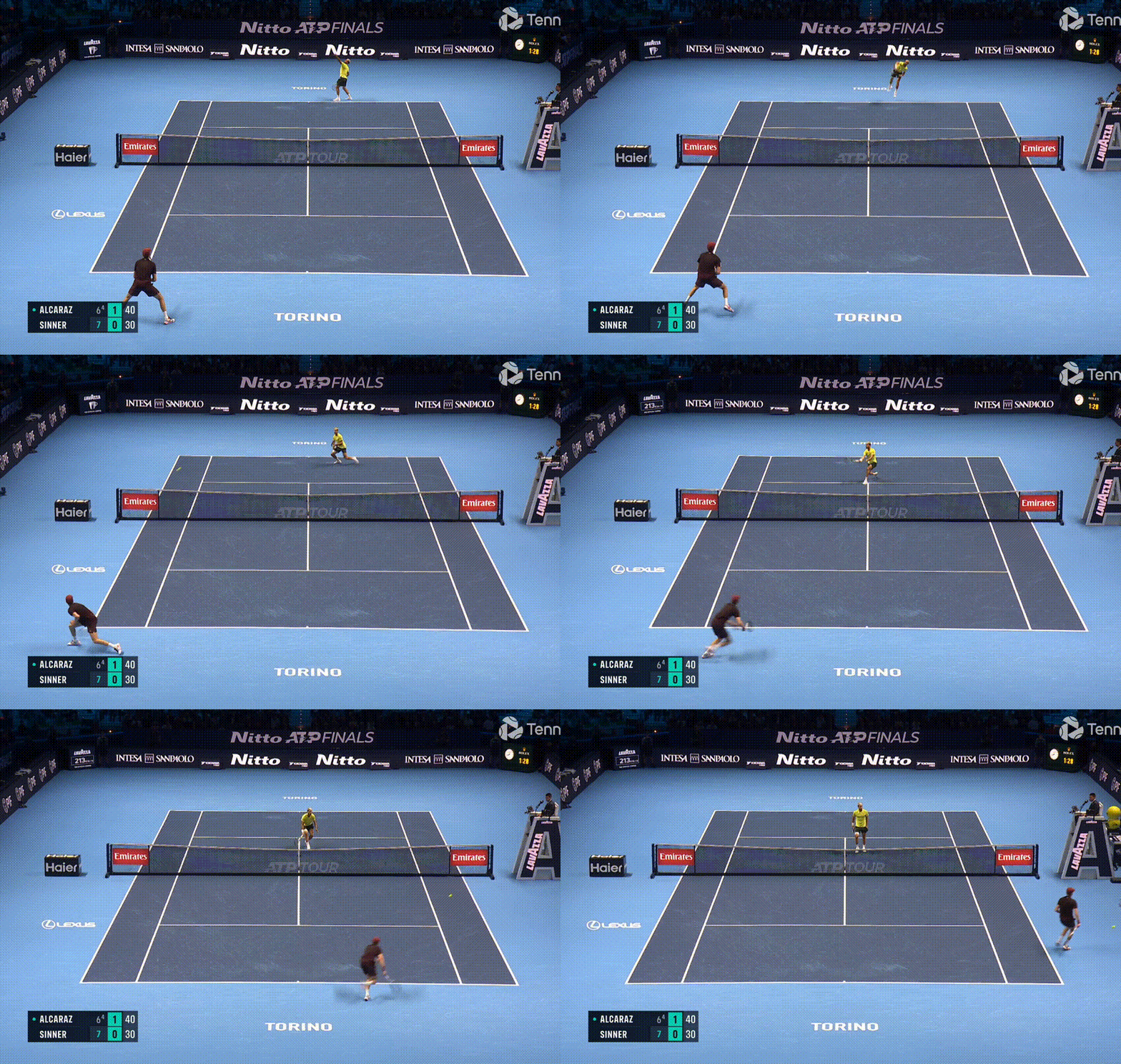
The other intangible shot that has influenced this matchup is the Alcaraz backhand slice. Defensively, he is unmatched in his abilities, but lately he has taken a page out of the Dimitrov Wimbledon playbook, and used it to create some semblance of “neutral” in a rivalry defined by its fifth-gear tempo.
In the 5-6 game where Alcaraz generated a set point, he used it to buy height and time again:

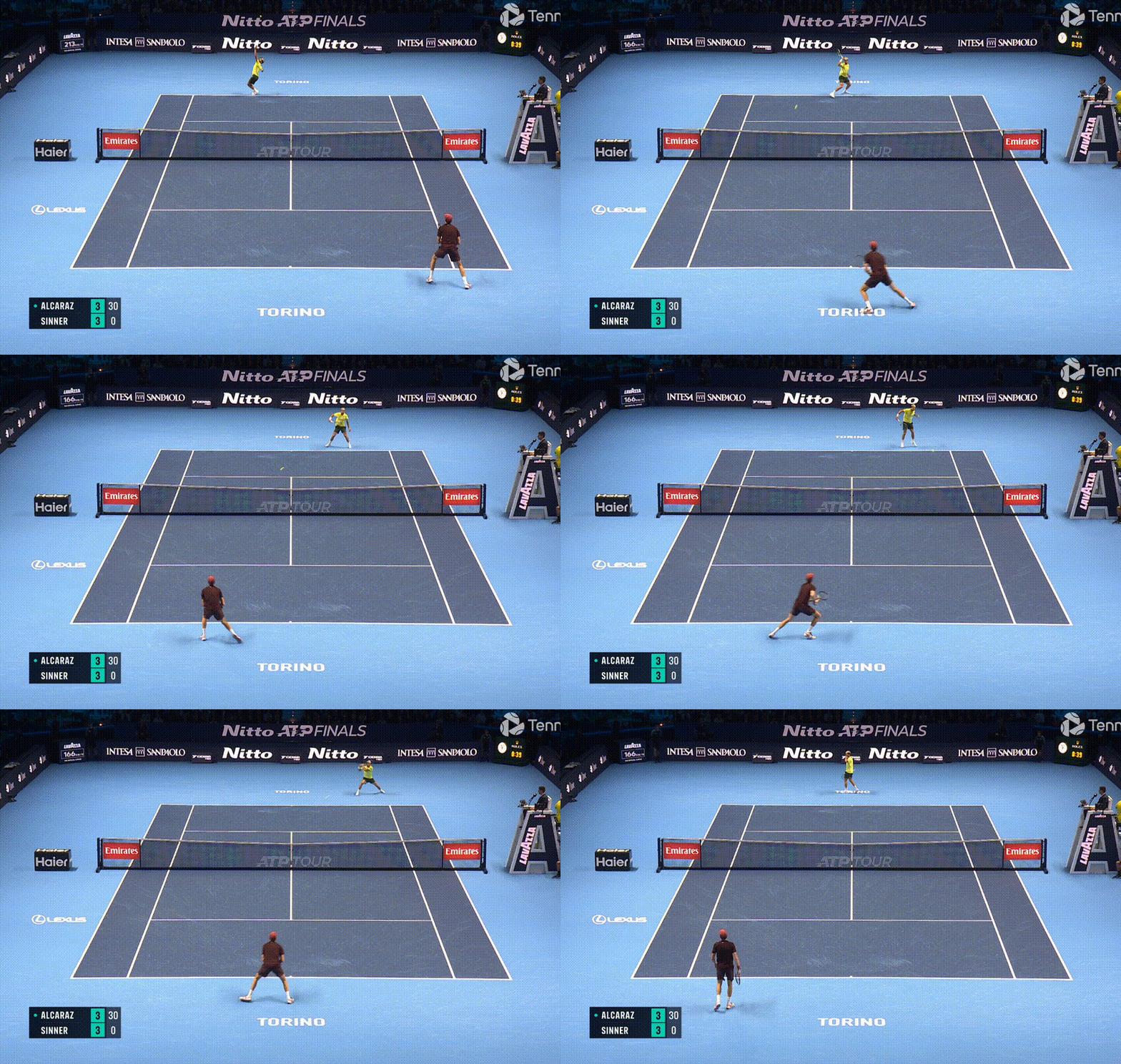
It’s a balancing act getting the ratio of slice correct against the power of Sinner; too much and he will adjust his rhythm and punish you, but too little means he’s also getting rhythm off your topspin ball. Tonight, I thought Alcaraz left some slice opportunities on the table. He nearly always gets the tempo and height he wants when he plays it.
Late in the first set is also when a couple of pivotal things happened. First, Alcaraz tweaked his right hamstring lunging for a wide Sinner serve at 3-4 40-15. Through his first four holds, Sinner’s serve was tracking his post-US Open trend of being more T-biased than his 2024 data. He was also hitting 68% in — again in line with his post-US Open trend, and up 6% from his 2024 average:
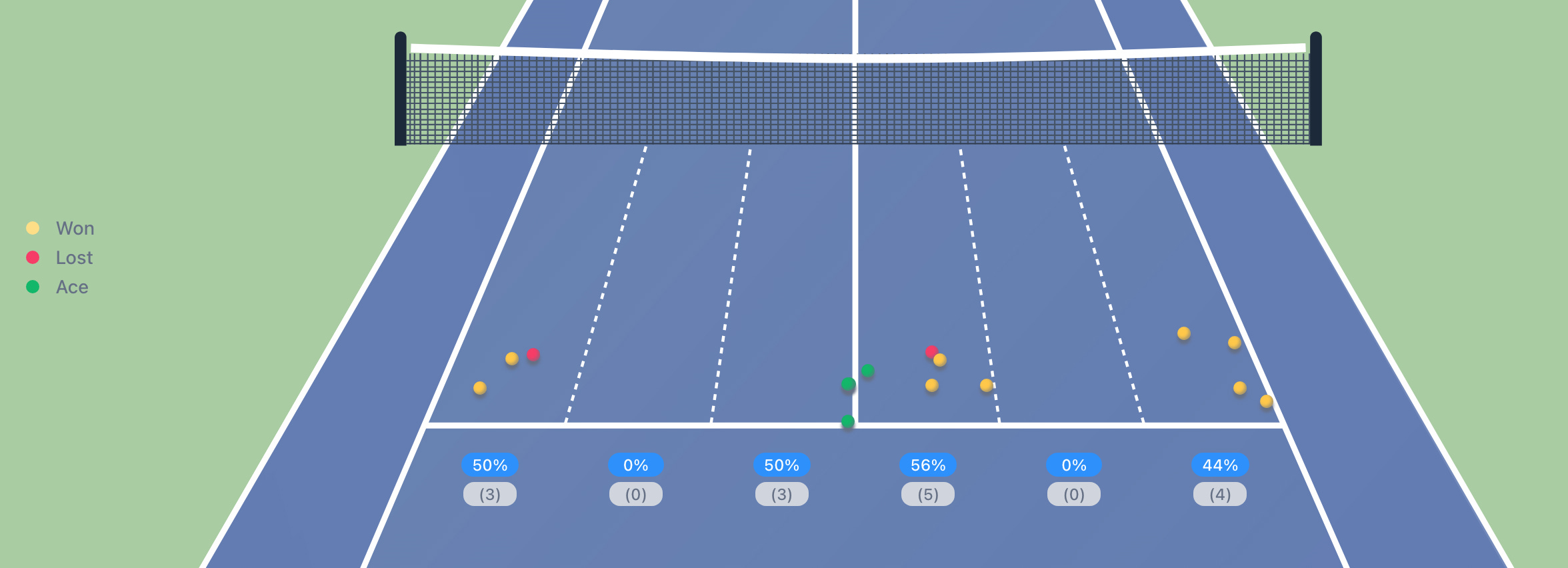
But at 5-4 Alcaraz took a medical timeout for the right hamstring issue, and for the rest of the set, Sinner’s serve strategy became more about spreading the court to wide locations, testing the Alcaraz legs.
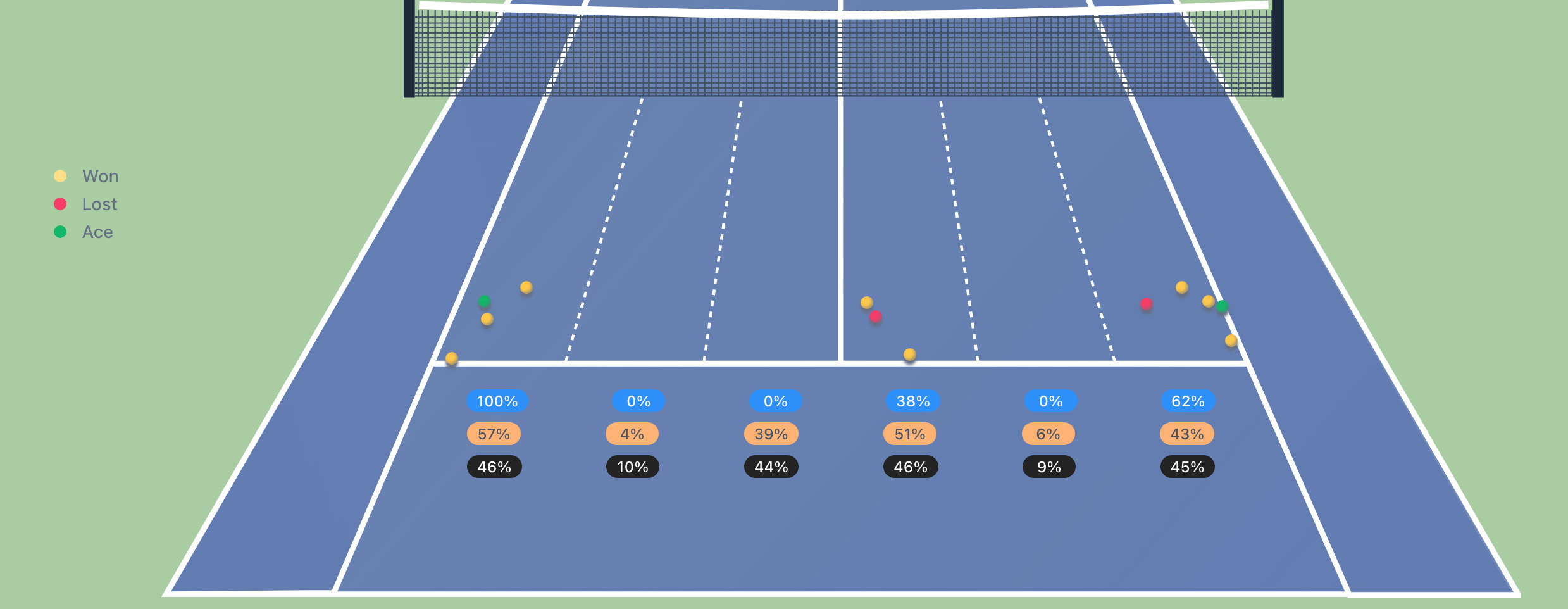
I wonder if this was the genesis of Sinner’s serve % drop off. From 4-4 to the end of the first set Sinner averaged 55% in. The Italian’s average dipped down to 47% in the second set, where again he had a slight bias to go wide on both sides 10-15% more than his recent averages.
So I did some more digging on Sinner’s serving numbers, thanks to TennisViz and TDI, who’s database also tracks the direction of missed serves, and looked at what Sinner’s make-% was when hitting to each of the four corners.
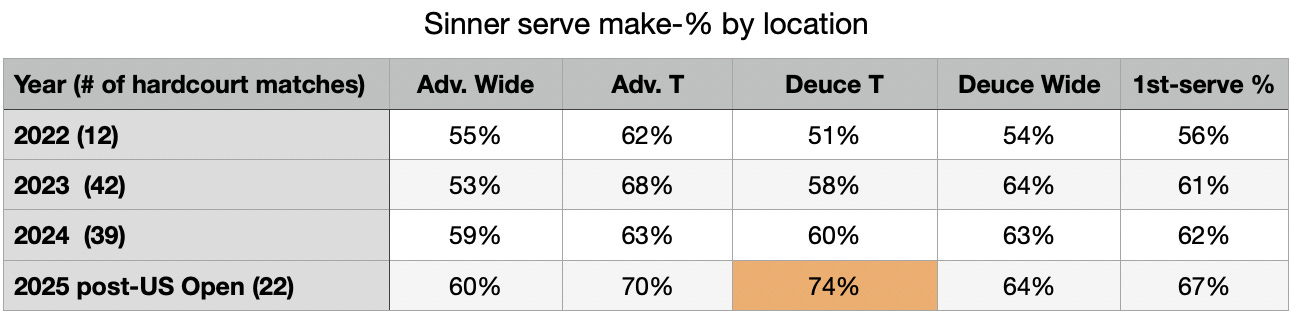
By far the most dramatic increase in make-% Sinner has made in his career thus far is post-US Open deuce T (shoutout to Advantage T also up 7%). In fact, the serving gains from the ball toss/rhythm/technical adjustments that Sinner has made recently seem to be confined to T serves only when it comes to make-percentages.
That’s interesting in the context of this rivalry for a couple of reasons.
-
In their last five hardcourt ATP matches, the deuce wide serve has been the most successful of the four corners for both men in terms of points won-% (Alcaraz wins ~ 73% of points, Sinner ~ 76%).
-
Sinner’s win-% against Alcaraz in those five matches is much lower for his T serves on both sides compared to his wide serves (~12% lower on deuce, and 6% lower on Ad). Could be something about Alcaraz being able to steal points at a much greater clip when starting in the middle of the court compared to wide spots (Sinner’s conversion score drops ~15% when playing Alcaraz), could be small sample size.
-
Carlos Alcaraz’s best first-serve in terms of make-% is — by quite a margin — his deuce wide. Last year he made 75% of his deuce wide serves. Since Roland Garros this year he’s at 70%. His deuce T has been a lowly 55%. He’s like inverse deuce Sinner.
Much of the narrative in this rivalry has been Sinner’s lower first-serve % when he plays Alcaraz compared to the field. This happened again on Sunday despite Sinner posting incredibly impressive serving numbers all week in Turin (and post USO, really). It’s possible Sinner goes for more against Alcaraz (his first serve average speed was up 4 mph) in a bid to get cheap points, or goes wide more often and isn’t as clinical at making that particular serve. Whatever the reason, figuring out a good serve percentage against the Alcaraz return continues to be an ongoing challenge for the Italian. Yet, Sinner has made workarounds in recent times (Wimbledon): he’s gone much bigger on second serves when it mattered. He did that again here on Sunday, landing a 187km/h second serve when Alcaraz earned his lone set point at 6-5 in the first set. Perhaps that’s always going to be a key: unpredictable courage against the machine.
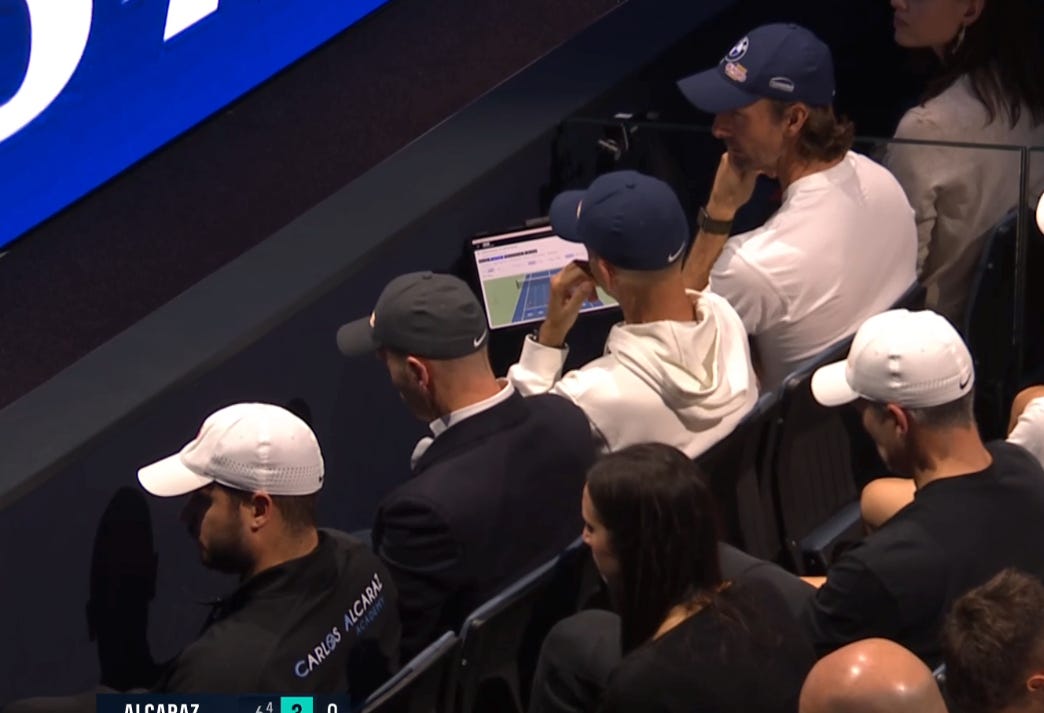
There’s probably a whole piece that could be dedicated to serving trends in this rivalry, but I’ve digressed on the Sinner serve enough, and maybe I’m not even reading the data right at 3 am now. The Italian likes his T, but against Alcaraz, it would probably be better if he loved wide.
On this occasion, the low serve percentage didn’t matter as much, because the rest of Sinner’s game was humming. After earning the break back with a mixture of luck and newfound variation…
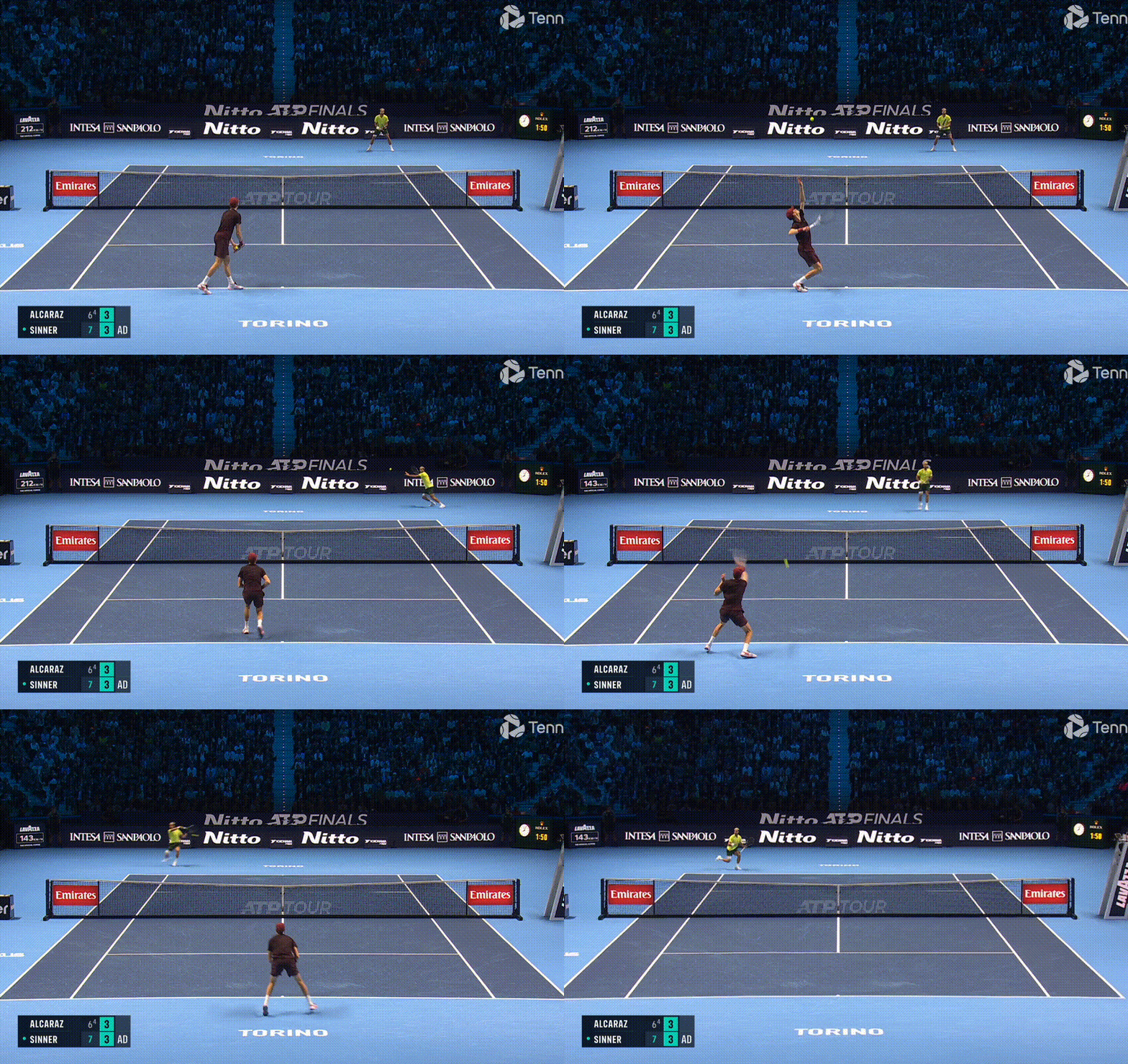
…Sinner survived the hold at 3-3, with a 24-ball rally at deuce being one of the best points of the match (again, note how the Alcaraz slice completely stalls the tempo):
The crowd was mental on Sunday, one of the best atmospheres of the year, but after that point they were willing Sinner home with Davis Cup-level decibels. Not to be perturbed, Alcaraz corrected the score sheet (and the previous missed forehand) on the very next point:
I thought Alcaraz’s forehand — especially from the middle — was the best shot for most of the second set, but his transition game let him down, missing and misplacing his volleys in an uncharacteristic manner. Usually he is flawless in his forecourt decision making, but he hit some head-scratching volleys on Sunday:
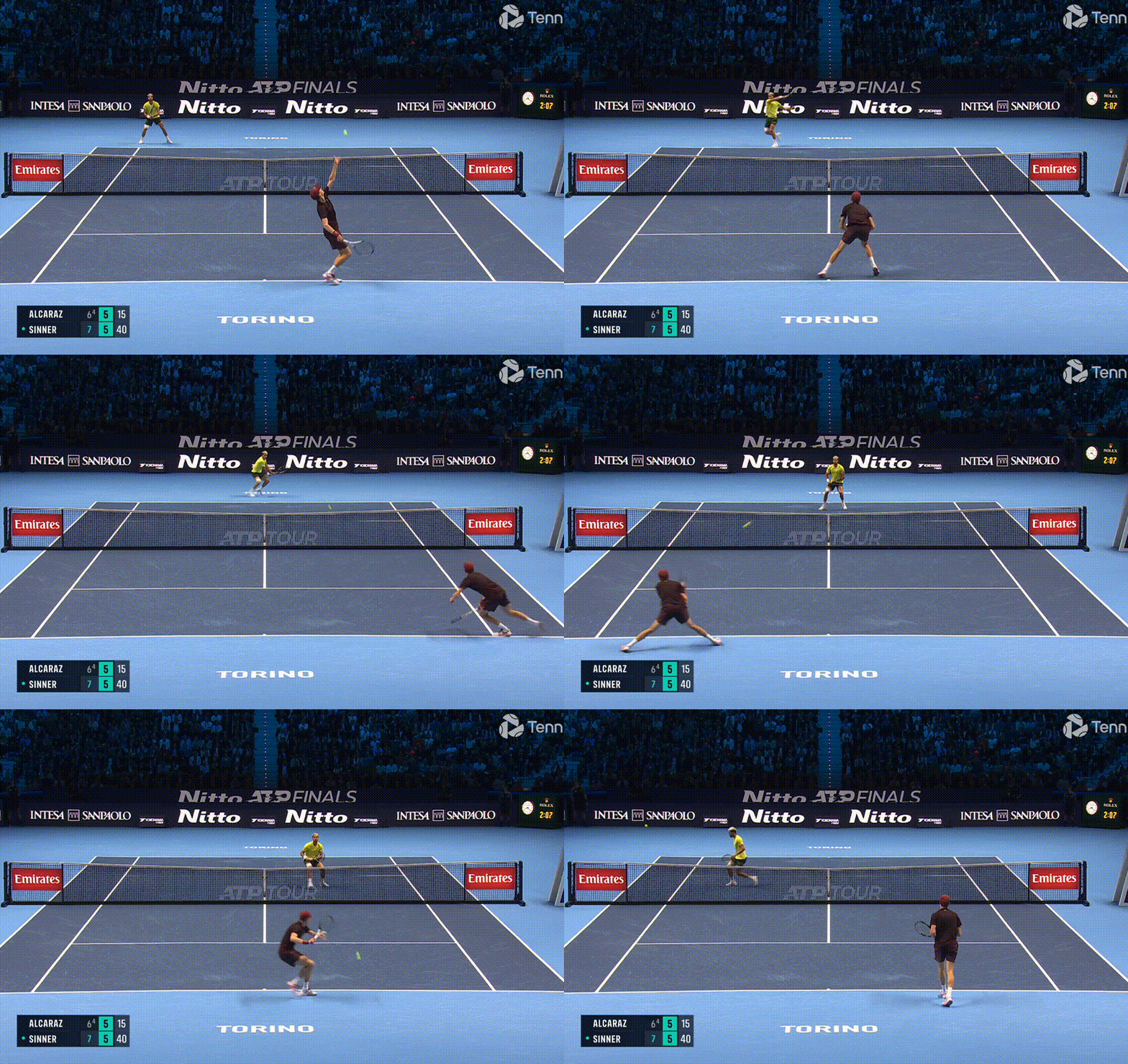
But kudos to Sinner here as well, who seemed to get his passing shots lower than ever — that’s been a key distinction between the pair in the past:

On this occasion, Sinner was anticipating to cover something much shorter, given how low he had hit his backhand. If Alcaraz was to go deep, it had to be back behind Sinner’s momentum:
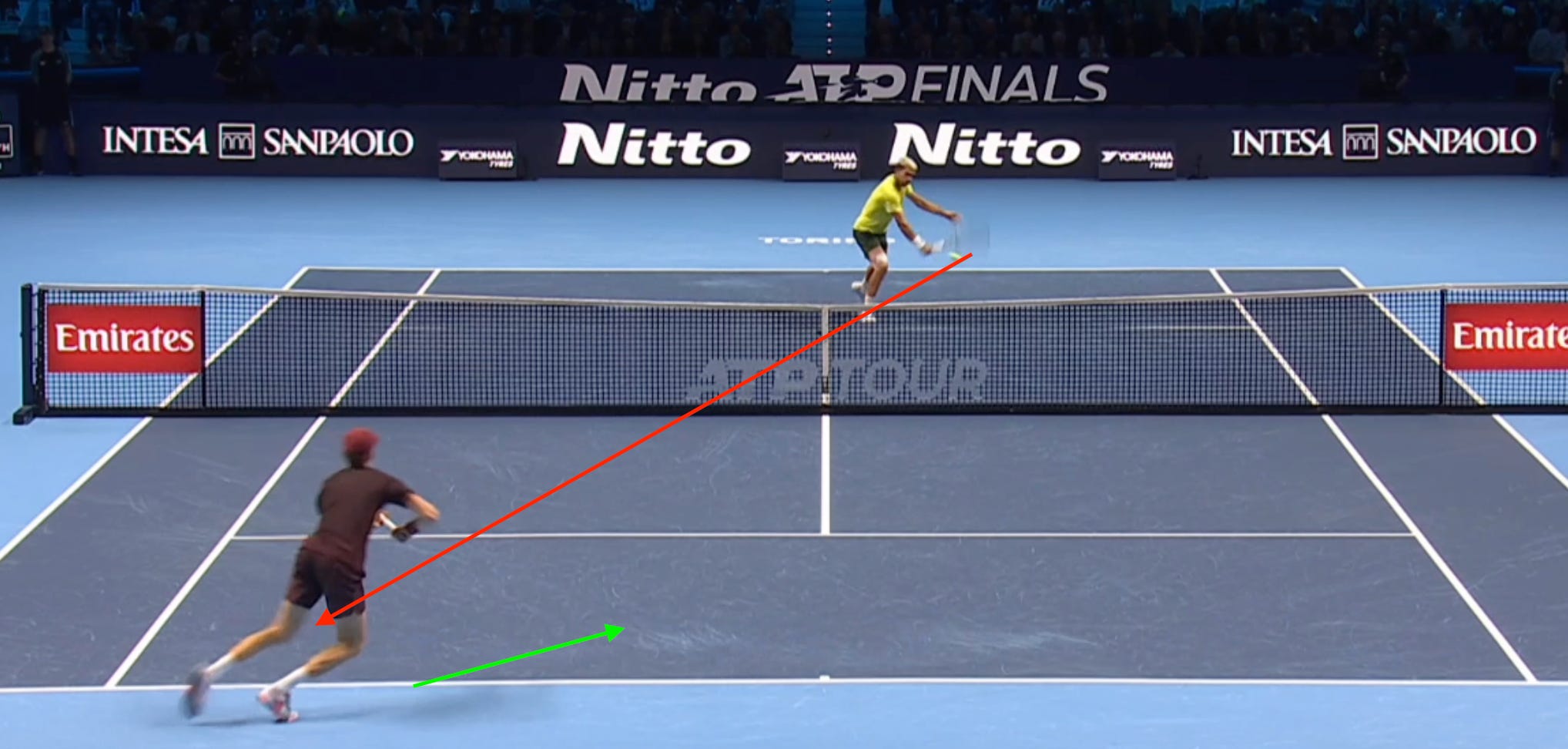
Alcaraz displayed that kind of elite perception in Tokyo against Fritz:
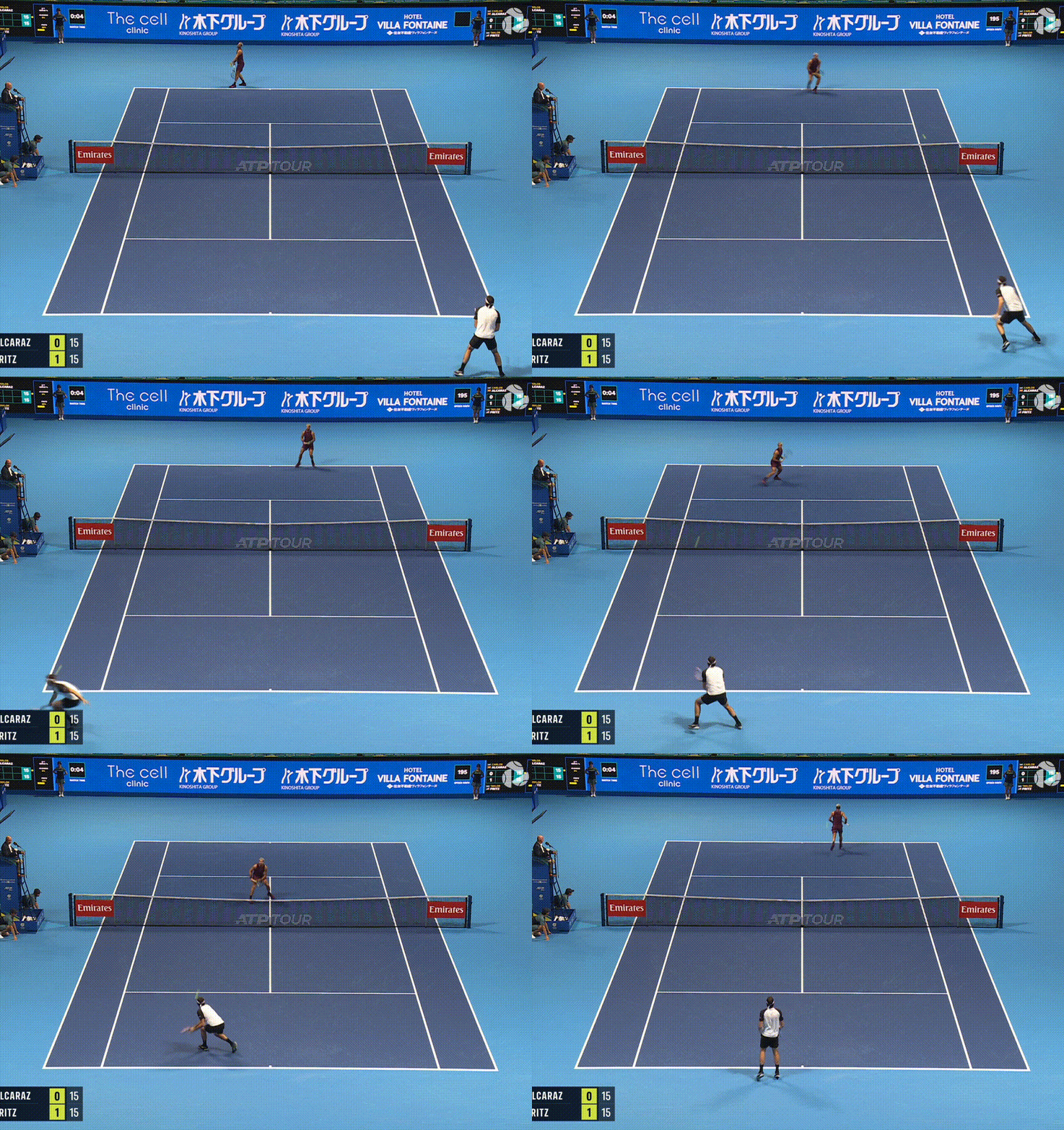
“He’s [Alcaraz] indicating to his team almost as if he’s done….I think it’s in regards to the final pass from Sinner. He’s almost indicating that he couldn’t lunge or dive for the ball.”
— Tennis TV
Perhaps the right thigh was to blame somewhat for his poor volley performance (as they were all poor backhand volleys, where all the weight lands through the right leg after contact). Perhaps Sinner’s lower height and weight of shot was an added challenge. Whatever the case, the Spaniard’s headspace foretold the final turn in this match, as Sinner earned a match point off another missed Alcaraz backhand volley (again, a very low backhand from Sinner). Sinner weathered a couple of Alcaraz forehands on match point, before the Spaniard’s backhand — the only shot on court that registered below an 8.0 rating between the pair — misfired to seal the win.
As is so often the case when playing at home as the favourite, victory is more relief than rapture:
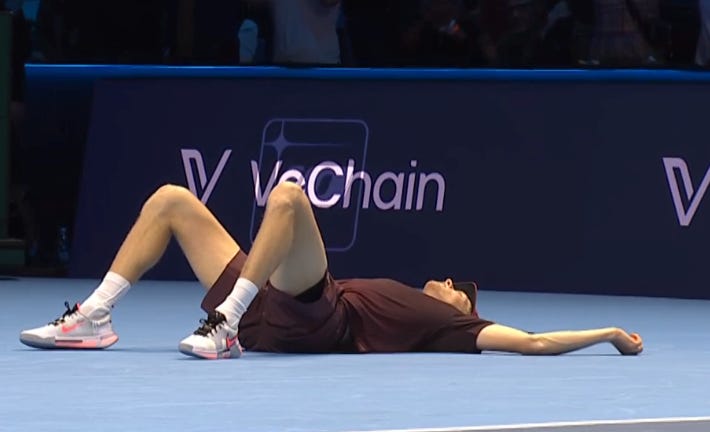
It caps off an extraordinary run of tournaments between the pair. Big finals in Rome, Roland Garros, Wimbledon, Cincinnati, US Open, and ATP Finals. There is daylight between them and the field, and I’m not sure it’s closing. Every time Sincaraz play each other, they get tested in a way that helps them learn so much about their weaknesses, and more crucially, they are able to act on that information, adapting their games so quickly. I think this is the defining traits of great players.
Sport is often compared to the brutal and competitive elements of nature and evolution, the “survival of the fittest” and all that. Turns out that is a misquote. It is actually better summarised as “the one that is most adaptable to change.”
— Wimbledon Final 2023
We’ll see what new tricks they bring in 2026. That’s all I got for now.
See you in the comments. HC