
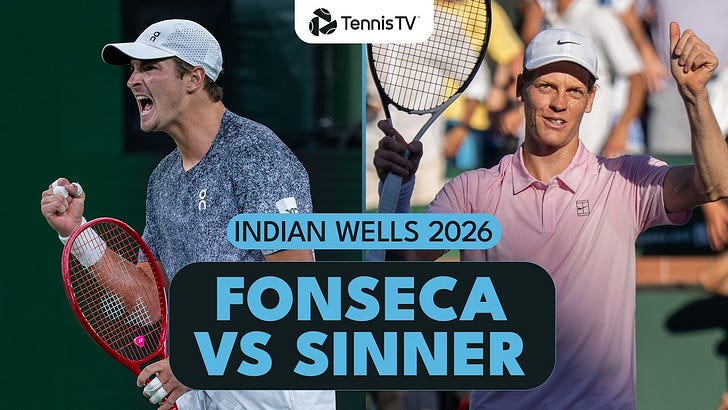
Jannik Sinner defeated Joao Fonseca 7/6 7/6 in the fourth round of the Indian Wells Masters on Tuesday evening, saving three set points in the opening tiebreak in what was one of the matches of the year.
“One of the questions I get asked so much is: do you teach consistency, or do you teach a youngster to develop racquet-head speed?
— Robbie Koenig on the comms for Tennis TV
To answer Robbie’s question, in 2026 you teach racquet head speed: best stretch wins.
Some lament the one-dimensionality of the modern power game, but Fonseca subverts the genre’s criticism by playing it with an almost camp excess, swinging and grunting at the limits of parody, yet with an execution that leaves your mouth agape, swivelling your head like those gaudy sideshow clowns with the arched eyebrows and rosy cheeks, blissfully astonished to see the ball vaporised at the rally’s crescendo:
Still, for all the wonders of his shots, many have suggested that the young Brazilian lacks the footspeed necessary to compete at the top. In that sense, this match was a kind of “proof-of-concept” of the Fonseca game. Yes, he lost the match, but here tonight was flesh-and-blood evidence that the prototype was of the requisite design and material to compete with the world’s best, if only short on the fine-tuning that comes from repeated trials.
So how did he do it?
In one sense, Fonseca dispels any criticism of poor movement with a fearlessly teenaged notion of “yeah tactics are cool and all, but have you tried hitting every ball at 100 mph?”
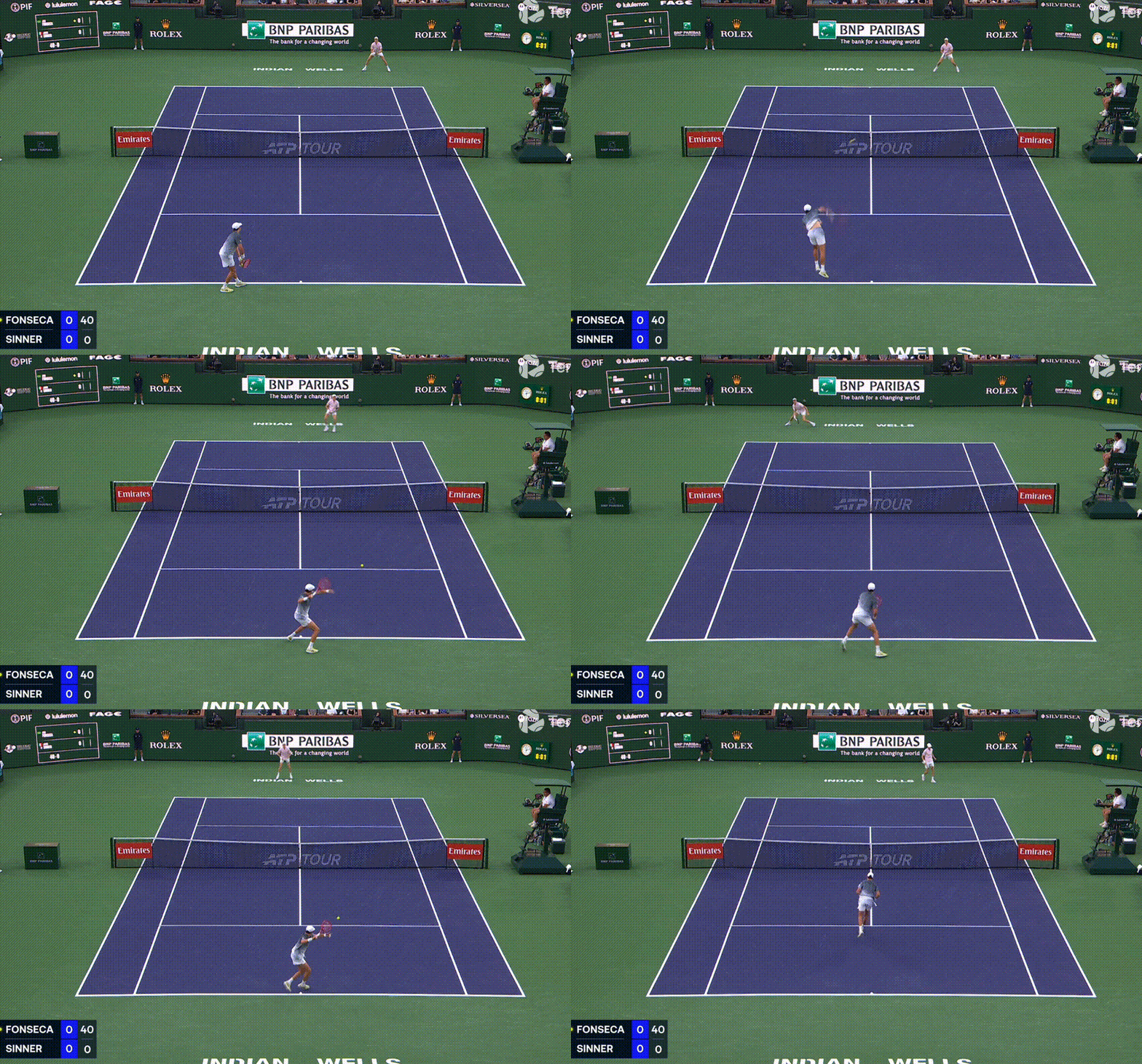
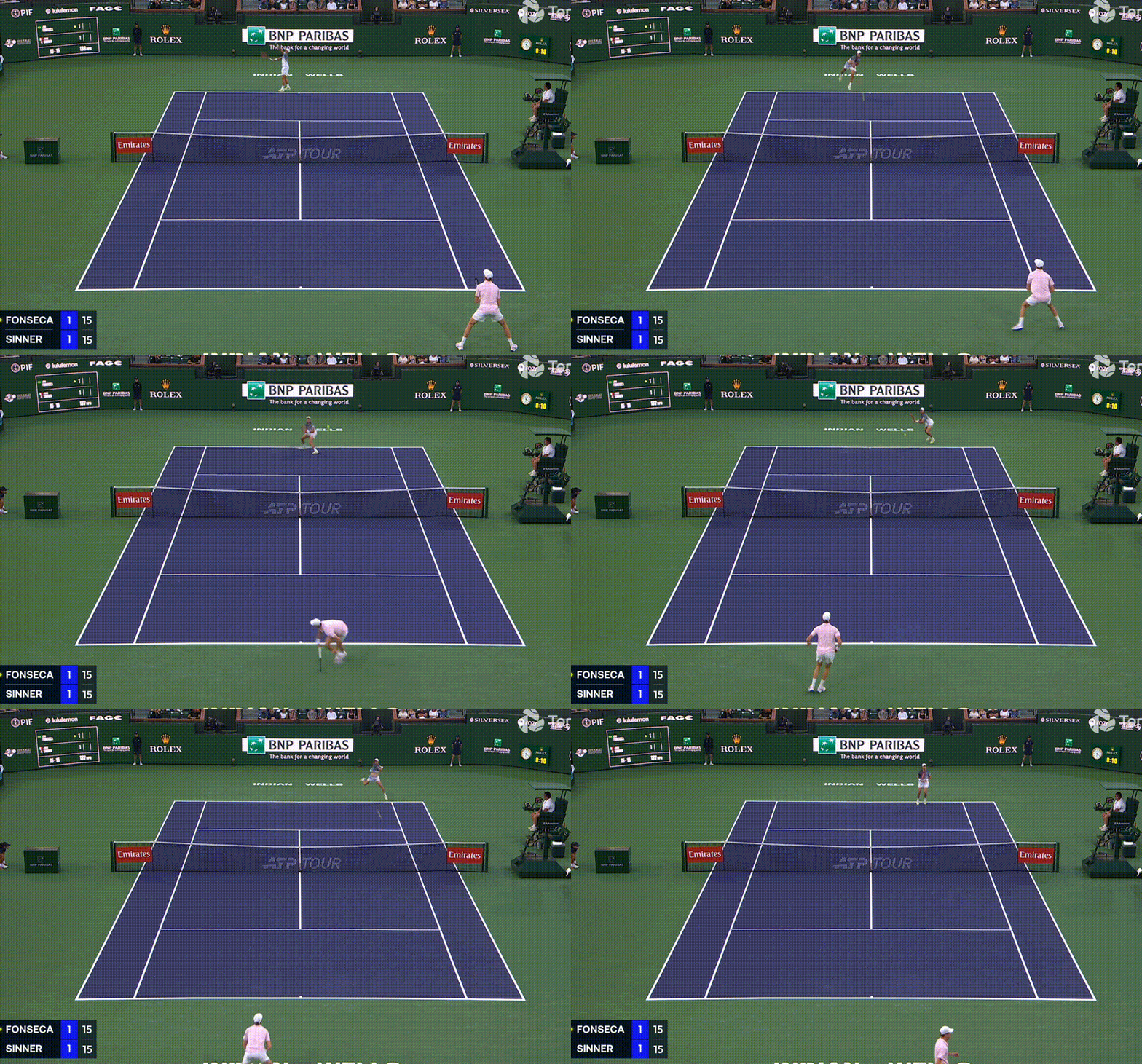
One of the tennis clichés that gets recycled too often for my liking is: “tennis is a movement sport”. There’s an edginess to it because obviously you hit the ball with a fucking racquet in a set of motions that are as complex as golf swings, but it’s often deployed to signal that the quipper possesses a deeper understanding of the game that runs counter to initial impressions.
Why don’t we just call it what it is: a moving and hitting sport. This reminds me of Roddick’s recent forehand podcast, when he was discussing another South American forehand of note:
“There are guys who are really fast, and there are guys who hit well on the run. Delpo [Juan Martin del Potro] is never gonna be accused of having good footspeed, but even when he was extended, he was able to inject something into it [forehand]. So he was great at hitting on the run, but not a great mover, which kind of should play into all that.”
Yeah, it kind of should. If tennis was a movement sport Alex de Minaur (bless him) would have 10 slams.
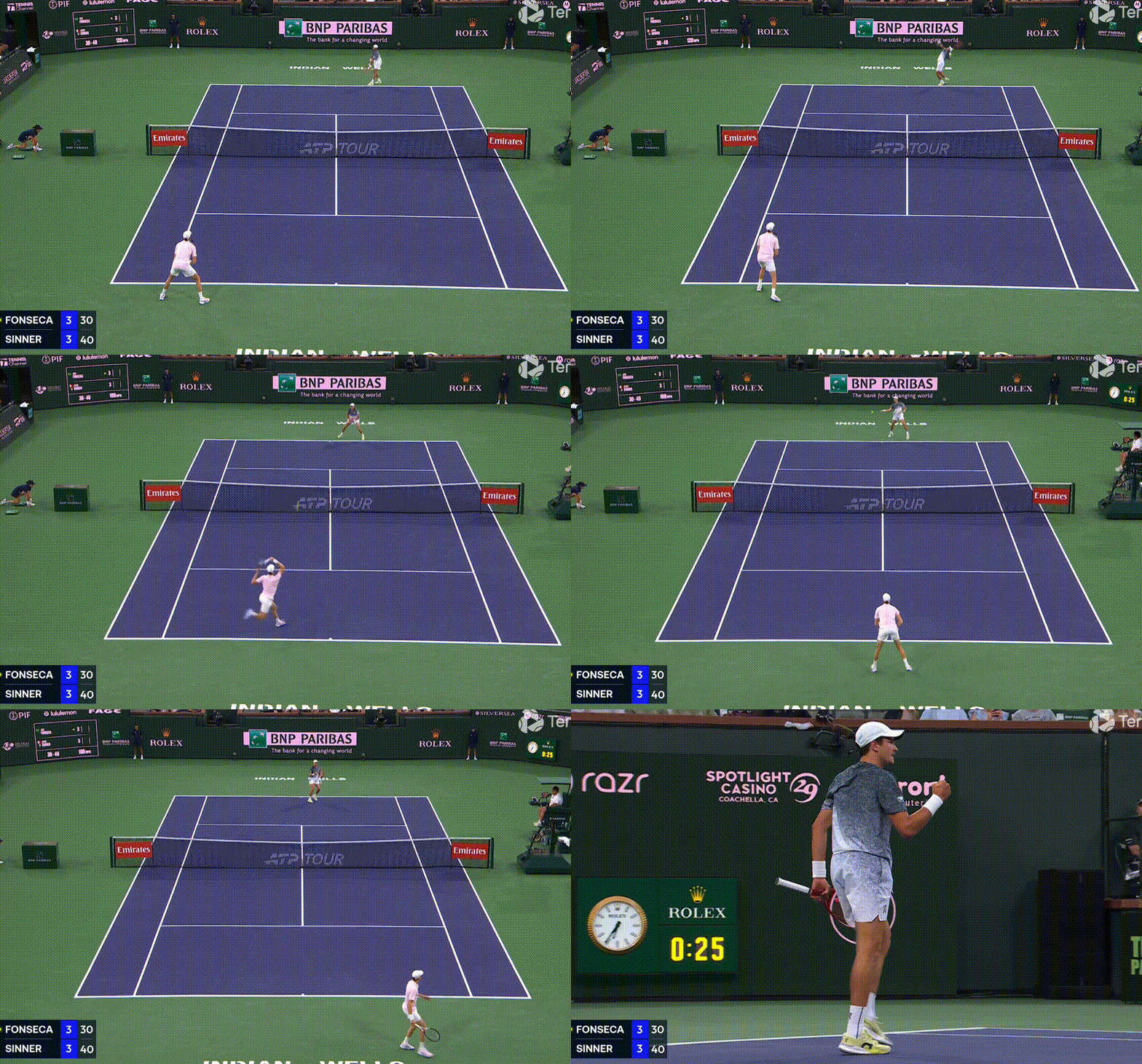
I’ll say it again: it’s a moving and hitting sport. Look at this pink flamingo combine both elements beautifully in his signature-in-the-making running forehand.
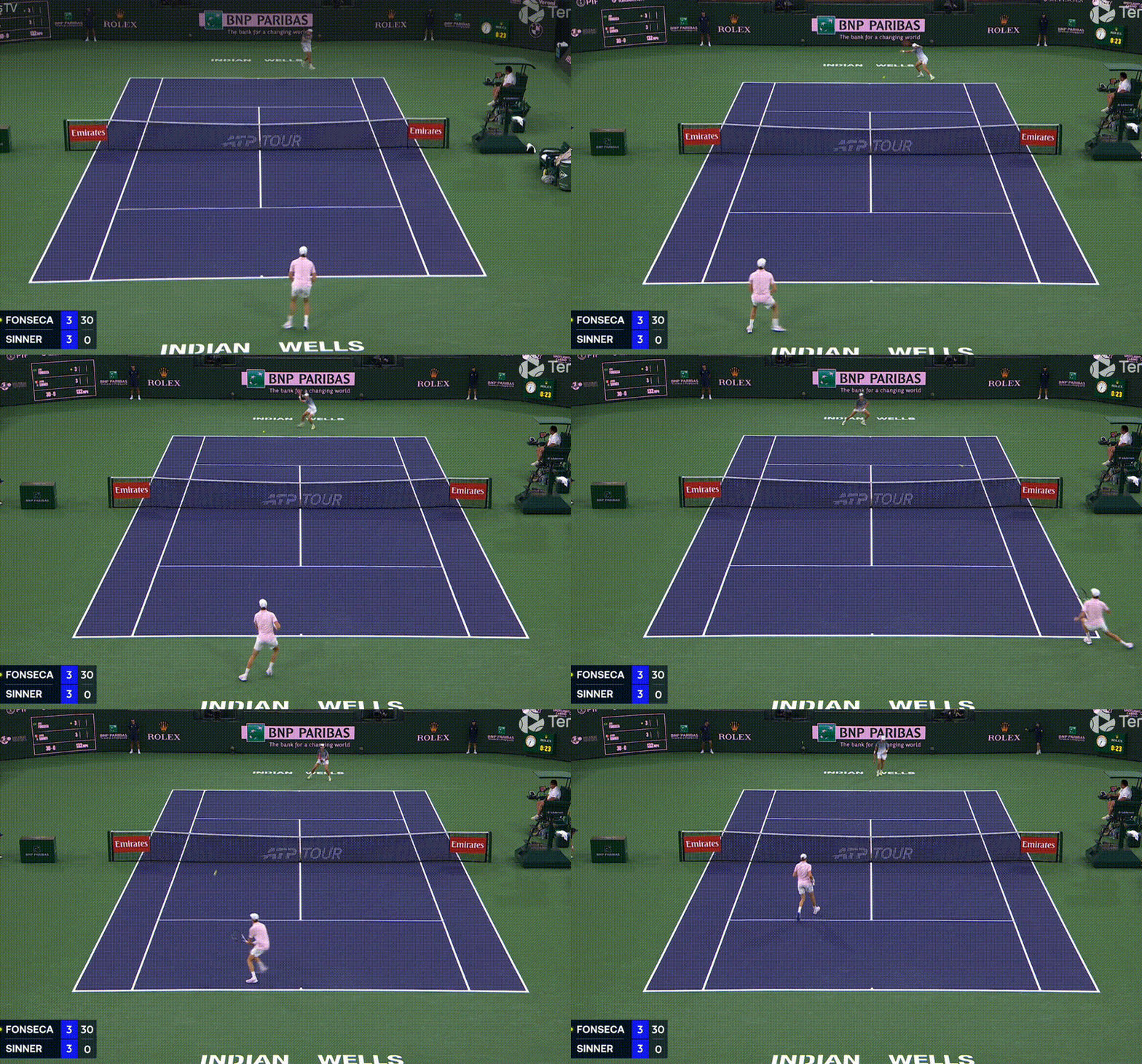
It kick-started a run of points that created Sinner’s first break opportunity on a second serve. Now is a good moment to reverse back to Robbie Koenig’s opening quote, where he provided the answer that Fonseca gave:
In the words of Joao Fonseca, “when I was younger, it was always my thing to hit it hard, mostly on the important points, when a little bit of pressure comes on. I wanted to go for it. I wanted to do what I do in practice: hit it hard.”
He’s been holding that mentality like a hot ember for 19 years; now seared in the DNA:
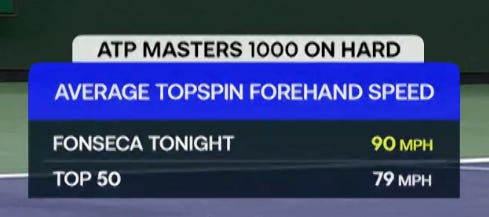
Through the first seven games Fonseca was averaging 90 mph fastballs on the forehand.
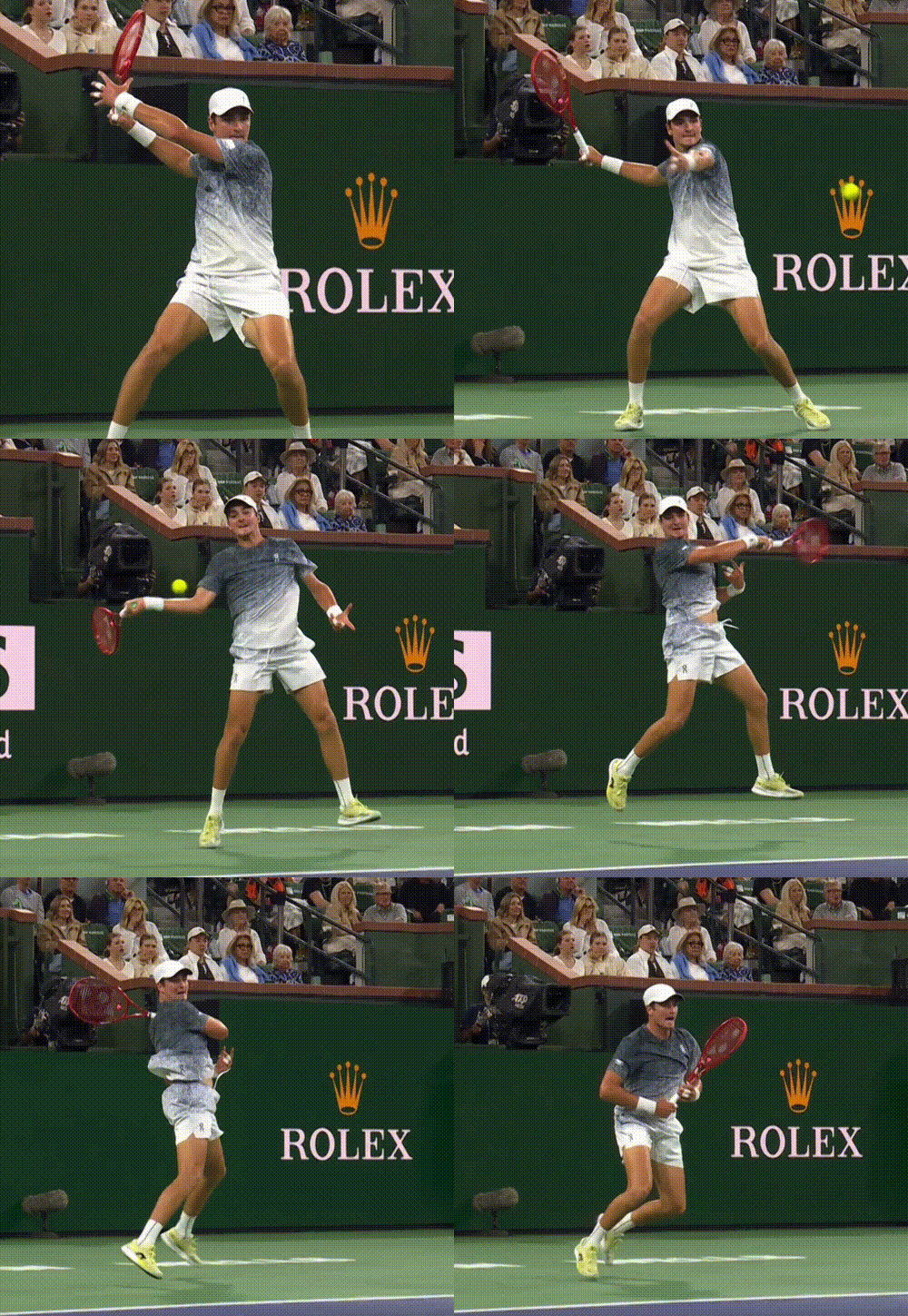
How does he create all that power?
“If the backward and downward motion of the racket is timed to coincide with the initial forward motion of the proximal segments of the body, this increases the eccentric stretch of the muscles that may be used to accelerate the arm and racket.”
— Knudson, D., & Elliott, B. (2004). Biomechanics of tennis strokes. In Biomedical Engineering Principles in Sports (pp. 153-181). Boston, MA: Springer US. (nerds can read more here)
Fonseca held for 4-3, much to the joy of the seemingly many Brazilian fans in the seats, who never fail to create an atmosphere, practiced as they are in futebol-arte.
Anyone who has tried to enter a Joao Fonseca match knows he is ground zero for a kind of global fandemic, driven largely by Brazil’s tennis-starved diaspora eager to feast its eyes on every blood-red slash of his Yonex VCORE 98. I witnessed this firsthand at last year’s Australian Open, waiting 75 minutes to squeeze into his second-round match against Italy’s Lorenzo Sonego.
Worth it.
But trouble arrived quickly once more. Fonseca faced another break point at 4-4, and he hit another big second serve, this time at 118 mph. It was a calculated risk, given the quality (8.2!) — and positioning — of Sinner’s return, which was smothering Fonseca after his serve:
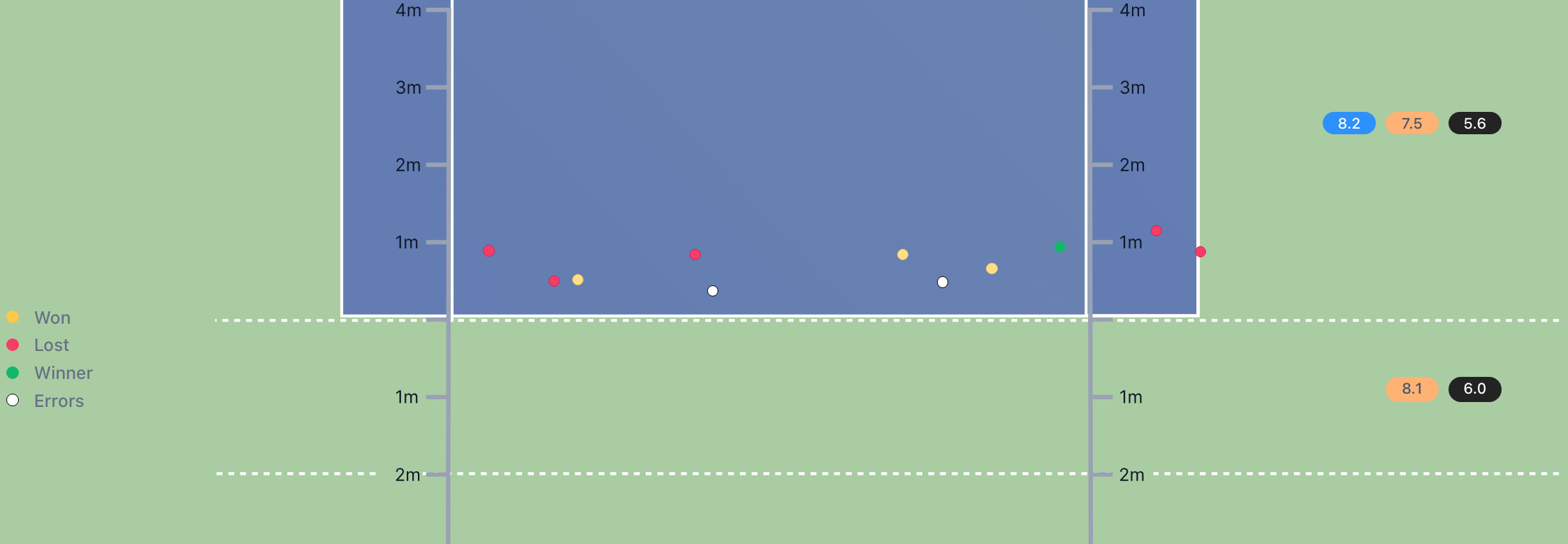
But that wasn’t even the most impressive part of Sinner’s game tonight. Last week I shared a graph from Matt Willis showing the serve accuracy vs. speed of the top 20 ATP players.
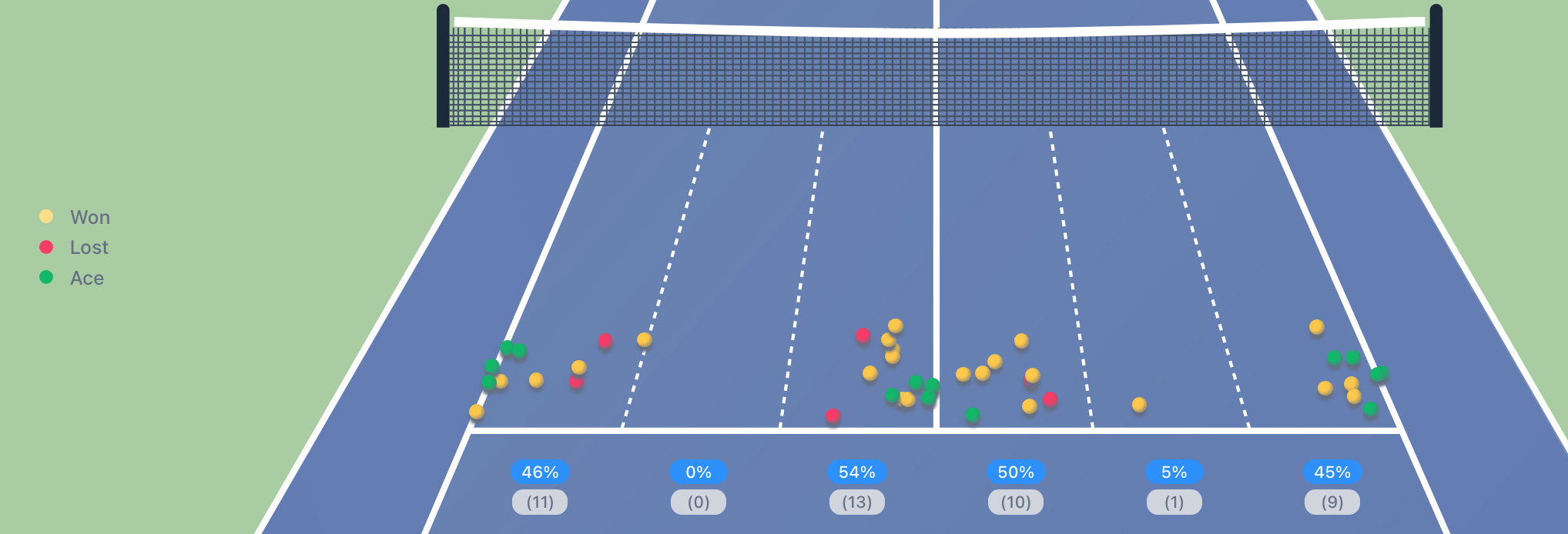
You can see Sinner averages a very tidy first-serve that lands ~54cm from the line. Djokovic is the best of the top 20 at sub-52 cm. But against Fonseca, Sinner averaged 43.5 centimetres from the lines, and still hit above his average speed, logging 124 mph. Look at these groupings. Throwing darts:
Wew.
So of course we got a buster. Fonseca got his nose in front, showing that his backhand is also pretty damn good, and that there’s a transition game that belies all that raw baseline power:
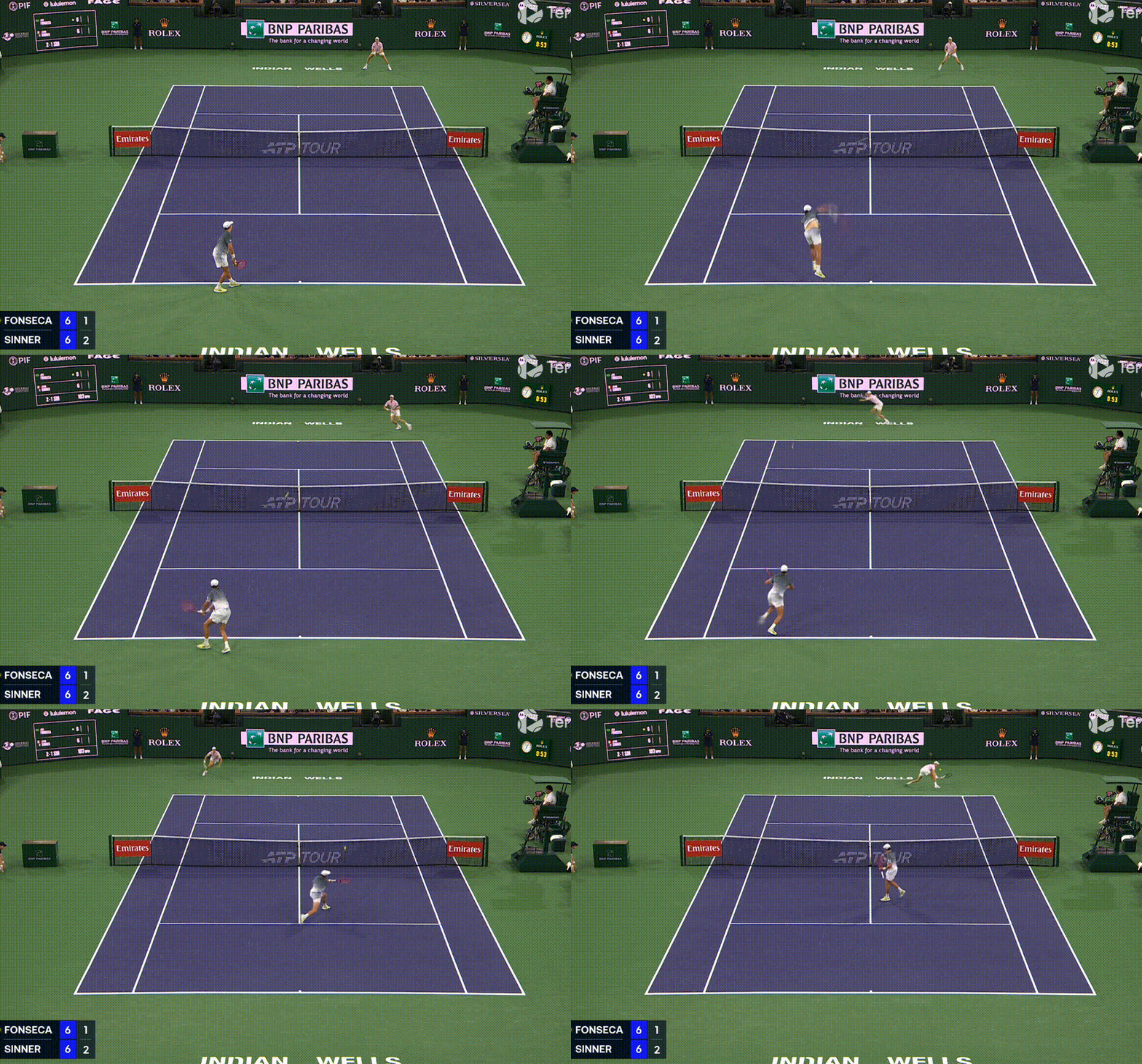
In fact his line backhand is one of the things I’ve liked most about his game from the start. He takes it line 34% of the time — a full 10% more than the tour average — as a way to funnel traffic back into his apocalyptic forehand. That’s been a key feature missing from other serve +1 hopefuls in the last ten years (Tsitsipas as poster boy).
Fonseca got out to a 5-2 lead before they played a long point where Sinner ran the young Brazilian ragged. It was of an intensity that makes the blood pulsate through the neck as the legs become languid. He even led 6-3, but Sinner snipered both his serves and at 6-5 Fonseca’s blood was still rushing enough for him to giddily overcook a forehand deep. Two points later and Sinner escaped with the first set in the bag.
If at this point you were still unclear of what the X’s and O’s were, rest easy: this match was a clear example of the direction the sport is going in. That is, not only does technique dictate tactic, but technique — through the increasing speed of rallies — will erase tactics. Zverev said something similar in one of his Indian Wells pressers when asked about tennis IQ (emphasis mine):
“I think the players that win the most are the ones that have the best shots. I think the players that win the most now — especially now, because tennis is just a powerful sport now — have the best forehand, have the best backhand, have the best serve, have the best return. I think those are the players that win the most in the last couple of years.
I think Carlos Alcaraz and Jannik Sinner are winning the most, not because they play tennis by a lot of tactics, their shots are just better than everyone else’s.
So, yeah, I think ten years ago, tactics and, you know, tennis IQ, as you said, was more important than it is now. I think it has lost a bit of value. I think just, yeah, whoever hits the ball the best wins the most matches.”
— Alexander Zverev
As I said: best stretch wins. And the better you stretch, the dumber you can play.
Ok maybe that’s too simplified, maybe it’s more like: if you’ve figured out how to create the kind of easy racquet-head speed Sinner and Alcaraz (and Fonseca) can generate all over the court, then you’ve earned the right to play on autopilot to a degree others simply can’t afford to. And if you find yourself playing someone of equal stretch ability (e.g., Sincaraz playstation points; this match) you’ll invariably find yourself playing tennis at a speed that is almost too fast for cerebral strategy:
Jimmy Connors’ grandfather once told him that “tennis was boxing at 90 feet”. Well, now it’s more like 70 feet. And the gloves are off. And both guys happen to now be dual-wielding Desert Eagles. Every swing is infused with a premeditated shoot-to-kill intent, save for the forced-defense they naturally create for each other. “Neutral balls” aren’t really in their lexicon.
— Alcaraz vs Sinner: 2024 Beijing Final Recap
But to don my coaching hat for a moment and give you the broad strokes: Sinner’s backhand is stronger and more reliable than Fonseca’s, and he tried to handcuff the Brazilian into backhand exchanges, only going line with that shot 12% of the time. It’s pretty simple, and it’s what Sinner tried to do (and did do, for a set) in the US Open Final against Alcaraz:
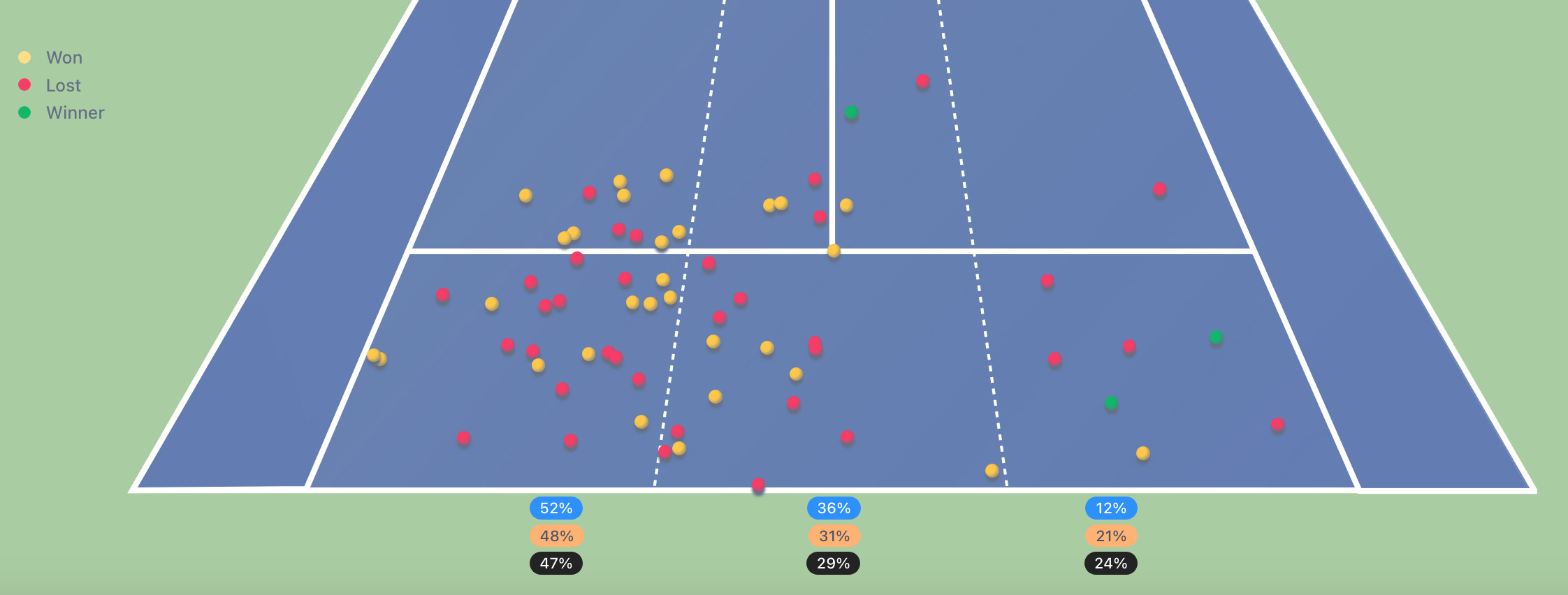
And in reply, Fonseca was going middle and line with his backhand to try and direct traffic back to his forehand.
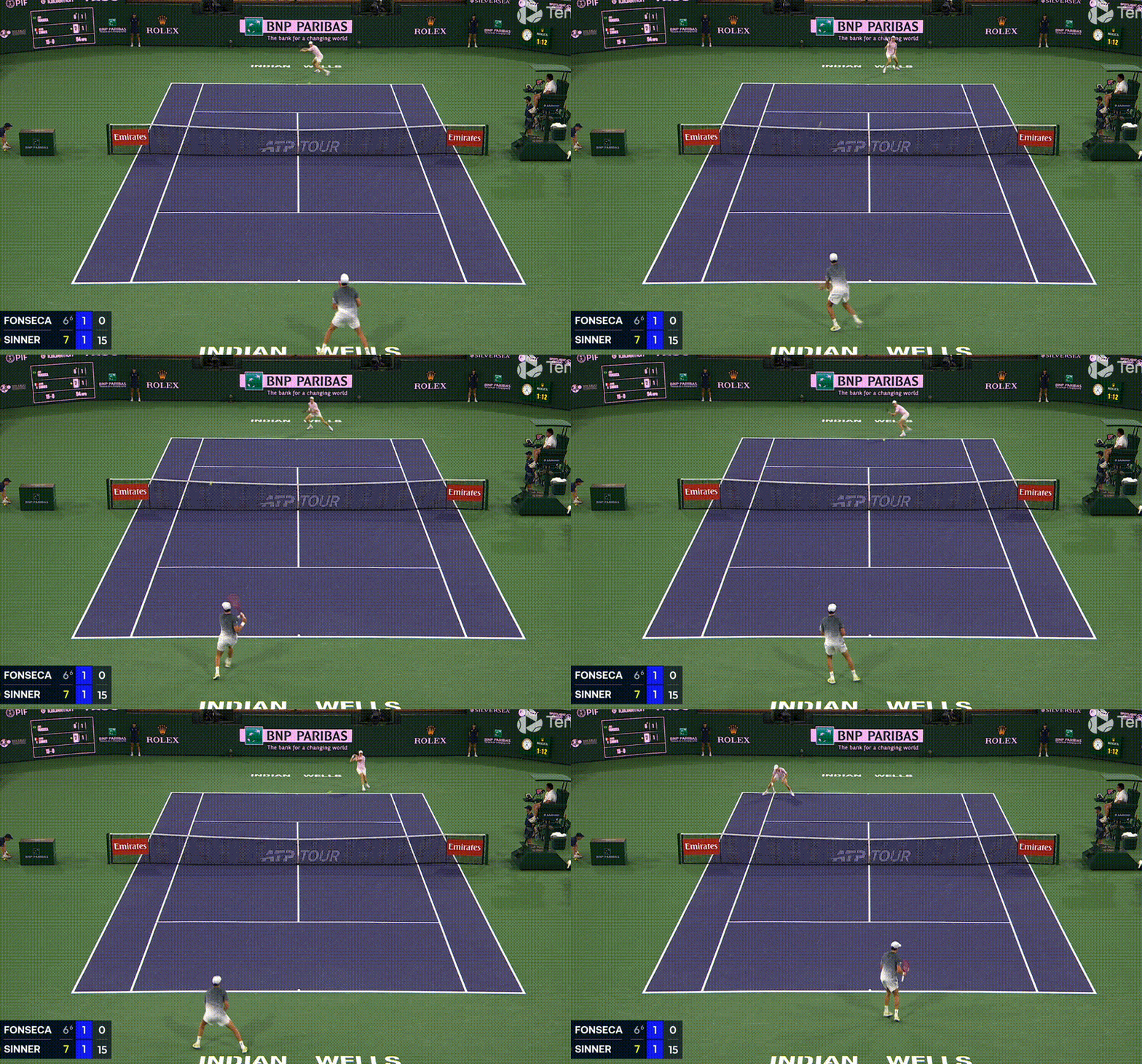
Of course, variation is still squeezed into the cracks: drop shots, angles, looped deep returns, and slice are still rewarded if executed well, but most of these rallies could have operated under a parking garage. Both used the forehand drop shot sparingly, and here Fonseca showed a willingness and awareness to play the slice short down the line:
Sinner got the first break of the match at 3-2 and eventually came to serve for the match at 5-3 when Fonseca played a blinder of a game to earn triple break point — his first break points since 1-0 in the first set! The opening point of the game had that familiar pattern: Sinner avoiding the forehand, but the moment he does change Fonseca goes big crosscourt. I think Sinner missed this forehand because he knew anything less than ball-to-the-walls power was going to get the nuclear treatment from Joao:
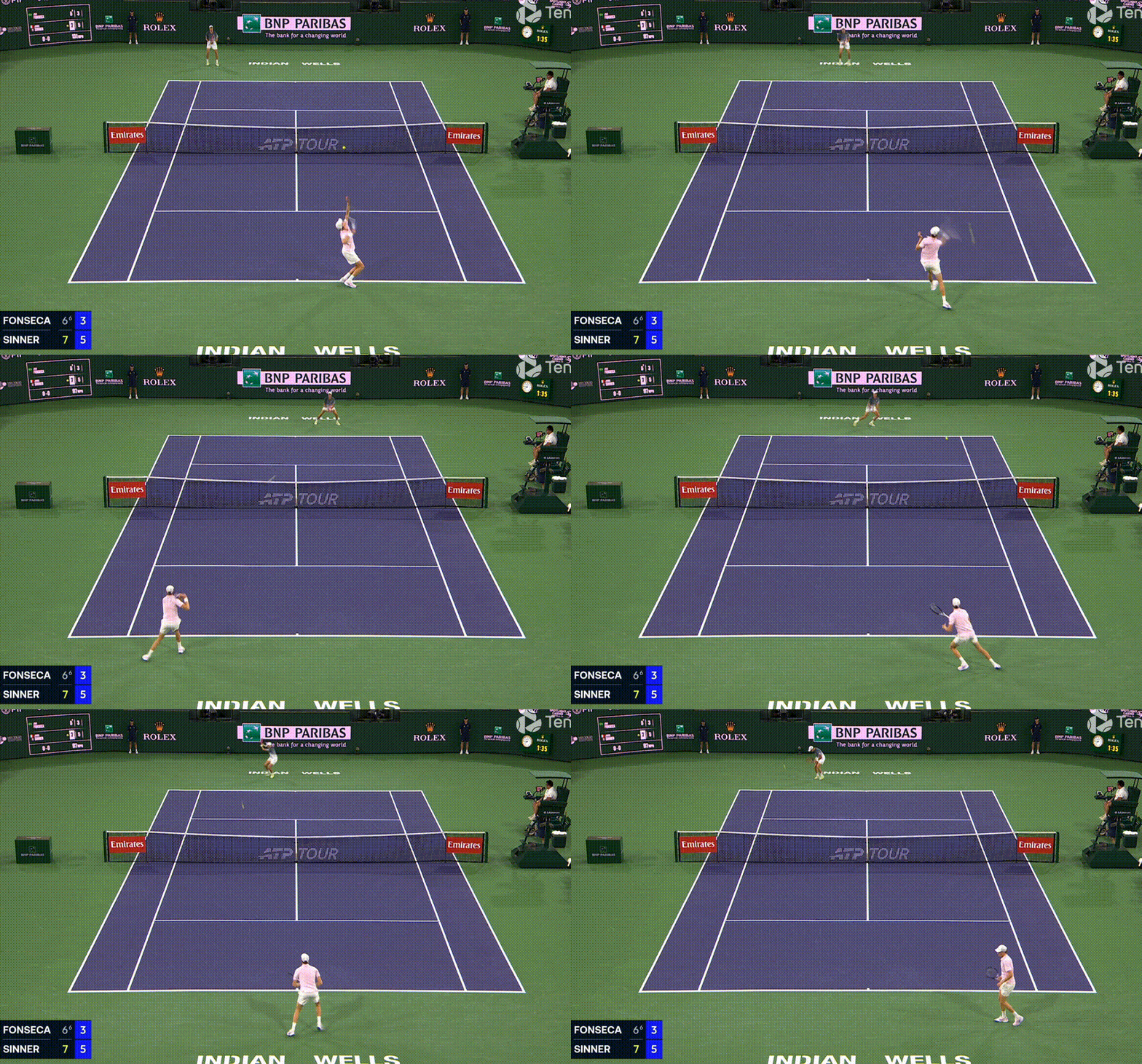
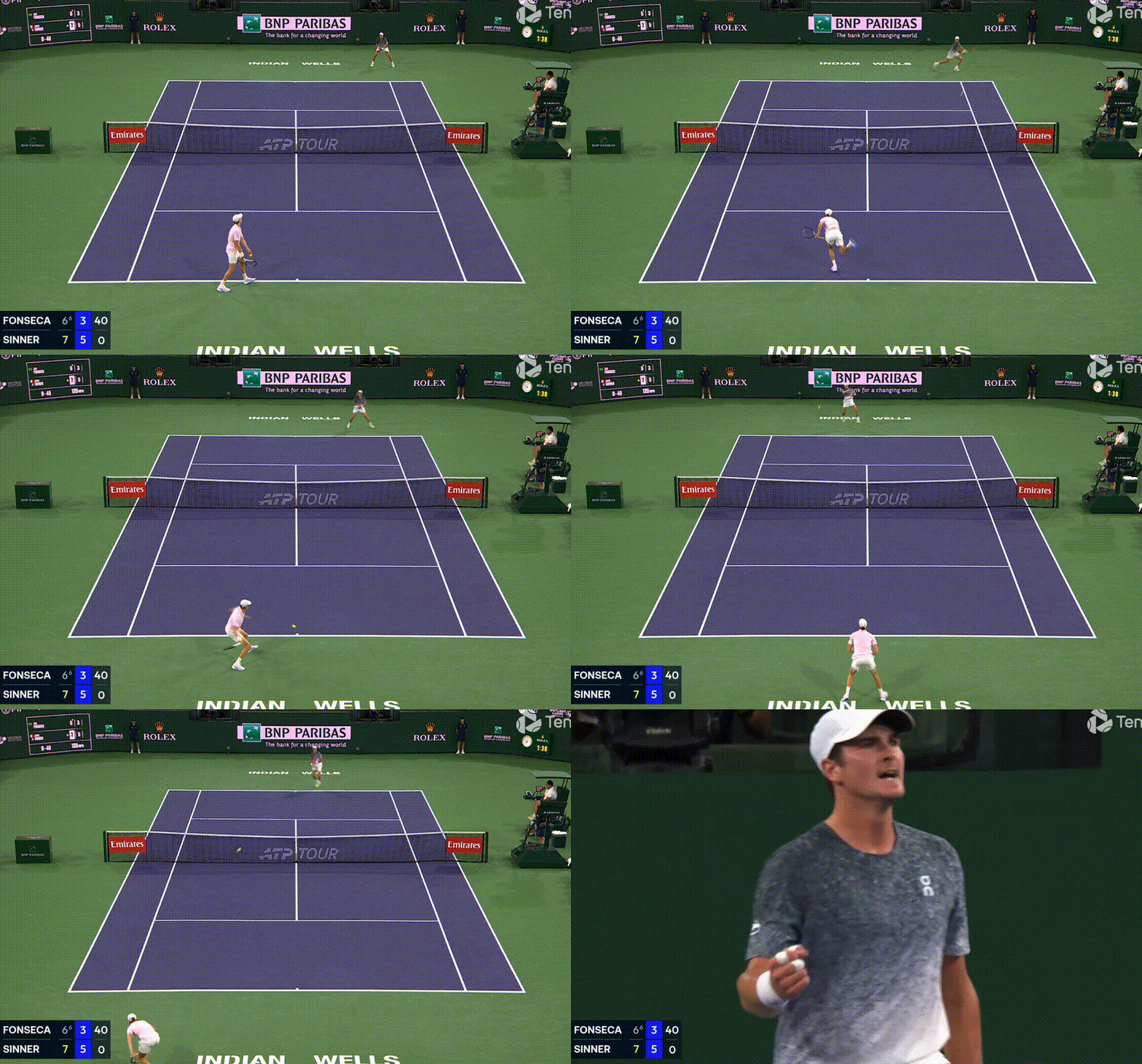
And that instinct was probably correct. Fonseca took his first chance in typical fashion:
We move forward to the tiebreak, where tennis was damn close to writing the birth of one star, and the obit of another:
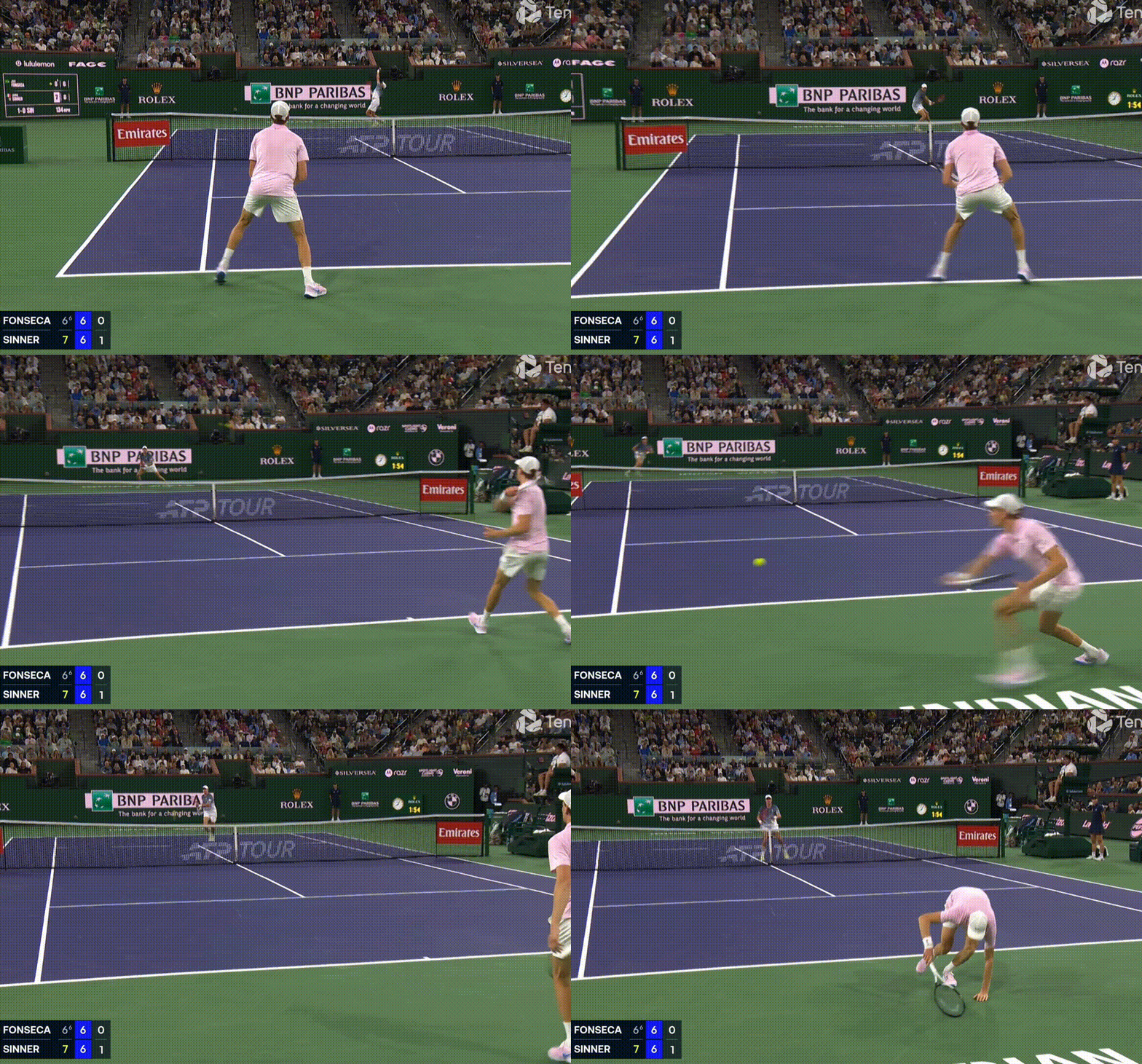
Corporate seats got their money’s worth tonight:
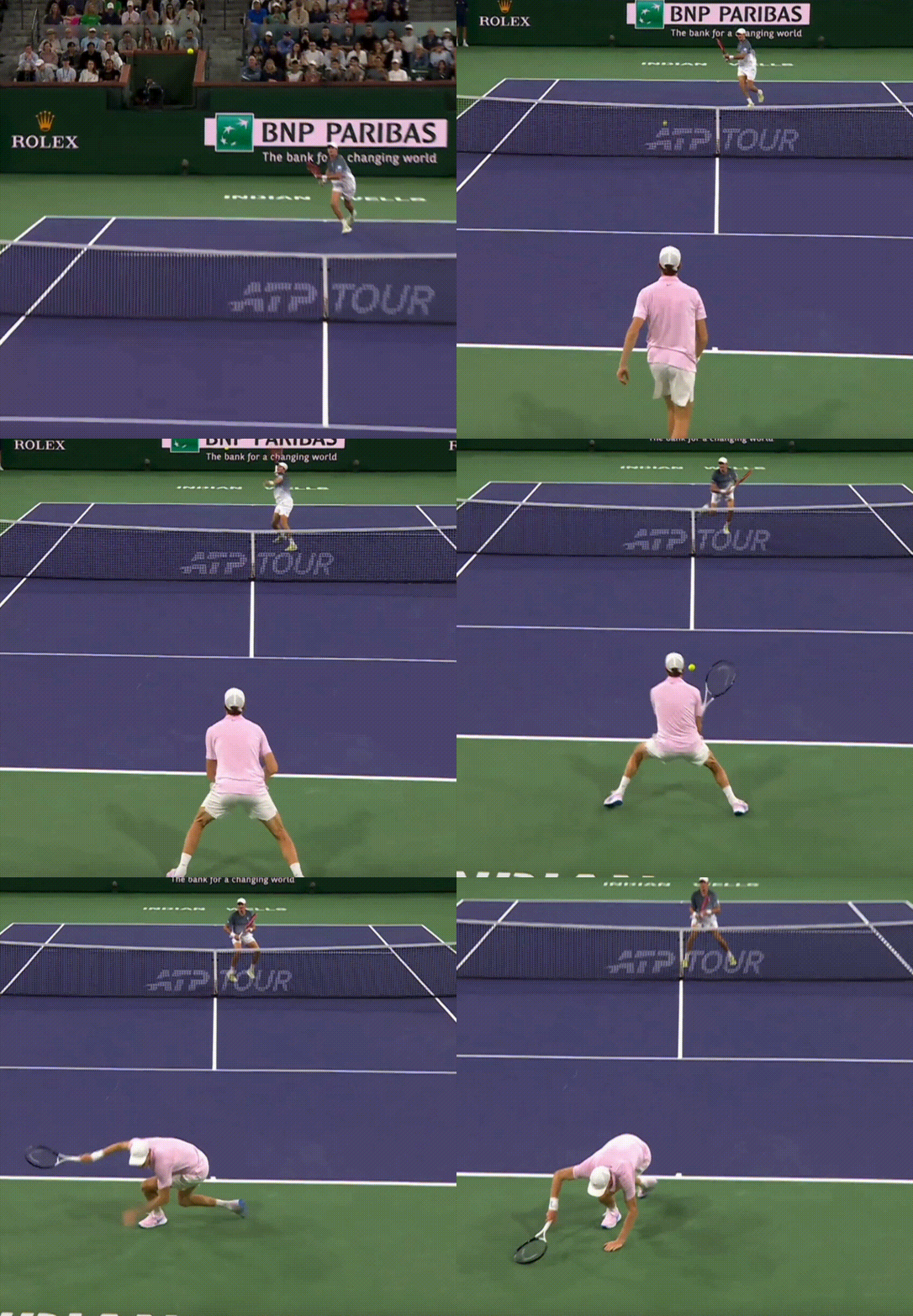
But Sinner is so cool. He gave the thumbs up and went straight back to work, containing this volcano of a kid who was swinging for the fences (and jugulars). On match point he stepped in and finished with his own forehand return winner: early, crosscourt, precise. Long known as the premier power baseliner, tonight he was shown a glimpse of the future, and his role in it is to be the absorber.
Hyperbole aside I think if I were to give myself a cold towel to the head (it’s six in the morning now and the coffee and adrenaline are fading) I’d say that evening conditions, on this type of court, are pretty close to Fonseca’s ideal. I think that level of aggression would be tough to control on a hot day, and the bounce in this court tees the ball up nicely for his tomahawk forehand. Sinner served impeccably, but he let slip chances that a fully confident version of himself is usually ruthless on, and Fonseca came up clutch rolling the dice on some big second serves. Fonseca did show restraint in sections of his win over Khachanov, and he does have variety at his disposal that often comes to the surface against weaker opposition. The movement looked better, and he’ll hopefully build on this run in Miami. I’m still sky-high on this kid.
Now, it’s Tien’s turn to face Sinner. I’ve been impressed with the young American this week, who’s strengths are more subtle but nonetheless proving very effective: change-of-direction (that forehand down the line is a menace), a beefed up first-serve, as cold-blooded as they come. That’ll be Mensik (who won let’s not forget), Fonseca, and Tien facing Sinner all within a couple of weeks, for a kind of up-to-date account of where their games stack up against the best.
That’s all I got. See you in the comments. HC.