
Jannik Sinner defeated Daniil Medvedev 7/6 7/6 in the final of the Indian Wells Masters on Sunday to claim his first desert title. The Italian is the youngest player ever to have won all six Masters 1000 hardcourt trophies, joining Djokovic and Federer. After starting out 0-6 against Medvedev, Sinner now leads the H2H 9-7.
Medvedev and Sinner are of the same rangy baseliner genus, but their games have evolved into wildly different species. Medvedev’s moniker is the octopus, but there’s a spider-like hydraulic repeatability to the Russian’s groundstrokes that emphasises timing over power, his flatter trajectories thriving in quicker conditions.
In contrast, Sinner’s pale limbs have the supple qualities of an aspen tree, yielding to the counter-motions of his racquet only to snap back with a kind of whip-crack elasticity that warps the ball into a gibbous orb against the strings, allowing the Italian to impart huge spin and speed, conditions be damned.
While many predicted a Sincaraz final before the semifinals (hey, me too), Medvedev had other ideas, ending Carlos Alcaraz’s unbeaten run in 2026, and reminding us all that he was the premier hardcourt player in the world not so long ago.
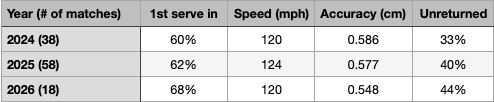
Part of the Medvedev resurgence in 2026 has been the uptick in serve quality, punctuated by a huge shift toward the forehand return of opponents. Compare Medvedev’s T-biased serve locations down the home stretch of 2025 (post-US Open, all hardcourt):
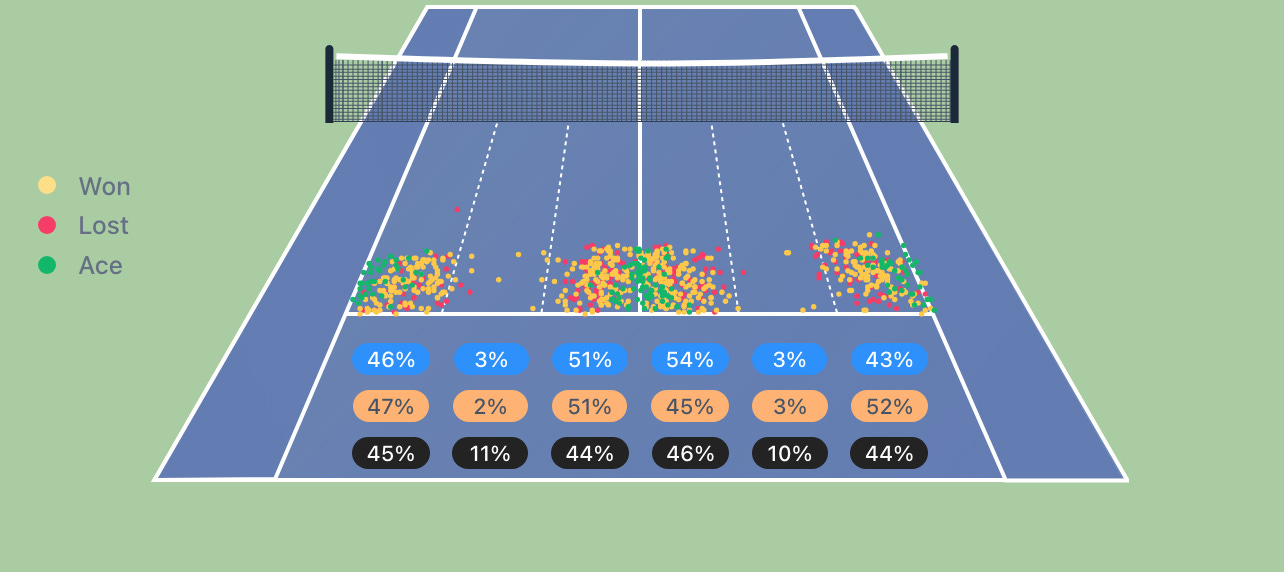
With his 18 matches recorded so far in 2026 (all hardcourt):
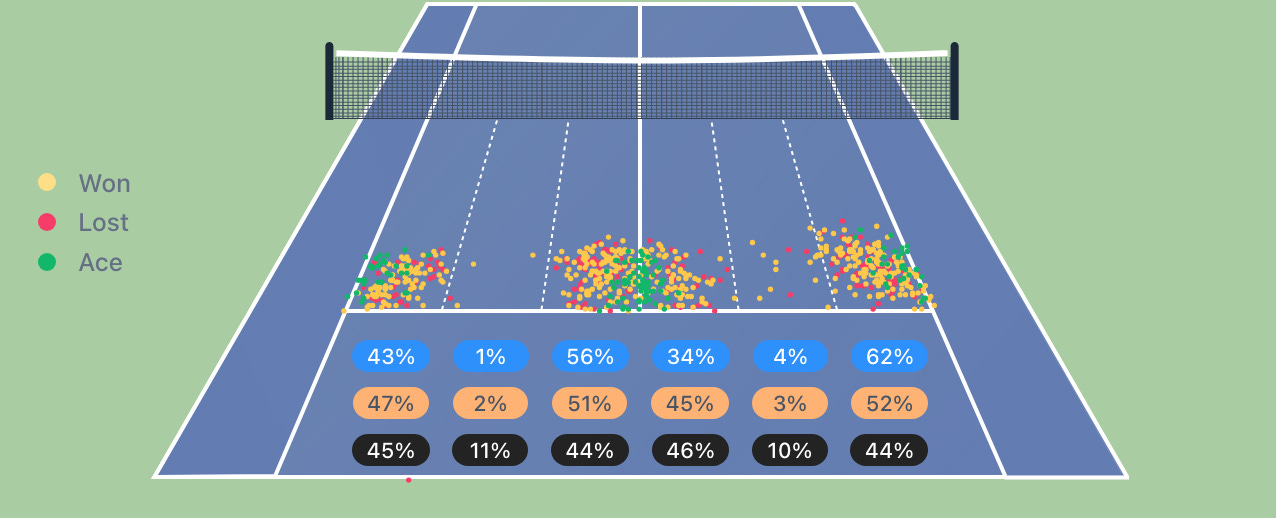
So far the strategy has paid handsomely. Here’s some 1st serve numbers:
But what I think really gave “hey that’s peak Medvedev!” vibes this week was the return of his net-flirting, downhill, laser groundstrokes. A potent admixture of several factors: fresh off the plane with the Dubai trophy, having escaped a literal war zone just days before his first match, Medvedev brought a “lucky loser” mentality with a bucket of wins under the belt. Then there was the court. Traditionally on the slower side, Indian Wells had an uptick in speed this year, registering in the high 30s in CPI (Court Pace Index). It was certainly welcomed by Medvedev, who once critiqued — as a self-anointed “hardcourt specialist” — the tournament’s sandpapered surface in a now-famous changeover rant.
Coupled with baking court temperatures over finals weekend, Medvedev’s average contact height in the final was ~6cm higher than his tournament average, yet his net clearance was one of his lowest in his career, at just a tick over 60cm.
I mean, Meddy made 91% of his backhands in this final with an average net clearance of 56 centimetres. Sinner blinked first in an early contest, catching the tape in a game of net chicken:
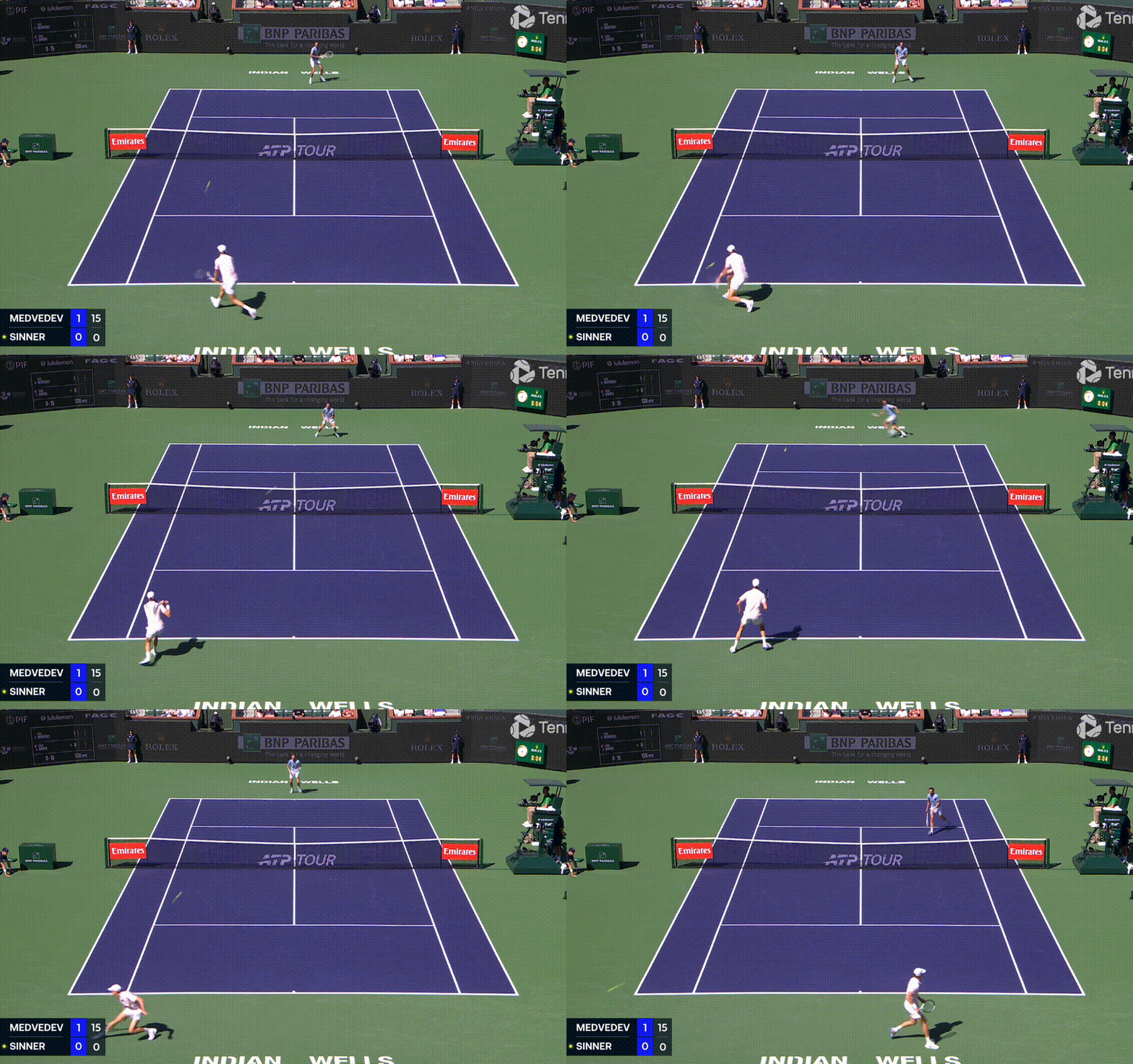
There’s a kind of positive feedback loop that happens when Medvedev finds this confident ankle-biting trajectory. The Russian hits low and flat —> Sinner, receiving the ball around his Nike laces, is forced to spend precious racquet head speed to lift the ball more than he would like —> which feeds Medvedev with another higher contact point to hit down on once more. Rinse, repeat. As a result, Sinner’s forehand net clearance was 10 centimetres higher than his average, and his forehand speed was down 6km/h (same pattern on backhand, too).
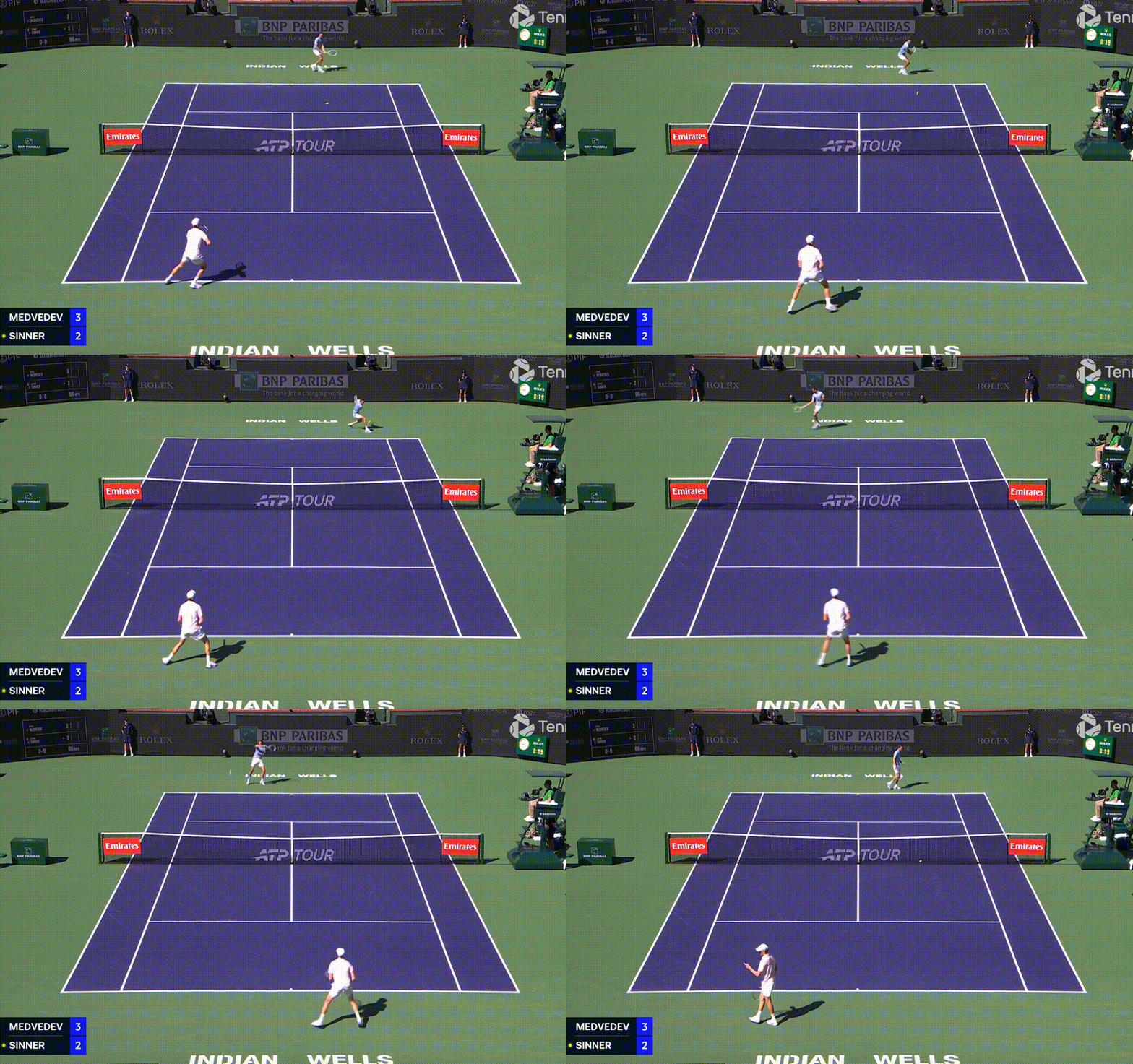
Anyway, despite this it was Medvedev who first found himself in trouble on serve, but the forehand and net-game came to the rescue:
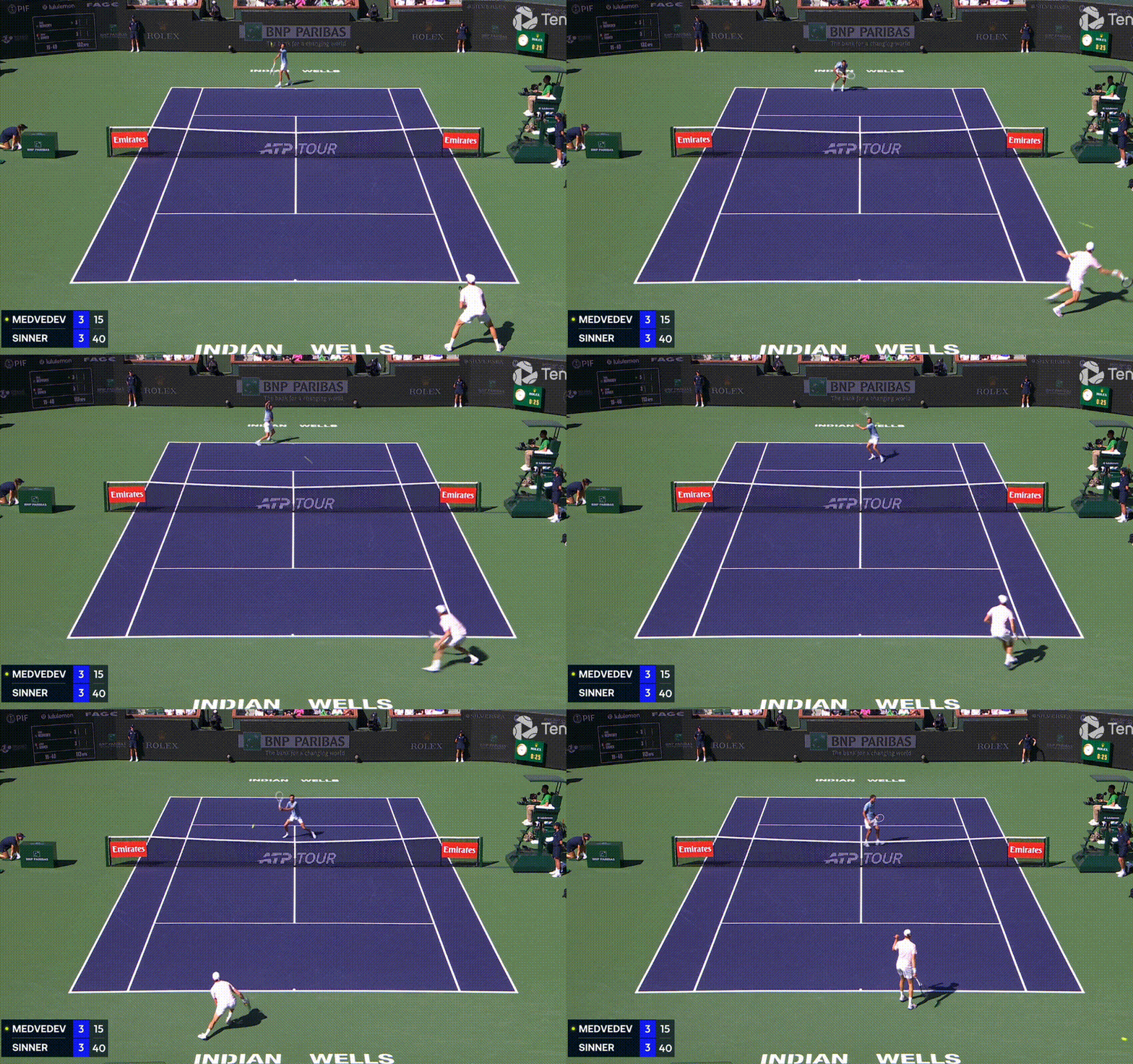
Crisis averted. Players keep holding.
And now for time’s sake we must fast forward to the business-end of the tiebreaker, where Medvedev was even cooking the forehand in big moments. We’re so back.
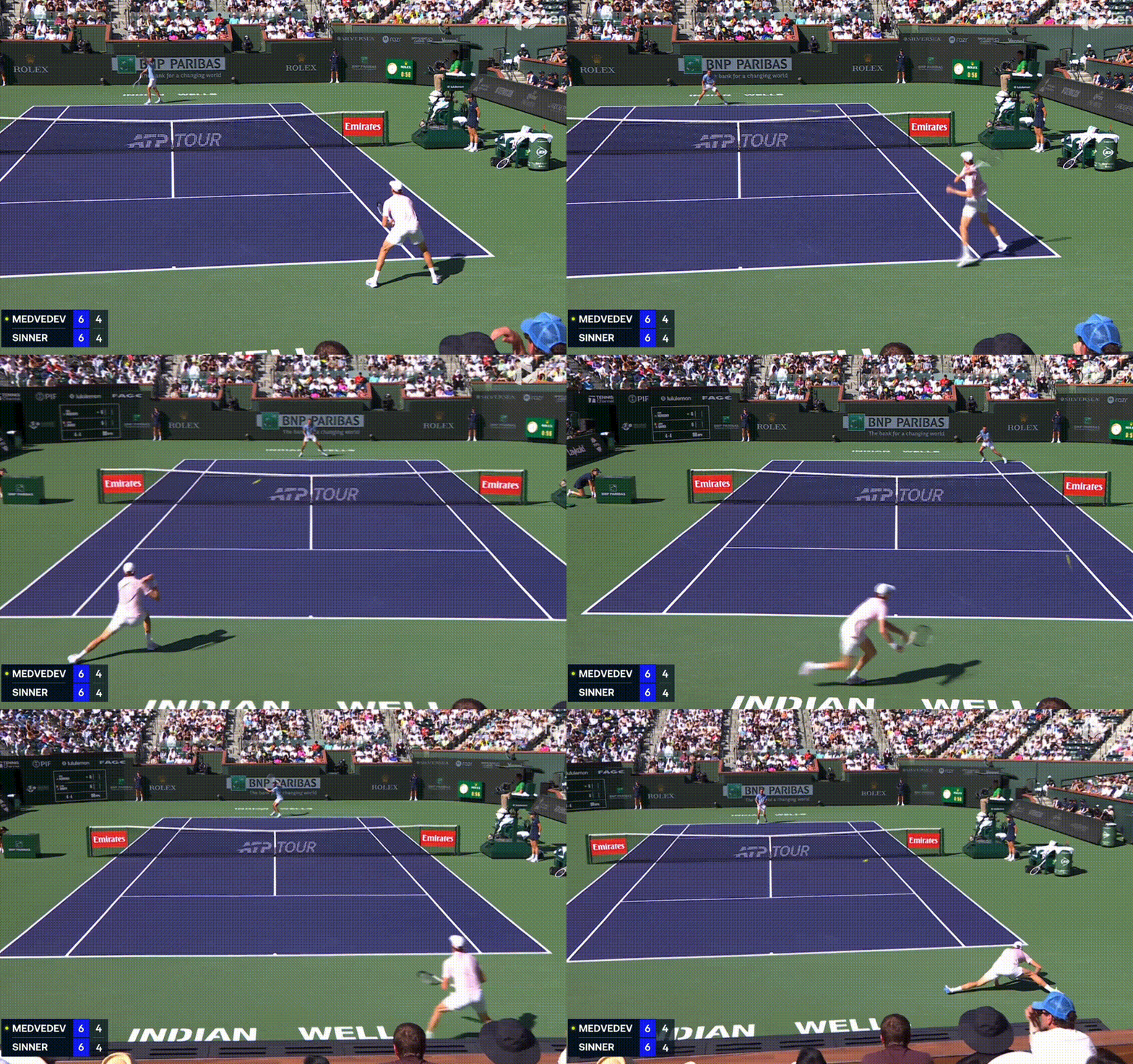
But that same net game that saved the Russian earlier was exposed as a still raw and insecure aspect, seen here misjudging, or perhaps hoping, that the ball would sail long at 5-4. Most people, YouTubers especially, focus on the projection element of tennis — the hitting the ball part — when giving a lesson, but before that occurs there are the more important anticipation/perception (“reading the play”) and reception (“moving into position”) elements that make all technical considerations moot if not adequately up to scratch. This was the first set right here:
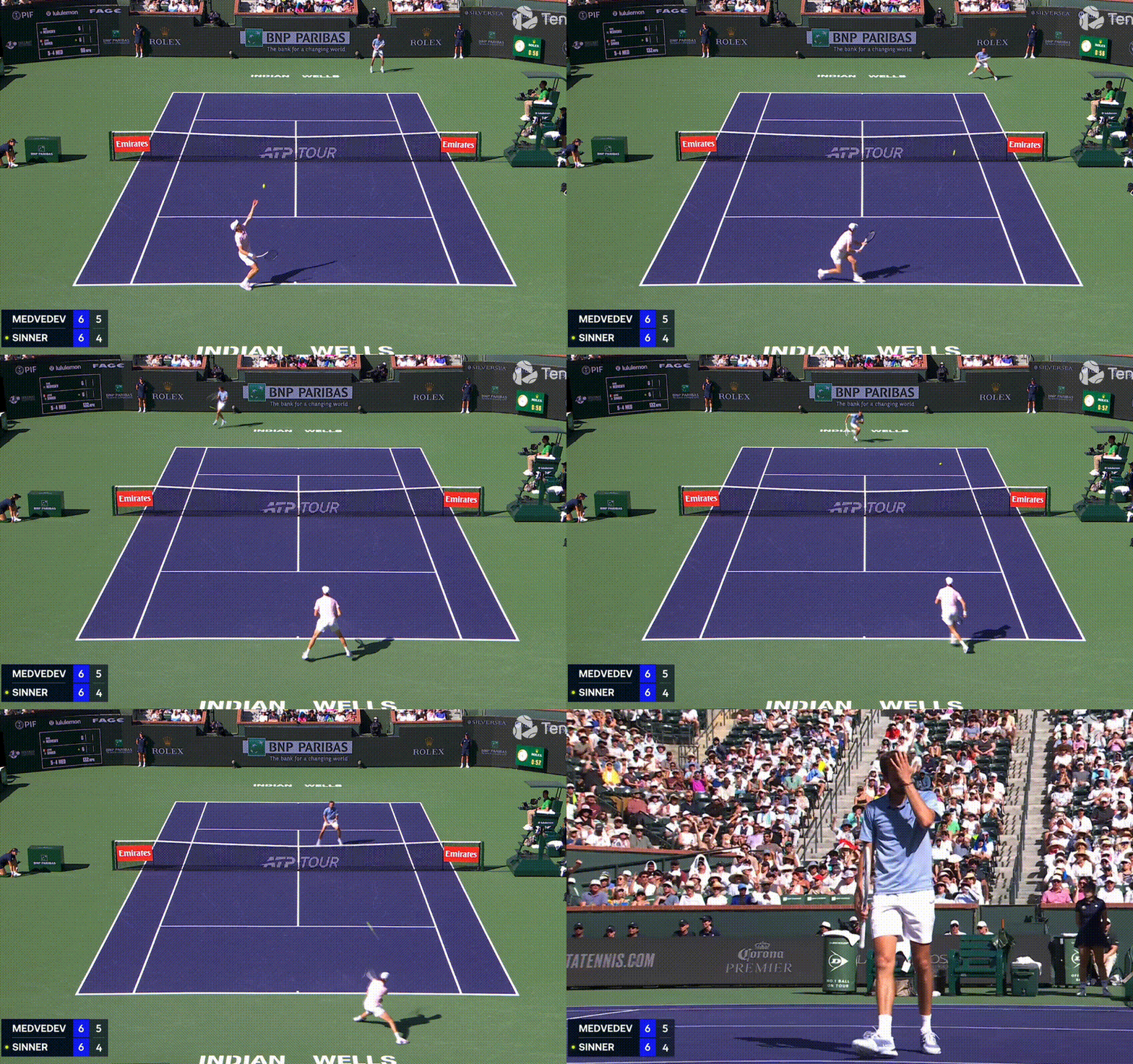
Or maybe Medvedev might feel that the point at 6-6 was fair game as well. All match he had played fearlessly on the forehand, but here he reverted to a flighted, ‘safer’ academy-style middle ball that is anything but against Sinner, backhand included:
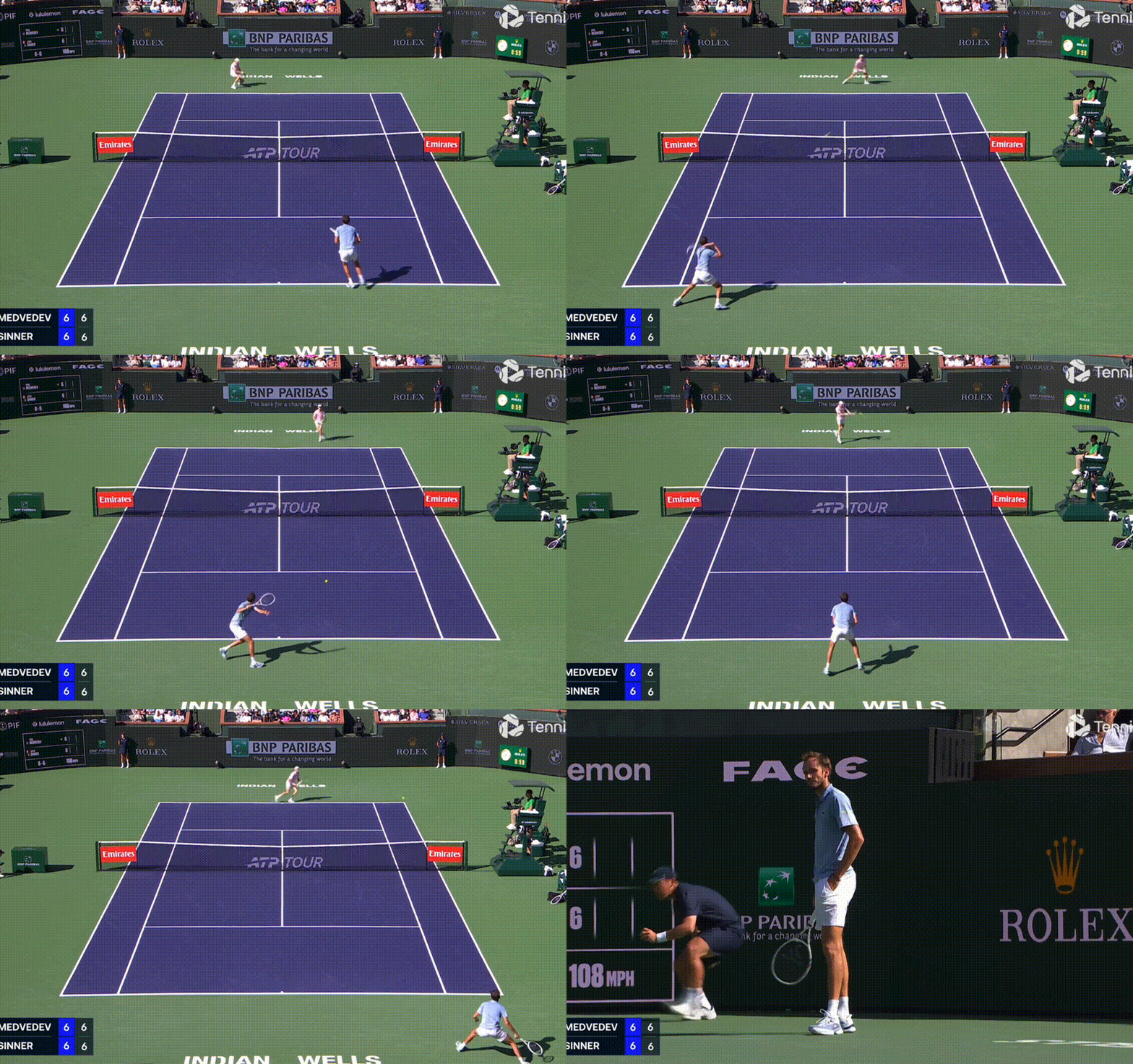
And as he had done so often in the desert, Sinner found an unreturned serve to seal the opening set.
So far all the focus has been on Medvedev. I know. That’s because this tournament was something of a ‘welcome back’ moment, not only in top 10 rank, but in form, and the eye test, for the Russian.
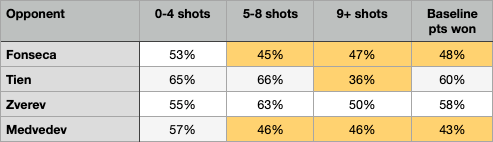
From Sinner’s end of the court, what has been interesting to observe is the juxtaposition between his groundstroke game and serve performance. Dare I say the Italian’s baseline game in Indian Wells has been a little underwhelming when using his “I’m a computerised slingshot sent from the future to destroy you” yardstick. He didn’t do well in the longer rallies against any of his last four opposition, and he straight up got smoked by Medvedev in the baseline game on Sunday:
But that didn’t matter, because the Italian’s serve was at genuine Bot levels this week, hitting his serve 7 centimetres closer to the lines than average. That’s only the width of an apple, but at 124 mph, those marginal gains compound to:
-
2.5 more aces/match
-
10% more serves unreturned. This week 53% of Sinner’s first-serves didn’t come back
-
86% of first-serve points won, up from 80%
-
96% of service games won
Here’s the chart I posted after the brilliant Fonseca match from Matt Willis again, this time with Sinner’s Indian Wells tournament average pointed out, which is literally off the chart:
So while faster conditions played into Medvedev’s downhill flat groundstroke style, it played equally well into Sinner’s well-timed serve-botting.
But shoutout to James for raising the question in the Fonseca/Sinner comments: is Jannik Sinner a top-10 server now? It’s still too early to say of course, but I did a little digging courtesy of Courtside Advantage, and it’s interesting to note that Sinner has been this accurate for months, stretching back to the beginning of the ATP Finals. Here’s his serve accuracy for each match since post-US Open technical serve tweaks were made:
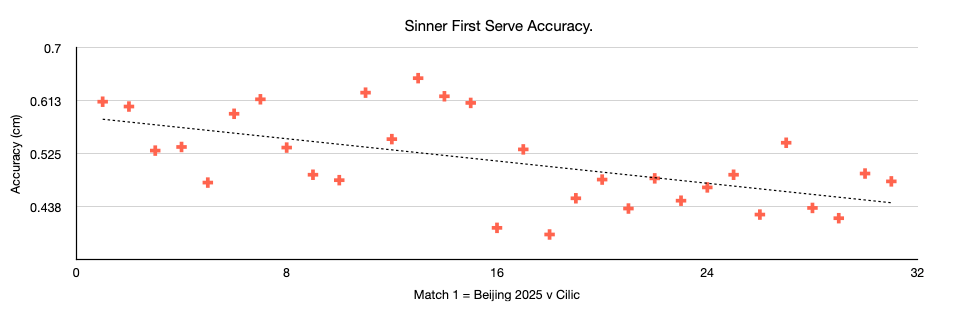
That’s 16 ATP matches in a row below Sinner’s 52-week char. Sure this is largely a collection of serve-friendly conditions picked lately, but the step-change in accuracy is something to keep an eye on, especially given his below-par serving has been a huge talking point in his rivalry with Carlos Alcaraz. While Alcaraz has reigned supreme for the last six-plus months, the notion of Sinner developing bot-level serving capabilities as a back-up is scary assuming he will find his forehand groove soon enough. I mean, the guy is still doing this, despite our concerns about his baseline well-being:
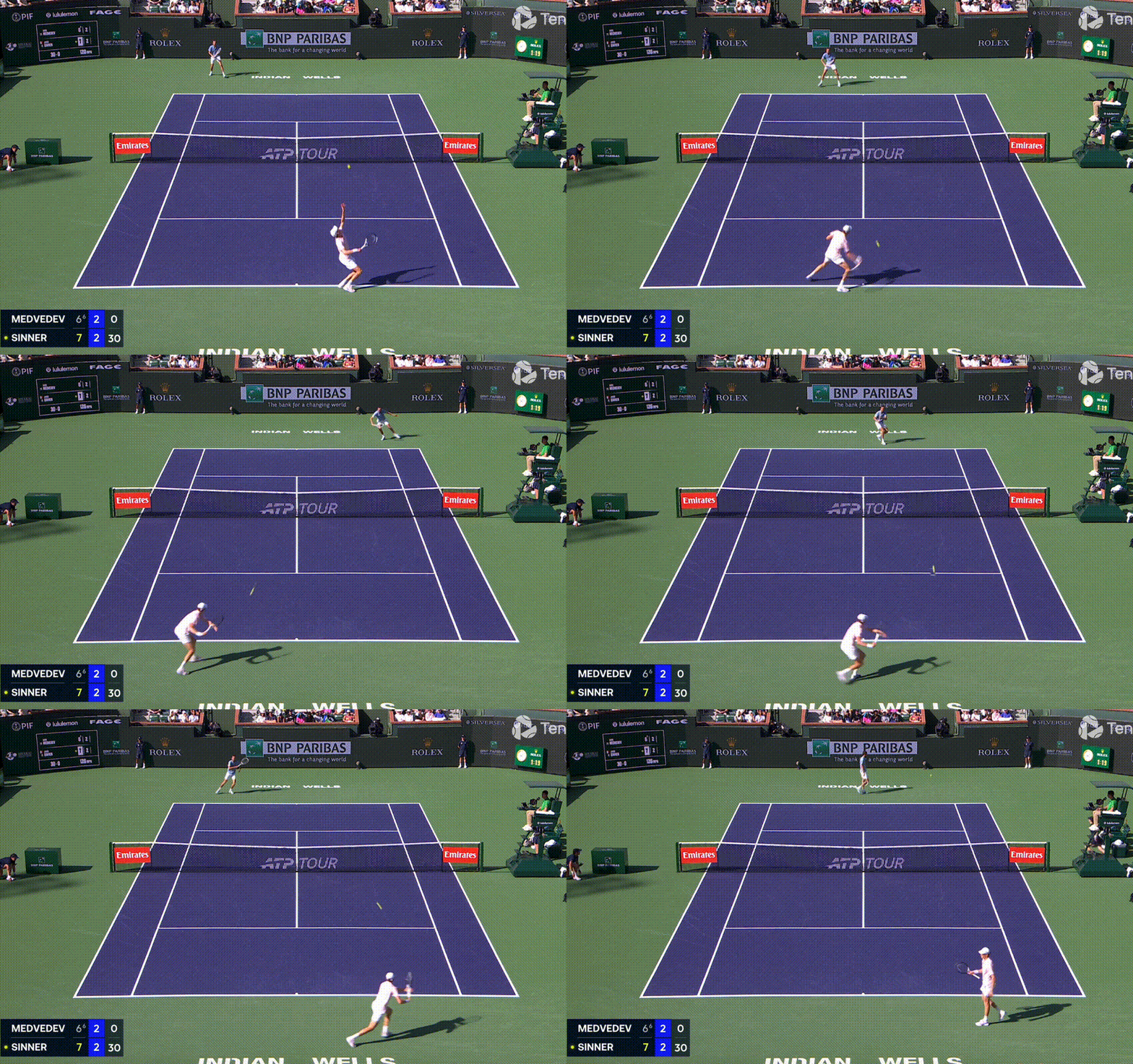
Yeah he’s going to be just fine.
I’ll keep an eye on the serves in Miami. See you in the comments. HC.